
Best Pokies in Sydney 2026: Licensed Venues, the Online Prohibition, and What the ACMA Record Shows
Updated 28 October 2026 · Verified against the ACMA’s blocking register and Liquor & Gaming NSW venue data.
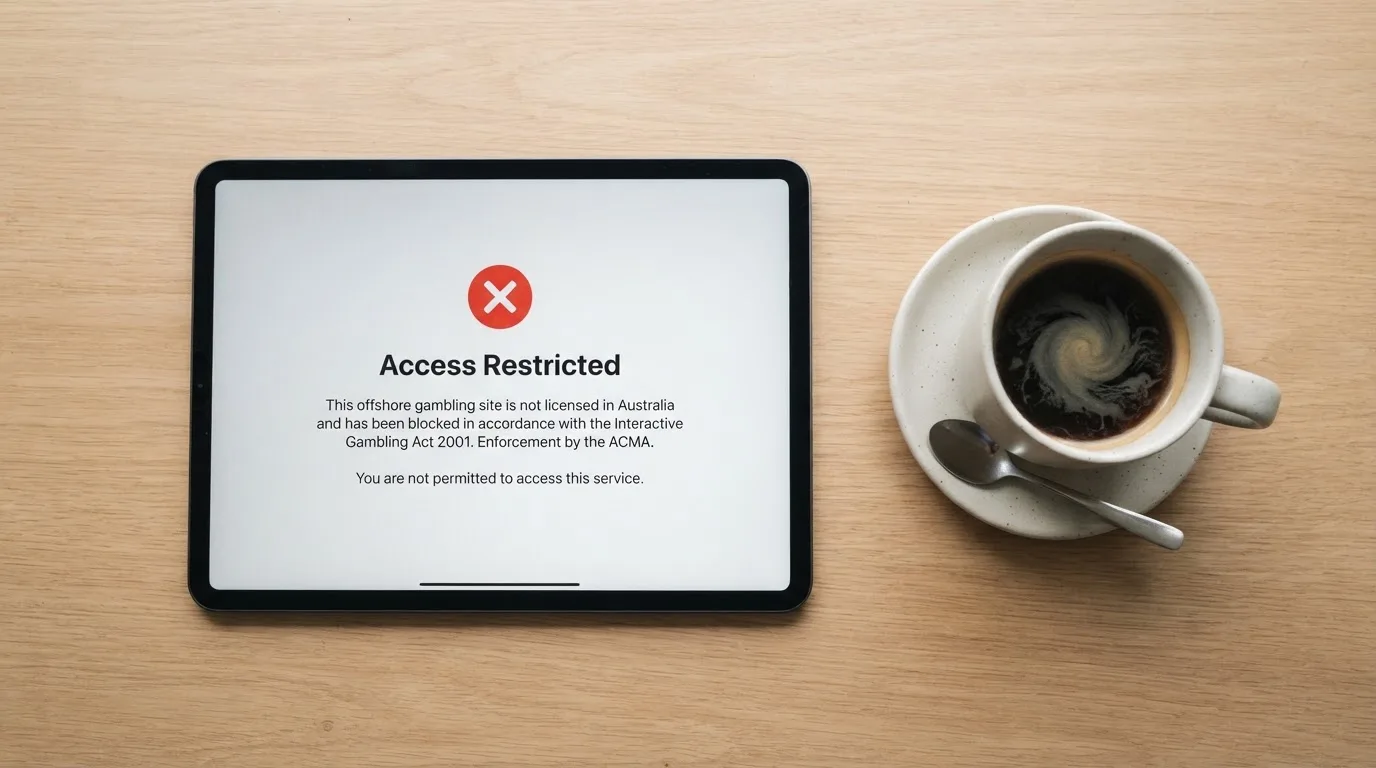
A pokie is the Australian term for an electronic gaming machine, and in Sydney the only lawful place to play one is a venue licensed by the New South Wales government — chiefly the casino floors at Barangaroo and Pyrmont, alongside roughly 87,000 machines spread across 2,195 pubs and clubs across the state. Offshore sites that market themselves as “Sydney pokies” sit on the other side of a federal prohibition. The cost angle of this comparison is the gap between those two facts: what a player pays to play inside the licensed framework, and what an offshore site extracts under a banner the regulator has already named.
Table of Contents
- Pokies Paytable Realities: What a Sydney Player Actually Carries Home
- Crown Sydney and The Star: Pokies on the Harbour
- Eleven Operators the ACMA Has Warned Over “Sydney Pokies”
- Pokies Venues in Sydney: The Fundamentals of What ‘Best’ Can Mean
- The Prohibition: Why No Online Casino Can Offer “Sydney Pokies” Lawfully
- Self-Exclusion, Help Lines, and the Limits of BetStop
- Inside Sydney’s Licensed Pokies Venues: Crown, The Star, and the Pub and Club Network
- How Fast the Blocklist Has Grown
- Frequently Asked Questions
Pokies Paytable Realities: What a Sydney Player Actually Carries Home
A pokie’s paytable looks like a price list, but it functions like a tax receipt. Every machine in Australia is wired to a return-to-player (RTP) percentage set by the game’s designer and certified by an independent testing house. NSW’s regulatory floor for club and pub machines is calibrated against a long-run average — over many millions of spins, the machine returns that share of what it takes in. The share it keeps is the house’s take, and on NSW pub and club machines outside the casino that take runs in the high single digits as a percentage of turnover.
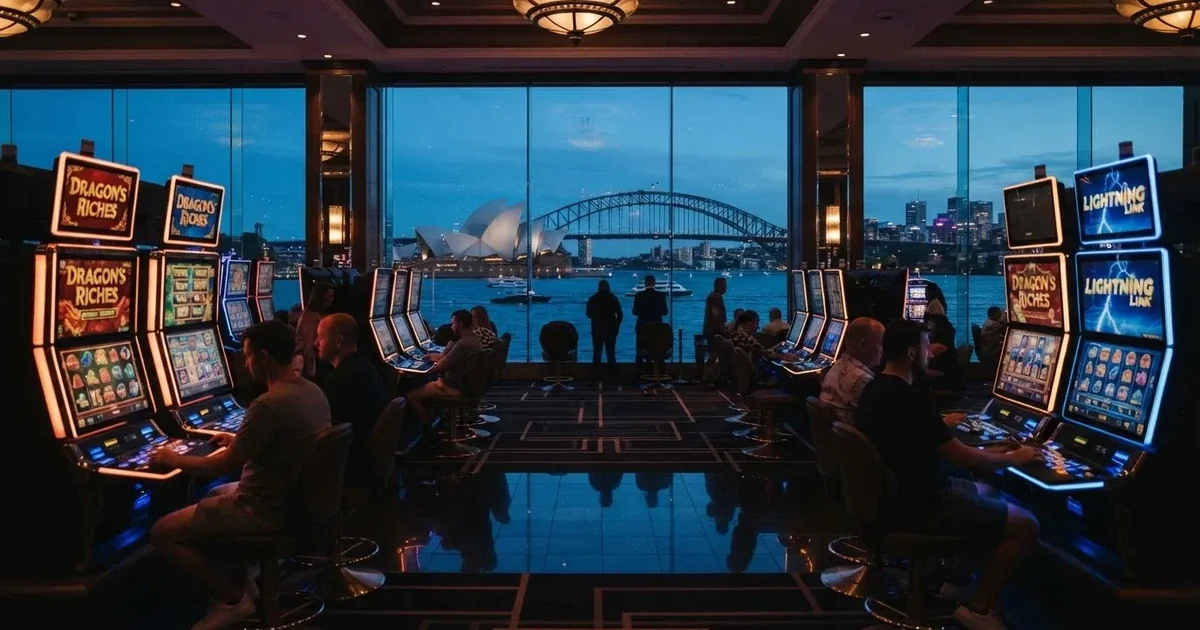
South Australia, useful as a comparator, sets a statutory minimum RTP of 87.5% on gaming machines outside the casino and a general maximum bet of A$5.00 per spin, while Adelaide Casino itself faces no such bet cap. NSW does not publish a flat RTP floor across all pub and club machines, but the practical range across approved titles clusters around the same band, with variation between games. Where a player feels that variation is in volatility — a low-volatility game returns more often but pays less per hit, a high-volatility game goes quiet and pays in lumps. Most pub machines sit somewhere in the middle. The “best paying pokies” question is, in practice, a question about which end of that range a particular venue’s catalogue leans.
The paytable matters most for one number: how long a bankroll survives. Two players dropping A$200 into a 90% RTP machine at a 5-cent stake and no bonus features will see around 4,000 spins before the average session ends. Two players on a volatile 87% machine at A$1 a spin will see fewer spins and a wider spread of outcomes — short of an average that includes a long quiet stretch punctuated by a larger return. The arithmetic is the same; the experience is not. Players who want a slow, social session choose differently from those chasing a feature round, and a venue’s room layout — the high-volatility bank near the entrance, the low-volatility wall near the bar — is set up to channel that choice.
Pokies payouts in a venue, when the machine prints a ticket, take seconds. The grey area is what an “instant withdrawal” line on an offshore site actually means. In NSW licensed venues there is no withdrawal — your winnings print as a ticket you redeem at the counter or feed back into another machine. The “payout percentage” comparison that recurs in pokies coverage is RTP measured against turnover, not against what you put in on the day. A machine returning 90% over millions of spins can hand a player A$40 back on A$50 spent on a single visit, or A$80, or nothing. The window is wide, and the published number is a long-run average rather than a session promise.
The maximum cash payout figure a venue can dispense on a single machine is the kind of detail that surfaces in FAQs and rarely in practice. Clubs and pubs in NSW honour tickets across the venue network through the linked gaming system, so a win that exceeds one machine’s payout cap is paid out at the cashier counter, not refused. Around Sydney Airport the handful of gaming-lounge venues operate under the same NSW framework as the rest of the state, with the short-stay passenger profile sharply limiting the bankroll that ends up on the floor and the same ticket-redemption rules. A player chasing a venue’s “maximum cash payout” line is usually chasing a number the venue does not publish; the ticket-redemption path makes the question moot.
The deepest cost in any pokie session is the one nobody quotes on the paytable: the difference between stakes wagered and credits returned, paid across months of play. NSW recorded A$8.18 billion in losses on poker machines outside casinos in FY22-23, against A$986 per capita — the highest figure of any Australian state per adult. Adelaide Casino’s externalised equivalent in South Australia ran at roughly A$0.92 billion across 471 venues, or A$497 per adult, for the same window. Sydney sits inside the NSW number, not next to it, and the spread between those two averages tells you that venue mix, opening hours and machine density — not the paytable — set the total a player loses. The “best paying pokies in Sydney” question, measured in average cost per player per year, has a depressing answer the machine room itself does not print.
Crown Sydney and The Star: Pokies on the Harbour
Two casino floors carry the bulk of legal pokies play inside Sydney: Crown Sydney at Barangaroo on the western harbour edge, and The Star Sydney in Pyrmont overlooking Darling Harbour. They are the only two properties in NSW licensed to run gaming machines without the per-machine cap and venue-density rules that govern pubs and clubs.
Crown Sydney opened in December 2020 as a 271.3-metre, 75-floor tower — the tallest habitable building in the city. The casino occupies part of a podium that runs beneath the residential and hotel floors above, with around 1,500 gaming machines across its main floor and the higher-stakes Crystal and Loft salons, alongside roughly 140 table games. The complex includes the 349-room Crown Towers hotel, residential apartments and a cluster of restaurants. Crown’s licence was issued by the NSW Independent Casino Commission and the venue operates under the Casino Control Act 1992, with the operating conditions attached to the licence after the Bell Inquiry into Crown Resorts’ suitability to hold NSW casino licences.
The Star Sydney is the older and larger of the two, and the more troubled. Star Entertainment Group runs it on a site at the Pyrmont peninsula, with two gaming floors, a 351-room hotel (the Darling), the 2,000-seat Sydney Lyric theatre and a 3,000-seat Event Centre. The licence position has been under continuous repair since at least 2022, when the NSW Independent Casino Commission found The Star unsuitable to hold its casino licence over failures to manage anti-money-laundering risk. The Commission fined the operator A$100 million in October 2022 and placed operations under a special manager, Nicholas Weeks, with supervision expected to continue through at least September 2025. On 10 February 2025 ASIC sued members of The Star’s former board over the same failure to track money-laundering risks.
For a player, the practical differences between the two floors are in scale and feel rather than in paytable. Crown runs a newer venue with smaller gaming floors spread across the podium, more emphasis on table games and a tighter hold on the higher-limit spaces. The Star runs at higher volume across its two floors, with a deeper machine catalogue and the music-and-showroom integration that comes with its own theatre. Neither floor is cheaper to play than the other on the machines; both honour printed tickets at the cashier and run the standard linked gaming network. Where they diverge is on the floor above the machine: the Crown complex carries hotel and residential above, the Star complex carries a theatre and event centre.
The mechanics that set Crown and The Star apart from a pub machine are credit and bet sizing. A casino floor in NSW has no statutory maximum-bet limit on gaming machines, whereas South Australia caps its pub and club machines at A$5.00 a spin. The casino floors also publish their own higher-end RTP bands, since the wagering-denomination structure is built for players staking tens or hundreds a spin. A player who walks in with A$100 will see the same per-spin volatility as the pub punter, but the cash conversion takes longer in the wallet, and the night is more easily blown out at a single round.
Eleven Operators the ACMA Has Warned Over “Sydney Pokies”
A “best Sydney pokies” list with online casino brands at the top would be misleading. The Interactive Gambling Act 2001 prohibits Australian-facing online casino games, and no state or territory licence covers them. The eleven sites below appear in this comparison for a different reason — the Australian Communications and Media Authority has issued a formal warning against each one for offering prohibited services to people in Australia. The list is not a recommendation, and the table below is a regulator’s record, not a ranking.
| Brand | ACMA action and date | Operator named by the ACMA | Subject support |
|---|---|---|---|
| RocketPlay | Formal warning, March 2026 | Pulsup Ltd | — |
| Level Up Casino | Formal warning, May 2022 | Dama N.V. | — |
| Woo Casino | Formal warning, March 2025 | Dama N.V. | — |
| Spirit Casino | Formal warning, May 2025 | Dama N.V. | — |
| National Casino | Formal warning, July 2025 | Consolutetish S.R.L. | — |
| Bizzo Casino | Formal warning, July 2025; prior 2022 | Consolutetish S.R.L. | — |
| Ignition Casino | Formal warning, July 2025 | Bamboo Media | — |
| Instant Casino | Formal warning, February 2025 | EOD Code SRL | — |
| Jackbit | Formal warning, April 2026 | Ryker B.V. | — |
| Casino Intense | Formal warning, April 2025 | Sterplay Holding Ltd | — |
| Sky Crown | Formal warning, September 2022 | Hollycorn N.V. | — |
The “Subject support” column is empty by design: offshore pokies and casino games carry no enforceable Australian licence, no subject-specific regulatory coverage, and no Australian complaints body. Several brands appear in encyclopaedic or regulator references from non-Australian jurisdictions, and those listings report only what those sites publish. They do not amount to local endorsement. Each operator entry below states the published ACMA action and a verdict on what the warning signal means for a Sydney reader.
RocketPlay
In March 2026 the ACMA issued a formal warning to Pulsup Ltd over Rocketplay.com.au. The same RocketPlay brand had earlier been the subject of a May 2022 ACMA formal warning against Dama N.V., one of the most-named operators in the regulator’s record. The site’s Australian-facing brand has been re-issued under a new company after the first warning, which is the typical response cycle for offshore operators: change corporate wrapper, keep the marketing.
Subject support: no-data. The brand carries no Australian-licence attachment, no verifiable payment-method coverage for Australian players, and no published RTP list for the Australian-facing site. The ACMA action is the only data point of consequence.
Verdict: the only reason RocketPlay appears here is that the ACMA has named it twice. For a reader in Australia, the brand sits on the wrong side of the prohibition and offers none of the consumer protection an onshore venue is required to provide.
Level Up Casino
Dama N.V. received an ACMA formal warning in May 2022 covering six casino brands, of which Level Up Casino was one. Dama was warned again over Woo Casino and Spirit Casino in 2025, and has become the single most-named operator in the ACMA’s corporate-warning archive.
Subject support: listings-only (sources). Level Up Casino surfaces in encyclopaedic listings and in the Victorian regulator’s published register by virtue of Dama’s Curaçao registration; neither listing constitutes Australian authorisation.
Verdict: an offshore brand the ACMA has named alongside five sister sites. The “Level Up” name carries weight in affiliate marketing that the regulator’s record flatly contradicts. Worth noting only as a marker that Dama’s portfolio has not retracted in the four years since the first warning.
Woo Casino
Dama N.V. was warned over Woo Casino in March 2025, the second time the corporate group had appeared in the ACMA’s record. Woo Casino markets itself as a withdrawal-friendly brand with a crypto-friendly cashier. Neither feature changes its legal position in Australia — the cashier is still offshore and the warning still standing.
Subject support: listings-only (sources). Encyclopaedic entries reference Woo Casino’s Curaçao registration and its corporate association with Dama.
Verdict: a brand relit through a familiar corporate group after the 2022 round. The regulator’s reappearance two years later tells the only story that matters for a Sydney reader.
Spirit Casino
Spirit Casino joined the ACMA’s warning list in May 2025 under Dama N.V., completing a sweep across three of the operator’s brands in three months.
Subject support: no-data. Spirit Casino does not surface in encyclopaedic or jurisdictional listings beyond its association with Dama N.V.
Verdict: a side label of the same warning pattern rather than a distinct operation. Its separate brand identity is marketing; its regulator exposure is shared with Woo and the earlier Dama group.
National Casino
In July 2025 the ACMA warned Consolutetish S.R.L. over National Casino. The same formal warning also covered Bizzo Casino, both operated by the same corporate group. National Casino had appeared in earlier Australian press coverage and in federal infrastructure-policy coverage as one of the offshore brands to which Australian-issued cards were reportedly redirected before the credit-card gambling ban of 11 June 2024.
Subject support: listings-only (sources). National Casino appears in Australian press and in federal infrastructure-policy coverage; neither listing constitutes local endorsement.
Verdict: the credit-card ban of 11 June 2024 cut off the easiest deposit route Australian players had used, and the ACMA’s 2025 formal warning closed off any remaining ambiguity about the brand’s Australian-facing status.
Bizzo Casino
The ACMA’s July 2025 warning against Consolutetish S.R.L. over Bizzo Casino was its second look at the brand: a 2022 formal warning had been issued to TechSolutions (CY) Group Limited and TechSolutions Group N.V. over the same operation.
Subject support: no-data. Beyond its appearances in the ACMA’s record, Bizzo Casino does not surface in Australian-facing listings.
Verdict: an operator the regulator has revisited twice under two different corporate wrappers. The 2022 warning named TechSolutions; the 2025 warning named Consolutetish. The corporate shift is the signal.
Ignition Casino
The ACMA warned Bamboo Media over Ignition Casino in July 2025. Ignition has historically marketed itself under a poker-facing brand identity, but the ACMA’s action covers the broader casino offering rather than the cardroom.
Subject support: no-data. Ignition does not surface in Australian-facing regulatory or encyclopaedic listings.
Verdict: another offshore brand flagged in the same July 2025 sweep that took National Casino and Bizzo. Its poker marketing makes it harder to recognise as a casino site; the regulator’s warning makes the recognition unnecessary.
Instant Casino
EOD Code SRL was warned by the ACMA over Instant Casino in February 2025, the first ACMA action over a brand from this corporate group.
Subject support: no-data.
Verdict: a marketing line that promises speed of payout. For an Australian player, the regulator’s warning is the more relevant datum, because the ACMA can block the entire site under the Interactive Gambling Act, leaving any unused balance behind.
Jackbit
The ACMA warned Ryker B.V. over Jackbit and the same operator’s CasinOK brand in April 2026. Jackbit markets a crypto-first cashier and a sportsbook alongside a casino catalogue.
Subject support: no-data.
Verdict: a crypto-first operator in a market where paying for gambling with digital currency is banned under Australian rules for licensed services, and where the ACMA’s record over this corporate group is now on the table.
Casino Intense
Sterplay Holding Ltd was warned by the ACMA over Casino Intense in April 2025. Casino Intense surfaces in regulator-style listings from a small number of overseas jurisdictions and in Australian press coverage of the offshore sector.
Subject support: listings-only (sources). Casino Intense appears in South Australian consumer-protection materials and in Australian press coverage; the listing pattern is consistent with the offshore sector’s reach into Australian consumer queries.
Verdict: a brand whose regulator-action footprint is lighter than Dama N.V.’s but whose listing footprint in Australian consumer coverage shows up where it shouldn’t.
Sky Crown
The ACMA issued a formal warning to Hollycorn N.V. over its Sky Crown and Blue Leo casino services in September 2022, the earliest formal warning in this comparison set. Sky Crown continues to market to Australian players under the same name.
Subject support: listings-only (sources). Sky Crown appears in encyclopaedic references; Hollycorn N.V. has been named in overseas regulator publications since.
Verdict: an offshore brand on the ACMA’s record since 2022 with a stable corporate presence behind it. The longevity is the warning.
Pokies Venues in Sydney: The Fundamentals of What ‘Best’ Can Mean
A “best pokie” is doing more work than the marketing suggests. Three different questions sit inside the phrase. One is the best-paying machine: the highest long-run return-to-player percentage on the floor, certified and published. Another is the best venue experience: the room with the right opening hours, the right crowd, the right stake sizes, and a reasonable food and drink service around play. The third is the lowest-cost evening: the venue with the cheapest fee structure, the highest density of low-stake machines and the friendliest rules on cashing out. A reader chasing one of those is not chasing the others, and the phrase collapses three different decisions into one search query.
New South Wales’ pub and club network carries the bulk of Sydney’s everyday machine play. Outside the two casinos, the state had 87,298 gaming machines across 2,195 venues in June 2023, the highest machine count of any Australian state. A typical Sydney pub with a gaming room runs twenty to fifty machines in a separated lounge off the bar, with opening hours set by the venue’s liquor licence. Clubs run larger rooms, often over a hundred machines, with longer opening hours and member-guest arrangements.
The cost of playing inside that network is set by three numbers. The first is the per-spin stake: a typical pub machine in NSW has a minimum credit of one cent and a maximum bet of A$5.00 per line, with multi-line and multi-credit structures pushing the maximum wager higher. The second is the RTP, which on a NSW pub machine typically sits in the high-80s to low-90s for the lower-volatility titles. The third is the frequency of “feature” rounds — the bonus mechanics that interrupt the base game and pay a lump sum on top of the line wins. A player choosing between two venues on the same suburban strip may be choosing between two RTP bands five percentage points apart, with the difference compounded across every session of the year.
Sydney’s CBD has fewer machines per square kilometre than the western and southwestern suburbs, where the state’s pub and club density is highest. Crown Sydney and The Star each host the casino floors already covered, while CBD pubs operate under standard NSW pub-gaming rules. The “best pokies in Sydney CBD” question is, in practice, a question about which pub gaming room you can reach from your office — the regulatory framework is the same, the venue menu is what changes. The southwest corridor — Canterbury-Bankstown, Fairfield, Liverpool — carries the heaviest machine density in the metropolitan area, with the higher per-capita machine counts that come from larger pub and club venues and longer trading hours.
The airport side of the picture is its own pocket. Sydney Airport’s gaming lounge operates under NSW rules but in a captive passenger environment, with a small machine floor and a strict cash-handling regime tied to the building’s licensing position. A player looking for pokies near Sydney Airport is choosing between the on-airport option and the surrounding suburbs of Mascot, Botany and Rockdale within a fifteen-minute drive — a different kind of “best” question, where the answer depends on whether the cost of an extra fifteen minutes is worth a different room.
The interstate view sharpens the local picture. Adelaide Casino’s table-game monopoly in South Australia, extended to 30 June 2035 under a 2013 licence, illustrates how concentrated a state casino floor can be by contrast with Sydney’s two-operator model. Sydney has Crown and The Star, with The Star’s licence under reform. Brisbane’s Treasury Casino closed on 25 August 2024 to make way for The Star Brisbane at Queen’s Wharf, on the back of a 2022 finding that Star Entertainment was unsuitable to hold its Queensland casino licence after a Gotterson review. The pattern across the eastern seaboard is two big casino floors per state capital, with the rest of the machine count distributed across pubs and clubs — and with one operator’s licence position now the recurring regulatory story across multiple states.
The Prohibition: Why No Online Casino Can Offer “Sydney Pokies” Lawfully
The legal ground beneath every offshore “Sydney pokies” brand on the table above is the Interactive Gambling Act 2001, the federal statute that prohibits the supply of online casino games and online pokies to people in Australia. The Act, as tightened by the Interactive Gambling Amendment Act 2017, makes it a criminal offence for an operator to provide online casino games, online pokies or in-play betting to a customer in Australia. No state or territory licence in the country covers online casino games — what is licensable is wagering on races and sport placed before the event, lotteries, and keno, in practice licensed by the Northern Territory Racing and Wagering Commission.
The Northern Territory’s wagering regulator is the body of record for most of Australia’s licensed online bookmakers. Sportsbet, Bet365 and Ladbrokes all hold NTRWC licences. The Commission, which had no full-time staff and met once a month in Darwin as of April 2026, is the federal de facto gambling regulator by way of the licences it issues. The Commission does not license online casino games, and the Northern Territory’s framework is often conflated with offshore licensing in marketing copy. They are not the same, and the conflation is one of the more durable half-truths in the sector.
Enforcement under the Act sits with the ACMA. The ACMA investigates complaints, issues formal warnings, and — most visibly since November 2019 — directs Australian internet service providers to block illegal sites. By June 2026 the ACMA’s published blocking record covered a running total of 1,751 illegal gambling and affiliate marketing websites blocked since the first blocking request in November 2019, against more than 230 unlicensed services that had exited the Australian market since enforcement intensified in 2017. In a single June 2026 round the regulator asked ISPs to block twelve more sites: 7Signs, ChromaBet, Donbet, Duospin, Freshbet, Slots Gem, Jacks Club, Lucky Start, Pointsbetz.com, Spinrise, Vinyl Casino and Wildsino.
A formal warning is the regulator’s first move. A site that keeps operating after a warning is liable to a blocking request. Of the eleven brands in the table above, several had been warned more than once — Dama N.V.’s portfolio, TechSolutions’ Bizzo, the reissued RocketPlay under Pulsup. The ACMA’s record is therefore not a snapshot but a sequence, and a brand’s history in that record is the closest thing to a forward indicator. The recurrence tells the regulator and a reader where the operator’s appetite for re-entry sits.
The 2026 reform layer sits above all of this. The Interactive Gambling Amendment (Gambling Reform) Bill 2026 passed Parliament on 19 August 2026, with its advertising and inducement measures commencing on 1 January 2027. The starting date is what makes that law prospective rather than current: a “Sydney pokies” site blocked or warned about on a 2026 reading is being judged under the IGA regime as it stood before the new advertising rules commenced. The new rules will narrow what an operator can say about its offer to Australians, but they do not legalise the underlying service.
The offshore site that is not blocked is still not enforceable in Australia. A player who signs up, deposits, plays and seeks to withdraw from an unlicensed offshore casino has no Australian complaints body to approach, no Australian regulator to ask for a refund, and no Australian court with jurisdiction over a Curaçao or Costa Rica corporate wrapper. The site’s “AML and KYC” pages — the anti-money-laundering and know-your-customer materials that appear on most licensing pages — describe the operator’s own checks, not any right of recourse for an Australian customer. Where a site displays the badge of an Australian payment processor or bank, the badge is a marketing claim rather than a contractual undertaking.
The credit-card ban of 11 June 2024 closed the easiest Australian deposit route into the unlicensed market. Licensed wagering cannot accept credit cards, credit-related products or digital currency as payment; legal deposit routes are debit card, bank transfer, PayID/Osko and BPAY, with operator penalties for non-compliance of up to A$247,500. The rule applies to licensed services, but the same payment institutions typically decline offshore-gambling transactions as a matter of policy. An offshore site that asks for credit-card details is operating outside the Australian financial-transaction framework; a site that offers crypto deposits is operating outside the framework the licensed market uses. A player reading an offshore cashier page and being offered “instant withdrawal by Visa” or “Bitcoin deposits” is, in both cases, looking at a cashier that does not connect to the Australian payments system the regulator approves.
Self-Exclusion, Help Lines, and the Limits of BetStop
The National Self-Exclusion Register, BetStop, has been live since August 2023 and is the federal government’s main entry point for self-exclusion from wagering. BetStop’s reach, however, is bounded: it binds only Australian-licensed online and phone wagering services. An offshore casino site is not connected to BetStop, and a self-exclusion request placed with BetStop does not extend to a Curaçao-licensed site the player also uses. The practical effect is narrower than the marketing reads — BetStop covers a player across Sportsbet, Ladbrokes, Bet365 and the licensed field, and stops at the edge of that field.
State-based schemes do the heavier lifting inside Sydney. Liquor & Gaming NSW operates the state’s self-exclusion register for pubs and clubs, applied for in person at a registrar’s office or online, and applied to The Star Sydney and Crown Sydney through each venue’s own exclusion scheme with cross-venue agreements through the Casino Exclusion Order. Crown’s exclusion scheme also reaches the rest of the Crown Resorts network under the operator’s own self-exclusion commitments. The cost in poker-machine play that an exclusion achieves is substantial — the only consistent figure in the literature is the quieter observation that excluded players do not gamble at excluded venues, a tautology that hides the more important fact that most self-excluded players continue to gamble at venues they have not excluded from, with the relevant help being treatment and counselling rather than the form alone.
For ongoing support, the National Gambling Helpline on 1800 858 858 is free, runs 24/7 and connects to Gambling Help Online for chat-based support. Gamblers Anonymous meetings run across Sydney and the wider NSW region. The federal government’s Gambling Help Online platform includes self-help modules, financial counselling links and family support resources, with a service-and-treatment gateway aimed at the people around the player as well as the player themselves. A player who has lost more than they can afford to lose in a single session is in the right place to call the helpline before the next session starts.
The cost angle here is the cost of the alternative. Self-exclusion does not remove the urge; it removes the venue. Treatment does the heavier lifting. A player who has self-excluded from their local pub and continues to drive to the next suburb’s pub to play is paying for two venues’ worth of transactions, not one, and a registered exclusion that has driven them out of their natural venue often comes with a spike in online play — exactly where BetStop cannot reach. The protection is at its strongest where the player wants it and weakest where they do not, and a comparison that promises a level of protection it does not provide is doing the reader no favour.
The NSW framework also runs voluntary pre-commitment tools at the licensed venues, including time and spend alerts on the gaming-machine terminals. Crown and The Star publish their own responsible-gaming codes with the NSW government’s Responsible Gambling Fund as the backstop for treatment services. The fund’s existence is the clearest indication that the cashflows from a venue’s machine floor include a contribution to the treatment of the people the floor is failing — and that contribution is itself a cost the venue has priced into the cash it keeps.
Inside Sydney’s Licensed Pokies Venues: Crown, The Star, and the Pub and Club Network
Crown Sydney and The Star Sydney each sit inside the NSW casino framework; the rest of the city’s pokies play happens in pubs and clubs licensed under the Liquor Act 2007 and the Gaming Machines Act 2001. The two casino floors were covered earlier under the game and paytable analysis; the venue-density question belongs here.
Crown Sydney at Barangaroo
Crown Sydney sits inside the Barangaroo precinct on the western harbour edge, with the casino among the residential and hotel floors of a 271.3-metre tower. The gaming floor covers around 1,500 machines across the main floor and the higher-stakes Crystal and Loft spaces, with the venue’s restaurant and bar offerings running above and around the gaming areas. The casino licence was issued by the NSW Independent Casino Commission under the Casino Control Act 1992 and the Casino Control Regulation 2019, with operating conditions attached to the licence approval after the Bell Inquiry into Crown’s suitability, the assessment that landed in 2021 and preceded the venue’s public opening in December 2020.
Crown Resorts’ Australian licences, including the Barangaroo venue, sit alongside Crown Melbourne and Crown Perth under common ownership. The integration that lets a Crown Rewards player carry points across the three floors is a feature of the group’s footprint rather than a regulatory requirement. The licence conditions specific to Crown Sydney — the ones imposed at the time the licence was granted, the ones tightened after the Bell Inquiry, and the ones modified since — sit inside the operator’s compliance documentation and are accessible to a player who asks the venue’s compliance team for them.
The Star Sydney in Pyrmont
The Star Sydney, in Pyrmont overlooking Darling Harbour, is Australia’s second-largest casino by gaming-floor size after Crown Melbourne. The property runs two gaming floors, the 351-room The Darling hotel, the 2,000-seat Sydney Lyric theatre and a 3,000-seat Event Centre on the site. Star Entertainment Group operates it under a licence that has been under continuous reform since 2022.
The NSW Independent Casino Commission’s September 2022 finding that The Star was unsuitable to hold its casino licence, on the basis of failures to manage money-laundering risk, led to a A$100 million fine in October 2022 and the placement of operations under a government-appointed special manager, Nicholas Weeks, with supervision expected to continue through at least September 2025. ASIC’s 10 February 2025 lawsuit against members of The Star’s former board, over failures to track money-laundering risks, is the regulatory sequel to the 2022 finding and remains before the courts. A player at The Star Sydney in 2026 is playing inside an operation being overseen by a regulator-appointed manager, with the licence position under continuous supervision. The venue is open; the operation is on a leash.
Pubs, Clubs, and the Wider NSW Network
Outside the two casinos, NSW had 87,298 gaming machines in 2,195 venues in June 2023. Sydney’s share of that count sits across the local government areas with the heaviest pub and club density — Western Sydney, the Inner West, Canterbury-Bankstown, and the Cumberland corridor — where the regulatory floor is the Liquor Act 2007 and the Gaming Machines Act 2001 rather than the casino framework.
The cost of a pub session is set by the machine and the bar. A NSW pub gaming room is typically a separated lounge off the main bar, with twenty to fifty machines ranging from low-stake one-cent credit games through to multi-line, multi-credit games with maximum bets around A$5.00 per spin. A club gaming room runs larger, often with a hundred or more machines and longer trading hours. Both venue types run the standard linked gaming network: a printed ticket from one machine is honoured at the venue’s cashier and at the broader network’s terminals where the venue has a membership arrangement. The bar tab a player runs alongside the gaming room is the second cost line, and a NSW pub session that pairs A$100 in machine spend with A$60 in drinks bills the player A$160 against a long-run return around A$90.
A venue’s compliance with the NSW responsible-gambling code of practice is what sits behind the gaming room’s signage, the staff training and the self-exclusion arrangements. The framework is what separates a Sydney pub room from an Adelaide Casino, a Brisbane Treasury (now The Star Brisbane at Queen’s Wharf), or a Darwin casino — the federal prohibition on online play means a player in Sydney choosing to play a pokie is choosing a venue, and the venue’s regulatory framework is the only protection that venue offers.
How Fast the Blocklist Has Grown
The arithmetic of the regulator’s record completes the picture: 1,751 illegal sites blocked as of June 2026, against the first blocking request in November 2019. Eighty months of enforcement at a band of between twenty-one and twenty-two sites per month is the closest the public record comes to a per-month block-rate. The number rises sharply when the ACMA runs a long blocking round — twelve in the June 2026 round alone — and falls in months where no formal blocking request goes out.
The condition matters. The band is averaged across the full enforcement window, not just the busy months, on the assumption that the regulator’s running total covers every site blocked since November 2019, with no allowance for the months of no visible action. A year that the ACMA runs three large rounds will sit well above the band’s top edge; a quieter year will sit below it. The trend the band does not capture is the recent pace. Enforcement has lifted since the Interactive Gambling Amendment Act 2017 strengthened penalties, and the running total at 2026 reflects the compound effect of repeated rounds rather than a steady monthly rhythm. The growth rate is the headline figure; the cadence is the more granular one and is not publicly itemised.
What the rate implies for a player is that the operator’s marketing lifetime is short. A brand the ACMA warned about last year is, on past form, more likely than not to be blocked within the next two to three years. The handful of brands that have re-entered under a new corporate wrapper — RocketPlay under Pulsup after Dama’s 2022 warning, Bizzo under Consolutetish after TechSolutions’ 2022 warning — are the exceptions that prove the rule, and each re-entry has itself ended up in the regulator’s record. A player picking an offshore brand on the assumption of long-term access is, on the data, picking a brand with a regulatory half-life of around thirty months.
Frequently Asked Questions
The questions below come from the most common reader concerns about Sydney pokies as a topic of search, with answers grounded only in what the ACMA, Liquor & Gaming NSW and the venue operators themselves publish. No answer quotes an affiliate marketing page, and no answer claims a bonus term or a payout promise that an operator’s own page does not publish.
Which venues in Sydney are licensed to operate pokies?
Crown Sydney at Barangaroo and The Star Sydney at Pyrmont, together with the NSW pub and club network’s 87,298 gaming machines across 2,195 venues, hold the licences that authorise pokies play in person. The casino licences sit under the Casino Control Act 1992; the pub and club authorisations sit under the Liquor Act 2007 and the Gaming Machines Act 2001.
Are pokies in Sydney available around the clock?
Licensed venue hours set the opening times. Crown Sydney and The Star Sydney both run extended hours, with The Star typically operating later than Crown; the pub and club network closes its gaming rooms at the venue’s licensed end-of-trading, generally no later than the venue’s last drinks. For late-night machine play in Sydney, the casino floors are the practical late option.
What identification do venues in Sydney require before letting someone play pokies?
Entry to Crown Sydney and The Star Sydney requires photo ID and proof of age — minimum 18 — at the door, with gaming floors operating on a closed-to-minors basis. NSW pub and club gaming rooms require age verification for any cash conversion or prize claim, and the venue’s staff may ask for ID before paying out a printed ticket.
Can visitors to Sydney use self-exclusion schemes at local pokies venues?
A visitor can place a venue-level exclusion at Crown Sydney or The Star Sydney, and a state-level exclusion through Liquor & Gaming NSW that covers NSW pub and club venues. The exclusions bind at the venues named in the order; they do not extend to offshore sites, which fall outside BetStop’s coverage and outside NSW registers.
Is it legal for an online casino to advertise “pokies” in Sydney the same way a pub or club does?
No. The Interactive Gambling Act 2001 prohibits an Australian-facing operator from supplying online casino games including online pokies, and the ACMA’s blocklist covers the operational side. From 1 January 2027 the Interactive Gambling Amendment (Gambling Reform) Bill 2026 will additionally restrict the advertising and inducement side; until that commencement date, the prohibition covers the supply rather than the marketing around it.