Online craps in Australia: what is allowed, what is not, and where the dice actually land
 Available in US
Data current as of 23 September 2026, cross-checked against the Australian Communications and Media Authority’s register of formal warnings and blocking requests.
The page a reader came for is not the page that exists. No Australian-licensed online casino offers craps, and none can. The Interactive Gambling Act 2001 makes the provision of online casino games — craps included — a criminal offence in this country, with daily penalties that run into seven figures for a corporation. The brands an offshore comparison site lines up under a banner of “best online craps casinos for Australia” are offering a product that no Australian regulator licences, that the ACMA can block on a fortnight’s notice, and that leaves the punter holding the bag if a withdrawal is refused. What follows is the shape of that gap, the enforcement record behind it, and what a person in Australia who actually wants to roll dice is left with.
Table of Contents
- How craps actually works at the table
- Why the comparison list on every other site is misleading
- What an Australian reader can actually play
- How the regulator’s framework actually works
- Responsible play, and what BetStop actually covers
- Bonuses, turnover, and the math underneath the matched-deposit headline
- Where the brands sit, and what the ACMA file shows
- Where to actually roll dice in Australia
- The verdict, such as it is
- Frequently asked questions
How craps actually works at the table
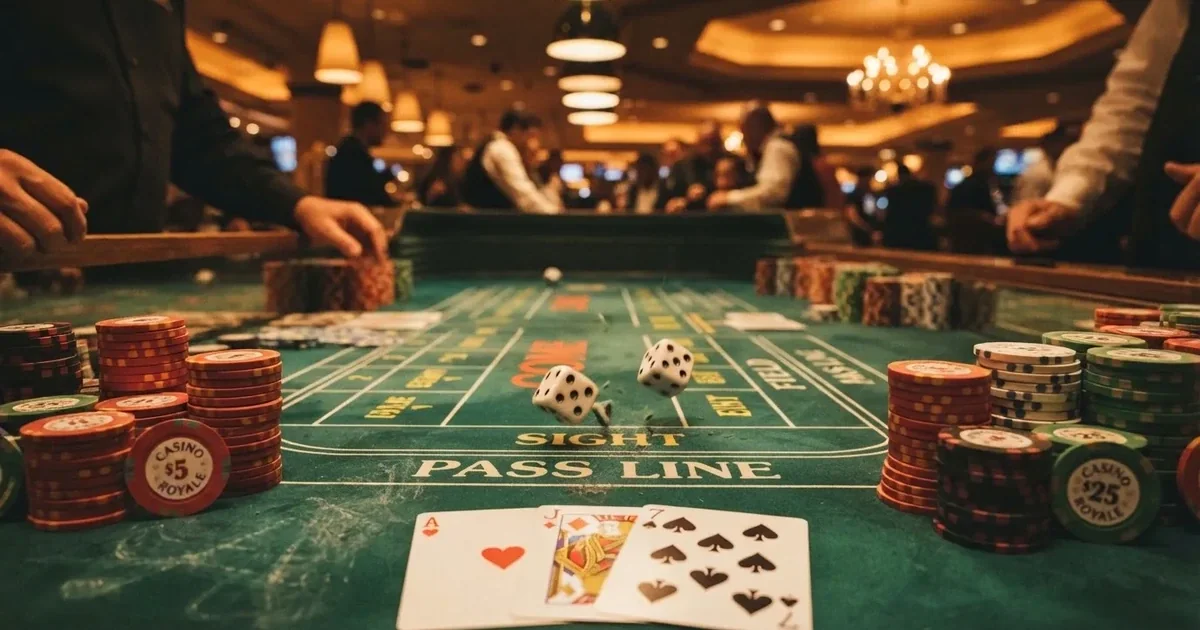
A craps table looks intimidating because a third of the felt is dedicated to proposition bets almost nobody should touch. The game underneath is small. A shooter rolls two dice on the come-out roll: 7 or 11 wins the Pass Line bet immediately, 2, 3 or 12 loses it immediately, and any other number (4, 5, 6, 8, 9 or 10) becomes “the point” — a target the shooter must hit again before a 7 to win the Pass Line. Once a point is set, the round keeps running until either the point or a 7 lands. That is the entire engine of the most-played bet on the table.

The mathematics of the bet are gentler than the felt suggests. The Pass Line carries a house edge of 1.41%, and its mirror image, Don’t Pass, sits at 1.36%. After a point is established, the player can back the Pass Line with an “odds bet” paid at true odds — a wager with a 0% house edge because the casino pays exactly what the probability of winning is worth. Free odds are the only bet in the casino with no built-in margin, and a Pass Line plus maximum odds is the closest a craps player gets to a fair fight.
The same felt also carries bets most players would do well to ignore. The Field bet runs at a 5.56% house edge, Any 7 at 16.67%, and Any Craps at 11.11%. These are the bets the table’s design draws the eye to, and the bets that pay a croupier’s salary. A reader who walks up to a craps table and lays money on anything in the centre proposition box is funding the house’s margin twice as fast as someone who keeps their chips on the Pass Line.
Craps as it is played today is an American simplification of an older English dice game called Hazard, brought to New Orleans around 1805 by Bernard Xavier Philippe de Marigny de Mandeville and trimmed down to the “Pass” rules the French word describes. The Don’t Pass layout that lets the house back the other side dates from around 1907, when Philadelphia dice maker John H. Winn introduced it; his innovation gave casinos an incentive to use fair dice, because both sides of the table now carried a margin. Crapless Craps and street craps are variants in the same family — Crapless Craps removes 2, 3, 11 and 12 as come-out losers or winners, street craps is the informal version played on a kerb without a stickman — and the same house-edge logic applies to both.
Why the comparison list on every other site is misleading
Eleven brands recur across the offshore pages that rank “best online craps casinos” for Australian readers. They share almost nothing in common except one thing: every one of them has been the subject of a formal warning from the Australian Communications and Media Authority under the Interactive Gambling Act 2001. None of them is licensed to take a bet from a person in Australia. Several have been warned about more than once, and several are operated by companies that the ACMA has had to chase across multiple brand names.
The framing of these pages — “top 10 offshore casinos accepting Australian players” — rests on a category error. A “top 10” implies a ranked choice among licensed, comparable options. There are no licensed options to rank. There is an unregulated offshore market and an Australian law that says it cannot offer the product it is selling, and a regulator that has spent seven years telling it so.
A reader who treats the comparison as a shopping list has already lost the most important step in the decision. The question is not which brand offers the bigger matched-deposit bonus. The question is whether the brand can lawfully take the deposit at all.
The ACMA’s enforcement record
The ACMA began requesting ISPs to block illegal gambling sites in November 2019. As reported in June 2026, 1,751 illegal gambling and affiliate marketing websites have been blocked under that regime, and more than 230 unlicensed gambling services have left the Australian market since enforcement was strengthened in 2017. The most recent published round alone asked ISPs to block twelve more: 7Signs, ChromaBet, Donbet, Duospin, Freshbet, Slots Gem, Jacks Club, Lucky Start, Pointsbetz.com, Spinrise, Vinyl Casino and Wildsino. The pace has not slowed; the regulator’s queue is longer than the queue of new entrants it has managed to push out.
The pattern of formal warnings tells the same story one operator at a time. The ACMA does not name every brand it warns — its published list is the minimum it has chosen to publish — but the list it has published since 2022 reads like a who’s-who of the offshore casino market pitching to Australians: Dama N.V. (Bambet, Dazard, Level Up, Rocketplay, Wild Tornado, Cobra Casinos) in May 2022, then Woo Casino in March 2025 and Spirit Casino in May 2025; Hollycorn N.V. over Sky Crown and Blue Leo in September 2022; Bamboo Media over Ignition Casino and Consolutetish S.R.L. over National Casino and Bizzo Casino in July 2025; EOD Code SRL over Instant Casino in February 2025; Sterplay Holding Ltd over Casino Intense in April 2025; Pulsup Ltd over Rocketplay.com.au in March 2026; Ryker B.V. over Jackbit and CasinOK in April 2026. Several of these warnings repeat a brand the regulator had already warned. Bizzo Casino was warned in 2022 under its previous operator, TechSolutions, and again in 2025 under Consolutetish S.R.L.
The blocking rate, in plain arithmetic
Taking the ACMA’s headline figure of 1,751 sites blocked since November 2019 and reading it against the roughly six-and-a-half-year window since the first blocking request produces a rate of roughly 270 sites a year, or about five a week, every week, for the entire period. That is not a one-off enforcement drive; it is the steady drip of a regulator operating against a churn of new domain registrations.
The reading is harder than a single rate suggests. The blocked-site count and the formal-warning count do not move together — a formal warning usually precedes a blocking request by weeks or months — and the ACMA’s own figure aggregates gambling sites with affiliate marketing pages, so the gambling-only component is lower than 1,751. Even so, the band — somewhere between one and three gambling-domain blocking requests a week sustained across seven years — is the right scale for a reader trying to picture how durable an offshore brand’s Australian-facing presence actually is. A site that is online today can be unreachable in Australia within a billing cycle, and a balance left on it is unrecoverable through any Australian channel.
What an Australian reader can actually play
The product the law prohibits is not the product the law permits. Australia licenses online wagering on racing and sport (placed before the event, not in-play), lotteries and keno. In practice, the bulk of online bookmakers — Sportsbet, Bet365, Ladbrokes among them — are licensed in the Northern Territory through the Northern Territory Racing and Wagering Commission, which regulates 52 of them and meets once a month in Darwin with no full-time staff of its own. The commission’s small footprint is not a sign of laxity; it is the consequence of a federal framework that hands the licence to one jurisdiction and lets the others recognise it.
None of that framework extends to craps. Craps is offered at land-based casinos in Australia, and at those venues only. Crown Melbourne, for example, runs a regulated craps table under Victorian Gambling and Casino Control Commission approval, alongside baccarat variants (Traditional Baccarat, Crown Baccarat and 2 to 1 Baccarat) and a stack of blackjack variants whose rules are publicly logged — the “Crown Pairs” rename in December 2024, the “Free Bet” option with “Pot of Gold” side bet in March 2024. Crown’s competitors in Sydney, the Gold Coast, Perth, Adelaide, Hobart and the ACT operate under the same kind of regulator approval for their table games.
The implication for a reader who wants to roll dice is straightforward: at a licensed venue, against a stickman who is paid by an Australian operator, under rules approved by an Australian regulator, with a complaint route that ends in an Australian tribunal. Offshore, none of those four conditions holds.
How the regulator’s framework actually works
The Interactive Gambling Act 2001 is the federal statute; it has been strengthened twice, most consequentially by the Interactive Gambling Amendment Act 2017, which widened the prohibition and gave the ACMA its modern enforcement tools. The offence sits with the provider, not the player. An individual in Australia who opens an account with an offshore casino commits no offence under the IGA; the operator offering the service to them is the party the Act targets. The individual penalty the Act specifies runs up to A$220,000 a day for a person and up to A$1.1 million a day for a corporation. Those are maximums, but they are also the maximums the regulator needs to put on the page of an Act to make offshore operators take its correspondence seriously.
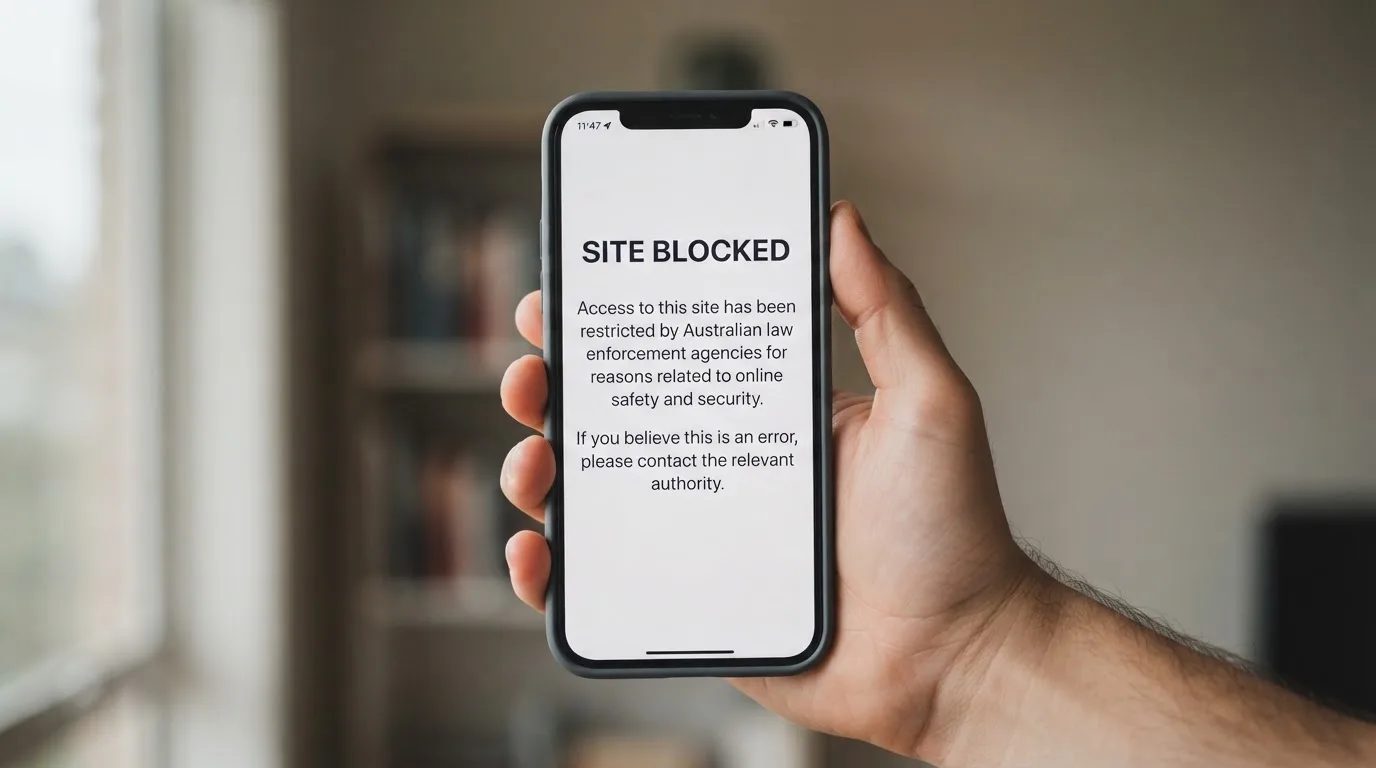
The ACMA’s three enforcement levers are formal warnings, civil penalty orders, and ISP blocking requests. Formal warnings are published and become a public record. Civil penalty orders are pursued in the Federal Court when warnings are ignored. ISP blocking requests rely on Australia’s major internet service providers to make named domains unreachable from Australian IP addresses — a process that takes weeks, not months, and that has now been run more than 1,700 times.
A 2026 reform sits on top of this stack. The Interactive Gambling Amendment (Gambling Reform) Bill 2026 passed Parliament on 19 August 2026. Its advertising and inducement measures commence on 1 January 2027, which means the law is enacted but not yet in force at the time of writing — a reader reading this after the new year will be reading it under a stricter regime.
Payments and credit: where the rules bite
Since 11 June 2024, credit cards, credit-related products and digital currency have been banned as payment for licensed online wagering in Australia. Penalties for operators that ignore the ban run up to A$247,500. Legal deposit routes for an Australian-licensed wagering account are debit card, bank transfer, PayID/Osko and BPAY. A site that asks an Australian customer for a credit-card deposit or a crypto transfer is operating outside the Australian rules — useful information, because the offshore casino market still leans on both methods.
Tax treatment
For a recreational player, gambling winnings in Australia are not assessable income under section 6-5 of the Income Tax Assessment Act 1997, and losses are not deductible. A player who carries on a business of gambling is in a different position; that is the ATO’s model, not a guide, and the right answer for anyone in the second category is to check with the ATO.
Responsible play, and what BetStop actually covers
BetStop, the National Self-Exclusion Register, has been live since August 2023 and binds every Australian-licensed online and phone wagering service. A person who registers excludes themselves from licensed wagering for a chosen period: the minimum exclusion is three months, and exclusions can run for longer periods or be made permanent. The register works because licensed operators must check it before opening an account and must refuse service to anyone on it.
An offshore casino is not connected to BetStop. Registering with BetStop does not exclude a person from a Curacao- or Kahnawake-licensed brand any more than registering with a single pub excludes a person from every bar in town. For a reader who has decided that self-exclusion is the right move, the relevant lever is to register with BetStop and to address the offshore account directly — by closing it, by asking the operator to remove the person from its marketing list, and by treating any balance on it as funds at risk of being frozen when the operator is blocked.
For readers in immediate difficulty, the National Gambling Helpline is 1800 858 858, free and open 24 hours a day, with chat also available through Gambling Help Online. The line and the chat are run by Australian counselling services and are the right first call.
The numbers behind the illegal market
H2 Gambling Capital’s 2025 report estimates that Australians lose about A$3.9 billion a year to illegal gambling sites. The same report puts the share of gambling going through legal channels at 64%, down from 74% in 2021. The fall over four years is the kind of movement that would dominate any other consumer-protection conversation in the country — ten points of legal-channel share, surrendered to a market the regulator is unable to keep out. Whether the 2026 reform turns that around is the question the next twelve months will answer.
Bonuses, turnover, and the math underneath the matched-deposit headline
Every offshore casino page aimed at an Australian reader leads with a matched-deposit offer. The headline is usually a percentage and a maximum. What the page is not interested in saying is what the percentage costs the person who claims it, and what the maximum takes to clear.
The arithmetic is simple in principle. A bonus carries a wagering requirement — sometimes called a playthrough or a turnover multiple — that says how many times the bonus amount has to be wagered before any winnings can be withdrawn. A A$500 bonus with a 40x wagering requirement obliges the player to put A$20,000 through eligible games before withdrawal. Craps, when it is available at all, is usually weighted at 20% or less toward wagering clearance, meaning the effective turnover on a craps-only playthrough is higher than the headline suggests.
The expected cost of clearing a bonus is the turnover times the house edge on the game used. On a craps Pass Line bet with a 1.41% house edge, a A$20,000 turnover has an expected loss of roughly A$282 — a number the casino will not print on its promotional page. The same A$500 bonus, cleared on Any 7 (16.67% house edge), has an expected loss of A$3,334 — a different order of magnitude, and the reason craps players who do gamble on bonuses do so on Pass Line plus odds, not on the proposition bets the table centre advertises.
The free-bet offers the offshore market bundles in carry a second cost: maximum cashout caps, game restrictions, and time limits that expire before a careful player has cleared the requirement. None of these terms is unique to one brand; they are the industry standard, and the standard is harder on the punter than the promotional artwork suggests.
For a reader who has decided to play, the conclusion of the calculation is that the headline number is the smallest part of the cost. The size of the bonus, the multiplier, the eligible games, the weighting, the time limit and the max cashout together determine what the offer is worth, and only the first of those five is on the front page.
Where the brands sit, and what the ACMA file shows
Eleven brands appear in the public ACMA file and recur across the offshore comparison pages targeting Australian readers. None of them is licensed to offer online casino games to Australians. The list below carries the ACMA’s published action against each, and only that — the operator the regulator named, the date of the formal warning, and the fact that the subject is unlicensed in this country.
| Brand | ACMA action and date | Operator named by the ACMA | Subject support |
|---|---|---|---|
| RocketPlay | Formal warning, March 2026 | Pulsup Ltd | — |
| Level Up Casino | Formal warning, May 2022 | Dama N.V. | listings-only (Bgaming) |
| Woo Casino | Formal warning, March 2025 | Dama N.V. | — |
| Spirit Casino | Formal warning, May 2025 | Dama N.V. | — |
| National Casino | Formal warning, July 2025 | Consolutetish S.R.L. | listings-only (Wikipedia) |
| Bizzo Casino | Formal warning, July 2025; earlier 2022 | Consolutetish S.R.L. / TechSolutions | — |
| Ignition Casino | Formal warning, July 2025 | Bamboo Media | — |
| Instant Casino | Formal warning, February 2025 | EOD Code SRL | — |
| Jackbit | Formal warning, April 2026 | Ryker B.V. | — |
| Casino Intense | Formal warning, April 2025 | Sterplay Holding Ltd | listings-only (ABC News, ACMA, Crown Melbourne) |
| Sky Crown | Formal warning, September 2022 | Hollycorn N.V. | — |
The column on subject support reads “—” wherever the ACMA file does not link a brand to the craps game specifically; “listings-only” wherever a third-party directory lists the brand as carrying craps, which is not the same as the brand offering the game to Australians lawfully.
RocketPlay — formal warning, March 2026
Pulsup Ltd was the operator named in the most recent ACMA action against this brand, in March 2026. Rocketplay had already been the subject of a 2022 warning under its previous operator, Dama N.V., which makes it one of a handful of brands the regulator has had to warn twice as the corporate wrapper changed. The brand carries no Australian licence, and the offshore licences it does display do not authorise the provision of casino games to customers in this country. A reader who opens an account with RocketPlay is dealing with an unlicensed operator under Australian law.
Level Up Casino — formal warning, May 2022
Dama N.V. was named by the ACMA in May 2022, when the regulator warned the operator across six brands at once. Level Up is one of those six, alongside Bambet, Dazard, Rocketplay, Wild Tornado and Cobra Casinos. Bgaming, one of the studios whose craps titles are listed in third-party game directories, attributes Level Up to its distribution list, which is a listing rather than a license to deal to Australian customers. The brand’s continuing operation under Dama N.V. is the same pattern the ACMA’s 2025 warnings to Dama N.V. over Woo Casino and Spirit Casino also describe.
Woo Casino — formal warning, March 2025
The March 2025 warning to Dama N.V. covered Woo Casino specifically. The pattern here is informative: the operator had already been warned in 2022 under different brand names, and the ACMA found it necessary to issue a fresh warning under a new brand twelve months into the new round. Woo Casino is unlicensed in Australia. Any licence it displays is for a different market.
Spirit Casino — formal warning, May 2025
The May 2025 warning to Dama N.V. over Spirit Casino came two months after the Woo Casino warning, against the same operator, and is the third Dama N.V. brand the ACMA has named in twelve months. The volume of warnings under a single corporate umbrella is the kind of pattern that prompts blocking requests rather than further letters.
National Casino — formal warning, July 2025
Consolutetish S.R.L. was the operator the ACMA named in July 2025. The brand is listed in third-party directories as carrying craps titles, which is a directory entry rather than a licence to operate in Australia. The ACMA’s published record is the relevant fact for an Australian reader, and the published record says the brand has been formally warned.
Bizzo Casino — formal warning, July 2025; earlier 2022
Bizzo is the cleanest case of an operator changing names to dodge a regulator. The ACMA warned TechSolutions (CY) Group Limited and TechSolutions Group N.V. over Bizzo Casino in 2022, and again warned Consolutetish S.R.L. over the same brand in 2025. The brand is unchanged; the corporate wrapper is not. For a reader, the lesson is that the brand name is the surface and the operator name is the substance, and the substance has been warned twice.
Ignition Casino — formal warning, July 2025
Bamboo Media was named by the ACMA in the July 2025 round that also covered National Casino and Bizzo Casino. Ignition is one of the longer-established offshore brands targeting Australian readers, and its appearance in the warning list is one more entry in the regulator’s published register.
Instant Casino — formal warning, February 2025
EOD Code SRL was the operator named by the ACMA in February 2025. The brand’s market position rests on the same unregulated framework as the rest of the list. The fact that the warning was issued earlier than the July 2025 cluster does not soften it; the regulator’s timing is publication timing, not enforcement priority.
Jackbit — formal warning, April 2026
Ryker B.V. was named by the ACMA in April 2026, in the same enforcement round that also covered CasinOK. Jackbit is one of the more recent additions to the regulator’s published list, and its presence in the table is a function of how recently the warning was issued rather than how prominent the brand is in the market.
Casino Intense — formal warning, April 2025
Sterplay Holding Ltd was named by the ACMA in April 2025. Third-party listings tie the brand to a broader set of Australian-facing coverage, including ABC News reporting on the NTRWC and ACMA material on the regulator’s enforcement record, alongside Crown Melbourne’s own table-game disclosures. None of those listings constitutes a licence; what they reflect is the surface the brand presents.
Sky Crown — formal warning, September 2022
Hollycorn N.V. was named by the ACMA over its Sky Crown and Blue Leo services in September 2022. Sky Crown is the older of the two warnings in the ACMA’s file on this page’s list, and the brand has continued to operate against Australian customers in the years since. The 2022 warning has not been retracted; the regulator does not retract formal warnings once issued.
Where to actually roll dice in Australia
The honest answer for a reader in Australia is that craps is a land-based game in this country, played at licensed casino floors under regulator-approved rules. The Melbourne casino runs a regulated craps table under the Victorian Gambling and Casino Control Commission, which took over from the VCGLR on 1 July 2022. Sydney’s casino, the Gold Coast’s, Perth’s Crown, Adelaide’s SkyCity, Hobart’s Wrest Point and Casino Canberra all operate under their state or territory regulators, and craps — or its closest local equivalent — is available on the gaming floor in most of them. The state regulator approves the rules of every table game before it is introduced, and operators must make copies of the approved rules available to patrons on request (the NSW Casino Control Act 1992 is explicit on this point at section 66). The point is not that the experience is identical to a Las Vegas craps pit. The point is that the rules, the dice, the payout, the stickman and the complaints process are all inside an Australian framework.
For a reader who wants to roll dice online, the answer in 2026 is the same as it has been since the Interactive Gambling Amendment Act 2017 took effect: there is no lawful Australian-licensed online casino offering craps. Wagering on racing and sport is licensed and regulated; craps is not. The offshore market that exists to take Australian customers exists because it judges the ACMA’s enforcement cycle slow enough that the customers it loses to a blocking request are replaced by new ones faster than the regulator can write to them.
The verdict, such as it is
A reader who arrived at this page looking for a “best online craps casino” for Australia has been given the worst answer that an honest comparison can give: there is no licensed option to rank. The eleven brands that recur on the offshore comparison pages are all unlicensed in this country, all on the ACMA’s published warning list, and several of them have been warned more than once under different corporate wrappers. The matched-deposit bonus the pages lead with is real; the expected loss against the wagering requirement is real too, and the latter is the larger number. The free odds bet at a craps table is the closest thing the game offers to a fair fight, and it is not available on any of the offshore sites on the list.
For a reader who wants to roll dice, the choice in 2026 is between a regulated land-based casino and an offshore site the regulator has named in writing. The first is the only one that offers a complaint route, a regulator-approved rule book and a payout that cannot be blocked by an ISP. The second offers a promotional bonus, an offshore licence that does not extend to Australian customers, and a balance that can become unreachable when the next blocking request lands.
Frequently asked questions
What house edge does the Pass/Come bet carry in craps?
The Pass Line and Come bets both run at a 1.41% house edge. Don’t Pass and Don’t Come are marginally lower at 1.36%. The free odds bet taken behind either of them carries a 0% edge, paid at true odds, and is the only wager on the table with no built-in margin.
What is the difference between a Pass Line and a Don’t Pass bet in craps?
Pass Line wins on a come-out roll of 7 or 11 and loses on 2, 3 or 12. Don’t Pass is the mirror image: it loses on 7 or 11 and wins on 2 or 3, with 12 a push (tie). After a point is set, Pass Line wins if the point is rolled before a 7, and Don’t Pass wins if the 7 comes first.
Is it legal for an online casino to offer craps to players in Australia?
No. The Interactive Gambling Act 2001 makes it an offence to provide online casino games — craps included — to customers in Australia, with daily penalties of up to A$220,000 for an individual and A$1.1 million for a corporation. The provider is the party the Act targets; the player is not prosecuted.
Why is the Any Craps bet considered a poor-value wager?
Any Craps bets on 2, 3 or 12 as a single roll, paying 7:1, and carries a house edge of 11.11%. By comparison, Pass Line is 1.41% and the free odds bet is 0%. Any Craps costs the player roughly eight times the rate of a Pass Line bet for a single decision.
Can craps be played at a licensed Australian land-based casino?
Yes, at licensed casino floors under state or territory regulator approval. Crown Melbourne, for example, runs a regulated craps table under the Victorian Gambling and Casino Control Commission, which replaced the VCGLR on 1 July 2022. The rules of the game and any change to them require regulator approval before being introduced.
What should someone do if they are chasing craps losses online?
The first call is the National Gambling Helpline on 1800 858 858 — free, 24/7, with chat also available through Gambling Help Online. Registering with BetStop, the National Self-Exclusion Register, excludes the person from Australian-licensed wagering services. An offshore casino account is not connected to BetStop and must be closed directly with the operator.
Written by the editors at Casino Slots Info AU.