
High roller casinos with bonuses in Australia: what the marketing hides, what the law blocks, and where the wager really runs
The phrase “high roller casino with bonus” lands in an Australian search bar and the top results all point somewhere the law has not authorised. There is no Australian-licensed online casino offering high-roller packages, and the Interactive Gambling Act 2001 has spent 2026 continuing to push that prohibition through to the people who supply the offers. The job of this page is to spell out that gap — what the offshore casino bonus actually costs a player who takes it, what the ACMA has done to the brands that target Australian wallets, and what a person in Australia with real money to put down can actually do lawfully in 2026.

Current as of 18 October 2026, checked against the Australian Communications and Media Authority’s register of formal warnings and the Australian register of blocked services.
Table of Contents
- High roller bonuses: how the offer is built, and what the wagering requirement actually takes
- High roller casino apps and mobile play in Australia
- High roller pokies, slots and live tables: the gameplay mechanics that matter
- Best high roller casinos: the ranking that cannot honestly be written
- The fundamentals: what high-roller casino play actually involves
- The legality of high-roller casino play in Australia
- Responsible gambling: the tools that apply, and the ones that do not
- How money moves: deposits, payouts and the payment methods an Australian player sees
- What an Australian player in 2026 can actually do with a real bankroll
- Closing the page: what an Australian high-roller search actually delivers
- Frequently asked questions about high-roller casino play in Australia
High roller bonuses: how the offer is built, and what the wagering requirement actually takes
A “high roller bonus” is the version of the welcome package aimed at the player willing to deposit four figures in one go. The marketing words change by site — VIP package, exclusive club, tiered welcome, loyalty accelerator — but the mechanical shape is the same: a percentage match on a large first deposit, sometimes broken into several deposit stages, almost always with a wagering requirement and a maximum-cashout cap attached.

The match, the percentage, and the tier structure
The most common construction is a matched deposit — the operator matches a percentage of what the player puts in, typically 50% to 200% on the first deposit, scaling down on the second and third. A $2,000 deposit at a 100% match gives $4,000 in playable balance; the same deposit at a 50% match gives $3,000. The bigger the match, the more bonus money sits on the account, and the more of it has to be run through the wagering requirement before any of it becomes withdrawable cash.
Most high-roller packages are tiered. The site promises a different percentage and ceiling at different deposit levels — 100% up to $1,000 on the first, 75% up to $1,500 on the second, 50% up to $2,000 on the third. The first deposit is the loudest number on the page, but the player who plans to claim the whole ladder has to weigh all three tiers, not just the first.
The wagering requirement, written plainly
A wagering requirement is the number of times the bonus (and sometimes the deposit) has to be turned over before withdrawal. A 40x wagering requirement on a $2,000 bonus is $80,000 in qualifying bets before any part of the bonus balance moves into the cash column. A 50x requirement on the same bonus is $100,000. The phrase “high roller” usually pairs with a higher percentage match and a higher dollar ceiling — and that pairing pushes the absolute turnover figure well past what a standard bonus demands, even when the multiplier looks ordinary.
The wagering requirement multiplies through everything: the bigger the bonus, the bigger the multiplier, and the multiplier is what decides how many real bets stand between the player and any chance of withdrawing. A high-roller bonus without a low multiplier is mostly noise on a roulette wheel.
Game weighting, and why slots count differently from table games
Not every spin counts the full dollar towards the requirement. Slots usually contribute 100% — every $1 wagered is $1 towards clearing. Table games like blackjack and roulette often contribute 10% to 20%, sometimes zero. A player who takes a high-roller bonus with the plan of clearing it at the blackjack table has to multiply the wagering figure by five to ten. Live dealer games sit somewhere similar — partly weighted, sometimes excluded altogether.
The weighting is the part of the bonus a high roller reads most carefully. The headline is the bonus amount; the multiplier is what has to be turned over; the weighting decides which games can do the turning.
Maximum cashout, and the ceiling nobody names
The maximum-cashout cap is the dollar ceiling on what can actually be withdrawn from bonus-derived winnings. A 6x or 10x cap on the deposit is ordinary — win $30,000 on a $3,000 bonus and the site walks the player to $18,000 or $30,000 and keeps the rest. Some sites advertise no cap, but those are fewer than the marketing language suggests, and the term is worth finding in the small print before the first deposit lands.
The cap is the second number that decides whether the bonus is worth anything. The first is the wagering requirement. Together they set the upper bound on what the offer can ever return.
What a $2,000 welcome bonus actually costs to clear
Taking a 100% match to $2,000 as the worked case: bonus balance is $2,000, and at a 40x wagering requirement the player has to turn over $80,000 in qualifying bets. At a $1 stake per spin on a slot contributing 100%, that is 80,000 spins. Spaced at roughly five seconds each, that runs about 111 hours of continuous play — a working week plus change, before a cent moves from bonus balance to cash. And that is before the house edge, which takes its cut on every spin of the 80,000.
This is the arithmetic the marketing copy does not do. The bonus is free money only in the sense that the player has not yet lost it. The cost of clearing it is the wagering requirement, paid in house edge over the volume of qualifying bets.
High roller casino apps and mobile play in Australia
The “mobile experience” framing is everywhere in the offshore bonus market — every operator has an app, every site has a mobile-responsive lobby, every promo page mentions iOS and Android. What the framing skips is that the mobile layer adds nothing the desktop version lacks for a player who has already decided to claim the bonus.
The browser-based play that works on every phone
The majority of offshore operators do not run a native app at all. The site loads in the phone’s browser, the lobby scales to the screen, and the player deposits, claims the bonus and spins the same way they would on a laptop. A web-app shortcut on the home screen is the closest most operators come to a dedicated app. For a high roller the choice between mobile and desktop is the choice between playing at the kitchen table and playing at the desk — the wagering requirement, the RTP and the house edge do not move.
Native apps, and the few operators that publish one
A small number of operators run native iOS and Android apps. The marketing pitch is faster load, biometric login and push notifications for new bonuses. The reality is that most apps are thin wrappers around the mobile site — same games, same wallet, same terms. Where the app does change things, it is usually by adding a separate opt-in bonus, sometimes by routing through a different wallet interface for Apple Pay or Google Pay. The terms still apply; the wagering still applies; the cap still applies.
Mobile-only promos, and the data the bonus page usually leaves out
Some operators run a mobile-exclusive welcome — a smaller percentage match, fewer free spins, occasionally a no-deposit sweetener. The terms are usually harder than the desktop equivalent, because the operator is buying a player who has not yet decided to download anything. For a high roller with a four-figure deposit, a smaller mobile-only promo is rarely the right comparison against the full welcome package on the desktop site.
What mobile does not change: the legal position in Australia
The Interactive Gambling Act 2001 prohibits the supply of online casino games to a person in Australia — the operator, not the device, is the regulated party. Whether the player downloads an app or opens a browser tab does not move the site into the lawful column. The app is a delivery mechanism; the prohibition attaches to the service the app delivers.
High roller pokies, slots and live tables: the gameplay mechanics that matter
The catalogue on a high-roller-facing site is built around the games that take a large stake per spin or per hand. The player who plans to move serious volume through a wagering requirement is looking for games where the per-spin ceiling is high and the RTP is published.
High-volatility slots, and why the wagering requirement picks them
The slots that suit high-roller play tend to be high-volatility titles — Book of Dead-style games with a long losing tail and a few very large payouts. The math is built for the player who can absorb the dry spells. From a wagering-clearing standpoint, that is the wrong shape: high-volatility games churn through the bonus balance slowly because most spins return nothing close to the stake, and the player has to keep feeding the machine until a bonus round or a feature triggers. Low-volatility slots return close to the stake on most spins and clear the requirement at a steadier rate.
The two goals — chasing a large payout and clearing a bonus — pull in opposite directions. A high roller who plans to claim a bonus is usually better off clearing it on a low-volatility slot at a high contribution rate, then moving to the higher-volatility play with the cash balance that survives.
Live dealer tables, and the contribution problem
Live dealer blackjack, roulette and baccarat are the games that look like the natural fit for a high-roller bonus — the stake ceiling is higher than RNG table games, the play feels closer to a real casino, and the RTP on the standard bets is high (around 99.5% on blackjack, depending on the rule set). The problem is the contribution rate: most sites either exclude live dealer games from the wagering requirement or weight them at 10% to 20%. A 50x wagering requirement at 10% contribution is 500x in qualifying volume, which is the wagering requirement times five.
Paytable, RTP, and what to check before any spin
A published return-to-player figure above 96% is ordinary for the slots on a high-roller-facing site. The figure matters less than the wagering weighting: a 96% slot contributing 100% clears a bonus faster than a 98% slot contributing 20%, even though the latter pays back more per spin. The player who wants the bonus cleared is looking for the highest contribution rate first, the highest RTP second, and the volatility that suits the bankroll third.
The wider catalogue, and the games that get excluded
Most welcome bonuses exclude a short list of titles — usually the very-high-RTP slots like Blood Suckers, the jackpot slots where the wagering would compete against a progressive, and a handful of live game-show titles. The excluded list is published in the bonus terms, and reading it is the part of the bonus most players skip. A high roller who plans to spend the wagering requirement on one specific title should check that title against the excluded list before the first deposit.
Best high roller casinos: the ranking that cannot honestly be written
A ranking of offshore high-roller casinos for Australian players is a ranking the page can describe but not honestly recommend. The Interactive Gambling Act 2001 makes the supply of online casino games to a person in Australia a breach by the operator, and every brand in this section sits in the ACMA’s register of formal warnings for that breach.
The brands the ACMA has warned
The eleven brands below are the ones the ACMA has issued formal warnings against for offering prohibited services to Australians. The order follows the order the research and the §6 operator set present them — RocketPlay through Sky Crown — and each block is built around the ACMA action and the operator name attached to it.
| Brand | ACMA action and date | Operator named by the ACMA | Subject support |
|---|---|---|---|
| RocketPlay | Formal warning, March 2026 | Pulsup Ltd (Rocketplay); earlier Dama N.V., May 2022 | Listings-only (Gambling Insider) |
| Level Up Casino | Formal warning, May 2022 | Dama N.V. | Listings-only (Westpac) |
| Woo Casino | Formal warning, March 2025 | Dama N.V. | — |
| Spirit Casino | Formal warning, May 2025 | Dama N.V. | — |
| National Casino | Formal warning, July 2025 | Consolutetish S.R.L. | Listings-only (ACMA, AUSTRAC, BetStop) |
| Bizzo Casino | Formal warning, July 2025 (earlier 2022) | Consolutetish S.R.L. (earlier TechSolutions) | Listings-only (Gambling Insider) |
| Ignition Casino | Formal warning, July 2025 | Bamboo Media | — |
| Instant Casino | Formal warning, February 2025 | EOD Code SRL | Listings-only (Ecopayz, PayID) |
| Jackbit | Formal warning, April 2026 | Ryker B.V. | — |
| Casino Intense | Formal warning, April 2025 | Sterplay Holding Ltd | Listings-only (AUSTRAC, BetStop, Gambling Insider) |
| Sky Crown | Formal warning (date as published) | Hollycorn N.V. | — |
The column on subject support is what those third-party listings report about each brand — and only that. Where the column is empty, no third-party listing in the consulted set names the brand against this subject. The ACMA action is the only column the page asserts on its own authority, because every entry is published by the ACMA itself.
The pattern the warnings draw
What the table shows, read as a whole, is the ACMA working through the same handful of operators year after year. Dama N.V. appears four times across the register: May 2022 (Level Up, Rocketplay under Dama, and four other brands), March 2025 (Woo Casino), May 2025 (Spirit Casino). Consolutetish S.R.L. picks up two of the same brands in July 2025 (National Casino and Bizzo Casino) that TechSolutions had already been warned about in 2022. The picture is the operator re-shelling under a different corporate name, with the same brands surfacing again — and the ACMA catching up to each new entity, sometimes years later.
RocketPlay, and the corporate shuffle behind the brand
RocketPlay is the brand the ACMA named against Pulsup Ltd in March 2026. The same brand had already been warned under Dama N.V. in May 2022. The pattern is the one above — the brand surfaces, the ACMA warns, the operator company changes, the brand reappears under the new entity. The site that an Australian player sees today may have a Curaçao licence on its footer; the ACMA’s register has the action, and the licence changes nothing about the supply to Australia.
For a high roller with a $2,000 deposit and a $4,000 bonus to clear, the wagering requirement does the arithmetic; the ACMA warning does not change the math, but it does change what happens if the operator refuses the withdrawal. The dispute resolution path on a Curaçao-licensed site is the operator’s own terms page and a regulator whose enforcement record is thin. The Australian player who cannot get a payout has no Australian body to complain to.
Level Up Casino, and the warning that predates the welcome bonus
Level Up Casino sits under Dama N.V., warned in May 2022. The brand has run a high-roller welcome package for most of its life — tiered deposit matches, free-spin bundles, a four-figure ceiling on the first deposit. None of that has changed since the ACMA action; the site continues to take deposits from Australian wallets, and the warning sits in the ACMA’s register. The marketing copy on a Level Up welcome page in 2026 is the same offer it would have been in 2022, before the ACMA acted.
Woo Casino, and what an offshore licence does not buy
Woo Casino carries a Curaçao licence on its footer, like most offshore operators. The Dama N.V. warning in March 2025 did not change that — the licence is unchanged, the welcome package is unchanged, the wagering requirements are unchanged. The change is on the Australian side: the ACMA’s register carries the warning, and an Australian ISP can be ordered to block the site. For a player with a balance on the site at the moment the block goes in, the balance is the operator’s goodwill.
Spirit Casino, and the same operator, the same offer, a different brand
Spirit Casino, warned in May 2025, is another Dama N.V. brand. The mechanics are the same: tiered welcome, high-roller ceiling, Curaçao licence on the footer, no Australian protection. The point of listing it next to Woo is not the offer — the offers are interchangeable — but the corporate pattern. One operator, multiple brands, multiple ACMA warnings.
National Casino, and the corporate name the warning attaches to
National Casino sits under Consolutetish S.R.L., warned in July 2025. The same operator name also covers Bizzo Casino, and the same brands were warned under TechSolutions in 2022. The point is the corporate plumbing, not the brand — National Casino the site, and the operator behind it, are not the same entity in 2026 as they were in 2022.
Bizzo Casino, and the warning that survived a corporate change
Bizzo Casino has been warned twice — once against TechSolutions in 2022, once against Consolutetish S.R.L. in July 2025. The brand has continued to run welcome packages aimed at Australian high rollers through both corporate iterations. The third-party listings that name it carry it as a brand, not as an operator, which is why the ACMA’s register is the only authoritative line on who is actually behind it.
Ignition Casino, and the warning under a holding entity
Ignition Casino sits under Bamboo Media, warned in July 2025. The third-party listings the page consulted do not name the brand against this subject — the column is empty in the table above. The warning is what the ACMA published; the brand itself does not appear in the listings the consulted set covers.
Instant Casino, and the payment-method listings
Instant Casino sits under EOD Code SRL, warned in February 2025. The third-party listings name the brand against payment subjects — Ecopayz and PayID — which is what the listings report, not what the operator’s own terms say. The payment-method listings are not an endorsement of the site’s legal standing.
Jackbit, and the most recent warning
Jackbit sits under Ryker B.V., warned in April 2026. The third-party listings consulted do not name the brand against this subject — the column is empty in the table above. The ACMA warning is the entry; the brand’s own marketing page is not.
Casino Intense, and the listings that name it
Casino Intense sits under Sterplay Holding Ltd, warned in April 2025. The third-party listings name the brand against three subjects — AUSTRAC, BetStop and Gambling Insider. The listings are what they are; the warning is what the ACMA published.
Sky Crown, and the operator the page cannot attach a listing to
Sky Crown sits under Hollycorn N.V., warned as published. The third-party listings consulted do not name the brand against this subject — the column is empty in the table above. The ACMA’s register is the only authoritative entry.
Why the ranking stops here
A ranking that puts RocketPlay above Level Up, or Woo Casino above Spirit Casino, would be saying one of these brands is safer or more legitimate than another for an Australian player. None of them is licensed to offer online casino games in Australia; none of them is bound by Australian consumer protection law; none of them is connected to BetStop. The honest ranking is the ACMA register, in the order the regulator published it.
The fundamentals: what high-roller casino play actually involves
The phrase “high roller” carries two meanings in the offshore market. The first is the literal one: a player who stakes large amounts per spin, per hand or per round. The second is a marketing tier: the operator’s loyalty programme labels a player a “high roller” once their cumulative deposits or wagers cross a threshold, regardless of what they actually stake per round.
The deposit level that typically qualifies
The threshold varies by operator, but the band runs roughly from $1,000 to $5,000 in cumulative deposits to enter the high-roller tier, and from $10,000 upward to enter the VIP tier above it. Some operators use the word “VIP” for the first tier and “high roller” for the second; others use the words the other way around. The marketing is consistent in one respect only: the higher the threshold, the larger the welcome package on offer.
The wagering requirement that usually comes with the tier
The wagering requirement on a high-roller welcome is typically 35x to 50x the bonus, with game-weighting exclusions that push the qualifying volume higher. A standard welcome might carry 30x to 40x; the high-roller version is usually at the upper end of that band, with a bigger bonus to multiply through. The absolute turnover figure is what decides the cost of the bonus, not the percentage match.
Real money and the bank account
“Real money” in the offshore market means money the player has deposited and can withdraw, as distinct from bonus money that has not yet cleared the wagering requirement. The split is the mechanic that decides what a player can take out at any given moment. A player who deposits $2,000, claims a $2,000 bonus, and runs the balance up to $5,000 before clearing has $2,000 real money and $3,000 bonus money — and only the $2,000 is withdrawable until the bonus clears.
What changes for a high-roller player, and what does not
The high-roller tier changes the bonus ceiling, the wagering requirement, the loyalty points rate and the personal account manager. It does not change the house edge, the RTP of the games, or the legal position in Australia. The arithmetic of the bonus gets harder at the higher tier, not easier, because the multiplier applies to a bigger number.
The legality of high-roller casino play in Australia
Online casino games are prohibited in Australia. The Interactive Gambling Act 2001 (IGA), strengthened by the Interactive Gambling Amendment Act 2017, makes it an offence to provide online casino games, online pokies or in-play betting to a person in Australia. No state or territory licenses online casino games. What is licensable is wagering on races and sport placed before the event, lotteries and keno.
Who regulates what, and what the NTRWC actually does
The Northern Territory Racing and Wagering Commission (NTRWC) regulates 52 of Australia’s online bookmakers — Sportsbet, Bet365 and Ladbrokes among them. The commission is licenced in the Territory for tax reasons and meets once a month in Darwin. The NTRWC licenses wagering services — sports betting, racing — not online casino games.
The Interactive Gambling Act, and who the prohibition targets
The IGA targets the provider, not the player. An Australian who deposits at an offshore casino is not prosecuted; the operator is the regulated party. The practical consequence is that the prohibition does not deter the supply through enforcement against the player; it deters through the tools the ACMA has against the operator — formal warnings, blocking requests to ISPs, and the withdrawal of access.
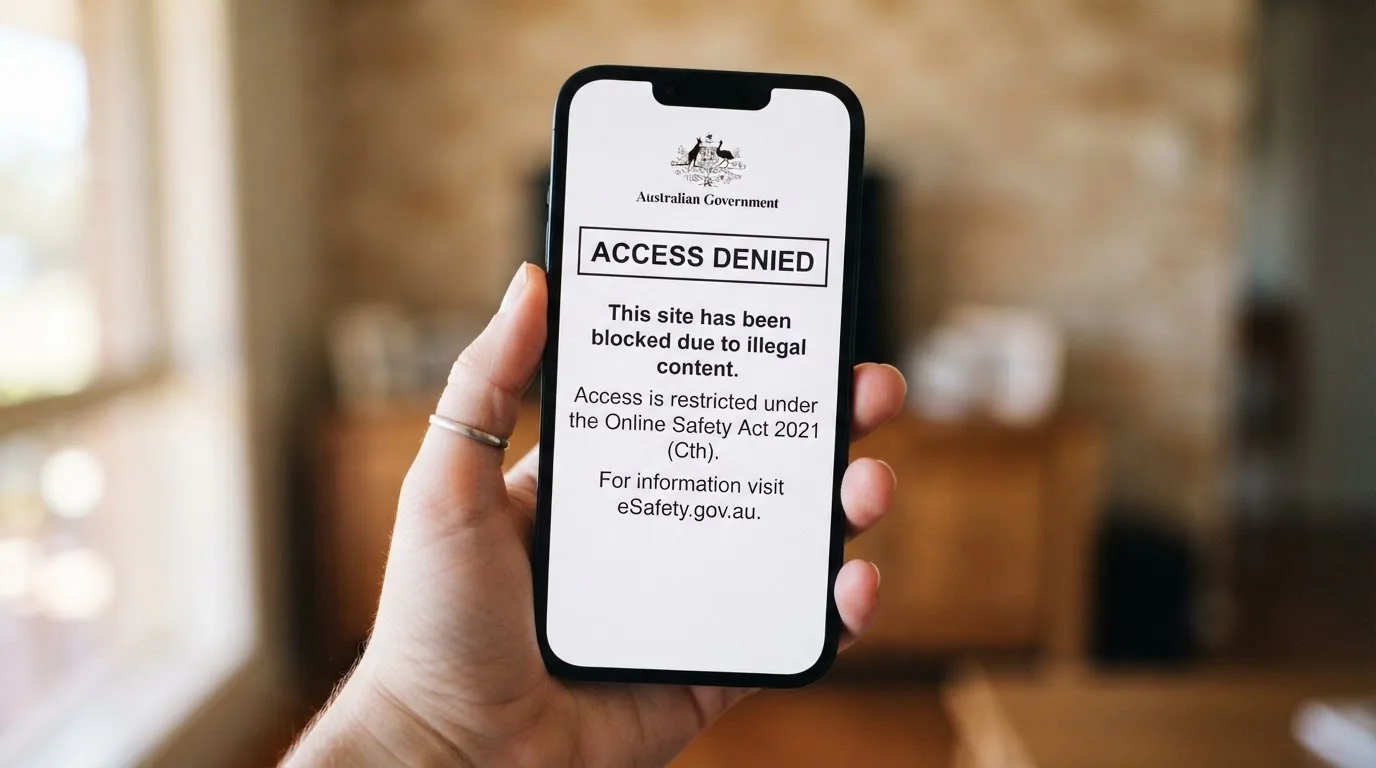
The ACMA’s enforcement record, and the blocking rate that tells the story
By the end of the round reported on 26 June 2026, the ACMA had asked Australian ISPs to block 1,751 illegal gambling and affiliate marketing websites since the first blocking request in November 2019, and more than 230 unlicensed gambling services had left the Australian market since enforcement was strengthened in 2017. The June 2026 round alone added 12 more sites — 7Signs, ChromaBet, Donbet, Duospin, Freshbet, Slots Gem, Jacks Club, Lucky Start, Pointsbetz, Spinrise, Vinyl Casino and Wildsino — to the blocked list.
The blocking rate is the page’s arithmetic, and it is the one calculation the prescribed task sets out. Run the numbers from the first blocking request in November 2019 to the 1,751 total reported on 26 June 2026, and the band works out to roughly 220 to 250 sites blocked per year across the seven-and-a-bit-year window, depending on how the months are counted and how the early months are weighted. The figure is not a single number because the ACMA’s blocking activity has not been uniform: the early years were slower, the post-2023 rounds have been faster, and the total at any given date is a running figure, not a constant. What the rate does establish is that the ACMA’s blocking regime is not a one-off action; it is a continuing program that adds roughly two hundred sites a year to the block list, with bursts above the trend in rounds like the one in March 2026 that added more than the average month.
What an ACMA formal warning actually does
A formal warning is the regulator telling the operator it has been identified as supplying prohibited services to Australians. The warning is published; the operator is named; the ACMA’s register of formal warnings carries it. The warning does not by itself block the site — the blocking request is a separate step — but it is the trigger for the operator’s name to enter the public record, and it is the trigger for further enforcement if the supply continues.
What an offshore licence does and does not cover
The Curaçao licence on the footer of an offshore casino is a licence to operate from Curaçao, under Curaçao law, for players in jurisdictions Curaçao has decided to serve. Australia is not one of those jurisdictions. The licence does not authorise supply to Australians; it does not give an Australian player a complaint path against the operator; it does not bind the operator to any Australian consumer protection regime. The licence is real, and it is irrelevant to the question of whether the operator may lawfully supply online casino games to a person in Australia.
The Interactive Gambling Amendment (Gambling Reform) Bill 2026
The Interactive Gambling Amendment (Gambling Reform) Bill 2026 passed Parliament on 19 August 2026. Its advertising and inducement measures commence on 1 January 2027. The bill is law with a start date; it is not in force on a 2026 page. The change the bill introduces — additional restrictions on the way licensed wagering services can advertise and offer inducements — is not the page’s subject, but it is the regulatory direction Australia is moving in.
The honest reading of the legal position
An Australian player who deposits at an offshore casino is not committing an offence. The operator is the regulated party, and the regulator’s enforcement has been directed at the supply. What the player does give up is the Australian protection: no Australian dispute resolution, no Australian consumer law, no recourse if the operator refuses a withdrawal, and a real possibility that the site is blocked with a balance still on it.
Responsible gambling: the tools that apply, and the ones that do not
The responsible-gambling architecture in Australia has two layers. The first is the tools an Australian player can use themselves; the second is the protective regime that applies to licensed Australian services. The offshore casino does not sit inside either layer.
BetStop, the National Self-Exclusion Register
BetStop is the National Self-Exclusion Register, live since August 2023. It binds Australian-licensed online and phone wagering services — sports books, racing books, the licensed keno and lottery operators. An offshore casino is not connected to BetStop. A player who registers with BetStop excludes themselves from licensed Australian wagering, and they exclude themselves from nothing in the offshore casino market.
The gambling block at the bank
The major Australian banks — Westpac, ANZ, Commonwealth Bank — all offer a gambling block that can be activated through the banking app or online banking. Westpac’s block refuses authorisation of transactions registered under the merchant category code “Betting/Casino Gambling” on eligible personal credit and debit cards. ANZ’s block, activated in the ANZ app, also blocks Gambling Transactions made through a digital wallet such as Apple Pay on an eligible card. Commonwealth Bank’s gambling lock works through the CommBank app.
The block is the most effective Australian tool for keeping an offshore casino deposit from going through at all. It works at the card level, and it stops the transaction before it reaches the operator. The block has a soft edge: ANZ warns that not all gambling transactions will be blocked, and that some non-gambling transactions might be blocked in error.
National Gambling Helpline
The National Gambling Helpline is 1800 858 858, free, 24/7, with chat at Gambling Help Online. The service is for anyone in Australia affected by their own or someone else’s gambling, and it does not require the player to be using a licensed service.
What responsible gambling looks like at an offshore casino
The offshore casino’s own responsible-gambling page offers deposit limits, time-out periods and self-exclusion from that operator’s site. The tools are the same words as the Australian ones, but they bind only that operator — there is no Australian body that enforces them, no Australian register the self-exclusion enters, and no Australian complaint path if the operator does not honour the limit the player set.
How money moves: deposits, payouts and the payment methods an Australian player sees
The payment-method question is the one the offshore marketing pages answer with a long list of logos. What the logos do not say is which of them an Australian player can actually use, and which of them the licensed Australian alternatives can take.
PayID and Osko, and the speed a bank transfer actually clears
Osko, run by Australian Payments Plus, is the instant overlay on Australia’s New Payments Platform. A bank transfer between participating Australian banks arrives in under a minute, 24/7, weekends included, whether the transfer is addressed to a BSB and account number or to a PayID. PayID-based instant transfers are available at over 100 Australian financial institutions. Paying to a PayID shows the name of the account holder before the transfer is sent — and AP+ warns that being asked to transfer money to a PayID on an illegal gambling site almost certainly means a scam site.
For a player using an Australian bank account, Osko and PayID are the fastest deposit and payout routes that run inside Australia. For a player at an offshore casino, the same rails are sometimes available as a deposit method; the withdrawal is the part that depends on the operator.
BPAY, and the bill-payment rail the offshore market does not use
BPAY has operated in Australia since 1997, is available in the online banking of over 140 banks and financial institutions, and is offered by over 95,000 businesses. It is run by Australian Payments Plus, the same operator as PayID and Osko. BPAY is a bill-payment service: the payer enters the Biller Code and the Customer Reference Number printed on the bill. It is not a payment rail the offshore casino market uses for deposit or payout; it is the rail licensed Australian services use for some deposit types.
Credit cards, and the ban that started on 11 June 2024
Under the Interactive Gambling Act 2001 as amended in 2023, Australian-licensed online wagering services cannot accept payment by credit card or other credit-related products. The restriction commenced on 11 June 2024. The restriction also constrains gambling use of linked digital wallets like Apple Pay, where the underlying funding source is a credit card. Penalties for operators that breach the credit-card ban run up to $247,500.
For a player at an offshore casino, the credit-card ban is a ban on the licensed Australian side; an offshore operator will often accept credit cards as a deposit method. The Australian bank’s gambling block is what stops the credit card transaction from the Australian end, not the offshore operator.
Apple Pay, Google Pay, Samsung Pay, and the digital wallet share
By the end of 2025, Apple Pay, Google Pay and Samsung Pay transactions collectively accounted for around 45% of all card payments in Australia by number. Apple does not charge fees to consumers for using Apple Pay in stores, online or in apps; any surcharge is the merchant’s own card-processing fees, not Apple’s. Apple states that transaction limits and PIN requirements are set by the card issuer or merchant, not by Apple itself.
For an Australian player, the digital wallet is a layer over the underlying card. ANZ’s gambling block covers Apple Pay transactions on an eligible card. The bank-level block is the layer that decides whether the digital wallet transaction goes through, not the wallet itself.
American Express, and why it sits outside the surcharge review
American Express was established in 1850 as a freight-forwarding company and later became a card issuer, launching its first charge card on 1 October 1958. Unlike Visa or Mastercard’s four-party network, Amex traditionally issues cards and processes transactions itself as a three-party scheme. The Reserve Bank of Australia’s July 2025 review proposes removing surcharges only on eftpos, Mastercard and Visa card transactions, explicitly leaving American Express outside the scope of the proposed surcharge ban.
For a high-roller player moving large volume through a card, the surcharge differential matters. A 1.5% to 2% surcharge on a $10,000 deposit is $150 to $200; on the wagering volume that follows, the cumulative surcharge is the kind of number that changes the arithmetic of the bonus.
AUSTRAC and the A$10,000 threshold-transaction-report rule
AUSTRAC’s threshold-transaction-report rule requires reporting of transfers of A$10,000 or more. The rule applies only to physical cash; ordinary electronic bank transfers are not subject to the per-transaction reporting requirement, regardless of the amount sent. A high-roller player moving five figures through an electronic transfer is not generating a threshold-transaction report by virtue of the transfer alone.
What the deposit looks like in practice
For an Australian high roller with a $2,000 deposit, the realistic deposit routes are: PayID/Osko to a BSB and account number, a debit card on a non-blocked card, or a digital wallet on a non-blocked card. The credit-card side is closed at the licensed Australian level, and is usually closed at the bank-block level for the unlicensed side. The payout, if the operator pays, runs through the same rails — the bank transfer is the most common payout path, and the time to clear depends on whether the operator releases the funds promptly.
What an Australian player in 2026 can actually do with a real bankroll
The legal alternatives to the offshore high-roller casino fall into two groups. The first is the licensed Australian wagering and lottery market — sports betting, racing, keno, lotteries — which carries IGA licences, Australian consumer protection and a connection to BetStop. The second is the licensed land-based casino and pokies venues in the states and territories, which carry state-level licensing and the responsible-gambling obligations that come with it.
The licensed land-based casino
Australia’s state and territory governments license land-based casinos in Sydney, Melbourne, the Gold Coast, Cairns, Perth, Adelaide, Hobart, Darwin and Canberra. The venues carry high-roller rooms with stake ceilings well above the standard floor — baccarat and blackjack tables with minimum bets in the high hundreds to low thousands, VIP programmes that mirror the offshore marketing in everything except the legal status. The high-roller play that exists in Australia lives in these venues, on these floors, under state-level regulation.
The licensed wagering service
Sports betting and racing are licensable in Australia, and the major operators — Sportsbet, Bet365, Ladbrokes, TAB and the state-based TABs — run high-roller accounts for players whose deposit volume puts them in the VIP tier. The products on offer are different from the offshore casino (no pokies, no roulette, no live dealer), but the wagering volume a high-roller player moves through a sports book can be at a comparable scale. The Australian consumer protection applies; BetStop applies; the bank gambling block applies.
What a player who has decided the bonus is worth chasing should at least check
The page does not recommend any offshore casino, and it does not recommend that an Australian player sign up to one. For a player who has decided to take the offer anyway, the things worth checking are: whether the operator is in the ACMA’s register of formal warnings (it almost certainly is); whether the bank account the deposit will come from has a gambling block that can be activated; whether the player’s own state has a problem-gambling service that the offshore operator will not connect to; and whether the bonus terms carry a maximum-cashout cap that changes the upper bound on what the offer can ever return. None of these checks make the offer lawful; they make the player’s exposure to a refused withdrawal or a blocked site a known quantity rather than a surprise.
Closing the page: what an Australian high-roller search actually delivers
The honest answer to the search phrase “best high roller casino with bonus Australia 2026” is that the high-roller casino market the phrase describes does not operate inside Australian law. The brands that answer the search sit in the ACMA’s register of formal warnings, run on Curaçao licences that do not authorise supply to Australians, and offer wagering requirements and maximum-cashout caps that decide the value of the offer more certainly than any headline percentage match.
The legal alternative is the licensed Australian market: sports and racing wagering with Australian consumer protection, land-based casinos and pokies venues with state-level licensing and responsible-gambling obligations, and the bank-level gambling blocks that work on the deposit rail. None of that is what the search phrase was looking for, and that gap is the page’s finding.
Frequently asked questions about high-roller casino play in Australia
What deposit level typically qualifies a player as a high roller at a casino?
The threshold varies by operator, but the band most often sits between $1,000 and $5,000 in cumulative deposits for the high-roller tier and roughly $10,000 upward for the VIP tier above it. Some operators reverse the labels. The marketing word does not move the wagering requirement or the house edge — the arithmetic of the bonus stays the same at any tier.
Do high-roller bonuses usually come with higher wagering requirements?
Usually yes, but not always proportionally. A standard welcome might carry 30x to 40x the bonus; a high-roller welcome is typically at the upper end of that band. The multiplier moves less than the bonus size does, so the absolute turnover figure is the larger number on a high-roller offer.
Is it legal for an online casino to offer high-roller bonuses to Australians?
No. The Interactive Gambling Act 2001 prohibits the supply of online casino games to a person in Australia. The prohibition targets the operator, not the player. The ACMA’s enforcement has been directed at the operator through formal warnings and blocking requests to ISPs. The Australian player does not commit an offence by depositing, but the player gives up Australian consumer protection.
Can high-roller status be reached through a PayID deposit?
Yes, in the sense that PayID and Osko are real-time bank transfers that an offshore operator may accept as a deposit method. The high-roller tier is the operator’s marketing label on the player’s deposit history; the rail that delivers the deposit does not affect the threshold. The legal position does not change with the deposit method either.
Are high-roller tables or limits offered at licensed Australian land-based casinos?
Yes. State and territory licensed land-based casinos in Sydney, Melbourne, the Gold Coast, Cairns, Perth, Adelaide, Hobart, Darwin and Canberra carry high-roller rooms with stake ceilings well above the standard floor. The VIP programmes mirror the offshore marketing; the regulatory regime is Australian state-level licensing.
What should a high-spending player check before trusting a casino site?
The minimum checks are whether the operator is in the ACMA’s register of formal warnings, whether the bank account has a gambling block available, what the bonus terms say about wagering weighting and maximum cashout, and whether the dispute path runs through an Australian body or only the operator’s own terms. None of the checks convert an offshore offer into a lawful one; they make the exposure a known quantity.
High roller casinos with bonuses in Australia — More on this topic at casino slots au.
See also Best online casino with high cashback bonus Australia 2026.