
Melbourne’s licensed pokies in 2026: the venues, the numbers, and what an offshore “pokies” page actually is
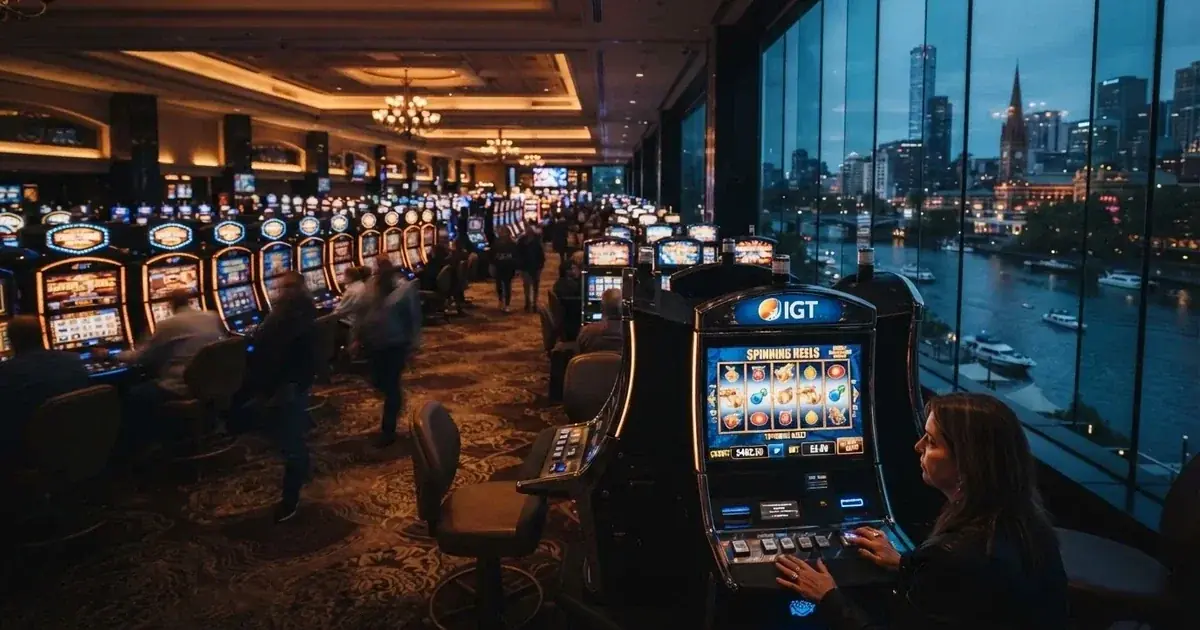
A punter looking for “the best pokies in Melbourne” is looking for a machine in a room — not a website. That’s where this page starts and stays. Crown Melbourne runs the country’s biggest gaming floor on the south bank of the Yarra, with 2,500 poker machines inside a complex the size of two city blocks. Around it, the suburbs of Melbourne hold roughly 26,380 more gaming machines, distributed across 488 pubs and clubs, all of them capped under Victoria’s statewide 30,000-machine limit. Every one of those machines is licensed by a Victorian regulator. None of the websites that advertise “pokies” to Australians are.
28 October 2026 — checked against the ACMA register of formal warnings and blocking requests, and against the Victorian Gambling and Casino Control Commission’s public venue data.
Table of Contents
- What a Melbourne punter is actually choosing between
- How money moves on a Melbourne pokie
- The games and the floor
- The eleven brands the ACMA has acted against
- Comparing Melbourne to the rest of Australia
- What the law actually says
- Responsible gambling in Melbourne
- Where the machines actually sit
- What a Melbourne punter actually pays
- Where to from here
- Frequently asked questions
What a Melbourne punter is actually choosing between
A Melbourne player has three legal options for a spin on a poker machine: the integrated casino at Crown, the network of suburban pubs and clubs licensed under the Victorian Commission, and licensed social or membership-only venues. None of these are online products. The Interactive Gambling Act 2001 makes it an offence to provide online casino games or online pokies to a person physically in Australia, and no state or territory issues a licence that would authorise one. A site running a “pokies” section out of Curaçao or Cyprus is offering a service the IGA prohibits, and the ACMA has spent the last decade making that prohibiton bite.

That distinction is the spine of this page. The shelves below close in this order: how money actually moves on and off a machine in Melbourne, what the floor looks like and who runs the games, the eleven brands the ACMA has acted against and what each one actually does, an overview of where Melbourne sits in the national picture, what the law says and what it costs when it’s ignored, the support a player has if something goes wrong, and the venues themselves. The angle is cost — what playing a pokie in Melbourne really runs, and what an offshore “pokies” page costs a punter who treats it as a substitute.
How money moves on a Melbourne pokie
A poker machine is a cash instrument. The credits you load onto it come from a note feeder or a debit card at the cashier’s window, not from a payment processor in another country. That sounds obvious, but it matters because the offshore “pokies” sites pitch their deposit rails — cards, e-wallets, increasingly crypto — as if they were the same product. They’re not.
Payout percentage
A gaming machine’s return-to-player is the share of money put in that the machine, on average across its entire operating life, returns as wins. Victoria does not publish a single statewide figure for community-venue pokies in the way South Australia publishes its 87.5% minimum, but the regulator requires every machine to display its RTP on the cabinet or in its help screen. Crown Melbourne’s gaming floor is licensed under the casino regime rather than the community-venue regime, which is a different machine population with different maths. If a player wants the number for a specific cabinet, the help screen is the answer; what can be said in general is that community-venue pokies in Victoria, like those elsewhere in the country, sit in the high-eighties to low-nineties as a population, with individual titles varying around that band.
Maximum cash payout
This is the figure players most often get wrong. The maximum cash payout is the largest amount the machine will pay out in a single transaction before the win has to be hand-paid by a venue staff member. On a community-venue pokie in Victoria, that ceiling is a few thousand dollars per spin — a hand-pay kicks in above it, and the rest of the win is processed by the venue, often via cheque or EFT, with the paperwork that comes with it. Crown Melbourne, as a casino, runs different limits because it operates under a different licence class. What a player cannot do, at any licensed Melbourne venue, is feed a note and walk out with an unlimited payout — the machine ceiling kicks in well before that, by design.
Settlement times
There is no settlement time on a poker machine in the way there is on an online casino withdrawal. The machine either pays out — credits roll down into the tray, a hand-pay happens at the counter, or a ticket is printed and redeemed at the cashier. The closest thing to a “withdrawal delay” in a community venue is the queue at the cashier on a Saturday night. Crown’s cage operates continuously during gaming hours and processes hand-pays on the floor. For online wagering on races or sport — which is licensed in Australia under a different regime — PayID and Osko settle in near real time during banking hours, BPAY runs overnight, and a debit card moves money in minutes. None of this applies to the offshore “pokies” sites that promise payouts in “24 hours”, because they’re processing withdrawals to bank accounts in jurisdictions where the consumer has no recourse when the payout doesn’t arrive.
What the deposit side looks like in practice
A punter at a Melbourne pub buys credits at the bar or the dedicated gaming-area cashier with cash or, at the larger venues, EFTPOS. Crown accepts cash, debit cards and the usual card products at the cage. There is no “first deposit bonus” on a community-venue machine because the machine has no mechanism to issue one. What a player gets instead is the bar meal, the live sport, the band, or the loyalty card that tracks play across the pub group’s venues — those are the inducements the law permits. The bonus structures offshore sites advertise to Australians are precisely what the IGA prohibits as an inducement to use a prohibited service, and the credit-card and crypto deposit bans that took effect on 11 June 2024 sit on top of that.
The games and the floor
A poker machine in Melbourne is one of two kinds: an electronic gaming machine at a pub or club, or a casino-class machine at Crown. They look similar — five reels, a paytable, a “feature” — but the licence class they’re running under changes what’s possible.
Crown Melbourne pokies
Crown’s gaming floor runs to about 220,000 square feet with 2,500 poker machines and 540 table games. The poker-machine population there is not the same product line as the suburban pub’s, and Crown’s licence permits bet sizes and denominations the community-venue cap of A$5 maximum per spin does not. The resort itself — opened on its current south-bank site in May 1997 — sits inside a 510,000 m² complex with 1,604 hotel rooms across three towers. It is, in floor area, the largest casino complex in the Southern Hemisphere.
The two-year special management period that followed the Finkelstein Royal Commission is the live regulatory fact about Crown today. The Royal Commission concluded in October 2021, finding money laundering and ties to organised crime on the gaming floor; Crown kept its licence only under a court-appointed Special Manager. The Victorian regulator then fined Crown A$80 million in June 2022 for processing A$164 million in illicit payments, and a further A$120 million in November 2022 for a decade of responsible-gambling breaches including letting patrons gamble more than 24 hours continuously without a mandatory break. The Casino and Gambling Legislation Amendment Act 2021 created the Victorian Gambling and Casino Control Commission as Crown’s new regulator and banned junket operations outright. A punter walking onto the Crown floor today is on a venue under continuous regulatory scrutiny, not the free-wheeling operation it was through the 2010s.
Pokies around Melbourne’s geography
The pubs and clubs around Melbourne’s landmarks — Melbourne Airport, Melbourne Central, the inner-city suburbs of North, South, Port and East Melbourne, and the western suburbs — are the everyday reality for most players. The state caps the total machine population at 30,000 across all community venues; as of 2021-22, 26,380 machines were operating in 488 venues, leaving room for the cap but no slack. The cap matters because it shapes how new venues enter the market: a new pub licence with gaming entitlements is a scarce commodity, and the trading of those entitlements is itself a market. By suburb, the inner-city and bayside corridors have higher concentrations than the outer growth corridors; that’s a planning fact, not a regulatory one. Players tend to find the densest clusters around shopping strips, transport hubs and licensed clubs, and the thinnest in dry-area residential zones.
Game providers and what a punter sees
The manufacturers whose cabinets fill Melbourne floors are the same names that fill the rest of the country — Aristocrat, IGT, Konami, Novomatic, AGS. A community-venue machine is most likely to be an Aristocrat or AGS cabinet running a multi-game setup with a handful of titles selectable from a menu, with denominations of 1c, 2c, 5c and (at higher-licence-class venues) higher. Crown’s floor carries the broader casino-class catalogue, with higher-denomination machines, linkable progressives and the table-game products the community-licence doesn’t permit. The game mechanics that fill the help screens — hold-and-spin features, free-game retriggers, multi-way paytables — are universal across the Australian market, which is why a “best paying pokies” question can’t be answered by brand alone; it depends on the specific cabinet, the specific title and the specific RTP that machine publishes.
Live tables and electronic table games
Crown runs roughly 540 table games, of which around 100 are poker. The community-licence regime doesn’t permit traditional table games, so what a player outside Crown sees as “electronic table games” — automated roulette terminals, video poker — are still subject to the same gaming-machine cap and the same A$5 maximum bet. The distinction matters for cost: a table game has a different house edge than a pokie, and Crown’s table products let a player make a different kind of bet than a community-venue machine will.
The eleven brands the ACMA has acted against
What follows is not a ranking. Each brand is named because the ACMA itself issued a formal warning over it for offering prohibited online casino services to people in Australia. No bonus terms are given — the only sources for them are affiliate marketing pages, and bonus inducements are themselves prohibited under the same regime. The order is the order of §6 of the research. The subject support column reflects what the public listings actually say about that brand; where there’s nothing on the public record, that’s marked.
RocketPlay
The ACMA issued a formal warning to Pulsup Ltd over Rocketplay.com.au in March 2026. The same brand was earlier the subject of a May 2022 warning to Dama N.V. covering six brands. The site markets online casino games, including pokies, to Australian players. Online casino games cannot be licensed anywhere in Australia, whatever foreign licence the site displays. Public listings carry no Australian venue information on RocketPlay, which is the expected result for a brand whose product is prohibited here.
Level Up Casino
The ACMA issued a formal warning to Dama N.V. over Level Up Casino in May 2022 as part of the same six-brand warning. Dama N.V. has since been the subject of further warnings — Woo Casino in March 2025 and Spirit Casino in May 2025 — over the same operator group. The site runs an online casino product. Public listings that cross-reference the brand place it among the network of Dama N.V. operations that have been repeatedly the subject of ACMA action; that’s what the public record supports and no more.
Woo Casino
The ACMA issued a formal warning to Dama N.V. over Woo Casino in March 2025. Woo Casino offers online casino games — including pokies — to Australian players through an offshore-licensed operation. The public record on Woo Casino consists of its listing in the ACMA’s register of formal warnings and its appearance in operator-network listings; the venue-side facts that would matter for a land-based Melbourne comparison don’t apply because there is no land-based venue.
Spirit Casino
The ACMA issued a formal warning to Dama N.V. over Spirit Casino in May 2025. Spirit Casino is another Dama N.V. brand offering an offshore online casino product to Australians. Public listings carry no further information on Spirit Casino beyond the ACMA action itself, which is enough: a brand whose product is prohibited and whose operator has been warned twice in thirteen months is not a comparison point for a Melbourne punter who can drive to Crown.
National Casino
The ACMA issued a formal warning to Consolutetish S.R.L. over National Casino in July 2025. National Casino is an offshore online casino offering pokies and table games to Australian players. Public listings on National Casino include references to Australian regulatory news coverage and infrastructure-policy commentary; what’s not in those listings is any indication that the brand holds an Australian licence, because none is available.
Bizzo Casino
The ACMA issued a formal warning to Consolutetish S.R.L. over Bizzo Casino in July 2025. Bizzo Casino had earlier been the subject of a 2022 formal warning to TechSolutions Group over the same product. Two warnings from two operators over the same brand is unusual and worth noting. There is no credible record of this brand operating as a venue in any Australian jurisdiction, which is exactly what we expect from a prohibited service.
Ignition Casino
The ACMA issued a formal warning to Bamboo Media over Ignition Casino in July 2025. Ignition Casino is an offshore online casino product; it has been the subject of affiliate-marketing campaigns targeting Australian players. The only official trace of Ignition Casino in Australia is the ACMA’s formal warning, confirming its status as a prohibited offshore product with no local standing.
Instant Casino
The ACMA issued a formal warning to EOD Code SRL over Instant Casino in February 2025. Instant Casino is an offshore online casino offering pokies and table games. Official records offer no additional details on Instant Casino in an Australian context, underlining its nature as an offshore site without domestic oversight.
Jackbit
The ACMA issued a formal warning to Ryker B.V. over Jackbit and CasinOK in April 2026. Jackbit is an offshore online casino and sportsbook offering pokies to Australian players. Unlike a licensed venue where the regulator oversees the floor, Jackbit remains entirely opaque, leaving the player with no local recourse if a withdrawal is refused.
Casino Intense
The ACMA issued a formal warning to Sterplay Holding Ltd over Casino Intense in April 2025. Casino Intense is an offshore online casino offering pokies. Public listings that cross-reference Casino Intense include Australian regulatory news coverage and the South Australian Consumer and Business Services register, neither of which suggests an Australian licence; what they do suggest is that the brand has been visible enough to Australian regulators to warrant action.
Sky Crown
The ACMA issued a formal warning to Hollycorn N.V. over its Sky Crown and Blue Leo casino services, published in September 2022. Sky Crown is an offshore online casino brand operating under a Curaçao licence. Public listings on Sky Crown include Wikipedia references and operator-network catalogues; what they don’t include is any Australian licence, because none is available.
Comparing Melbourne to the rest of Australia
A punter in Melbourne is sitting inside the country’s second-largest gaming-machine population, behind New South Wales and ahead of Queensland. That ordering is fixed by the size of the population and the per-capita machine density each state allows. What varies is the surrounding regulatory architecture.
The Crown comparison
Crown Melbourne is the largest casino complex in the Southern Hemisphere by floor area. Adelaide Casino — operating commercially as SkyCity Adelaide — is the sole licensed casino in South Australia, with 90 gaming tables and 950 gaming machines, sitting inside the heritage-listed Adelaide railway station building on North Terrace. Treasury Casino in Brisbane, operated by Star Entertainment Group, closed on 25 August 2024 to make way for the new Star casino at Queen’s Wharf, which began a staged opening on 29 August 2024. The Star Brisbane opening was accompanied by licensing concerns around Star Entertainment, which is the parallel story to Crown’s special-management period — a major operator under regulatory scrutiny at the moment its newest venue opened.
The community-venue comparison
Victoria’s 26,380 community-venue machines in 488 venues sit against Queensland’s 21,122 machines in 351 venues (October 2023) and South Australia’s 11,672 machines outside Adelaide Casino in 471 venues (September 2023). The per-capita density differs. South Australia sets a minimum gaming-machine RTP of 87.5% and a maximum bet of A$5.00 outside the casino; Adelaide Casino itself has no maximum-bet limit. South Australian gaming-machine losses outside Adelaide Casino totalled about A$0.92 billion in 2022-23, equivalent to roughly A$497 per adult. Victorians lost a record A$3.318 billion on EGMs in 2025-26, according to the Victorian Local Governance Association.
What the comparison tells a punter
The headline number to carry is the per-state loss figure. A$3.318 billion in Victoria, A$0.92 billion in South Australia, against populations of roughly 6.7 million and 1.8 million respectively. Per-capita, the two states are within the same order of magnitude, with Victoria higher because of Crown’s contribution to the totals and a higher community-venue density. The per-machine loss varies much less than the aggregate, which is what the RTP math would predict: most of the per-state difference is population and machine count, not machine behaviour.
What the law actually says
The IGA and its 2017 amendments make it an offence to provide online casino games, online pokies and in-play betting to a person physically in Australia. No state or territory issues a licence that would cover those products. What is licensed is wagering on races and sport placed before the event, lotteries, and keno — in practice licensed through the Northern Territory Racing and Wagering Commission, which oversees 52 online bookmakers including Sportsbet, Bet365 and Ladbrokes from a part-time commission that meets once a month in Darwin.
Enforcement
The ACMA investigates, issues formal warnings and directs Australian internet service providers to block illegal sites. The individual player is not prosecuted — the IGA targets the provider — but an offshore site gives no Australian consumer protection, no complaints body and no recourse if a withdrawal is refused. The site can be blocked while a balance is still on it. By June 2026, the ACMA had asked ISPs to block 1,751 illegal gambling and affiliate marketing websites since the first blocking request in November 2019, and more than 230 unlicensed gambling services had left the Australian market since enforcement was strengthened in 2017. The blocking rate over that period — 1,751 sites blocked across roughly 79 months — sits at an average of about 22 sites blocked per month, with substantial variation between quiet rounds and the larger ones. The most recent round reported on 26 June 2026 covered 12 sites in a single direction.
Payments
Credit cards, credit-related products and digital currency are banned as payment for licensed online wagering since 11 June 2024, with penalties of up to A$247,500 for operators who breach the rule. Legal deposit routes for licensed wagering are debit card, bank transfer, PayID, Osko and BPAY. A site asking an Australian for a credit card or a crypto deposit is operating outside the Australian rules. The ban applies to licensed wagering services; offshore sites aren’t subject to it because they aren’t licensed in the first place, which is why the deposit rails on those sites look different.
The 2026 reform
The Interactive Gambling Amendment (Gambling Reform) Bill 2026 passed Parliament on 19 August 2026, with its advertising and inducement measures commencing on 1 January 2027. The law is enacted but not in force on a 2026 page; the operative date for the inducement rules is 1 January 2027.
Tax
Gambling winnings of a recreational player are not assessable income under section 6-5 of the ITAA 1997, and losses are not deductible, unless the person carries on a business of gambling. This is a model answer; a punter with a specific tax question is asking the ATO, not a comparison page.
Responsible gambling in Melbourne
A punter who needs to step back from the machines has a different set of tools in Melbourne than they would for an offshore site.
BetStop
BetStop, the National Self-Exclusion Register, has been live since August 2023. It binds Australian-licensed online and phone wagering services. An offshore casino is not connected to it, which is the structural reason a self-exclusion through BetStop does not stop a player from opening an account at an offshore site the ACMA later blocks.
Gambling Help Online
The National Gambling Helpline is 1800 858 858, free and 24/7, with chat support through Gambling Help Online. The service is funded federally and available to anyone in Australia, including visitors. For Victorian-specific support, the VGCCC publishes venue-level self-exclusion arrangements that apply to Crown and to the community-venue pubs and clubs; the mechanism differs from venue to venue.
The structural point
The support system is built around Australian-licensed operators. An offshore site has no obligation to honour an Australian self-exclusion, no obligation to provide a complaints process, and no Australian regulator behind it if a withdrawal stalls. A player who has self-excluded from every licensed venue in Melbourne and then opens an account at an offshore site has, in practical terms, walked outside the regime that was set up to protect them.
Where the machines actually sit
A Melbourne punter with a specific destination in mind is choosing among Crown, the bayside and inner-suburban clubs, and the suburban pub network.
Crown Melbourne
The integrated resort on the south bank of the Yarra. 2,500 poker machines, 540 table games, 100 poker tables, 1,604 hotel rooms across three towers, opened in its current south-bank form on 8 May 1997. The venue’s gaming licence is held under the Victorian regime administered by the Victorian Gambling and Casino Control Commission. The current operating reality is shaped by the Finkelstein Royal Commission, the A$200 million in cumulative VGCCC fines and the court-appointed Special Manager period. A punter at Crown is on a venue under heavier regulatory oversight than at any time in the venue’s history.
The community-venue network
488 pubs and clubs across metropolitan Melbourne, holding 26,380 gaming machines between them, all of them under the 30,000-machine statewide cap. The geographic distribution of machines is not uniform — the inner-city, bayside and middle-suburban corridors have higher densities, the outer growth corridors have lower ones. The community-venue machines run at the A$5 maximum bet that the Victorian regime sets. Crown, as a casino-class venue, is not bound by that ceiling.
What’s not on this page
What isn’t on this page is just as important. A search for “best pokies in Melbourne” leads to a simple reality: licensed venues are the only real choice, and offshore sites are merely a costly alternative. The eleven ACMA-warned brands are not options — they’re the alternative that the law has already rejected. A page that treats them as substitutes misreads what the question is asking. The punter who searches this key wants the venue, not the offshore product; if they wanted the offshore product they’d have searched for it directly.
What a Melbourne punter actually pays
The angle of this page is cost — what playing a pokie in Melbourne actually runs. The RTP math gives the per-machine average, the A$5 cap gives the per-spin ceiling, the per-capita loss figures give the population scale, and the regulatory fines give the cost of doing this badly. The aggregate picture is A$3.318 billion lost on Victorian EGMs in 2025-26, a record. That’s the number an Australian punter is choosing to participate in every time they put a note in a machine.
The cost of going offshore instead
The other cost is the one an offshore site imposes when it offers the same product out of Curaçao. The deposit is the easy part; the withdrawal is where the cost lands. An offshore site that has been blocked by the ACMA — and 1,751 sites have been — can be cut off mid-session, with a balance on it and no Australian complaints body behind the player. The bonus terms that affiliate pages advertise to drive traffic are inducements the IGA prohibits, and the credit-card and crypto rails those sites use are the ones Australia banned at the licensed end on 11 June 2024.
The structural cost
The deeper cost is the regulatory architecture that doesn’t reach the offshore site. BetStop doesn’t extend to it. Gambling Help Online will help a player who’s lost on it, but it can’t recover the money. The Victorian Commission’s self-exclusion scheme doesn’t reach it. The cost of choosing the offshore site isn’t the bonus — it’s the absence of every protection the licensed venue provides for free.
Where to from here
A punter who has read this far has the answer to the question they asked. The licensed pokies in Melbourne sit at Crown, in 488 community-venue pubs and clubs across the metropolitan area, and nowhere else that is lawful. The eleven brands the ACMA has acted against are the alternatives the regulator has already rejected, and the page that lists them as substitutes is not being honest about what’s on offer. The cost of playing a pokie in Melbourne is what the machine math says, the A$5 cap sets, and the per-capita loss figure measures. The cost of choosing an offshore site instead is the absence of every protection a Victorian punter is otherwise entitled to.
The shelves below — payments, games, brands, overview, legality, responsible gambling, and venues — are the supporting material. The angle has been cost. The conclusion is the same one the data supports: the venue is the answer, and the offshore site is the cost of walking away from it.
Frequently asked questions
Which venues in Melbourne are licensed to operate pokies?
Crown Melbourne holds the state’s casino licence and operates 2,500 poker machines on its south-bank gaming floor. Outside Crown, 488 pubs and clubs across metropolitan Melbourne hold community-venue licences covering 26,380 gaming machines, all of them within the state’s 30,000-machine cap. Every machine in those venues is licensed by the Victorian Gambling and Casino Control Commission. No other venue type — and no online product — is licensed to operate pokies to a person in Melbourne.
Are pokies in Melbourne available around the clock?
Crown’s gaming floor operates continuously during the venue’s opening hours, which run twenty-four hours a day for the main gaming areas. Community-venue pubs and clubs set their own opening hours under their liquor licences, and gaming areas typically close with the venue — most suburban pubs close by midnight or 1 a.m., with a smaller number holding late trading licences. The hours a player sees are a venue-by-venue fact, not a statewide rule; the pub’s gaming area closes when the pub closes.
What identification do venues in Melbourne require before letting someone play pokies?
Entry to Crown Melbourne’s gaming floor requires photographic identification at the door, with the venue operating under the VGCCC’s casino entry requirements. Community-venue pubs and clubs require proof of age for entry to the gaming area, with the minimum age of 18 enforced at the point of entry. An offshore site that asks for identity documents is doing so under the rules of whatever jurisdiction it claims, not under Victorian law — those documents have no protection behind them if the site is blocked.
Can visitors to Melbourne use self-exclusion schemes at local pokies venues?
Victoria’s self-exclusion arrangements apply at the venue level — a person can self-exclude from Crown through the VGCCC’s process, and from individual community venues through the venue’s own arrangements. BetStop, the National Self-Exclusion Register, applies to Australian-licensed online and phone wagering services, not to land-based venues and not to offshore sites. A visitor who has self-excluded in another state can extend the arrangement to Victorian venues through the relevant state-body process, but the offshore site they used before travelling is unaffected.
How does the payout percentage on Melbourne pokies compare with other Australian cities?
South Australia publishes a minimum gaming-machine RTP of 87.5%, which sets a floor for community-venue pokies in that state. Victoria does not publish a comparable statewide minimum but requires every machine to display its RTP on the cabinet. Crown’s gaming floor, as a casino-class venue, operates a different machine population with different mathematics and is not bound by the community-venue RTP framework. Across the country, community-venue pokies cluster in the high-eighties to low-nineties as a population, with individual titles varying around that band — the differences between cities are smaller than the per-state loss figures suggest, because most of the per-state difference is machine count and population, not machine behaviour.
Is it legal for an online casino to advertise “pokies” in Melbourne the same way a pub or club does?
No. The Interactive Gambling Act 2001 makes it an offence to provide online casino games or online pokies to a person in Australia, and no state or territory issues a licence that would authorise the activity. The ACMA has issued formal warnings to eleven offshore operators for offering prohibited services to Australians, has directed ISPs to block 1,751 illegal sites since November 2019, and has reported that more than 230 unlicensed services have left the Australian market since 2017. A website advertising “pokies” to Melbourne players is offering a prohibited service; the pub down the road is offering a licensed one. The difference between the two is the entire regulatory architecture — BetStop, the helpline, the complaints body, the consumer protection — that the offshore site sits outside.