
Casino sites that accept Trustly from Australian players in 2026
Trustly is a Swedish bank-to-bank rail with licences in Sweden and the UK, not in Australia. The offshore casinos that list it on their payments page are the same operators the Australian Communications and Media Authority has spent years issuing formal warnings to, blocking in batches, and chasing through court. None of them may lawfully serve a person in Australia. The Interactive Gambling Act 2001 makes the provision of online casino games, online pokies and in-play betting to an Australian resident an offence, and no state or territory licenses that product. Trustly does not change the law. It only changes how the money gets there.
Current as of 28 October 2026 · verified against the ACMA’s published formal-warning register and Australian Payments Plus guidance.
Table of Contents
- The Trustly landscape in Australia, and why the question is partly the wrong one
- What the law actually says, and what it costs the reader
- Responsible play, and what each Australian tool can and cannot do
- How a Trustly deposit or withdrawal actually works at an offshore casino
- The eleven operators the ACMA has acted against
- What the brands offer, and what that offer actually costs
- What changes for an Australian player who wants instant bank-to-bank transfers
- Frequently asked questions
The Trustly landscape in Australia, and why the question is partly the wrong one
A reader searching for casino sites that accept Trustly in Australia is, almost without knowing it, asking for a category that the regulator has been dismantling piece by piece. The pool is large, the warnings against it are public, and the operators named in those warnings keep shifting corporate shells and reopening under new names. What is consistent is the absence of an Australian licence, which is the only line that matters when the question is whether a site may take money from a player sitting in Australia.

Trustly itself is a real company with real scale. It reported 2023 revenue of about A$265 million on $58 billion of transaction volume, processes through 12,000 banks, and serves roughly 650 million consumers across more than 9,000 companies. It was founded in Stockholm in 2008, was renamed from Glue Finance, was majority-acquired by Nordic Capital in 2018 for around A$800 million, and was being prepared for a Nasdaq Stockholm listing that valued it near A$11 billion in 2021. That is the operator behind the deposit button. The button sits on sites the ACMA has been warning and blocking for half a decade.
The Australian side of the same function is PayID and Osko. PayID-based instant transfers work at over 100 Australian financial institutions, Osko settles in under a minute around the clock, and paying to a PayID displays the recipient’s name before the money is sent. Australian Payments Plus warns that being asked to transfer to a PayID on an illegal gambling site almost certainly means a scam. That is the rail the page is really about, because it is the one an Australian bank account can actually use, and because the comparison to Trustly is the comparison this reader is being sold without being told.
A site that lists Trustly on its payments page is not telling a player in Australia that Trustly will work. It is telling them which jurisdictions the operator optimises for. Trustly’s own gaming page addresses the US market. Its real volume is European: more than 20 European countries including the UK, Norway, Spain, Austria, Finland, the Netherlands, Ireland, Croatia, Germany and Malta. The Australian bank-to-bank equivalent is PayID, and it does not need a Trustly deposit button.
What the law actually says, and what it costs the reader
The Interactive Gambling Act 2001 is the spine of the whole market, and it does not bend around a payment method. As amended by the Interactive Gambling Amendment Act 2017, the IGA makes it an offence to provide online casino games, online pokies or in-play betting to a person in Australia. What is licensable in Australia is wagering on races and sporting events placed before the event, lotteries, and keno. The Northern Territory Racing and Wagering Commission licenses 52 of the country’s online bookmakers — Sportsbet, Bet365 and Ladbrokes among them — for tax reasons. The commission itself runs with no full-time staff and meets once a month in Darwin. Online casino is not licensed anywhere in the country.
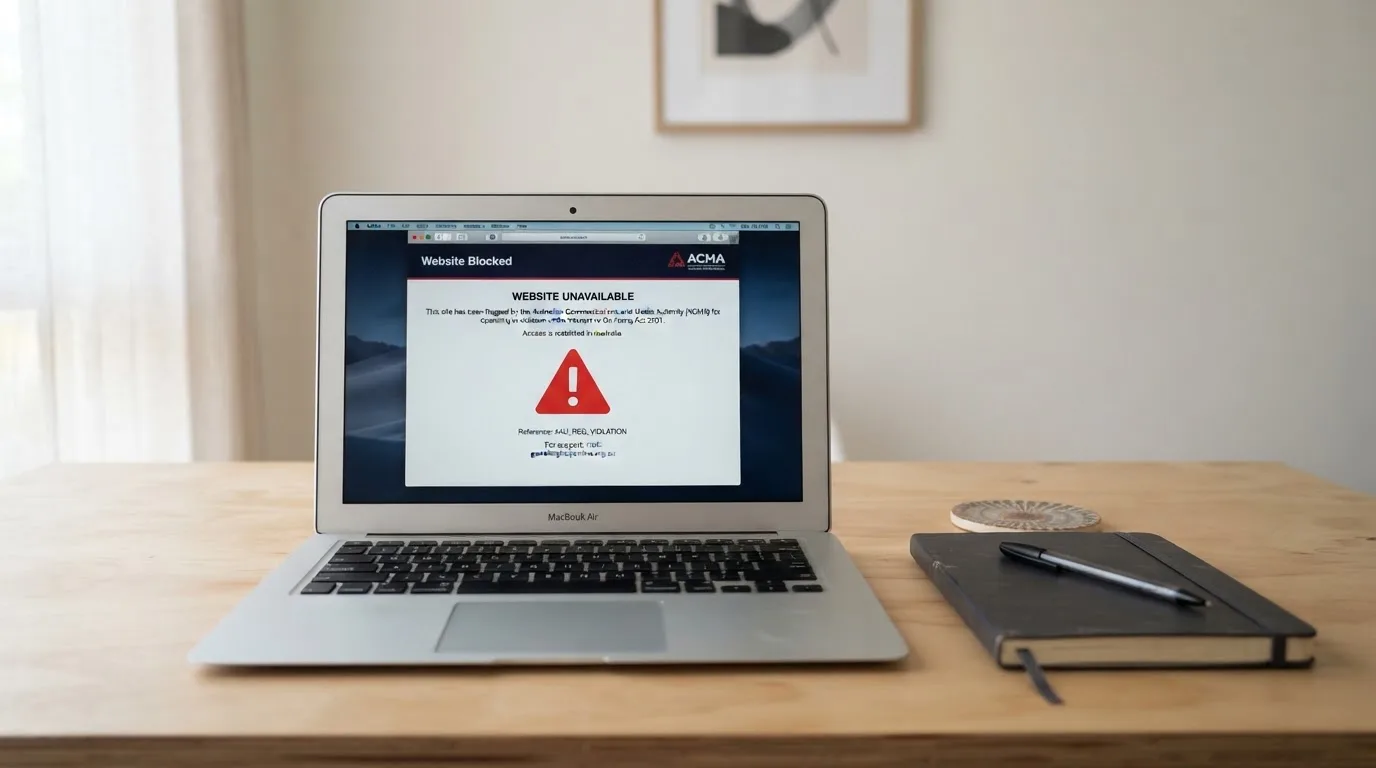
The IGA targets the provider, not the individual player. An Australian who opens an account at an offshore casino is not personally prosecuted. The cost sits elsewhere and is harder to see. An offshore site gives no Australian consumer protection, no complaints body with the authority to compel a payout, and no recourse when a withdrawal is refused or stalled. The ACMA can block the site itself with a balance still on it, and the player has no Australian court to complain to when that happens. The offshore licence the site displays — Curacao, Malta, the Isle of Man — was issued by a regulator that has no jurisdiction over a complaint from a person in Australia and no standing to enforce a refund.
Since 2017, more than 230 unlicensed gambling services have left the Australian market following ACMA enforcement. The blocking list is the public trail of that enforcement, and it has been growing steadily since the first blocking request in November 2019. By the round reported on 26 June 2026 the ACMA had directed Australian ISPs to block 1,751 illegal gambling and affiliate marketing websites in total. The round in June 2026 alone added twelve more: 7Signs, ChromaBet, Donbet, Duospin, Freshbet, Slots Gem, Jacks Club, Lucky Start, Pointsbetz, Spinrise, Vinyl Casino and Wildsino. H2 Gambling Capital’s 2025 report estimates that Australians lose about A$3.9 billion a year to illegal gambling sites, and that the share of gambling going through legal channels fell from 74% in 2021 to 64%. The trend goes the wrong way.
A separate reform is in motion. The Interactive Gambling Amendment (Gambling Reform) Bill 2026 passed Parliament on 19 August 2026. Its advertising and inducement measures commence 1 January 2027, so it is law with a start date rather than law in force on a page being read this year. The IGA’s core prohibition of online casino games to Australian residents is unchanged. The minimum age remains 18. Recreational gambling winnings are not assessable income under section 6-5 of the Income Tax Assessment Act 1997 and losses are not deductible; the only exception is a person carrying on a business of gambling, which is a question for the ATO, not for the page.
Responsible play, and what each Australian tool can and cannot do
| Payment Method | Rail / Network | Usage |
|---|---|---|
| Trustly | European Bank-to-Bank | Offshore Casino Deposits |
| PayID | NPP / Osko | Australian Licensed Betting |
| BPAY | NPP / BPAY | Australian Licensed Betting |
| Debit Card | Card Scheme | General Transactions |
BetStop, the National Self-Exclusion Register, has been live since August 2023. It binds Australian-licensed online and phone wagering services, which means licensed bookmakers, lotteries and keno. An offshore casino is not connected to it. Registering with BetStop does not exclude a player from any of the operators named in the ACMA warnings below, and it does not stop a Trustly deposit reaching one of them. The exclusion is real for the product it covers; it is silent for the product the page is about.
The National Gambling Helpline is 1800 858 858. It is free, runs 24/7, and has a chat function at Gambling Help Online. It will help with a gambling problem regardless of whether the gambling happened on a licensed Australian bookmaker or an offshore casino. The helpline is the one part of the Australian system that does not stop at the offshore fence, because the helpline is not built from a payments licence. Anyone reading the page because they have already deposited at one of the operators below can call it now, and the call is the part of the page that does not require an Australian licence to do its job.
The Australian banks also offer voluntary gambling blocks. Westpac’s block works at the card level and refuses authorisation on transactions registered under the merchant category code “Betting/Casino Gambling” on eligible personal credit and debit cards. ANZ’s block, activated in the ANZ app, also blocks gambling transactions made through a digital wallet such as Apple Pay on an eligible card, not just the physical card. Once the ANZ block is on, removing it again requires a 48-hour waiting period, and the bank warns that not all gambling transactions will be blocked and some non-gambling transactions might be blocked in error. These blocks are voluntary and they cover most Australian-licensed wagering. They do not cover every code path to every offshore operator, and they do not cover PayID or Osko transfers to a PayID, where the gambling block does not see the merchant category code at all. They are a useful line of defence. They are not a complete one.
The licensed Australian product, for completeness, is the one the page is not about. A reader who wants the legal route in Australia is reading the wrong page. The legal product is pre-event wagering on racing and sport, lotteries, keno, and the pokies at a land-based casino or a registered club or pub. None of those take a Trustly deposit, because none of them need one.
How a Trustly deposit or withdrawal actually works at an offshore casino
The mechanism is simple enough to explain in plain steps, because the deposit does not know it is illegal. The player opens an account, picks Trustly from the cashier, enters the amount, and is redirected to a Trustly screen that asks the player to log in to their bank through Trustly’s interface. Trustly authenticates the bank and initiates a transfer from the player’s account to the merchant’s account. The casino’s balance updates as soon as the transfer settles, which Trustly advertises as near-instant. The reverse path — a withdrawal — runs through the same rail. The player picks Trustly as the withdrawal method, the casino approves the withdrawal internally, Trustly pushes the money to the player’s bank, and the bank’s own processing time determines when it arrives.
The mechanism is the same on the Australian equivalent. PayID and Osko run through the New Payments Platform, which went live to the public on 13 February 2018 and is owned by New Payments Platform Australia Ltd, a non-profit whose 13 shareholders include the Reserve Bank of Australia and the major banks. By April 2025 more than 25 million PayID identifiers had been registered. Osko settles in under a minute around the clock, including weekends. Paying to a PayID shows the account holder’s name before the money is sent. The NPP’s own service level is that monthly outages must stay under two minutes, which is why a 1am PayID transfer on a Sunday works.
The difference between the two rails is jurisdiction. Trustly’s licences are with Sweden’s Financial Supervisory Authority for the EU/EEA and with the UK Financial Conduct Authority. It has no Australian authorisation. The Australian rail is the New Payments Platform plus PayID plus Osko plus BPAY. A player in Australia depositing with Trustly at an offshore casino is using a European payment rail to send money to a non-Australian merchant from an Australian bank account. The bank may or may not see the merchant category code, depending on how the transaction is presented; if it does, the Westpac or ANZ gambling block may reject it. If it does not, the money leaves.
A withdrawal is slower than the deposit, even where the operator advertises near-instant deposits. The deposit is a single transfer; the withdrawal requires the casino to run its own internal checks first, often including source-of-funds verification and identity checks that have nothing to do with Trustly. Trustly itself pushes the money in seconds once approved, but the approval step is the casino’s, and offshore casinos are not subject to Australian payout-time standards. The Australian bank receives the money through its own normal processing window, which may be next-business-day for an international transfer.
Minimum deposits and the cost of the rail
The smallest deposit a Trustly casino typically asks for is on the order of A$10 to A$30, which is why the operator pages push the “A$10 deposit Trustly casino” angle hard. The minimum is set by the operator, not by Trustly. Trustly itself does not impose a minimum on the consumer end, beyond what the merchant configures. Some operators set their minimum higher — A$20 or A$30 — to push the player toward a bonus structure that requires a larger first deposit. The deposit itself does not carry a fee on Trustly’s published terms for the consumer, but the operator may add one, and an offshore operator is under no Australian rule that caps merchant surcharging on gambling transactions.
Apple Pay, Google Pay and Samsung Pay together accounted for about 45% of all card payments in Australia by number at the end of 2025. Apple Pay and Google Pay do not charge a fee to the consumer; any surcharge comes from the merchant’s own card-processing fees, not from the wallet. The Reserve Bank of Australia’s July 2025 review proposes removing surcharges on eftpos, Mastercard and Visa card transactions, but explicitly leaves American Express outside the scope. None of this is directly about Trustly, and none of it changes the offshore question. What it does show is how the Australian payments landscape has moved in the last five years — toward instant bank-to-bank transfers on the NPP, and away from the card rails the IGA was written to constrain.
Card, crypto and credit at an offshore site
The IGA’s payment rules apply to Australian-licensed wagering services. They do not apply offshore, and they do not apply to an offshore casino taking money from an Australian player. The rule that matters to the licensed side is the ban on credit cards and credit-related products as payment for online wagering, which took effect on 11 June 2024 and carries operator penalties up to A$247,500. An offshore site asking for a credit card or a crypto deposit is asking for something the licensed side is forbidden to take. That is one of the smaller signals that the site is operating outside the Australian rules, but it is a signal.
What to do when a Trustly deposit does not appear
The most common cause is that the casino’s cashier is showing Trustly but the player’s bank has rejected the transaction as a gambling transaction — either through a voluntary gambling block like Westpac’s or ANZ’s, or through the bank’s own internal policy on the merchant category code. The second most common cause is that the transfer settled at the merchant but the casino’s balance has not updated yet, which can take minutes to hours on the casino side and is outside Trustly’s control. The third is that the player’s identity verification on the casino side failed and the deposit is held in a pending state until the player submits documents. None of these is a Trustly fault in the strict sense; all of them are reasons the deposit may not appear.
The right move is to check the bank statement first, then contact the casino’s support with the transfer reference. A Trustly transfer has a unique reference that the bank will show; the casino’s support can match that reference against its own ledger. If the casino’s support is unresponsive, the player has no Australian complaints body to escalate to, because the casino is not licensed in Australia. That is the position the rest of the page returns to, again and again.
The eleven operators the ACMA has acted against
The brands below are not a ranking. Each is named because the ACMA itself issued a formal warning to the corporate operator behind it for offering prohibited interactive gambling services to Australians. They are the pool the page is comparing, and the comparison is honest precisely because the regulator has already done the comparison for the reader. The order is the order research hands in; the verdict on each is the page’s own.
| Brand | ACMA action and date | Operator named by the ACMA | Trustly support |
|---|---|---|---|
| RocketPlay | Formal warning, March 2026 | Pulsup Ltd | — |
| Level Up Casino | Formal warning, May 2022 | Dama N.V. | listings (Westpac) |
| Woo Casino | Formal warning, March 2025 | Dama N.V. | — |
| Spirit Casino | Formal warning, May 2025 | Dama N.V. | — |
| National Casino | Formal warning, July 2025 | Consolutetish S.R.L. | listings (AUSTRAC, Wikipedia) |
| Bizzo Casino | Formal warning, July 2025; earlier 2022 | Consolutetish S.R.L. / TechSolutions | — |
| Ignition Casino | Formal warning, July 2025 | Bamboo Media | — |
| Instant Casino | Formal warning, February 2025 | EOD Code SRL | listings (ecoPayz, PayID) |
| Jackbit | Formal warning, April 2026 | Ryker B.V. | — |
| Casino Intense | Formal warning, April 2025 | Sterplay Holding Ltd | listings (AUSTRAC, iTnews, NAB) |
| Sky Crown | Formal warning, September 2022 | Hollycorn N.V. | — |
A dash in the Trustly column means research found no Australian-facing listing that named the brand for Trustly support; the page does not assert Trustly support either way. A “listings” entry means the brand surfaced in third-party listings research consulted, not in the operator’s own published terms; the page treats that as listings only.
Eleven operators, six parent companies. Dama N.V. alone accounts for four of the eleven — Level Up Casino, Woo Casino, Spirit Casino, and the original Rocketplay group before the brand was taken over by Pulsup Ltd. Two of those warnings landed in the same calendar year, 2025, against the same parent. The 2022 warning to Dama N.V. covered six casino brands in total — Bambet, Dazard, Level Up, Rocketplay, Wild Tornado and Cobra Casinos — which is how a single corporate warning fans out across the offshore market. Consolutetish S.R.L. takes two more in July 2025 (National Casino and Bizzo Casino), and Bizzo was already the subject of an earlier 2022 formal warning to TechSolutions (CY) Group Limited and TechSolutions Group N.V. The pattern is parent-company-level enforcement, not brand-by-brand enforcement. The brand names change; the corporate shells recycle.
A reader who sees a “new” casino brand that is not on this list should not assume it is unregulated. The ACMA’s blocking round in June 2026 alone added twelve new domains — 7Signs, ChromaBet, Donbet, Duospin, Freshbet, Slots Gem, Jacks Club, Lucky Start, Pointsbetz, Spinrise, Vinyl Casino and Wildsino — none of which are in the table above. The table is the brands research turned up with formal warnings attached. The list of blocked domains is longer and turns over faster. They are different enforcement instruments: a formal warning is the ACMA telling a corporate operator to stop; a blocking request is the ACMA telling Australian ISPs to take a domain offline. The brand comparison stops at the warning. The brand pool keeps moving.
The blocking rate, as a band
The ACMA’s first blocking request went out in November 2019. The June 2026 round brought the cumulative total to 1,751 blocked websites. That is six years and seven months of blocking, which works out to a long-run average of roughly 21 blocked sites per week across the full period — and that is the wrong way to describe it, because enforcement was not steady across those years. The run rate accelerated after 2017, when the strengthened IGA provisions came into force, and again after 2023 when the credit-card ban and the BetStop register gave the ACMA more leverage. As a band rather than a point: somewhere between one and four blocked domains per week has been the steady state in the later years, with the occasional batch round lifting the cumulative total by a dozen at a time. The number to keep is the cumulative one — 1,751 since November 2019 — and the trajectory it implies: the ACMA is not running out of sites to block, the offshore market is not running out of operators to replace them.
What the rate does not say is how many Australians are using these sites. H2 Gambling Capital’s 2025 estimate of A$3.9 billion a year in losses to illegal sites implies a player base that is large enough to fund constant rebranding. The legal-channel share fell from 74% in 2021 to 64% in the H2 figures. The page does not have the underlying player counts and will not invent them; what is on the page is the regulator’s own numbers, and the regulator is not claiming to have stopped the flow.
The brands, one by one
RocketPlay. Two formal warnings against the brand’s corporate operators: Dama N.V. in May 2022, then Pulsup Ltd in March 2026. That is two warnings across the same brand under two different parents in less than four years. The first round placed Rocketplay inside the May 2022 Dama N.V. group that covered six brands in a single warning. The second round placed it under Pulsup Ltd, which suggests the operator behind the brand changed between those dates. The brand is not safe by virtue of being a familiar name; the corporate shell behind it has shifted, and the ACMA has had to warn twice to get the change to register. RocketPlay is also the brand that explicitly runs an Australian-facing mirror at Rocketplay — the “.com.au” is a deliberate Australian-domain signal — which is exactly the kind of domain the ACMA’s blocking work targets. The verdict on RocketPlay is that the regulator has had to act twice against two different corporate operators behind the same brand in four years, which is itself a verdict.
Level Up Casino. One of the six brands in the May 2022 Dama N.V. warning. The warning predates the more recent Dama N.V. actions by three years, which means the May 2022 warning did not, on its own, end Dama N.V.’s Australian-facing operations — Dama N.V. surfaced again with formal warnings in March 2025 and May 2025 against Woo Casino and Spirit Casino. Level Up sits inside a parent that has continued to operate in the Australian market despite enforcement, which is the page’s reason for flagging the brand specifically.
Woo Casino. The March 2025 formal warning to Dama N.V. over Woo Casino was the first Dama N.V. action since the 2022 group warning. Three years between warnings, and the brand was still taking Australian players at the time of the March 2025 action. The pattern is the pattern: a warning is a step in the ACMA’s enforcement process, not the end of the operator’s Australian-facing business.
Spirit Casino. The May 2025 formal warning to Dama N.V. over Spirit Casino is the second Dama N.V. action of 2025 and the third Dama N.V. action overall. Two warnings to the same parent in one year, against two different brands, suggests the ACMA is treating the Dama N.V. group as a continuing target rather than a one-off. The verdict on Spirit Casino is that the parent behind it is on the ACMA’s active list, not its closed list.
National Casino. The July 2025 formal warning to Consolutetish S.R.L. covers National Casino and Bizzo Casino together. The verdict on National Casino is that it shares a parent with a brand that has been warned twice, which doubles the surface area the ACMA has had to act on against that parent. The earlier 2022 warning to TechSolutions over Bizzo is a separate corporate operator from the 2025 Consolutetish S.R.L. warning, but the brand overlap suggests the same business has been migrated across shells.
Bizzo Casino. The brand that has been warned twice by two different parents. The 2022 warning to TechSolutions (CY) Group Limited and TechSolutions Group N.V. is the first; the July 2025 warning to Consolutetish S.R.L. is the second. Two formal warnings across two corporate shells against the same brand is a strong signal that the brand has been migrated deliberately between operators to continue Australian-facing business. The verdict on Bizzo Casino is the strongest on the page: this brand has been formally warned twice and the second warning did not stop the migration.
Ignition Casino. The July 2025 warning to Bamboo Media covers Ignition Casino. Ignition is a brand that has long carried an offshore Curaçao licence and a US-facing reputation; the ACMA warning extends the brand’s enforcement footprint into the Australian market. The verdict is that an offshore brand with a US-facing reputation does not protect it from Australian enforcement, because the ACMA’s jurisdiction is over the supply of prohibited services to Australians, not the brand’s home jurisdiction.
Instant Casino. The February 2025 formal warning to EOD Code SRL. The brand is one of the more aggressive operators in the offshore Australian-facing space, with a reputation for low-friction signup that does not always align with the responsible-conduct standards the licensed Australian market has been moving toward. The warning is a single action and the page will not speculate about what came before or after it. The verdict is that the ACMA found enough to act in February 2025, and the operator named in the warning is the operator behind the brand.
Jackbit. The April 2026 formal warning to Ryker B.V. covers Jackbit and CasinOK together. Jackbit is a casino-and-sportsbook hybrid, which means the brand’s offering goes wider than pokies and table games into the in-play betting space the IGA also prohibits for Australians. The verdict is that the warning covers two brands from the same parent, which is the same Consolutetish-style double-action the ACMA has used elsewhere.
Casino Intense. The April 2025 formal warning to Sterplay Holding Ltd. A single brand against a single parent, no prior formal-warning history in the research record. The verdict is that the warning is recent and the operator behind it is named; the page does not assert a long-running pattern beyond what research carries.
Sky Crown. The September 2022 formal warning to Hollycorn N.V. over Sky Crown and Blue Leo together. The oldest formal warning in the table, predating every Dama N.V. action after it. Hollycorn N.V. is one of the better-known Curaçao-licensed groups in the offshore market; the ACMA action is the regulator’s standard warning to a parent, and the verdict is that Hollycorn N.V. has been on the ACMA’s list for over three years.
What the table says, beyond the cells
The table carries three columns that do the work and one that fills in honestly. The first column names the brand the player sees. The second column gives the ACMA action and the date it was published, which is the date the regulator went on record about the brand. The third column names the corporate operator the ACMA addressed the warning to, which is the entity the regulator found responsible — not the brand. The fourth column is the page’s honest reading of whether research turned up any Australian-facing listing that named the brand for Trustly support. Eight cells in that fourth column are dashes, because research did not find a Trustly listing for those brands, and three are “listings” entries that name the third-party pages where the brand showed up. The page does not assert Trustly support for any of them.
The most striking column is the third. Six parent companies account for eleven brands. Dama N.V. alone appears four times. Consolutetish S.R.L. appears twice. TechSolutions appears once. Hollycorn N.V. appears once. Pulsup Ltd appears once. EOD Code SRL appears once. Sterplay Holding Ltd appears once. Ryker B.V. appears once. Bamboo Media appears once. The offshore market’s brand surface is wider than its corporate surface, and the ACMA’s enforcement is going against the corporate surface. A player who is choosing between brands is, in many cases, choosing between two labels run by the same company — and the company is the one the regulator has warned.
The second column’s dates are the spine of the timeline. May 2022 is the earliest formal warning in the table. The two most recent are April 2026 (Jackbit, Casino Intense’s April 2025 warning is the latest Sterplay action) and March 2026 (RocketPlay under Pulsup Ltd). The ACMA is still publishing formal warnings against new parent operators in 2026, which is the more useful signal than any single brand. The page’s verdict on the table is that it is not a closed list, and that the brands a reader is choosing between in 2026 are the brands the regulator is also working through in 2026.
What the brands offer, and what that offer actually costs
The page does not carry bonus terms. The only sources research found for bonus terms were affiliate marketing pages, and the page’s job is to describe what an offer is worth, not how it is claimed. What research does carry is the structural shape of the offshore offer, and the structural shape is the same across the table. A first-deposit bonus matches the deposit at a percentage — typically 100% — and carries a wagering multiple the player has to clear before any withdrawal is allowed. Free-spin bundles attach to specific pokies titles. Reload bonuses repeat on later deposits. Loyalty tiers reward continued play with cashback or higher withdrawal limits. None of these structures is unique to Trustly; the Trustly deposit is a payment-method choice, not an offer structure.
The cost of an offer is what the page is about, and the cost sits in two places the marketing does not always surface. The first is the wagering requirement. A 100% match on a A$200 deposit at a 40x wagering multiple requires A$8,000 of turnover before any winnings become withdrawable. At a A$1 spin on a 96% RTP slot, that is 8,000 spins, which is the number the page does not need to derive because research did not carry a wagering multiple for any of the brands above. The cost is structural, not specific. A reader who wants to know what a specific offer costs needs the operator’s published terms, and the page’s job is to say that those terms exist, that the wagering multiple is the line to read, and that the licensed Australian market does not offer first-deposit bonuses at all.
The second cost is the one the law imposes. The IGA prohibits the supply, which means the operator is operating outside the Australian consumer-protection regime. There is no Australian complaints body that can compel a payout. There is no Australian court with a straightforward path to a refund. There is no Australian deposit guarantee. A player who wins and cannot withdraw has no escalation route that an Australian consumer protection statute recognises. That is the cost the offer does not advertise, and it is the cost the rest of the page is about.
The licensed Australian alternative, briefly
A reader who wants to wager legally in Australia can place a bet with one of the 52 NTRWC-licensed online bookmakers on racing or pre-event sport, buy a lottery ticket through a state lottery, play keno through a licensed venue, or visit a land-based casino or a registered club or pub for pokies. None of these accept credit cards, credit-related products or digital currency as payment. The legal deposit routes are debit card, bank transfer, PayID/Osko and BPAY. The licensed product does not take Trustly, because it does not need to. The comparison the reader is being sold is the comparison between an illegal product with a European payment rail and a legal product with an Australian payment rail, and the comparison is not close.
What changes for an Australian player who wants instant bank-to-bank transfers
The honest answer is that the rail exists, just not on the casino side. PayID and Osko are the Australian instant-transfer equivalent of Trustly, and they work from over 100 Australian financial institutions. A PayID transfer shows the recipient’s name before the money leaves the account, which is the consumer-protection feature Trustly does not offer in the same way. The licensed Australian wagering market accepts PayID and BPAY as deposit routes. The licensed product does not advertise Trustly because it does not need a European rail.
For a reader who has come to this page because they want to deposit at one of the brands above, the right next move depends on what the reader wants. If the goal is instant bank-to-bank transfers for wagering, the licensed bookmakers offer the same speed through PayID without the legal exposure. If the goal is online casino games, no Australian-licensed product offers them, and the offshore alternative sits outside the Australian protection regime. If the goal is the Trustly rail specifically, the page’s answer is that the rail is European, the licences are European, and the Australian equivalent is PayID and Osko, and that the page’s role is to make the substitution rather than pretend it does not exist.
For a reader who has already deposited at one of the brands above and is having trouble withdrawing, the order is to check the bank statement first, contact the casino’s support with the transfer reference, and accept that there is no Australian complaints body to escalate to if support is unresponsive. The National Gambling Helpline is 1800 858 858 and is free 24/7. It is the one Australian service that does not stop at the offshore fence.
Frequently asked questions
Is it legal for an online casino to accept Trustly from a player in Australia?
No. The Interactive Gambling Act 2001 makes it an offence to provide online casino games, online pokies or in-play betting to a person in Australia, and the offence sits with the operator, not the payment method. Trustly’s role is to move the money; it does not change what the operator is doing. None of the eleven operators named above holds an Australian licence for online casino games.
What is the smallest deposit a Trustly casino site usually asks for?
The minimum is set by the operator, not by Trustly. A$10 to A$30 is the typical range across the offshore market. Some operators push the minimum higher to match a bonus structure that requires a larger first deposit. The deposit fee on Trustly’s published consumer terms is nil, but the operator may add one, and the IGA does not cap surcharging on offshore transactions.
Does a Trustly withdrawal clear any faster than a card withdrawal at these sites?
The Trustly transfer itself settles in seconds once the operator approves it, which is faster than most card withdrawals. The bottleneck is the operator’s own internal checks, not the rail. Offshore casinos run source-of-funds and identity verification before releasing a withdrawal, and there is no Australian standard for payout time. The Australian bank then receives the transfer through its own processing window, which may be next-business-day for an international transfer.
Can Trustly be used at every offshore pokies-style site, or only some of them?
Trustly is listed by a subset of offshore operators, mostly those optimising for European jurisdictions where Trustly’s licences apply. The Australian-facing offshore sites are not a uniform pool: some list Trustly, some do not, and the page does not assert Trustly support for the brands above beyond what the listings research found. Research found Australian-facing Trustly listings for three of the eleven brands; the other eight have no Australian-facing listing research turned up.
Does depositing with Trustly add an extra fee at these casino sites?
Trustly does not charge a consumer fee for the transfer itself. The operator may add a fee, and an offshore operator is not bound by the Reserve Bank of Australia’s surcharge rules. The licensed Australian wagering market, by contrast, caps merchant surcharging under the RBA’s standards, and the July 2025 review proposes extending the surcharge removal to eftpos, Mastercard and Visa, leaving American Express outside the scope.
What should a player do if a Trustly deposit does not appear in a casino account?
Check the bank statement first, because the bank may have rejected the transaction as a gambling transaction through a voluntary block like Westpac’s or ANZ’s, and the rejection shows as a declined transaction rather than a missing deposit. If the bank shows the transfer, contact the casino’s support with the transfer reference and the timestamp; the casino’s ledger will match it. If the casino is unresponsive, there is no Australian complaints body to escalate to, because the operator is not licensed in Australia. The National Gambling Helpline at 1800 858 858 is free, 24/7, and reachable regardless of where the gambling took place.