
Online casino no-deposit free spins Australia: what an Australian actually pays for them in 2026
A “no-deposit free spins” offer promises something the marketing rarely explains: a number of free pokie rounds, credited before any money changes hands, with a small cash prize if the spins happen to land. For an Australian reader the headline is half the picture. The other half is that no offshore casino offering these sign-up inducements is licensed to take wagers from anyone in Australia, and every brand covered in this comparison has already been the subject of a formal warning from the Australian Communications and Media Authority. The free spins are real — the protection behind them is not.
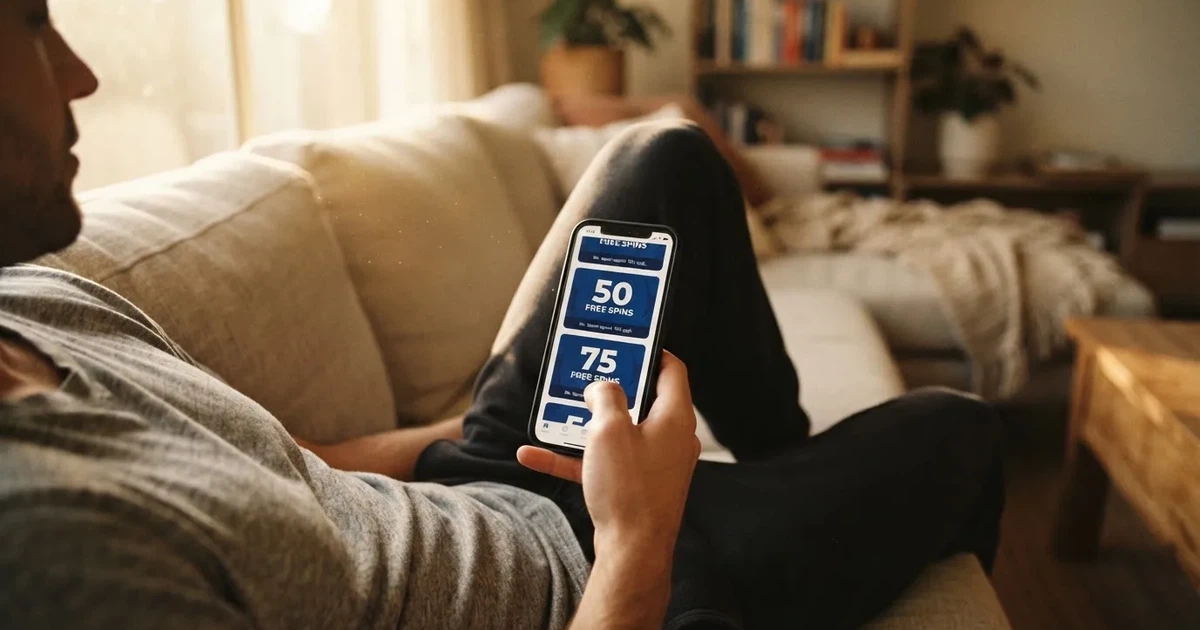
This page closes eight shelves of background on the offer: how the payments underneath it work in Australia, how the bonus itself is typically structured, which titles the marketing tends to spotlight, how the eleven publicly warned brands stack up against each other, the broader landscape of prohibited interactive gambling services, the responsible gambling framework that does and does not reach them, and what paying with crypto changes (almost nothing, on the legal question). The recurring point throughout is cost — what the offer takes from the punter beyond the advertised spins.
Data current as of 18 October 2026 and checked against the ACMA register of formal warnings, the Interactive Gambling Act 2001 as amended, and public statements from AUSTRAC and BetStop.
Table of Contents
- How Australians actually pay when an offshore casino takes their deposit
- The shape of a no-deposit free spins offer and what it actually costs
- The titles offshore casinos put behind a free-spin sign-up
- Comparing the eleven brands the ACMA has warned
- The wider landscape of no-deposit free spins offers
- Why no offshore casino offering these bonuses is licensed in Australia
- Keeping the offer in perspective — responsible gambling in Australia
- Paying with crypto does not make the offer Australian-legal
- The blocking arithmetic — how many sites the ACMA has taken down, and how fast
- What the page has established, and what the punter decides
- Frequently asked questions
How Australians actually pay when an offshore casino takes their deposit
A no-deposit offer avoids the deposit question on the way in. The deposit question reappears on the way out, when a player has cleared the wagering and wants to withdraw. The payment methods marketed at Australians for these offers read like a list of options, but the list is constrained on both ends by what Australian banks and the IGA permit.

PayID and Osko — instant bank transfers, with a name attached
PayID is Australia’s instant bank-transfer rail, run by Australian Payments Plus. An Osko payment between participating banks arrives in under a minute, 24/7, including weekends and public holidays, whether the payer uses a BSB-and-account-number or a PayID such as a phone number, email or ABN. Over 100 Australian financial institutions offer it, and the underlying New Payments Platform has had more than 25 million PayID identifiers registered as of April 2025. AP+ itself warns that being asked to send money to a PayID on an illegal gambling site almost certainly means a scam.
The relevant feature for a withdrawal is the name display: when paying to a PayID, the account-holder’s name appears before the transfer is sent. A punter can see whose account they are paying. That name on the other end will not be an Australian-licensed operator, because no such operator exists for casino games. It will be a payment processor, often offshore, sitting between the punter and the brand the ACMA has warned about.
BPAY — older but still running through Australian banks
BPAY has been in Australian online banking since 18 November 1997, owned jointly through Cardlink Services Limited by ANZ, Commonwealth Bank, National Australia Bank and Westpac. It is available through more than 140 banks and financial institutions, used by over 95,000 businesses, and is run by the same AP+ that runs PayID and Osko. The mechanic is simple: a biller code, a customer reference number, and the money leaves the payer’s bank account on the next business day or immediately on some setups.
For a punter, BPAY is the method that looks most domestic and feels safest. It is also the method most readily blocked by an Australian bank’s own gambling controls, because BPAY transactions pass through the same retail-banking rails a customer’s debit card uses. Commonwealth Bank’s gambling lock, for instance, applies to eligible cards via the CommBank app, with the bank’s own caveat that it cannot guarantee every gambling transaction will be stopped.
Cards and digital wallets — credit banned, debit workable, wallets inherit the rule
Since 11 June 2024, the IGA as amended prohibits Australian-licensed online wagering services from accepting credit cards or other credit-related products, with penalties up to A$247,500 for operators. The restriction also extends to credit-funded digital wallets, which is why Apple Pay transactions sit inside the same legal frame when they draw on a credit line. Apple itself sets no transaction limits on consumer Apple Pay use; any surcharge comes from a merchant’s own card-processing fees, not from Apple. Transaction limits and PIN requirements are set by the card issuer or merchant.
The de facto state of card payments in Australia by the end of 2025: Apple Pay, Google Pay and Samsung Pay together accounted for around 45% of all card payments by number. A wallet does not change the credit-versus-debit question. A debit-funded wallet is still subject to the card-issuer’s own gambling controls — ANZ’s gambling transaction block, once turned on in the ANZ app, also blocks gambling transactions made through a digital wallet on an eligible card, not just on the physical card. Removing that block requires a 48-hour waiting period, and the bank warns that not all gambling transactions will be blocked while some non-gambling ones may be.
The RBA’s July 2025 review proposes removing surcharges only on eftpos, Mastercard and Visa transactions, explicitly leaving American Express outside the scope of the proposed surcharge ban. Amex runs as a three-party scheme — issuer, acquirer and network under one roof — rather than the four-party model Visa and Mastercard use. Whether a punter ever sees an Amex surcharge on an offshore casino site is academic: the site is unlicensed in Australia, and the credit-card ban is enforced at the issuer end regardless.
Bank-side gambling blocks
Three of the four major banks now offer a card-level gambling block. Westpac’s works at the card level by refusing authorisation of transactions registered under the merchant category code “Betting/Casino Gambling” on eligible personal credit and debit cards. CommBank’s equivalent is a gambling lock activated through the app. ANZ’s block extends to digital-wallet transactions on an eligible card. None of these blocks apply to an AUSTRAC threshold-transaction report, which only covers physical cash transfers of A$10,000 or more; an electronic transfer at any amount is not subject to that per-transaction reporting rule, regardless of size.
The blocks matter because they cut the casino off at the last Australian choke point. A punter who has registered for a block cannot easily bypass it from inside the banking app, and any workaround (a non-blocked card, a foreign-issued card, a payment through a third party) is itself a separate decision with its own consequences.
The shape of a no-deposit free spins offer and what it actually costs
A no-deposit free spins offer is one piece of a wider sign-up package the offshore casino uses to acquire a customer. Reading the terms is where the cost lives.
The mechanics of “free”
The marketing says “free” because the spins cost the punter no deposit. They cost something else. The structure across the brands in this comparison follows the same template, because the platforms underneath them come from a small number of white-label operators.
The bonus is credited as a fixed number of spins on a named pokie, usually at the lowest stake the casino offers on that title — frequently A$0.10 or A$0.15 per spin. Any winnings from those spins land as bonus money, not as cash. To turn bonus money into withdrawable cash, the punter must wager it a stated multiple of the bonus amount (or the winnings, depending on the term). Until that multiple is cleared, no withdrawal is allowed, and any withdrawal attempt before clearing forfeits the bonus and any associated winnings.
The cost is the wagering. A 40x wagering multiple on A$10 of bonus winnings is A$400 of slot play the punter has to fund from their own deposit before they can cash out A$10. Most slots have a house edge somewhere between 3% and 6% on a per-spin basis. Across A$400 of play, the expected loss to the punter runs between roughly A$12 and A$24 — before any win on the A$10 of bonus money is realised. The “free” offer costs more than the bonus is worth, on average, and costs nothing only in the rare individual case.
Where the cost hides
Three places turn a small number into a real one. First, the maximum cashout cap: most no-deposit free spins offers cap the withdrawable winnings from the bonus at a small multiple of the bonus amount, sometimes as low as 5x. Anything over the cap is removed from the account when the wagering is done. Second, the eligible-games list: free-spins wagers often count only on a handful of slots, frequently at a reduced contribution rate (say, 50% rather than 100%) if the punter switches games. Third, the time limit: bonus funds expire in seven to thirty days, and any wagering not cleared inside the window is forfeit, regardless of how close the punter was.
None of these is unique to offshore casinos. Australian-licensed operators run wagering requirements too. The difference is what happens if something goes wrong. An Australian-licensed operator is bound by Australian consumer law and by the IGA’s enforcement perimeter. An offshore operator is not. A withdrawal refused at an offshore casino leaves the punter with no Australian complaints body to approach, no ADRA to escalate to, and no small-claims pathway that crosses jurisdictions cleanly.
What the bonus number on its own does not tell you
A 50-spin offer and a 200-spin offer can each be worth less than a 25-spin offer, depending on the wagering multiple, the per-spin stake, the eligible-games list and the cashout cap. The number of spins is the headline; the terms underneath decide what the punter keeps. Two offers at the same headline number can differ in real value by an order of magnitude.
A reasonable rule for any punter who still intends to claim such an offer is to read three numbers before signing up: the wagering multiple on the bonus winnings, the maximum cashout cap, and the time limit on the wagering window. The spins themselves are the smallest part of the calculation.
The titles offshore casinos put behind a free-spin sign-up
The no-deposit offer is almost always tied to one specific pokie, occasionally two. The title is chosen for its recognisability rather than its payout profile.
Why a casino names a particular pokie
A named title does three things at once. It signals to the punter that the offer is for a real game rather than a casino-branded mock-up. It carries the visual identity of the game’s publisher — a major studio’s logo on a game tile is a credibility cue. And it lets the casino route the offer through the studio’s existing promotional infrastructure, including demo links and pre-written marketing copy.
The titles most often named in this category of offer are well-known pokies with broad appeal: games published by studios with Australian distribution channels, sometimes via sweepstakes-style offshore brands. The free-spins allocation is always at the lowest stake, so a 50-spin offer at A$0.10 is A$5 of nominal value before wagering. Most no-deposit offers come in at A$5 to A$20 of nominal bonus value, and the punter’s path to any real cash is the wagering multiple on top.
Free spins and bonus-buy features
Some of the pokies named in these offers have a bonus-buy feature, where the punter can pay a multiple of the stake to trigger the bonus round directly. Bonus-buy purchases almost never count toward wagering on a no-deposit offer, and most terms explicitly exclude them. A punter who bonus-buys on a wagering-clearing session is paying for spins that do not contribute to clearing the bonus. That is its own kind of cost, and it is one the marketing does not mention.
Live tables and game-show titles
Live-dealer tables and game-show titles (Dream Catcher-style wheels, crash-style games,Monopoly-branded wheels) are usually excluded from no-deposit bonus wagering. When they are included, they often contribute at a much lower rate than slots. A punter who prefers live tables and tries to clear a slots bonus on them is effectively lengthening the wagering runway rather than shortening it.
Comparing the eleven brands the ACMA has warned
The brands below are not a ranking. Every one of them has been the subject of a formal warning from the ACMA for offering prohibited interactive gambling services to Australians. The ACMA register of formal warnings is the primary source; where a brand also appears on a payments or responsible-gambling page, that is noted in the table because it tells the punter something about how the brand has presented itself.
| Brand | ACMA action and date | Operator named by the ACMA | Subject support |
|---|---|---|---|
| RocketPlay | Formal warning, March 2026 | Pulsup Ltd | — |
| Level Up Casino | Formal warning, May 2022 | Dama N.V. | — |
| Woo Casino | Formal warning, March 2025 | Dama N.V. | — |
| Spirit Casino | Formal warning, May 2025 | Dama N.V. | — |
| National Casino | Formal warning, July 2025 | Consolutetish S.R.L. | listings-only |
| Bizzo Casino | Formal warning, July 2025; earlier 2022 | Consolutetish S.R.L. (2025); TechSolutions (2022) | listings-only |
| Ignition Casino | Formal warning, July 2025 | Bamboo Media | — |
| Instant Casino | Formal warning, February 2025 | EOD Code SRL | listings-only |
| Jackbit | Formal warning, April 2026 | Ryker B.V. | — |
| Casino Intense | Formal warning, April 2025 | Sterplay Holding Ltd | listings-only |
| Sky Crown | Formal warning, September 2022 | Hollycorn N.V. | — |
The “subject support” column is honest about a thin market: for most of the brands, no third-party listing of payment methods or bonus terms exists outside the brands’ own marketing. A few — National Casino, Instant Casino, Casino Intense — appear in passing on payment-method pages (AUSTRAC, BetStop, PayID, EcoPayz) or in affiliate listings, but those references are background, not endorsements. None of them changes the underlying fact that the ACMA has formally warned every brand in the table.
A note on what the dates cluster around. The ACMA issued these warnings in two waves, separated by a quieter period. The 2022 cluster (Level Up, Sky Crown, the original Bizzo warning to TechSolutions) and the 2025–2026 cluster (Woo, Spirit, National, Bizzo again, Ignition, Instant Casino, Casino Intense, RocketPlay, Jackbit) reflect a stepped-up enforcement posture under the amended IGA. A warning is not a fine, and it is not a criminal charge. It is the ACMA’s formal notice that the operator is providing a prohibited service to Australians, and it is the precursor to blocking at the ISP level for repeat offenders.
The wider landscape of no-deposit free spins offers
The offer does not exist in isolation. Three layers sit underneath it: the platform provider, the game studio, and the marketing affiliate. Each layer carries its own cost.
The platform layer
The eleven brands in this comparison are not independent casinos. Most of them run on one of two or three platform providers that license their software, payment integrations and bonus engines to dozens of white-label brands. Dama N.V. alone accounts for four of the eleven ACMA warnings in this table. That is not coincidence — it is one operator running multiple brands, each with its own sign-up offer, each carrying the same prohibition problem.
The marketing layer
The pages a punter finds through search are usually not the casino’s own page. They are affiliate pages, optimised for the search term, carrying the casino’s marketing copy almost verbatim, monetised by a revenue-share agreement that pays the affiliate a share of the punter’s losses for as long as the punter stays on the casino. The affiliate has an incentive to send the punter to whichever brand pays the highest commission, not to whichever brand is best for the punter. No affiliate page carries a licence statement, because none can.
The cost to the punter, named plainly
On a 40x wagering multiple with a 5x cashout cap, a 50-spin offer at A$0.10 nominally worth A$5 yields at most A$25 of withdrawable cash after the punter funds the A$200 of post-bonus wagering. The expected loss on that A$200 of wagering at a typical 4% house edge is A$8. The expected loss on the bonus itself is A$5 × 40 × 4% = A$8 as well, before the cashout cap clips anything above A$25. The punter is paying roughly A$16 in expected loss to win at most A$25, with non-trivial variance and a real risk of losing the whole bonus to a missed time window. That is the arithmetic underneath “free”.
Why no offshore casino offering these bonuses is licensed in Australia
The Interactive Gambling Act 2001, strengthened by the Interactive Gambling Amendment Act 2017, makes it an offence to provide online casino games, online pokies or in-play betting to a person in Australia. No state or territory licenses them. What is licensable is wagering on races and sport placed before the event, lotteries and keno — in practice licensed by the Northern Territory through the Northern Territory Racing and Wagering Commission.
The Northern Territory carve-out
The NTRWC regulates 52 of Australia’s online bookmakers — including Sportsbet, Bet365 and Ladbrokes — which are licensed in the Territory for tax reasons. The commission has no full-time staff and meets once a month in Darwin. The structure is unusual by international standards: a single small regulator carries the licence load for most of Australia’s legal online wagering market, and the licence is for sports and racing, not for casino games.
What the ACMA actually does
The ACMA investigates suspected breaches, issues formal warnings (the source for every brand in the comparison above), and directs Australian internet service providers to block illegal sites. In a round reported on 26 June 2026 the ACMA asked ISPs to block 12 more illegal gambling and affiliate marketing websites: 7Signs, ChromaBet, Donbet, Duospin, Freshbet, Slots Gem, Jacks Club, Lucky Start, Spinrise, Vinyl Casino and Wildsino. The total of blocked sites since the first blocking request in November 2019 reached 1,751 by that date. The pace is the point: the blocking regime has been running for more than six years and shows no sign of slowing.
What enforcement does not do
The IGA targets the provider, not the punter. An Australian who signs up at an offshore casino is not prosecuted. That is the legal position. The practical position is that the punter has no consumer protection at all — no Australian complaints body, no recourse to the ACMA for a withdrawal dispute, no small-claims pathway, and a real risk of seeing the site blocked with a balance still on it. The protection gap is the cost the marketing does not price.
The 2026 reform package
The Interactive Gambling Amendment (Gambling Reform) Bill 2026 passed Parliament on 19 August 2026, with its advertising and inducement measures commencing 1 January 2027. That is law with a start date, not law currently in force on this page. The reform is aimed at inducements — the sign-up bonus, the free-spins welcome, the affiliate commission — rather than at the underlying prohibition. The prohibition stands. What changes in 2027 is the inducement around it.
Tax and the recreational punter
Gambling winnings of a recreational Australian player are not assessable income under section 6-5 of the ITAA 1997, and losses are not deductible. The line is the business-of-gambling test — a professional gambler carrying on a business may be assessed differently, but the model a casual punter falls under treats winnings as windfalls and losses as non-deductible. The ATO is the authority on individual circumstances; this page is not.
Keeping the offer in perspective — responsible gambling in Australia
The Australian responsible-gambling framework is built for Australian-licensed operators. An offshore casino sits outside it, and that is the layer that matters most when the offer is “free”.
BetStop and its limits
BetStop, the National Self-Exclusion Register, has been live since August 2023. It binds Australian-licensed online and phone wagering services — the same operators that take wagers on races and sport, the same ones licensed by the NTRWC. An offshore casino is not connected to BetStop. A punter who has registered for self-exclusion and then signs up at an offshore casino has not breached BetStop, because BetStop does not reach the offshore site. The punter has, however, moved their gambling outside the protective frame that BetStop provides.
Card-level blocks as a backstop
The card-level gambling blocks offered by Westpac, ANZ and CommBank reach further than BetStop does. A Westpac gambling block refuses authorisation at the merchant-category-code level on eligible personal credit and debit cards. CommBank’s gambling lock works through the app. ANZ’s block extends to digital-wallet transactions on an eligible card and requires a 48-hour waiting period to remove. None of these blocks is foolproof — the banks state openly that not every gambling transaction will be blocked and some non-gambling transactions may be blocked in error — but they cut the casino off at the Australian end of the rail, which is something BetStop cannot do for an offshore site.
Help lines that do reach the punter
The National Gambling Helpline is 1800 858 858, free, 24/7, with chat available at Gambling Help Online. These services are not licensed-operator-specific; they take calls from anyone in Australia, including people who have signed up at an offshore site. They are the route that actually reaches a punter who has moved outside the licensed frame, and they are the one piece of Australian infrastructure that does not require the casino to be Australian.
The point of saying this on a page about free spins
A no-deposit free spins offer is the front door of an offshore casino, and the front door is where the responsible-gambling message belongs. The offer itself is small, the wagering underneath it is where the money goes, and the protection gap behind it is the cost the marketing never mentions.
Paying with crypto does not make the offer Australian-legal
Crypto casinos advertise a no-KYC angle — no identity verification, no documents, withdrawals to a wallet — and that angle pulls in readers searching for bitcoin casino free spins and crypto slots free spins no deposit. The pitch is real on the casino side and irrelevant on the Australian side.
Why crypto is not the loophole
The IGA’s prohibition runs against the provider, not the payment method. Paying for the bonus (or for the wagering underneath it) with bitcoin does not transform an unlicensed service into a licensed one. The site remains a prohibited interactive gambling service, the operator remains liable for providing it to a person in Australia, and the punter remains on the wrong side of a protection gap. Crypto changes how the money moves; it does not change what the casino is doing.
What crypto does change
It changes the trail. A bank transfer or a card transaction leaves an Australian record that the punter’s own bank can see and that the card-level gambling block can intercept. A crypto transfer does not. That is a feature of crypto that the punter can use to bypass their own bank controls, but it is not a feature that moves the casino inside Australian law. It also exposes the punter to the volatility of the asset — a win denominated in BTC and held in BTC varies in A$ terms between the spin and the conversion.
AUSTRAC and the threshold rule
AUSTRAC’s threshold-transaction-report rule, which requires reporting of transfers of A$10,000 or more, applies only to physical cash. Ordinary electronic bank transfers are not subject to that per-transaction reporting requirement, regardless of the amount. Crypto transfers do not flow through AUSTRAC’s reporting rails at all, and the AUSTRAC threshold has no application to a crypto deposit to an offshore casino.
The anonymity claim, examined
A no-KYC casino asks for less at signup. The trade-off is that the punter has no Australian complaints body to approach when something goes wrong. There is no Australian Securities and Investments Commission equivalent, no Australian Financial Complaints Authority route, and no ADRA escalation. The anonymity is bilateral — the casino does not know the punter, and the punter has no Australian-shaped recourse against the casino. For a punter who has self-excluded via BetStop and is using crypto specifically to bypass that exclusion, the trade-off is the wrong way around.
The blocking arithmetic — how many sites the ACMA has taken down, and how fast
The ACMA’s first blocking request went to ISPs in November 2019. The total of blocked illegal gambling and affiliate marketing websites reached 1,751 by the end of June 2026. That is the span of just over six and a half years. The pace has been uneven — a flurry of blocks around specific enforcement rounds, quieter months between them — but the cumulative curve has continued upward without a reversal.
| Statistic | Value |
|---|---|
| Total sites blocked | 1,751 |
| First blocking request | November 2019 |
| Total unlicensed services exited | >230 |
| Latest reporting date | 26 June 2026 |
Working through the arithmetic the inputs support: 1,751 sites blocked over a span from November 2019 to June 2026 — roughly 79 months of enforcement — works out to a long-run average of about 22 blocked sites per month. The most recent round reported on 26 June 2026 alone added 12, which is roughly half of one month’s average cleared in a single batch. Earlier enforcement rounds carried larger single-round totals; the more recent pattern is that the ACMA is blocking in smaller, more targeted groups focused on the platforms that have absorbed the most ACMA-warned brands.
The more relevant figure is what has happened at the operator end: more than 230 unlicensed gambling services have left the Australian market since enforcement was strengthened in 2017. That number counts operators exiting, not individual sites blocked. A single operator can run a dozen brands on a single platform; one operator exit can therefore remove many URLs from the regulator’s list at once. The blocking arithmetic and the exit arithmetic measure different things, and both have moved in the same direction.
The cost on the other side is harder to measure. H2 Gambling Capital’s 2025 report estimates that Australians lose about A$3.9 billion a year to illegal gambling sites, and that the share of gambling going through legal channels fell from 74% in 2021 to 64%. That is the scale of the market the ACMA is blocking into — not a market that has shrunk under enforcement, but a market that has grown while enforcement ran. The blocking rate is informative; it is not the whole picture.
What the page has established, and what the punter decides
Eleven brands, eleven formal ACMA warnings, one prohibition that applies to every one of them. A payment landscape where Australian banks can block the transaction at their end, where PayID shows the receiving party’s name, where BPAY still works through retail banking, and where crypto bypasses both the bank controls and the AUSTRAC threshold rule without changing the legal position. A bonus structure that costs the punter more than the bonus is worth on average, with the worst case being the most likely one. A responsible-gambling framework that reaches licensed Australian operators and stops at the offshore border, with help lines that do reach the punter regardless of where they signed up.
The cost question the page opened with has a clean answer in pounds and in structure: the spins are free, the wagering is not, and the protection underneath the wagering does not exist. What a punter does with that information is theirs.
Frequently asked questions
What is the difference between a no-deposit bonus and a no-deposit free spins offer?
A no-deposit bonus is a credit to the bonus balance that the punter can usually spend across multiple games, often at a stake of their choosing. A no-deposit free spins offer is restricted to a fixed number of spins on a single named pokie, usually at the casino’s minimum stake, and the winnings from those spins become bonus money subject to wagering. The free-spins version is narrower and is the form most offshore casinos use as a sign-up inducement.
Do free pokie spins from a crypto casino come with different terms than from a fiat casino?
The mechanics — wagering multiple, cashout cap, eligible-games list, time window — are the same in shape. What changes is the payment method on the deposit and withdrawal side: crypto skips Australian bank controls and AUSTRAC reporting thresholds, but it does not change the legal status of the casino itself, and it does not add any Australian-shaped consumer protection. The same prohibition applies regardless of which coin the punter pays in.
Is it lawful for an Australian to claim free spins at an offshore casino?
The Interactive Gambling Act 2001 targets the provider of a prohibited interactive gambling service, not the individual punter. An Australian who signs up and plays is not prosecuted. The practical risk is on the consumer-protection side: no Australian complaints body, no recourse if a withdrawal is refused, no BetStop coverage, and the offshore casino can be blocked by the ACMA with a balance still in the account. Lawful to claim in the strict sense; expensive to claim in the practical one.
Why would a casino pair free spins with a PayID deposit method, if the spins are meant to be free?
Because the free spins are the front door and the deposit is the back door. Once the bonus funds are credited and the punter wants to withdraw, the casino needs a way to take the deposit that funds the wagering requirement. PayID looks domestic and instant, but it is also the method where the receiving party’s name is shown before the transfer is sent — which is exactly the moment an Australian punter can see that they are paying an offshore entity rather than an Australian-licensed operator. AP+ warns that a PayID on an illegal gambling site almost certainly means a scam site.
How many free spins do these offers typically advertise, and does the number matter more than the terms?
The headline number runs anywhere from 10 to 200 spins across the brands in this market, with 20 to 50 being the most common. The number matters far less than the terms underneath it. A 200-spin offer at A$0.10 with a 60x wagering multiple and a 5x cashout cap is worth less on average than a 25-spin offer at A$0.20 with a 20x wagering multiple and no cap. The wagering multiple, the cashout cap and the time window decide the real value; the spin count is the headline the marketing leads with.
Online casino no-deposit free spins Australia — More on this topic at casino slots au.
See also What a reload bonus for returning players actually costs Australians in….