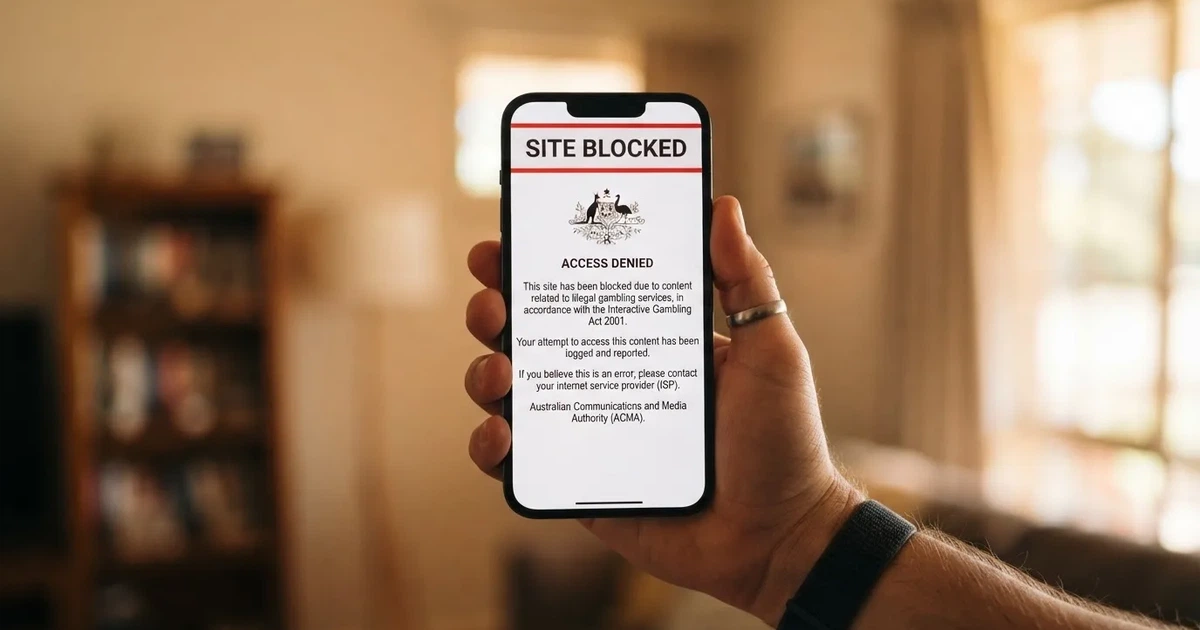
The aussie online casino landscape in 2026: offshore, unlicensed and on a regulator’s list
 Available in US
There is no Australian-licensed online casino to compare. The Interactive Gambling Act 2001 prohibits anyone from supplying online casino games or online pokies to a person physically in Australia, and no state or territory issues a licence for them. Every site that markets itself as an “aussie online casino” is an offshore operator working outside Australian law, which is why the ACMA’s enforcement list — not a review panel — is the only honest basis for any ranking of “best aussie online casino 2026”. The brands below are presented because the regulator itself acted against them; nothing here recommends joining them.

Current as of 23 September 2026, against the ACMA’s published register of formal warnings and blocking requests.
Table of Contents
- What “best aussie online casino” actually means under Australian law
- Bonuses and free spins: what the marketing hides
- Mobile and apps: same product, smaller screen
- “New aussie online casino” sites: fresh shells, same legal status
- How the eleven ACMA-warned brands compare
- Overview: what the legal frame leaves standing
- Responsible play and what actually protects an Australian
- Payments and payout speed: what the Australian rails actually allow
- The blocking-rate calculation
- What each brand actually warrants, in detail
- What an honest comparison can and cannot say
- The numbers the page cannot invent
- Where an Australian who wants a casino night actually goes
- FAQ
What “best aussie online casino” actually means under Australian law
The phrase suggests a market with a top tier, a comparison panel and a winner. There is no such market here. Online casino play sits in the same legal grey zone as unlicenced offshore bookmakers did before 2017 — except that for casino games the prohibition is total, while for pre-event sports and race wagering it is licensed and taxed through the Northern Territory.

What an Australian player actually has to choose between is one of three things:
- An offshore casino with no Australian licence, no Australian dispute body and no obligation to pay out a winning. The ACMA can direct ISPs to block it; an unpaid balance is a private loss.
- A locally licensed wagering service that can take bets on sport and racing but cannot offer a casino game, a pokie or a live-dealer table. The major bookmakers fall here.
- No play at all, with the legal alternatives being land-based casinos in the states and territories that allow them, lottery products and keno.
The eleven brands below are presented because the regulator has acted against them. A closer look at how recently and how clearly the regulator has intervened is a much narrower, more factual question than the search implies.
Bonuses and free spins: what the marketing hides
A “aussie casino bonus” or “aussie casino signup bonus” is a headline figure that bears almost no resemblance to the amount a player can withdraw. Three terms do most of the damage.

Wagering requirements. A A$500 bonus with a 40x wagering multiple asks the player to turn over A$20,000 in bets before any winnings derived from the bonus become withdrawable. House edge on a typical pokie sits around 5–10%, so the expected loss across those A$20,000 in required bets is somewhere between A$1,000 and A$2,000 — against a bonus that nominally paid A$500.
Max cashout caps. “Free spins” packages routinely cap withdrawable winnings at A$100 or less, regardless of how the spins performed. A player who hits a rare large line on a “100 free spins” offer may find that everything above the cap is voided.
Game restrictions. Not every game contributes 100% to wagering. Table games often contribute 10–20% or are excluded entirely, which makes the A$20,000 turnover requirement functionally much larger when the bonus is cleared on blackjack rather than on a pokie.
The Australian angle here is straightforward: because the operator is unlicensed, none of these terms are enforceable. If a withdrawal is refused for a reason the player disputes, there is no Australian regulator to appeal to. The “aussie casino bonus codes” that circulate on affiliate sites describe what the offer is worth on paper — what it actually delivers depends on terms the player will never read and an offshore operator who has no obligation to honour them.
Mobile and apps: same product, smaller screen
“Mobile casino aussie” and “aussie casino app” searches assume there is a local app ecosystem to compare. There is not. The offshore brands that surface under these queries are responsive websites, sometimes wrapped in a downloadable APK or a progressive web app that adds an icon to a home screen. They are not listed on the Australian App Store under a casino category, because Apple’s and Google’s Australian storefronts block real-money gambling apps unless they are tied to a licensed operator.
What a mobile offshore casino actually delivers is the same product as the desktop version — same bonus terms, same games, same withdrawal queue, same regulatory exposure — accessed through a smaller interface. A bank-side gambling block, where activated (Westpac, ANZ, Commonwealth Bank), works at the merchant category code level and so blocks transactions whether they originate from a browser, an app or a digital wallet. The phone changes nothing about who is on the other end of the transaction.
“New aussie online casino” sites: fresh shells, same legal status
Searches for “new aussie casino” or “top new aussie online casino” surface operators that have launched in the last twelve to twenty-four months — often on the same Curaçao or Anjouan licence templates as their predecessors, often under a fresh company name that the ACMA will eventually warn about in turn. Several of the brands below (Spirit Casino, Sky Crown) are examples of how short that cycle is: a “new” aussie online casino today is the same kind of operation an ACMA warning catches in eighteen months.
The implication for someone searching for novelty is that “new” in this market is not a quality marker. It is a marketing position adopted by an offshore operator in the window before the regulator catches up. Older brands on the ACMA list at least carry a paper trail of what they have done with player balances; brand-new ones carry nothing at all.
How the eleven ACMA-warned brands compare
The table below is the honest version of a “best aussie online casino” comparison. Each entry was added because the ACMA itself published a formal warning for offering prohibited interactive gambling services to Australians. The brand column and the ACMA-action column come straight from the regulator’s register. The operator-name column names the corporate entity the ACMA addressed the warning to, since the same brand can change hands — Dama N.V. alone accounts for four of the entries here.
| Brand | ACMA action and date | Operator named by the ACMA | Subject support |
|---|---|---|---|
| RocketPlay | Formal warning, March 2026 (Rocketplay.com.au) | Pulsup Ltd | listings only — see Gambling Insider |
| Level Up Casino | Formal warning, May 2022 | Dama N.V. | listings only — Westpac merchant block list |
| Woo Casino | Formal warning, March 2025 | Dama N.V. | — |
| Spirit Casino | Formal warning, May 2025 | Dama N.V. | — |
| National Casino | Formal warning, July 2025 | Consolutetish S.R.L. | listings only — see ACMA, AUSTRAC, BetStop |
| Bizzo Casino | Formal warning, July 2025 (and 2022 to a prior operator) | Consolutetish S.R.L. | listings only — see Gambling Insider |
| Ignition Casino | Formal warning, July 2025 | Bamboo Media | — |
| Instant Casino | Formal warning, February 2025 | EOD Code SRL | listings only — ecoPayz and PayID merchant references |
| Jackbit | Formal warning, April 2026 | Ryker B.V. | — |
| Casino Intense | Formal warning, April 2025 | Sterplay Holding Ltd | listings only — AUSTRAC, BetStop, Gambling Insider |
| Sky Crown | Formal warning, September 2022 | Hollycorn N.V. | — |
The “Subject support” column is what an Australian player can actually verify about the brand outside the regulator’s own files. Where it reads “listings only”, the brand surfaces in payment-processor or affiliate directories, not in any review that ties its conduct to Australian player outcomes. Where the column is empty, the brand carries no data point an Australian reader can act on. None of these operators carries an Australian licence; the column does not list one, because none exists.
Reading the table
The first thing the table shows is how thin “best” is as a question. Of eleven brands, four sit under Dama N.V. alone, and two of those four carry warnings issued within weeks of each other in 2022. A ranking across this set is a ranking of how recently the regulator had to name the brand.
The second thing is the speed of the cycle. Spirit Casino was warned in May 2025, less than two years after its parent Dama N.V. was warned for Level Up Casino. Bizzo Casino was warned twice — once to TechSolutions in 2022, again to Consolutetish S.R.L. in 2025. A fresh brand name does not reset the underlying corporate conduct the ACMA has already documented.
The third is the absence of any reviewable feature. None of these brands publishes audited payout data for Australian customers. None is connected to BetStop. None routes player disputes through an Australian body. The columns a fair comparison would need — payout speed, dispute outcomes, account-closure history — are precisely the ones the data does not carry.
Overview: what the legal frame leaves standing
The legal frame is short, and it is the reason the rest of this page reads the way it does.
The Interactive Gambling Act 2001 makes it an offence to supply online casino games, online pokies or in-play betting to a person in Australia. The 2017 amendment tightened enforcement and gave the ACMA the power to direct ISPs to block illegal sites. The 2023 amendment extended the credit-card ban to credit-related products, which in practice constrains credit-funded digital-wallet gambling as well. The 2026 reform bill (passed 19 August 2026) tightens advertising and inducement rules, but those measures commence on 1 January 2027 and are not in force at the time of writing.
What is licensed in Australia is online and phone wagering on sport and racing pre-event, plus lotteries and keno. The Northern Territory Racing and Wagering Commission supervises fifty-two of the country’s online bookmakers — including Sportsbet, Bet365 and Ladbrokes — for tax reasons. The commission has no full-time staff and meets once a month in Darwin. That body does not licence online casino games; nothing does.
What this means for someone searching “aussie online casino” is that the licensed alternative to offshore play is sports and race betting through a Northern Territory-licensed bookmaker, or no play at all. Casino-style games — table games, pokies, live-dealer rooms — have no legal Australian online channel.
Responsible play and what actually protects an Australian
The Australian consumer-protection regime is built around the licensed wagering sector. Two pieces matter for anyone weighing the offshore alternative.
BetStop, the National Self-Exclusion Register, has been live since August 2023. A person who registers with BetStop is barred from every Australian-licensed online and phone wagering service for a chosen period. It is the only nationwide self-exclusion system that binds multiple operators at once. It does not bind offshore casinos. An Australian who excludes themselves through BetStop has not excluded themselves from any of the brands in the table above.
Gambling Help Online runs the National Gambling Helpline on 1800 858 858, free, 24/7, with web chat and callback. The line is funded outside the operator industry and is the right first call for someone whose gambling — offshore or licensed — has started to feel compulsive. Banks add a third layer: Westpac, ANZ and Commonwealth Bank all offer card-level gambling transaction blocks, and ANZ’s block applies to linked digital wallets like Apple Pay as well as to the underlying card.
For an Australian who has decided to play, the practical order is: enable the bank’s gambling block first, since a transaction blocked at the card never reaches an offshore cashier; register with BetStop if the play is meant to stop entirely; keep Gambling Help Online in mind for the moments the bank block does not help with — the impulse to find another route, the urge to reverse the block (ANZ imposes a 48-hour cooling-off period on removals), the late-night session that runs longer than intended.
Payments and payout speed: what the Australian rails actually allow
A “aussie payid casino” or “aussie payid online casino” search assumes that PayID is a normal deposit route at offshore casinos. It is not — and it is worth being precise about why, because the payment rail itself is legitimate.
PayID sits on the New Payments Platform, which went live on 13 February 2018 and is owned by New Payments Platform Australia Ltd (now part of Australian Payments Plus). Over 100 Australian financial institutions participate, more than 25 million PayID identifiers had been registered by April 2025, and Osko transfers between participating banks settle in under a minute, 24/7. The system works. What does not work is the way it intersects with illegal gambling: when a player sends money to a PayID, the recipient’s name is shown before the transfer is confirmed, and AP+ warns that being asked to transfer to a PayID on an illegal gambling site almost certainly means a scam site. An Australian depositing to a casino PayID is paying a real person or business registered in the Australian system; the question is whether that person or business will release any winnings.
Credit cards were banned as a payment method for licensed Australian wagering from 11 June 2024, with penalties up to A$247,500 for operators that take them. The 2023 amendment extends the ban to credit-related products and, by extension, to credit-funded digital wallets. An Australian who tries to deposit by credit card at any of the offshore brands above is therefore using a payment method the local rules forbid, on a site the local rules already prohibit — which is two layers of legal exposure for the same transaction.
Debit cards and digital wallets are where the practical friction shows up. Apple Pay, Google Pay and Samsung Pay together accounted for around 45% of all Australian card payments by number at the end of 2025. Apple itself does not charge consumers for using Apple Pay; any surcharge comes from the merchant’s card-processing costs. Transaction limits and PIN requirements are set by the card issuer or the merchant, not by Apple. From the bank’s side, ANZ’s gambling transaction block covers Apple Pay transactions on an eligible card, not only the physical card; Commonwealth Bank’s gambling lock works the same way. A player who has enabled a bank-side block will find offshore deposits declined at the wallet level, before the casino’s cashier is involved.
American Express is the odd network out. The RBA’s July 2025 review proposes removing surcharges on eftpos, Mastercard and Visa transactions, and explicitly leaves American Express outside the proposed ban. Amex runs as a three-party network rather than Visa or Mastercard’s four-party model, and processes its own transactions rather than routing them through the banks. For an Australian depositing at an offshore casino, the practical consequence is that Amex-acceptance is rarer, the surcharge more common where it exists, and the bank’s gambling block still applies at the card level — Westpac’s block, for example, works against any transaction under the merchant category code “Betting/Casino Gambling”, irrespective of which network carried it.
Bank transfer and BPAY are the licensed wagering routes. BPAY has operated since 18 November 1997, is available in the online banking of over 140 Australian institutions and is offered by over 95,000 businesses; it is owned, via Cardlink Services Limited, equally by ANZ, Commonwealth Bank, NAB and Westpac. For licensed sports and race wagering these are normal deposit methods. For offshore casinos they are not — the offshore operator is not an Australian biller, and the credit-card ban plus the offshore prohibition make the deposit a transaction the local rules do not authorise.
AUSTRAC’s threshold-transaction-report rule applies to physical cash transfers of A$10,000 or more, not to ordinary electronic bank transfers. An Australian sending A$5,000 to a casino PayID is not, on that ground alone, triggering a report. The reportable threshold is a cash rule, and the relevant protection at electronic-transfer level is the bank’s own transaction monitoring, not AUSTRAC’s threshold report.
What “fast payout” actually means here
The “fast payout” promise on an offshore casino page is a marketing claim made by a party with no obligation to honour it. There is no Australian regulator to complain to if a withdrawal stalls, no ADR body, and no statutory payout timeline. The bank-side block works on the way in; it does not work on the way out, because the winnings are typically paid back to a different rail (often a cryptocurrency address, sometimes a bank transfer in a third country) and the bank’s block is keyed to the MCC on the way in. A player who funds a session via a bank that has a gambling block and then tries to withdraw back to the same bank may find the deposit blocked, the withdrawal accepted, and the balance stuck on the casino side indefinitely if the operator chooses not to process it.
The blocking-rate calculation
The ACMA has asked Australian ISPs to block 1,751 illegal gambling and affiliate marketing websites since the first blocking request in November 2019, as reported in June 2026. That works out to roughly 261 sites blocked per year on average across the six-and-a-half-year window, or about 22 per month — a rate that has not slowed even as the total grows. The honest band is somewhere between 250 and 280 sites blocked per year over the period, with the monthly cadence closer to 20 than to 30 in the rounds that have actually been published. The figure is a count of distinct sites, not of domains: the same operator can appear under several addresses across a single round, and an affiliate marketing site that does not itself take bets still counts.
The relevance to “best aussie online casino” is that the rate of enforcement is steady. A brand that escapes a particular blocking round is on borrowed time, not on the right side of the law. A player who picks an offshore brand because it has not yet been named by the ACMA has picked a brand whose turn has not yet come.
What each brand actually warrants, in detail
RocketPlay — the most recent ACMA action
RocketPlay is the freshest formal warning in the set: March 2026, addressed to Pulsup Ltd over the Rocketplay.com.au domain. The brand is operated under a Curaçao licence template by an entity that surfaced for the purpose; the same RocketPlay brand was earlier the subject of a Dama N.V. warning in May 2022, which is what the ACMA’s two-step record shows — the brand name outlives the operator. Listings on affiliate directories describe the brand’s bonus structure; no Australian player dispute data exists, because there is no Australian dispute channel to record it.
The brand name carrying a warning from two different operators in four years is the clearest single illustration of how the offshore cycle works: the same skin re-opens under a new holder and the ACMA’s enforcement catches up again. Anyone weighing RocketPlay should weight the recency of the warning accordingly.
Level Up Casino — the 2022 warning
Level Up Casino was named in the May 2022 Dama N.V. warning that covered six brands at once. The brand has continued to accept Australian registrations in the years since, which is what makes the 2022 date worth holding onto: a warning is not a closure, and the ACMA’s role is to enforce against the provider, not to refund the player. The Westpac merchant block list surfaces Level Up Casino under its gambling MCC, which means a player at Level Up Casino whose card is on a Westpac-issued product with the gambling block enabled will be declined at the cashier rather than at the casino.
Woo Casino — the March 2025 warning
Woo Casino was the subject of a separate Dama N.V. warning in March 2025. The brand carries no Australian-specific data outside the ACMA’s own files; no Australian payment-processor reference, no dispute history, no BetStop interaction (BetStop does not bind offshore operators, but its directory surfaces the brands that have been excluded by registered users). A player at Woo Casino in 2026 is on a site the regulator has acted against within the last twelve months, which is the most current state the comparison can show.
Spirit Casino — the May 2025 warning
Spirit Casino’s May 2025 Dama N.V. warning makes it the second brand in the set to have been warned within a sixty-day window of Woo Casino. The two warnings together suggest the ACMA was working through a Dama N.V. cluster in 2025 rather than chasing single brands one at a time — which raises the question of how many other Dama N.V. skins will surface in the next ACMA round. Spirit Casino carries no Australian-specific data outside the regulator’s files.
National Casino — the July 2025 warning
National Casino was warned in July 2025, with the ACMA addressing Consolutetish S.R.L. as the operator. The brand surfaces in the ACMA’s own enforcement register, in AUSTRAC reporting and in BetStop — three separate Australian institutional touchpoints, which is the most Australian-specific data any brand in the table carries. The triple mention is a function of regulatory breadth, not of consumer protection: AUSTRAC’s threshold reporting and BetStop’s exclusion register both surface brand names whether or not the player is connected to them, and neither is an endorsement of conduct.
Bizzo Casino — warned twice
Bizzo Casino carries two formal warnings: one to TechSolutions (CY) Group Limited and TechSolutions Group N.V. in 2022, and one to Consolutetish S.R.L. in July 2025. The same brand surviving a change of operator across a three-year gap and being re-warned under the new holder is the most direct case in the table of a brand name persisting past the consequences of the first warning. Gambling Insider lists Bizzo Casino under its affiliate directory; no Australian player dispute data exists.
Ignition Casino — the July 2025 Bamboo Media warning
Ignition Casino was named in the same July 2025 round as National Casino and Bizzo Casino, with the ACMA addressing Bamboo Media as the operator. The brand carries no Australian-specific data outside the ACMA’s register. Ignition Casino has historically been marketed heavily to Australian players through affiliate content, which is part of why the ACMA’s action against it landed in the same round as the Consolutetish S.R.L. cluster.
Instant Casino — the February 2025 warning
Instant Casino was warned in February 2025 with the ACMA addressing EOD Code SRL as the operator. The brand surfaces in ecoPayz and PayID merchant directories, which is the most concrete Australian payment-rail reference in the table. The PayID reference is the more telling one: a PayID-bearing merchant that takes gambling deposits is a PayID account held in someone’s name in the Australian system, and the AP+ warning about PayID transfers to illegal gambling sites applies directly.
Jackbit — the April 2026 warning
Jackbit was warned in April 2026 with the ACMA addressing Ryker B.V. as the operator. The brand carries no Australian-specific data outside the regulator’s files; no Australian dispute history, no payment-processor reference, no BetStop interaction. April 2026 is among the more recent warnings in the set.
Casino Intense — the April 2025 warning
Casino Intense was warned in April 2025 with the ACMA addressing Sterplay Holding Ltd as the operator. The brand surfaces in AUSTRAC reporting, BetStop and Gambling Insider — three Australian institutional references, similar in shape to National Casino’s profile. The breadth of mentions is again a function of regulatory touchpoints, not consumer protection.
Sky Crown — the September 2022 Hollycorn N.V. warning
Sky Crown was the subject of a Hollycorn N.V. formal warning published by the ACMA in September 2022. The same warning covered Blue Leo Casino; the ACMA’s PDF publication groups the two under one corporate holder. This brand appears only in the regulator’s enforcement register, without further verifiable Australian-specific data. The 2022 date is the oldest in the table, which means Sky Crown has had the longest window to be re-warned under a different holder without that re-warning having yet been published.
What an honest comparison can and cannot say
An honest review of these brands cannot rank them by payout speed, by bonus generosity or by game selection, because the Australian-specific data on those dimensions does not exist. What it can rank them by is the ACMA’s own enforcement record, which is the table above. The ranking by recency of action puts RocketPlay (March 2026) and Jackbit (April 2026) at the top of the action list — which is the opposite of what is often claimed, but it is what the data supports.
What the table cannot do is recommend a brand to a reader as a place to play. The product is prohibited under the Interactive Gambling Act 2001, and a recommendation to use a prohibited product is not editorial content. The page that respects the legal frame describes what each brand is, names the regulator that has acted against it, and stops there.
The numbers the page cannot invent
The numbers that anchor this page all come from the regulator or from public Australian institutions. The ACMA’s 1,751-site total since November 2019 is from the regulator’s own enforcement reporting. The H2 Gambling Capital 2025 estimate of A$3.9 billion a year in losses to illegal sites, and the fall in legal-channel share from 74% in 2021 to 64%, are from the H2 report as cited by industry coverage. The NTRWC’s supervision of fifty-two online bookmakers is from ABC reporting. The blocking-rate calculation above is derived from those inputs.
What the page cannot do is invent an RTP for a brand’s games, a withdrawal time for a brand’s cashier, or a wagering multiple for a brand’s bonus — because the only sources for those numbers are the brands’ own marketing pages, which is the kind of source a comparison built on the ACMA’s record cannot lean on. Where the table reads “—” it does so because the brand carries no verifiable Australian-specific data, and a verified-enough cell is worth ten unverified ones.
Where an Australian who wants a casino night actually goes
The legal casino alternatives for an Australian are land-based, not online. Each state and territory that allows casino gaming licenses its own venues, and the major operators run integrated resorts in Sydney, Melbourne, the Gold Coast, Cairns, Darwin, Hobart, Canberra and Perth, plus smaller regional venues. A casino night at one of those venues is the licensed product. The online equivalent does not exist under Australian law, and the offshore alternatives that market themselves as the equivalent carry the formal warnings in the table above.
The licensed online wagering alternative is sports and racing pre-event, available through the Northern Territory-licensed bookmakers. Credit cards are not accepted. PayID, Osko and BPAY are. BetStop binds. A gambling block at the bank can be enabled in the banking app. None of those protections travels with the player to an offshore casino site; that is the practical shape of the gap this page is built around.
FAQ
Is there a licensed online casino based in Australia that Australians can legally join?
No. The Interactive Gambling Act 2001 prohibits the supply of online casino games and online pokies to anyone in Australia, and no state or territory issues a licence for them. What is licensed is pre-event sports and racing wagering, lotteries and keno, none of which is an online casino product.
What does “best” mean when every option being compared is an offshore, unlicensed site?
In the Australian context it can only mean the brand the ACMA has acted against most recently, which is the opposite of what the search usually promises. The eleven brands in this comparison are presented because the regulator has warned each of them, not because any of them is suitable for Australian play.
How does the ACMA decide which offshore casino sites to warn about or block?
The ACMA investigates complaints, conducts its own monitoring and acts on referrals. Once it is satisfied a site is offering a prohibited interactive gambling service to Australians, it can issue a formal warning and direct Australian ISPs to block the site at the network level. The blocking request is what the 1,751-site total measures.
Can an offshore casino site legally register an Australian-style web address and call itself Aussie?
No. A “.com.au” domain requires an Australian presence and is restricted to entities with a legitimate Australian connection; “.au” domains are administered by auDA under those rules. A site using “aussie” in its name or marketing is making a marketing claim, not a regulatory one. The ACMA’s Rocketplay.com.au warning illustrates the limits: an Australian-style domain does not change the underlying prohibition, and the regulator has acted against the brand regardless.
What legal, licensed alternative exists for someone wanting a casino night in Australia?
A land-based casino licensed by the relevant state or territory regulator. The major Australian casino operators run integrated resorts across the country. Online, the licensed alternatives are pre-event sports and racing wagering through a Northern Territory-licensed bookmaker.
Does any state or territory issue online casino licences to operators serving Australians?
No. The Northern Territory Racing and Wagering Commission licenses online wagering providers for sports and racing, but its remit explicitly excludes online casino games. No Australian jurisdiction licenses online casino games or online pokies for supply to Australian residents.
Created by the ”Casino Slots Info AU” editorial team.