
Best pokie machine to play in Australia: what actually decides the outcome
Currency and licence claims verified as of 28 October 2026 against the Australian Communications and Media Authority register of formal warnings and blocking actions.
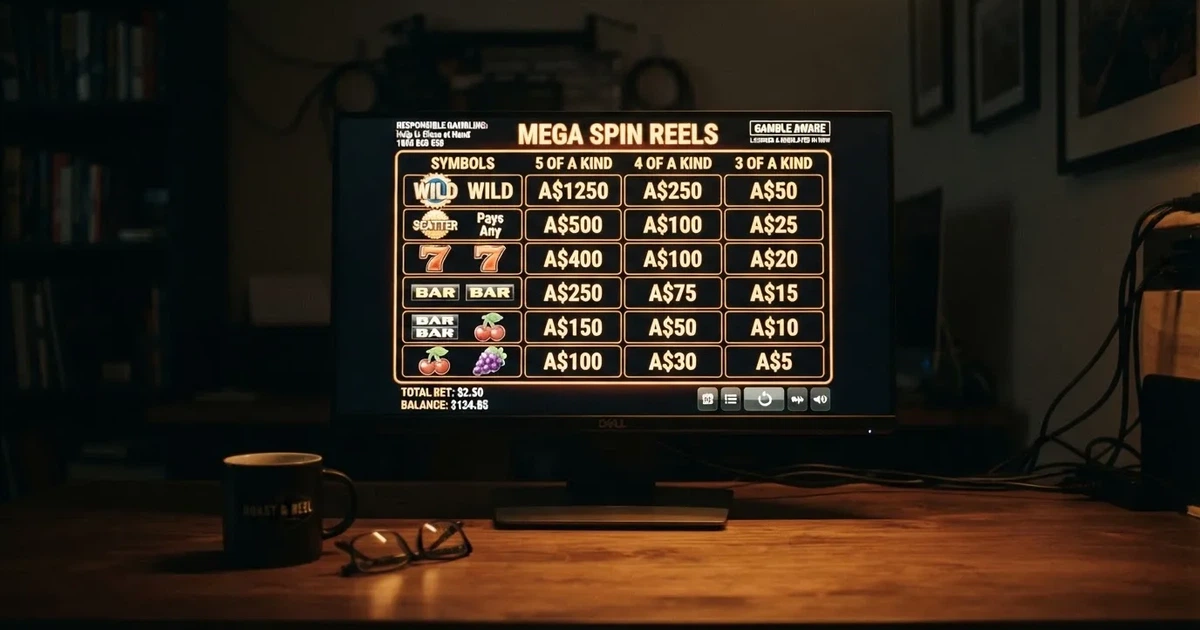
The phrase “best pokie machine” does most of its work in the head of the person typing it, and almost none of it on the floor of the pub or club where the machine sits. There is no single best pokie. There are machines with different volatility bands, different return-to-player floors, different stake tiers and different bonus structures — and the player who matches their bankroll and temperament to those numbers will lose less per hour than the player who simply picks the machine with the loudest cabinet. This page is built around that distinction. It walks through how a pokie machine is actually priced, where the legal floor sits in each Australian state, and why almost every “online pokie” advertised to an Australian is operating against the Interactive Gambling Act 2001 rather than under it.
Table of Contents
- Mobile pokie apps and browser play: what the touchscreen actually changes
- Specific games, providers and live tables: what the paytable actually says
- The top eleven offshore brands the ACMA has acted against
- The Australian pokie landscape: how many machines, where, and how much is lost
- What the Interactive Gambling Act 2001 actually prohibits
- How deposits and withdrawals work for a licensed Australian wagering account
- Responsible gambling: the supports that actually exist for an Australian punter
- Frequently asked questions
Mobile pokie apps and browser play: what the touchscreen actually changes
A pokie machine on a phone is the same mathematics as the same machine on a pub floor, but the surface around it is not the same. Touch input replaces a button panel, sessions are shorter, and the temptation to chase a near-miss on the bus is harder to resist than the temptation to chase it across a car park. That is where the practical difference lives.
The first thing to settle is the legal surface. No app available on a local Australian storefront offers real-money pokies as a lawful product. Apple and Google’s Australian stores block casino-style real-money apps, and the operators themselves do not publish a downloadable real-money pokie in the local stores. Browser play on an offshore site is a different story, and a worse one: those sites are not licensed in Australia, the ACMA has issued formal warnings over a long list of them, and the balance sitting in the account can be cut off the moment an Australian internet service provider is directed to block the domain. The mechanics feel native to the phone; the legal wrapper does not.
The mechanics themselves, on the rare occasion a player does reach a legitimate pokie — a Crown Perth terminal, a Melbourne hotel cabinet, an NSW club game — behave the same way the floor machine behaves. Random number generators do not know which surface they are running on. What changes on a phone is the cadence. A five-reel game with twenty paylines that took a punt about seven seconds per spin on a club cabinet takes the same seven seconds per spin in landscape mode on a tablet. The shorter the session, the more a punter’s hourly loss is dictated by stake size rather than spin count.
Browser play on licensed onshore products, where it exists, runs through a state-based lottery or wagering provider rather than through a casino app. None of those products is a pokie machine in the cabinet sense; they are digital lottery and keno products with their own house edge and their own pacing. Treating one as the other is the first mistake the marketing tries to plant.
A short list of what actually moves when a pokie moves to a phone:
- Session length. A pub visit runs ninety minutes; a phone session runs twelve. Smaller bankrolls hit a stake-size floor that a pub visit never reaches.
- Tilt triggers. A near-miss animation has the same psychology on a five-inch screen as on a twenty-inch screen, but the phone sits in a pocket.
- Load times. Browser play on a metered mobile connection can take a spin out of the rhythm. That is lost time, not lost money, but it changes the feel of a session.
- Withdrawal friction. Real-money withdrawal from an offshore mobile product takes days to weeks on the operators that pay at all, and an outright refusal on the operators that don’t. The pub machine has no withdrawal — you walk away with what’s in your wallet.
The phone is not where the maths changes. It is where the player’s behaviour around the maths changes.
Specific games, providers and live tables: what the paytable actually says
The clearest way to deflate a marketing word is to read the paytable beneath it. A pokie’s paytable is the contract between the machine and the player: it lists the symbol values, the bonus triggers, the number of paylines and the rules around wild substitutions. None of that is hidden — every licensed Australian cabinet has it on screen — but most players never scroll past the splash graphic to look at it.
The most important number on the paytable is not the headline jackpot. It is the return-to-player floor the machine is licensed to meet. In Australia that floor is set state by state. New South Wales, the Northern Territory, Queensland and most of Victoria set the minimum at 85% (87% at Crown Melbourne). The Australian Capital Territory and Tasmania set 87%. South Australia sets 87.5%. Western Australia sets 90% — the tightest floor in the country, and the reason the state’s pub and club floors are pokie-free by design. Every licensed machine in the country meets or exceeds its jurisdiction’s floor; the headline RTP printed on the paytable is set by the venue and the manufacturer within that legal minimum.
The second most important number is volatility. A low-volatility machine pays out often and in small amounts. A high-volatility machine pays out rarely and in larger amounts. The return-to-player figure on its own hides this completely — a 90% RTP can describe a machine that pays A$0.45 back on every A$0.50 spin, or a machine that pays nothing for ninety spins and then drops A$45 on the ninety-first. Same headline number, radically different experience at the cabinet.
Game providers matter at the cabinet level for two reasons: the maths is independently tested and the bonus mechanics are visible on the paytable. Aristocrat and IGT are the dominant manufacturers in Australian clubs and pubs, and their volatility bands are well documented. Konami and Ainsworth hold the remaining meaningful share. None of those manufacturers sells a real-money online pokie to Australians through a licensed channel, because no such channel exists.
The table-game shelves follow a different curve. Baccarat, blackjack and their variants are governed by different maths, and a quick reference is useful before anyone treats a casino-floor product as a substitute for a pokie.
Baccarat: where the 1.06% lives
Baccarat is the lowest-house-edge table game in any Australian casino. The bank hand carries a house edge of 1.06%, the player hand 1.24%, and the tie bet — the one every tourist reaches for first — carries 14.36%. Punto banco, the variant played in every Australian casino, banks the game from the house and runs both hands to fixed drawing rules; the player does not make any decisions after the bet is down, which is the structural reason the edge is so low. Cards two through nine count at face value, ten and the face cards count as zero, and aces count as one, with hand totals taken modulo ten. The shoe holds six or eight decks.
Three variants are approved at Crown Melbourne under the Victorian Gambling and Casino Control Commission — Traditional Baccarat, Crown Baccarat and 2 to 1 Baccarat — and they sit alongside baccarat derivatives from chemin de fer, the nineteenth-century French two-player variant, and baccarat banque. Crown’s regulator replaced the VCGLR on 1 July 2022, and each variant is on the approved game list under section 66 of the equivalent NSW framework: a casino operator cannot put a baccarat table on the floor unless the game and its rules are approved by the regulator, and the operator must hand a copy of those rules to any patron who asks.
Blackjack: optimal strategy flattens the edge
Blackjack’s house edge collapses once the player runs a correct basic strategy. Under liberal Las Vegas Strip rules — stand on soft 17, double on any two cards, double after split, resplit aces, late surrender — the edge drops to about 0.28%. Atlantic City rules push it to about 0.43%. The card values are simple: numbers at face value, jack/queen/king at ten, ace at one or eleven, and a starting two-card total of 21 is a “natural” or “blackjack” — the strongest hand. The dealer must hit until reaching seventeen or higher, with some rule sets requiring a hit on a soft seventeen as well.
Blackjack variants Australian casinos run include Spanish 21, which strips the tens out of the shoe and compensates with player-favourable rules; Double Exposure, where both dealer cards land face-up; Blackjack Switch, where the player swaps cards between two hands; and Super Fun 21, which permits up to four splits. The edge on each is higher than the base game, and the marketing on each leans into the novelty. The maths does not.
Live tables: the dealer is the variable
A live table game in a Sydney or Melbourne casino runs at the same edge as its electronic-floor sibling, but with a human cadence. The dealer reshuffles on a fixed schedule, draws to the same fixed rules, and pays at the same odds. The player’s hourly loss on a live baccarat table is therefore a function of hand count and bet size, not of which dealer is dealing — a fact that strips much of the superstition out of the game if the player is honest about it.
The paytable on a pokie, the rule card on a table game, and the licence line on the wall behind the cashier are the three documents the punter should read before the first bet lands. None of them is long, all of them are available on request, and the gap between what they say and what the marketing said is the size of the marketing budget.
The top eleven offshore brands the ACMA has acted against
This is not a ranking of casinos. Online casino games — and therefore online pokies — cannot be licensed anywhere in Australia, and any site that advertises “real money online pokies” to an Australian is operating against the Interactive Gambling Act 2001. What follows is the ACMA’s own list, in the order research carries it: each entry names the formal warning, the operator behind the warning, and the date the warning was issued. The brands share an absence rather than a quality. None of them is “best” at anything a licensed Australian venue would recognise as the product.
RocketPlay
The ACMA issued a formal warning to Pulsup Ltd over Rocketplay.com.au in March 2026. The same brand traces back to a separate May 2022 warning to Dama N.V. that covered Rocketplay alongside five other casino brands. A corporate vehicle changes, a brand re-emerges under a new operator name, and the warning cycle repeats. This operation holds no Australian licence.
Level Up Casino
A May 2022 formal warning to Dama N.V. covered Level Up alongside Bambet, Dazard, Rocketplay, Wild Tornado and Cobra Casinos. The brand surfaces in a listing on the BGaming provider site, which is a marketing channel for the studio and not an Australian regulator. Such brands operate without local authorization.
Woo Casino
A March 2025 formal warning to Dama N.V. landed on Woo Casino. The site claims an offshore licence, which carries no legal weight within Australia.
Spirit Casino
A May 2025 formal warning to Dama N.V. covered Spirit Casino, four months after the same operator was warned over Woo Casino. It operates under an offshore licence not recognized in this jurisdiction.
National Casino
A July 2025 formal warning to Consolutetish S.R.L. covered National Casino alongside Bizzo Casino. The brand surfaces in a Wikipedia listing of casino operators, which is a directory rather than a regulatory register. It holds no Australian licence.
Bizzo Casino
The July 2025 warning to Consolutetish S.R.L. was the second formal warning over Bizzo: TechSolutions (CY) Group Limited and TechSolutions Group N.V. had already been warned over it in 2022. A second warning over the same brand, years apart, highlights the operator’s disregard for Australian regulatory notices. It lacks a local licence.
Ignition Casino
A July 2025 formal warning to Bamboo Media covered Ignition Casino. Any advertised gambling services here operate outside of Australian regulatory control.
Instant Casino
A February 2025 formal warning to EOD Code SRL covered Instant Casino. It lacks any state-issued authorization to offer casino games in Australia.
Jackbit
An April 2026 formal warning to Ryker B.V. covered Jackbit alongside CasinOK. The site displays an offshore licence. No state or territory in Australia issues a casino or pokie licence.
Casino Intense
An April 2025 formal warning to Sterplay Holding Ltd covered Casino Intense. The brand surfaces in an assortment of press listings rather than in any Australian regulator’s register. The site displays an offshore licence. No state or territory in Australia issues a casino or pokie licence.
Sky Crown
A formal warning from September 2022 covered Hollycorn N.V. over Sky Crown and Blue Leo. The site displays an offshore licence. No state or territory in Australia issues a casino or pokie licence.
| Brand | ACMA action and date | Operator named by the ACMA | Subject support |
|---|---|---|---|
| RocketPlay | Formal warning, March 2026 | Pulsup Ltd | — |
| Level Up Casino | Formal warning, May 2022 | Dama N.V. | listings-only (BGaming) |
| Woo Casino | Formal warning, March 2025 | Dama N.V. | — |
| Spirit Casino | Formal warning, May 2025 | Dama N.V. | — |
| National Casino | Formal warning, July 2025 | Consolutetish S.R.L. | listings-only (Wikipedia) |
| Bizzo Casino | Formal warning, July 2025 (also 2022) | Consolutetish S.R.L. / TechSolutions | — |
| Ignition Casino | Formal warning, July 2025 | Bamboo Media | — |
| Instant Casino | Formal warning, February 2025 | EOD Code SRL | — |
| Jackbit | Formal warning, April 2026 | Ryker B.V. | — |
| Casino Intense | Formal warning, April 2025 | Sterplay Holding Ltd | listings-only (press, ACMA, Crown) |
| Sky Crown | Formal warning, September 2022 | Hollycorn N.V. | — |
The “listings-only” entries reflect where a brand surfaces in non-regulatory directories — a game studio’s partner page, an encyclopedia entry, a press mention. None of those is a substitute for an Australian regulator’s register, and the ACMA action above is the only line of that table that matters to an Australian punter. Where the subject support column is blank, research carries no record of the brand even appearing in a directory.
The Australian pokie landscape: how many machines, where, and how much is lost
Australia has roughly three per cent of the world’s pub and club poker machines and 0.3% of its population. In 2020–21 the country bet almost A$150 billion through gaming machines and lost A$12.18 billion on them — the largest per-capita loss figure of any jurisdiction in the published data. The machines sit in every state and territory, with each jurisdiction setting its own rules on machine count, return-to-player, opening hours and pre-commitment.
New South Wales is the largest single jurisdiction. In June 2023 the state had 87,298 gaming machines outside casinos spread across 2,195 venues, with player losses of A$8.18 billion across 2022–23. Queensland had 21,122 gaming machines operating in 351 venues in October 2023. Victoria had 26,380 machines outside Crown Casino in 488 venues across 2021–22, sitting beneath a statewide cap of 30,000. The numbers are not estimates — every jurisdiction publishes them, and the disparity between NSW and the rest is the central fact of any Australian harm-reduction debate.
| Jurisdiction | Machines | Venues | Annual losses |
|---|---|---|---|
| New South Wales | 87,298 | 2,195 | A$8.18 billion |
| Queensland | 21,122 | 351 | Not stated |
| Victoria | 26,380 | 488 | Not stated |
Western Australia banned poker machines in pubs and clubs when Crown Perth opened in 1985. Crown Perth’s own machine count has since grown from about 200 in 1985 to roughly 2,500, every one of them approved by the state’s Gaming and Wagering Commission. Tasmania held its machines under a Federal Group monopoly from 1968 until legislation passed in November 2021 ended the arrangement, moving oversight of the machines to the Tasmanian Liquor and Gaming Commission. Tasmania then planned nation-leading mandatory pre-commitment cards for its poker machines, with implementation delayed into late 2025.
The first legal poker machines in the country were registered-club machines in New South Wales in 1956. The pattern since then has been expansion, capping, and harm-reduction overlay in roughly that order, with each jurisdiction moving on its own clock. There is no national pokie regulator in the same sense as the NTRWC, which regulates 52 of Australia’s online bookmakers from a once-a-month meeting in Darwin with no full-time staff.
What the Interactive Gambling Act 2001 actually prohibits
Online casino games — and online pokies as a subset of them — cannot be lawfully supplied to a person in Australia. The Interactive Gambling Act 2001, strengthened by the Interactive Gambling Amendment Act 2017, makes the supply of online casino games, online pokies and in-play betting an offence. No state or territory issues a licence for them, and what is licensable is wagering on races and sport placed before the event, lotteries and keno. The Northern Territory Racing and Wagering Commission regulates 52 of the country’s online bookmakers for tax reasons, but a bookmaker licence is not a casino licence, and the NTRWC’s monthly Darwin meeting does not produce one.
The minimum age is 18. The individual player is not prosecuted under the Act — the IGA targets the provider — but the consumer protection consequences for an Australian punter on an offshore site are sharp. There is no Australian complaints body, no Australian recourse if a withdrawal is refused, no BetStop coverage (the National Self-Exclusion Register binds only Australian-licensed online and phone wagering services), and the ACMA can ask Australian internet service providers to block the site with whatever balance was sitting on it. Blocking requests do not refund balances.
The ACMA’s enforcement record is the clearest measure of how seriously the offshore sector treats the law. Since the first blocking request in November 2019, the ACMA has directed the blocking of 1,751 illegal gambling and affiliate marketing websites as of June 2026. More than 230 unlicensed gambling services have left the Australian market since enforcement was strengthened in 2017. In a single June 2026 round the ACMA asked Australian internet service providers to block twelve more sites: 7Signs, ChromaBet, Donbet, Duospin, Freshbet, Slots Gem, Jacks Club, Lucky Start, Pointsbetz.com, Spinrise, Vinyl Casino and Wildsino. The blocking rate is therefore the cumulative effect of a long enforcement programme, and the running total is the figure the ACMA itself uses when it talks about the size of the illegal market.
H2 Gambling Capital’s 2025 report puts a number on the demand side: Australians lose about A$3.9 billion a year to illegal gambling sites, with the share of gambling going through legal channels falling from 74% in 2021 to 64%. That drift is the consequence of an offshore sector that advertises freely into the country, accepts deposits through methods the licensed sector is forbidden to accept, and exits the market whenever the ACMA’s blocking round reaches them.
How fast the ACMA has been closing sites
The blocking programme began with the first request in November 2019. The cumulative total reached 1,751 sites blocked by June 2026, a span of roughly six and a half years. Across that period the running total works out to a band of roughly 250 to 280 sites blocked per year on average — close to five per week — with the more recent years running faster than the early years as the ACMA’s process matured. The rate is not constant; it accelerates when a high-profile operator expands its Australian affiliate footprint and slows when a wave of operators exits the market. The arithmetic, applied to the November 2019 starting point and the June 2026 running total, is the size of the gap between what the IGA prohibits and what the offshore sector is still willing to advertise.
The Interactive Gambling Amendment (Gambling Reform) Bill 2026 passed Parliament on 19 August 2026. Its advertising and inducement measures commence on 1 January 2027 — a law with a start date that has not yet arrived on a page dated within this year. Until that commencement the ACMA’s enforcement toolkit is what it has been since 2017: formal warnings, blocking requests, and the slow squeeze of an offshore sector whose licences do not extend to Australian residents.
How deposits and withdrawals work for a licensed Australian wagering account
The payment surface for a licensed Australian wagering service is narrower than the offshore sector makes it look. Since 11 June 2024, credit cards, credit-related products and digital currency are banned as payment for licensed online wagering in Australia, with penalties up to A$247,500 for operators that take them. What remains is debit card, bank transfer, PayID and Osko, and BPAY. A site that asks an Australian for a credit card deposit or a crypto deposit is operating outside the Australian rules, and that is a single-question test of whether the rest of the marketing can be trusted.
Withdrawal times vary by method and by operator, but the licensed sector settles inside hours on PayID and Osko and inside one to three business days on BPAY. Offshore sites quote faster withdrawal times in their marketing, then deliver them on the operators that pay at all and refuse the rest; there is no Australian recourse either way.
Tax is the other dimension the marketing never prints. Gambling winnings of a recreational player are not assessable income under section 6-5 ITAA 1997 and losses are not deductible, unless the person carries on a business of gambling. The model is “check with the ATO” for anyone whose gambling looks like a side income rather than a hobby.
Responsible gambling: the supports that actually exist for an Australian punter
BetStop, the National Self-Exclusion Register, has been live since August 2023. It binds Australian-licensed online and phone wagering services, which means a person who has registered with BetStop will be refused service by every licensed bookmaker in the country. An offshore casino is not connected to BetStop, and self-exclusion there is whatever the offshore operator’s account settings page allows — often nothing.
The National Gambling Helpline is 1800 858 858, free and 24 hours a day, with chat available through Gambling Help Online. State-based support lines and face-to-face services sit alongside the national line, and the state pokie regulators publish the relevant contact details on their own sites.
The harm-reduction measures layered onto Australian pokies are state-by-state and have moved at very different speeds. Tasmania’s mandatory pre-commitment cards were due to start late in 2025. Other jurisdictions have used load-up limits, mandatory breaks, and venue-level self-exclusion without moving to a card-based system. Each is a partial answer to a problem the legal minimum return-to-player floor cannot reach: a machine at the legal RTP floor still loses a problem gambler their bankroll at the same rate a higher-RTP machine loses a recreational player. The floor protects the math. It does not protect the person.
Frequently asked questions
What’s the difference between a low-volatility and a high-volatility pokie machine?
Low-volatility machines pay out often and in small amounts, while high-volatility machines pay out rarely and in larger amounts, even when both carry the same headline RTP. A low-volatility 90% machine might return A$0.45 on every A$0.50 spin; a high-volatility 90% machine might pay nothing for ninety spins and then drop A$45 on the ninety-first. The hourly loss depends on stake size and spin frequency rather than on the volatility label alone.
Does bet size change the odds on a pokie machine?
Bet size does not change the random-number-generator odds on a licensed Australian pokie, but it does change the payback structure. Many machines require a max-credits bet to qualify for the top jackpot line on the paytable, so a player betting below the threshold is playing a different effective game from a player betting above it. The ratio of return to stake is therefore not flat across stake tiers, even though the underlying odds are.
Are mobile pokie-machine apps the same as the licensed machines in a pub or club?
Mobile apps available in Australian storefronts do not offer real-money pokies at all, and browser play on offshore sites is not a licensed product. The mathematics of a pokie does not change between a club cabinet and a phone, but the legal wrapper does: a pub or club pokie sits under a state regulator, and an offshore mobile product sits outside Australian law entirely.
How can someone find the payout percentage of a specific pokie machine before playing?
The licensed return-to-player floor is set state by state — 85% in NSW, the NT, Queensland and most of Victoria (87% at Crown Melbourne), 87% in the ACT and Tasmania, 87.5% in South Australia, and 90% in Western Australia — and the paytable on the cabinet itself will list the venue-set RTP within that floor. Venue staff can name the figure on request.
Are multi-line pokie machines more likely to pay out than single-line ones?
A multi-line machine pays out more often, because each spin is evaluated across more lines, but the per-line payout is smaller and the total cost per spin is higher. The headline RTP can sit in the same band as a single-line machine, but the player’s hourly loss on a multi-line game is usually higher because more is being staked per spin. Frequency is not the same as profitability.
Who audits pokie machines in licensed Australian venues?
Each state and territory regulator audits the gaming machines in their jurisdiction through independent testing houses, and the manufacturer’s maths is tested against the state RTP floor before a machine can be deployed. The audit trail is the part of the machine’s paperwork the player does not see, and it is the part that justifies the floor beneath the cabinet.