
Instant bank transfer casino sites in Australia: what the deposit speed is actually worth
Current as of 28 October 2026 · verified against the Australian Communications and Media Authority’s register of formal warnings and blocking requests
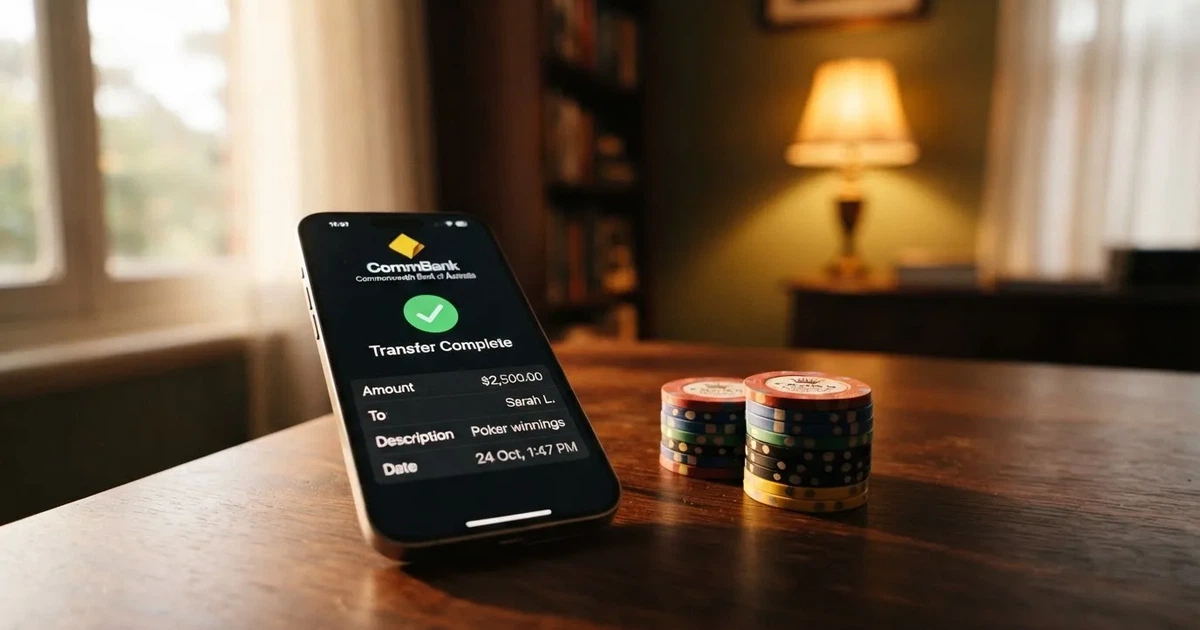
A bank transfer that lands in under a minute, a cashier screen that calls it “instant”, a bonus that promises a return on the deposit — that is the picture most offshore casino marketing paints for an Australian punter. The picture has a frame the marketing does not show. Under Australia’s Interactive Gambling Act 2001, no online casino or online pokies site can lawfully serve a person physically in this country. The eleven brands named in this article each received a formal warning from the ACMA for doing exactly that. The transfer speed is real; the licence to take it is not.
That is the whole argument of the page, and it sits underneath everything that follows.
Table of Contents
The eleven sites the ACMA has formally warned
These are the brands a person searching from Australia is most likely to meet. None is a recommendation. The selection follows the ACMA’s own register of formal warnings, not an editorial shortlist, because no shortlist of offshore casino brands can be made on any other basis here. Each entry below carries the date of the warning, the operator the ACMA named, and what is actually known about the brand’s payment support from sources other than the brand’s own marketing.
| Brand | ACMA action and date | Operator named by the ACMA | Subject support |
|---|---|---|---|
| RocketPlay | Formal warning, March 2026 | Pulsup Ltd | — |
| Level Up Casino | Formal warning, May 2022 | Dama N.V. | Listings only (Westpac gambling block page) |
| Woo Casino | Formal warning, March 2025 | Dama N.V. | — |
| Spirit Casino | Formal warning, May 2025 | Dama N.V. | — |
| National Casino | Formal warning, July 2025 | Consolutetish S.R.L. | Listings only (AUSTRAC threshold-transaction reports; New Payments Platform entry) |
| Bizzo Casino | Formal warning, July 2025; earlier 2022 | Consolutetish S.R.L.; earlier TechSolutions | — |
| Ignition Casino | Formal warning, July 2025 | Bamboo Media | — |
| Instant Casino | Formal warning, February 2025 | EOD Code SRL | Listings only (ecopayz; PayID register page) |
| Jackbit | Formal warning, April 2026 | Ryker B.V. | — |
| Casino Intense | Formal warning, April 2025 | Sterplay Holding Ltd | Listings only (AUSTRAC; ITNews; NAB) |
| Sky Crown | Formal warning, September 2022 | Hollycorn N.V. | — |
Dama N.V. alone accounts for four entries on the table. The ACMA warned the operator in May 2022 over six brands, then again in March 2025 over Woo Casino and in May 2025 over Spirit Casino — a second visit to the same corporate parent for the same conduct. RocketPlay also appears twice in the register: warned in May 2022 under Dama N.V., then again in March 2026 under Pulsup Ltd, which suggests the brand was carried across operators rather than wound down. The pattern repeats in other rows. Consolutetish S.R.L. was warned in July 2025 over both National Casino and Bizzo Casino; Bizzo had already been the subject of a 2022 warning to TechSolutions. Hollycorn N.V. is on the register for Sky Crown and a sister brand, Blue Leo. The ACMA’s file is not a list of unrelated operators; it is a record of brands that move between shells faster than enforcement can keep up.
The “Subject support” column deserves a separate note. A “Listings only” tag means the brand appears in a source outside the operator’s own marketing — a bank’s page about gambling blocking, an industry register, a Wikipedia entry on the payments rail — and nothing more. The marketing claim that a brand “supports” PayID, or Osko, or a particular bank-block feature, is not the same thing, and is not used here. Six of the eleven brands carry no tag at all: no source outside the brand’s own pages confirms the payment routing, and a reader should treat a marketing claim as exactly that.
RocketPlay
A formal warning in March 2026 named Pulsup Ltd as the operator of RocketPlay. The same brand was the subject of an earlier warning to Dama N.V. in May 2022 — meaning RocketPlay has been warned twice under two different corporate parents for offering prohibited casino games to Australians. No source outside the brand’s own pages confirms a payment method; the entry sits at the table’s first row because the most recent ACMA action belongs to it.
Level Up Casino
Warned in May 2022 under Dama N.V., in the same enforcement round that named five other brands. The only payment-related reference carried by non-marketing sources is the Westpac gambling block page, which describes the merchant-category code mechanism that lets an Australian bank refuse authorisation on a card transaction. That is not a Level Up feature; it is a rail-level statement about how a card transaction is identified.
Woo Casino
Warned in March 2025 under Dama N.V. — Dama’s second appearance on the register, two years and ten months after the first. The gap is the story: the operator did not adjust its conduct after the 2022 warning, and the regulator returned.
Spirit Casino
Dama N.V. again, in May 2025. Third Dama entry in three years. The brand sits here because the ACMA named it; no other source outside the operator’s own pages speaks to it.
National Casino
Warned in July 2025 under Consolutetish S.R.L. Payment-method references here come from AUSTRAC’s threshold-transaction-report documentation and the Wikipedia entry on Australia’s New Payments Platform — neither is a brand endorsement. Both are statements about the rail, not about what National Casino accepts.
Bizzo Casino
Two formal warnings to two different operators over the same brand. TechSolutions was warned in 2022; Consolutetish S.R.L. was warned in July 2025. A brand that has been warned twice in three years under two parent companies is the clearest entry on the register, in the sense a reader most needs to hear.
Ignition Casino
Warned in July 2025 under Bamboo Media. No external payment-source reference; the row is here on the regulator’s word alone.
Instant Casino
Warned in February 2025 under EOD Code SRL. The brand name is generic on purpose; it appears on the ecopayz merchant list and the PayID register page, which means it surfaces wherever a casino-marketing aggregator indexes it. Neither source is the brand speaking for itself, and neither is an endorsement.
Jackbit
Warned in April 2026 under Ryker B.V. — one of the most recent actions on the register, alongside RocketPlay. No external payment reference.
Casino Intense
Warned in April 2025 under Sterplay Holding Ltd. The brand surfaces in AUSTRAC’s documentation, an ITNews piece on payment-rail enforcement, and an NAB page; none of these is a Casino Intense feature.
Sky Crown
The Hollycorn N.V. warning covers Sky Crown and a sister brand, Blue Leo. The original ACMA publication is a September 2022 PDF. Sky Crown’s presence on a 2026 register is a reminder that a 2022 enforcement action is still on the file.
How an instant bank transfer actually moves
A person who has used Osko through a major Australian bank has already seen the rail these sites advertise. A PayID-to-PayID transfer, or a transfer to a BSB and account number at a participating institution, arrives in under a minute, twenty-four hours a day, weekends included. Australian Payments Plus, which runs Osko and PayID, also runs BPAY, and the same holding company absorbed the New Payments Platform in 2021. The rails are mature; the rail is not the question.
The question is what happens at the other end of the transfer. A bank transfer reaches the casino’s own bank account first. The casino then runs its own transaction review — sanctions screening, source-of-funds checks, sometimes a manual approval — before the balance shows in the cashier. That review is what an “instant” deposit screen is really measuring, and the review is the part that varies. The transfer is fast; the crediting is not always.
A PayID carries a small but useful safeguard: the name of the account holder shows before the transfer is sent. Australian Payments Plus warns that being asked to send money to a PayID on an illegal gambling site almost certainly means a scam site, because legitimate merchants do not route gambling deposits through a PayID in this country. A punter who sees an account name that does not match the casino brand on the PayID confirmation screen is being told, by the rail itself, that something is wrong.
What a bank transfer deposit looks like on a statement
A bank transfer leaves the clearest paper trail of any retail payment method. Card payments and e-wallet payments tend to show on a statement as a merchant descriptor that does not always read like a casino; a direct transfer shows as a transfer, to a named account, on a date, in an amount. For a punter tracking their own spend — and for a household where more than one person reviews the statements — that is a meaningful difference. A bank statement is also the document a problem-gambling counsellor or a financial counsellor is most likely to ask for, because the entries are unambiguous.
The paper trail runs both ways. A bank can also see the transfer, and Australian banks have moved, since 2023, to actively block gambling transactions at card level. Westpac’s gambling block refuses authorisation on transactions carrying the merchant category code for betting and casino gambling; ANZ’s block, activated in the ANZ app, blocks gambling transactions made through a digital wallet such as Apple Pay on an eligible card, not just the physical card; Commonwealth Bank offers a gambling lock on eligible cards via the CommBank app. Removal of the ANZ block requires a 48-hour waiting period, and the bank warns that not all gambling transactions will be blocked and some non-gambling transactions might be blocked in error. None of these products binds an offshore casino; all of them are signals the banks are sending to their own cardholders.
What the deposit rail does not cover
A direct transfer is not subject to AUSTRAC’s threshold-transaction-report rule. That rule, which requires reporting of transfers of A$10,000 or more, applies only to physical cash. Ordinary electronic bank transfers are not covered by it, regardless of the amount sent. A reader who has heard that “large cash transactions get reported” and assumes the same is true of a bank transfer has the rule the wrong way round.
There is also a question of whether the bank will let the transfer go at all. Card-level gambling blocks are well advertised; bank-level gambling blocks on direct transfers are less so. A punter whose own bank takes a dim view of gambling-related outbound transfers may see the transfer returned, sometimes without a clear reason given.
What the law actually says
The Interactive Gambling Act 2001, strengthened by the Interactive Gambling Amendment Act 2017, makes it an offence to provide online casino games, online pokies or in-play betting to a person in Australia. No state or territory licenses those products. What is licensable is wagering on races and sport placed before the event, lotteries and keno — in practice licensed by the Northern Territory, where the Northern Territory Racing and Wagering Commission regulates 52 of Australia’s online bookmakers, including Sportsbet, Bet365 and Ladbrokes. The commission has no full-time staff and meets once a month in Darwin. It does not regulate online casinos, because it cannot.
The ACMA is the enforcement body. It investigates, issues formal warnings, and directs Australian internet service providers to block illegal sites. The individual player is not prosecuted — the IGA targets the provider, not the customer — but an offshore site gives no Australian consumer protection, no complaints body, and no recourse if a withdrawal is refused. The site can also be blocked while a balance is still on the account, and the punter has nowhere to appeal that.
A separate rule binds licensed Australian wagering services: since 11 June 2024, credit cards, credit-related products, and digital currency cannot be used to fund a licensed online wagering account, with penalties of up to $247,500 for operators. The legal deposit routes for a licensed bookmaker are debit card, bank transfer, PayID and Osko, and BPAY. A site asking an Australian for a credit card or a crypto deposit is operating outside the Australian rules, regardless of what licence it claims elsewhere.
The Interactive Gambling Amendment (Gambling Reform) Bill 2026 passed Parliament on 19 August 2026; its advertising and inducement measures commence on 1 January 2027. The law is in place; the start date is not.
What enforcement looks like in practice
The ACMA’s blocking programme is the visible part. According to the ACMA as reported in June 2026, a total of 1,751 illegal gambling and affiliate marketing websites had been blocked since the first blocking request in November 2019, and more than 230 unlicensed gambling services had left the Australian market since enforcement was strengthened in 2017. In the round reported on 26 June 2026, the ACMA asked Australian internet service providers to block twelve more illegal gambling websites in one go: 7Signs, ChromaBet, Donbet, Duospin, Freshbet, Slots Gem, Jacks Club, Lucky Start, Pointsbetz, Spinrise, Vinyl Casino and Wildsino. A blocking request is not the same as a formal warning, but the two work together — a site that has been warned and continues to operate is the natural candidate for a blocking request.
The formal-warning register is the slower-moving side of the same enforcement. Each of the eleven brands in the table above was named on it. A formal warning is a public document; the ACMA publishes it, names the operator, names the brand, and gives the date. It is not a court order and it is not a fine. It is the regulator saying, in writing, that the conduct is prohibited and that further action will follow if the conduct continues. The pattern on the register — Dama N.V. warned twice across three years, Bizzo warned twice across three years under two different operators — shows what “further action” looks like when it does not come.
What the illegal market is estimated to cost
H2 Gambling Capital’s 2025 report estimates that Australians lose about A$3.9 billion a year to illegal gambling sites, and that the share of gambling going through legal channels fell from 74% in 2021 to 64%. The legal-channel number is the one to watch. A falling legal share with a rising illegal spend is the macro picture behind every blocking request and every formal warning. The enforcement is a response to a market that has moved offshore in scale, not in a handful of niche sites.
The blocking rate, since the first request in November 2019
Between the first blocking request in November 2019 and the ACMA total reported in June 2026, 1,751 illegal gambling and affiliate marketing websites have been blocked. That works out to a band of roughly 260 to 275 sites blocked per calendar year across the period — about five per week on a sustained basis. The band is the point, not any single number: the blocking rate has held in that range across years when the legal-channel share was falling and the illegal-spend estimate was rising. That is the rate at which enforcement has had to run to keep up with new arrivals, and it is also the rate at which new arrivals have had to enter to keep the market roughly where it is. A punter reading these numbers is being told that the market they are being marketed to is being replenished at the same speed it is being blocked.
What responsible play looks like when the product is prohibited
A bank transfer deposit gives a player the cleanest view of their own spend of any retail payment method, which is a genuine safeguard — but a safeguard inside a product that has no lawful basis in Australia is a small safeguard. The Australian-licensed wagering world has player-protection machinery the offshore world does not.
BetStop, the National Self-Exclusion Register, has been live since August 2023. A punter who registers with BetStop is excluded from every Australian-licensed online and phone wagering service for the period they nominate. An offshore casino is not connected to BetStop and is not bound by it. Self-exclusion is a real tool inside the licensed market and a non-existent tool outside it.
The National Gambling Helpline is 1800 858 858, free, twenty-four hours a day, with chat at Gambling Help Online. The helpline is for anyone affected by their own or someone else’s gambling — a punter, a family member, a person holding a bank statement they do not know how to talk about. It is not a regulator and it is not a complaints body; it is a counselling service that can also point a caller to financial counselling, legal aid, and self-exclusion registration.
The minimum age for any gambling product in Australia is 18. The IGA binds the provider, not the player — but a person under 18 who has been able to fund an account at one of these sites has been able to do so because the site has not checked.
Player protection on the licensed side
A licensed Australian bookmaker is bound by the Australian Consumer Law, by the IGA’s prohibitions on advertising to minors, by responsible-gambling codes, and by the BetStop register. A complaint that cannot be resolved with the operator can be escalated to the relevant state or territory gambling regulator or to an external dispute resolution scheme. None of this exists at an offshore casino. A punter whose withdrawal is refused at an offshore site has, in practice, no Australian forum to take the complaint to. The site may publish an “ADR” or “eCOGRA” badge; that badge is not an Australian badge, and it does not give an Australian punter Australian recourse.
A bank can also act on a customer’s behalf. A punter who has decided to stop gambling and is finding it hard to stop sending transfers can ask their bank to apply a gambling block at card level (Westpac, ANZ, Commonwealth Bank all offer one) or to put a flag on outbound transfers to known merchant categories. The block is not perfect — ANZ itself warns that not all gambling transactions will be blocked and some non-gambling transactions might be blocked in error — but a block plus a closed account plus a BetStop registration is the strongest set of stops an Australian punter can put in place, and each of them is more effective than the marketing copy on the offshore site they are leaving.
What a reader should take from the page
The transfer is real, the speed is real, and the marketing is built on a real rail. The rail is also the only thing on the page that is unambiguously real. The licence the site displays is not an Australian licence and cannot be, because no Australian licence for online casino games exists. The “instant” in the deposit screen is the bank’s speed, not the casino’s; the casino’s own transaction review sits behind it. The paper trail the transfer leaves is genuinely useful for tracking spend — and that paper trail is also the document a punter’s own bank will see when the bank’s own gambling controls engage.
The eleven brands in the table are not a shortlist. They are the brands the ACMA has formally warned by name, and they are the brands a punter searching from Australia is likeliest to meet. A punter who reads this page and chooses to play at one of them anyway is choosing to play outside Australian consumer protection, outside BetStop, and outside any Australian complaints forum. The transfer will arrive in under a minute. The recourse will not.
Frequently asked questions about instant bank transfer casinos in Australia
Is it legal for an online casino to accept a direct bank transfer from a player in Australia?
No. Under the Interactive Gambling Act 2001, online casino games and online pokies cannot be provided to a person in Australia by any operator, and no Australian state or territory licenses them. The bank transfer makes the deposit faster; it does not make the service lawful. The ACMA enforces by formal warning and by directing Australian ISPs to block illegal sites, with 1,751 sites blocked since November 2019 as reported in June 2026.
How does a bank transfer deposit at an offshore casino differ from a card deposit?
A card deposit runs through Visa, Mastercard, or American Express, and most Australian banks now apply a gambling block at the merchant-category-code level — Westpac, ANZ, and Commonwealth Bank all do. A direct bank transfer to the casino’s own account does not run through the card networks, so a card-level block will not stop it. The transfer still has to be screened and credited by the casino, which is where delays and rejections happen.
Does a bank transfer leave a clearer paper trail than a card or e-wallet deposit?
Yes. A card transaction often shows on a statement as a generic merchant descriptor, and an e-wallet deposit appears as a transfer to the wallet provider. A direct bank transfer shows on a statement as a transfer to a named account, on a date, in an amount. That clarity is useful for tracking personal spend, and it is also the document a financial counsellor or a problem-gambling service is most likely to ask for. It also means the punter’s own bank sees the transfer.
How long does an instant bank transfer usually take to actually clear at a casino site?
The transfer itself, over Osko or PayID between participating Australian banks, arrives in under a minute, twenty-four hours a day. That is the bank’s speed. The casino’s own transaction review — sanctions screening, source-of-funds checks, sometimes a manual approval — runs after the transfer arrives, and the crediting time depends on the casino. “Instant” on the deposit screen refers to the bank rail, not to the casino’s processing.
Can a bank flag or block a transfer sent to an offshore casino site?
A bank can act on a customer’s behalf by applying a gambling block, though bank-level blocks on direct transfers are less advertised than card-level blocks. The card-level blocks from Westpac, ANZ, and Commonwealth Bank work at the merchant-category-code level; the ANZ block also covers gambling transactions made through a digital wallet such as Apple Pay on an eligible card. A direct transfer may or may not be flagged, depending on the bank’s own controls. Removing the ANZ block requires a 48-hour waiting period once it is on.
What information does a casino site need to accept a direct bank transfer deposit?
At minimum, the casino needs the player’s account name on the casino site and a destination account to send the transfer to — typically a BSB and account number, or a PayID. The casino may also ask for the player’s own bank account details so a withdrawal can be paid back to the same account, a common anti-money-laundering control. The PayID rail will show the name of the receiving account holder before the transfer is sent; Australian Payments Plus warns that being asked to transfer to a PayID on an illegal gambling site almost certainly means a scam site.