
Best Pokies in South Australia 2026 — Where the Machines Are Real and the Licence Is Local
Every recommendation in this guide comes back to the same starting line. A pokies machine in South Australia is either licensed by the state, or it isn’t licensed at all. The state’s Consumer and Business Services, sitting inside the Attorney-General’s Department, is the regulator that issues those licences. Anything pitched at an Australian punter from outside that chain — a Curacao-registered brand, a Bitcoin-only cashier, a “pokies” tab on a site you reached through a banner — is offering something the Interactive Gambling Act 2001 makes unlawful to provide to a person in Australia. The chapter below is written on that distinction. The offshore brands that the Australian Communications and Media Authority has named in formal warnings appear here because the regulator itself named them, not because they are places to play.
Last checked 28 October 2026 against the ACMA’s formal-warning register and the South Australian Consumer and Business Services public material.
Table of Contents
- How payment timing actually works for pokies in South Australia
- Paytable mechanics and what a South Australian machine actually does
- The eleven brands the ACMA has named, and what that means
- The shape of the South Australian market as it actually stands
- The legal line and what falls on either side of it
- How the ACMA’s blocking record works in practice
- The responsible-gambling shelf
- Where to play in person, and where the law puts you
- How to read an offshore “best pokies in South Australia” page
- What the cashless card actually does
- How the offshore market treats the comparison anyway
- The audit this page is built on
- Where this leaves a reader
- Frequently Asked Questions
How payment timing actually works for pokies in South Australia
The shelf that most often gets mis-sold online is the one about payouts. A pokies machine does not have a “payout percentage” the way a deposit bonus has a wagering multiple — it has a return-to-player rate, set by the machine’s own logic and policed by the state regulator. South Australia sets a minimum return-to-player rate of 87.5% on gaming machines outside Adelaide Casino, and a general maximum bet of A$5.00 per spin on those same machines. Adelaide Casino is exempt from the per-spin cap. Those are the two numbers every comparison on this subject should be built around, because they define what a “best paying pokies in South Australia” claim actually means once you check it against the regulator.
Inside that frame, what changes between venues is settlement, not RTP. A machine that returns the regulated minimum will, over enough spins, pay back 87.5 cents of every dollar fed in. Whether the next payout arrives in the next minute or after a few more spins of dry luck is volatility, not generosity. Adelaide Casino, the state’s only licensed casino with 90 tables and 950 machines, runs higher-denomination machines than the typical suburban pub — which is the same thing as saying a single spin can cost more, the same thing as saying a single payout can be larger, and not the same thing as saying the machine pays more often.
The cashless card technology South Australia has been rolling out across its pub and club machines has a more practical effect on payment timing than any “fast payout” claim an offshore site makes. A player loads funds onto a card at the venue, plays to a balance, and cashes out at the same terminal. There is no offshore “withdrawal pending” window, no 48-hour “processing” hold, and no third-party processor between the machine and the player’s pocket. The delay is the time it takes to walk to the cashier. That is the entire payout experience on a licensed South Australian machine, and the reason offshore “fast payout” marketing has nothing to compare itself against in this state.
The one figure worth keeping is the per-adult loss: A$497 per adult in South Australia on non-casino gaming machines in 2022–23, on total machine losses of A$0.92 billion across the 11,672 machines in 471 venues outside Adelaide Casino. The number is what it costs an average adult South Australian to keep those machines running for a year. The minimum RTP says what each machine is required to give back. Put them side by side and the page is honest about what those machines are doing.
Paytable mechanics and what a South Australian machine actually does
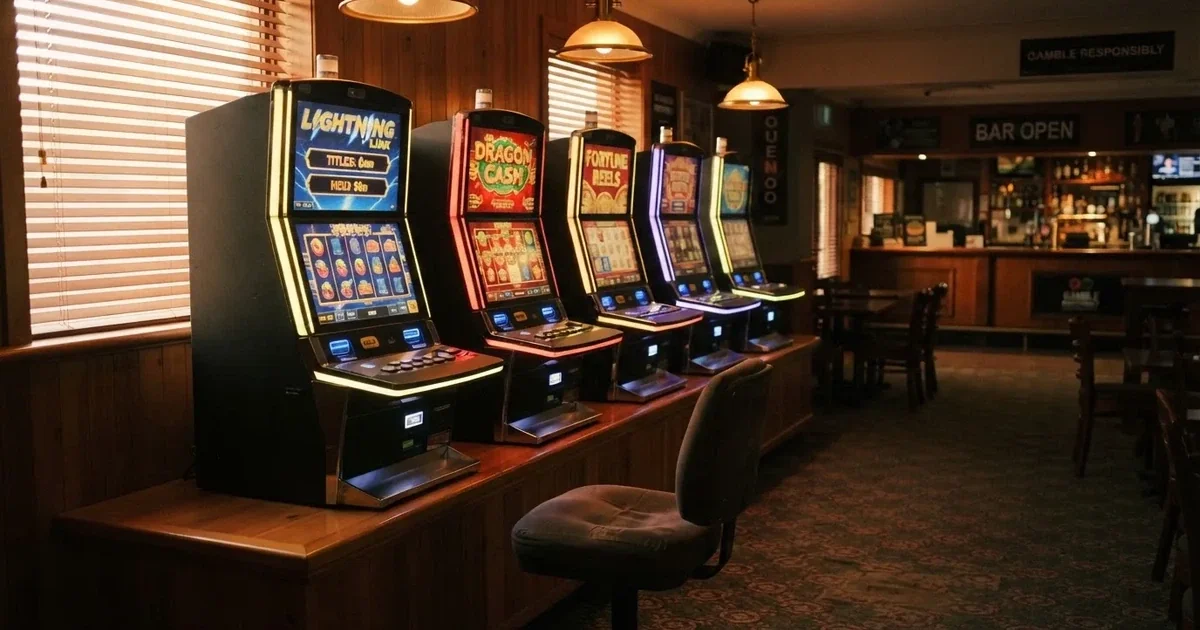
A “pokies” page written for South Australia has to do something the offshore reviews skip: explain what a player is sitting in front of when they sit down. The typical pub or club machine in the state is a conventional Australian-style electronic gaming machine — a five-reel video setup, multiple paylines, a hold button, a reserve button, and a fixed denomination set by the venue. The A$5.00 maximum bet cap applies machine-wide. A machine under that cap cannot legally offer a “max bet” feature above that line, whatever the on-screen display tries to suggest.
Adelaide Casino, sitting in the heritage-listed Adelaide railway station on North Terrace, runs on different rules. Its licence under the Casino Act 1997 allows the venue to operate machines outside the A$5.00 cap, and the licence formalised on 11 October 2013 extended the casino’s table-game monopoly to 30 June 2035. The same licence allows the venue to expand, subject to redevelopment, to up to 200 gaming tables and 1,500 gaming machines. The Riverbank precinct redevelopment worth about A$330 million added the EOS by SkyCity tower, which opened in 2021 with 120 hotel rooms and expanded gaming space. The point of those numbers is not the building — it is that the venue has its own product tier, regulated separately from the 471 pubs and clubs that hold the bulk of the state’s 11,672 non-casino machines.
The 24-hour pokies question has a South Australian answer that is narrower than the offshore marketing suggests. South Australia is not a 24-hour pokies state. Adelaide Casino runs extended hours but not a continuous floor in the way a Las Vegas property does, and the suburban pub and club trade is constrained by liquor licensing hours. “24 hour pokies South Australia open now” is a search term that returns venues whose gaming floor is open for extended sessions within licensed hours, not venues that run a continuous machine service. A player arriving at 3am expecting to find a working machine in Glenelg or Norwood will find the doors shut. That is a state-level rule, not a quirk of any particular venue.
Cashless pokies in South Australia — the state’s card-based gaming system — are a different layer of the same shelf. Players fund a card at a cashier or terminal, the machine deducts from the balance, and winnings credit back to the card for cashout at the same terminal. The system is built to support the state’s responsible-gambling tools: a player can set a time or spend limit on the card, and venue staff have access to player activity records that a coin-fed machine never produced. For anyone tracking what a session actually costs, the card’s own session record is more reliable than any “session loss” calculation run on marketing-page numbers.
The eleven brands the ACMA has named, and what that means
The brands below appear in this guide for one reason only: the Australian Communications and Media Authority issued a formal warning against the operator that runs each one, citing the offering of prohibited interactive gambling services to people in Australia. None of them is recommended as a place to play. Each entry records what the regulator published, when, and against which corporate entity. The order follows the regulator’s own file rather than any ranking criterion.
RocketPlay
The ACMA issued a formal warning to Pulsup Ltd over Rocketplay in March 2026. The same brand sits inside a longer file: an earlier ACMA action against Dama N.V. in May 2022 covered Rocketplay alongside five other casino brands operated under that corporate umbrella. The current warning names the operator as Pulsup Ltd and the service as Rocketplay. The page has no support details to add beyond that, because none of the consulted registers carry a Rocketplay listing that confirms Australian availability — a service the ACMA has warned against does not need a register to know it is unlawful here.
Level Up Casino
The ACMA’s May 2022 warning to Dama N.V. covered Level Up Casino alongside Bambet, Dazard, Wild Tornado, Cobra Casinos and Rocketplay. The consulted listings — a general gambling-in-Australia reference and the Victorian regulator’s responsible-gambling register — record the brand’s footprint on Australian-facing comparison material. They do not endorse the brand; they record that it has been marketed here. It is an unlicensed service that operates in direct violation of the Interactive Gambling Act 2001.
Woo Casino
The ACMA issued a separate formal warning to Dama N.V. over Woo Casino in March 2025, two and a half years after the May 2022 warning that covered the same operator’s other brands. The pattern is what the regulator’s own file shows: a single corporate entity rotating the brand surface while keeping the same underlying offering. The consulted reference material carries the brand name in the general gambling context. The legal position is unchanged: a brand the ACMA has warned against is offering something unlawful to Australians.
Spirit Casino
The ACMA issued a formal warning to Dama N.V. over Spirit Casino in May 2025. The consulted registers carry no Australian-facing listing for Spirit Casino specifically, which is itself a piece of information: the brand surfaces in the ACMA’s enforcement file without leaving a paper trail in the responsible-gambling registers. The product on offer is a prohibited interactive gambling service; the warning names the operator as Dama N.V., the same corporate entity that the regulator had already warned over its other brands in 2022 and over Woo Casino two months before.
National Casino
The ACMA issued a formal warning to Consolutetish S.R.L. over National Casino in July 2025. Australian-facing listings for the brand appear in mainstream media coverage and in infrastructure-policy references — the brand has been marketed here, and the consulted listings show that. The warning names Consolutetish S.R.L. as the operator. This platform remains an illegal offering with no consumer protection in Australia.
Bizzo Casino
The ACMA’s July 2025 warning to Consolutetish S.R.L. covered Bizzo Casino alongside National Casino. Bizzo Casino had an earlier paper trail: a 2022 formal warning to TechSolutions (CY) Group Limited and TechSolutions Group N.V. covering the same brand. Two operators, two warnings, one brand name — the kind of repetition that tells a reader the regulator has returned to the same offer more than once and found the same problem. The consulted registers carry no specific Australian-facing listing for Bizzo Casino beyond the general coverage.
Ignition Casino
The ACMA issued a formal warning to Bamboo Media over Ignition Casino in July 2025. The consulted registers carry no Australian-facing listing specific to Ignition Casino. The product on offer is a prohibited interactive gambling service. The warning’s content is the regulator’s own finding.
Instant Casino
The ACMA issued a formal warning to EOD Code SRL over Instant Casino in February 2025. The consulted registers carry no Australian-facing listing specific to Instant Casino. The product on offer is a prohibited interactive gambling service. The warning names EOD Code SRL as the operator.
Jackbit
The ACMA issued a formal warning to Ryker B.V. over Jackbit in April 2026. The consulted registers carry no Australian-facing listing specific to Jackbit. The warning names Ryker B.V. as the operator. A service that has been the subject of a formal ACMA warning in 2026 is one the regulator has found to be offering prohibited interactive gambling services to Australians in the same year.
Casino Intense
The ACMA issued a formal warning to Sterplay Holding Ltd over Casino Intense in April 2025. Australian-facing listings for the brand appear in mainstream media coverage and in industry trade press — the brand has been marketed here, and the consulted listings show that. The warning names Sterplay Holding Ltd as the operator.
Sky Crown
The ACMA issued a formal warning to Hollycorn N.V. over its Sky Crown casino service, as published in the regulator’s September 2022 formal-warning notice. The consulted reference material carries the brand name in the general Australian gambling context. The warning’s content is the regulator’s own finding, and the product is a prohibited interactive gambling service.
The shape of the South Australian market as it actually stands
South Australia runs a deliberately compact gambling market. Adelaide Casino, on North Terrace in the heritage railway station building, is the only licensed casino in the state. Outside it, 11,672 gaming machines sit across 471 pub and club venues as of September 2023. Players lost A$0.92 billion on those machines in 2022–23, an average of about A$497 per adult. Those are the four numbers a reader can carry into any other comparison. Every other figure on a “best pokies in South Australia” page either tracks back to one of those four, or is a marketing claim that does not.
The state regulator — Consumer and Business Services, part of the Attorney-General’s Department — handles policy, licensing and compliance for betting, casinos, gaming machines and lotteries. In December 2018 South Australia abolished the Independent Gambling Authority and consolidated gambling regulation under the Liquor and Gambling Commissioner, who is now the state’s sole gambling regulator. That consolidation matters because it gives the reader one place to point to when asking who is responsible for a venue’s conduct. The state’s gambling reforms giving South Australians greater protection from gambling harm, while aiming to keep the industry viable, took effect on 3 December 2020 — a date worth keeping because it predates the cashless card rollout and the current minimum-RTP rules.
Adelaide Casino is regulated under the Casino Act 1997, and Consumer and Business Services keeps a daily compliance presence at the venue focused on host-responsibility interactions with patrons. The Casino Act framework is different from the framework that governs the state’s pub and club machines, and the regulatory touch on a casino patron is closer than the touch on a pub patron. That difference is structural, not preferential: the casino is licensed to do things the pub cannot, and it is regulated accordingly.
The legal line and what falls on either side of it
The Interactive Gambling Act 2001, strengthened by the Interactive Gambling Amendment Act 2017, makes it an offence to provide online casino games, online pokies or in-play betting to a person in Australia. No state or territory licenses online casino games or online pokies. What is licensable is wagering on races and sport placed before the event, lotteries and keno — in practice licensed by the Northern Territory through the Northern Territory Racing and Wagering Commission. The commission regulates 52 of Australia’s online bookmakers — including Sportsbet, Bet365 and Ladbrokes — for tax reasons, and has no full-time staff, meeting once a month in Darwin. The regulatory shell that holds the licensed wagering market together is thinner than the marketing suggests.
Enforcement runs through the ACMA. The regulator investigates, issues formal warnings, and directs Australian internet service providers to block illegal sites. According to the ACMA as reported in June 2026, a total of 1,751 illegal gambling and affiliate marketing websites had been blocked since the first blocking request in November 2019. More than 230 unlicensed gambling services had left the Australian market since enforcement was strengthened in 2017. In the round reported on 26 June 2026, the ACMA asked Australian ISPs to block 12 more sites: 7Signs, ChromaBet, Donbet, Duospin, Freshbet, Slots Gem, Jacks Club, Lucky Start, Pointsbetz, Spinrise, Vinyl Casino and Wildsino. The blocking rate is a key metric for understanding the scale of the ACMA’s enforcement.
The individual player is not prosecuted. The IGA targets the provider. An offshore site gives no Australian consumer protection, no complaints body and no recourse if a withdrawal is refused. It can be blocked with a player balance still sitting on it. H2 Gambling Capital’s 2025 report estimates that Australians lose about A$3.9 billion a year to illegal gambling sites, and that the share of gambling going through legal channels fell from 74% in 2021 to 64%. The legal channel is shrinking while the illegal channel grows — a pattern that does not flatter the marketing of either side.
Player protections that work on Australian-licensed services do not reach the offshore market. BetStop, the National Self-Exclusion Register, has been live since August 2023 and binds Australian-licensed online and phone wagering services. An offshore casino is not connected to it. The National Gambling Helpline, 1800 858 858, is free and 24/7, with chat at Gambling Help Online. Those two services cover licensed wagering and any punter who reaches out, regardless of where they have been playing. They are the responsible-gambling shelf this page is built around.
How the ACMA’s blocking record works in practice
The blocking rate is what makes the ACMA’s enforcement record legible to a reader. From the first blocking request in November 2019 to the ACMA’s reporting in June 2026, a total of 1,751 illegal gambling and affiliate marketing websites have been blocked. That covers roughly six and a half years of enforcement activity. The arithmetic is rough because the ACMA’s figures are cumulative, but the band is what the page can publish: between roughly 250 and 280 sites blocked per year on average across the period, with the rate accelerating as the rounds stack up. In the single round reported on 26 June 2026, twelve more sites were blocked — a rate that, if sustained, would clear several hundred sites in a calendar year. The numbers are estimates drawn from the ACMA’s own cumulative figure and the date of the first blocking request; they describe an enforcement regime that is functioning, not one that has run out of work.
What the blocking record does not measure is the marketing reach the blocked sites had before they were blocked. An affiliate page ranking for “best pokies in South Australia” can funnel clicks for months before the ACMA’s enforcement round catches up with it. By the time the block lands, the marketing cost has been paid and the affiliate commission has already been earned. The reader pays for that lag, and the rate above — generous as it looks — does not count the months the blocked site spent at the top of a search result.
The blocking rate sits on the same shelf as the H2 Gambling Capital loss figure. Australians lose about A$3.9 billion a year to illegal gambling sites, on the 2025 estimate. At a per-site loss that would be a guess, but the volume — 230-plus services that have left the market, 1,751 sites blocked — is what the ACMA’s own record shows. A reader who lands on an offshore “pokies” page today is not seeing the full force of that record yet; they are seeing the marketing that outruns it.
The responsible-gambling shelf
Three services cover the responsible-gambling side of the South Australian picture. BetStop, the National Self-Exclusion Register, binds every Australian-licensed online and phone wagering service. A punter who registers with BetStop cannot open a new account with a licensed Australian wagering provider, and existing accounts close. The register covers licensed wagering only — a sports bettor, a phone-betting customer, an online lottery account. It does not reach an offshore casino that has no Australian licence to lose.
The National Gambling Helpline, on 1800 858 858, is free, confidential, and open 24 hours a day. Gambling Help Online runs the same service on a web chat. The helpline and chat are not betting-platform-specific — anyone can use them, regardless of where they have been playing. For a South Australian whose gambling has shifted to offshore sites, the entry point is the helpline, not BetStop. The state’s own Consumer and Business Services site points users to the same national services.
South Australia also runs state-level supports. Gambling Help Online is the federal service; the state runs its own counselling and financial counselling pathways through Health and community services. A player who has decided to stop should start with the national helpline, because it is open now, and the state services will pick the call up from there. The order matters: the 24/7 line is the one a reader can act on at 2am, and the rest of the system is built to take that first call.
For anyone tracking session-level activity, the cashless card on a South Australian pub or club machine produces a session record a player can ask the venue for. The record is more reliable than any “session loss” calculation built on marketing-page numbers, because it is the machine’s own log. A player can set a time or spend limit on the card before the session starts. The card is the responsible-gambling tool the state has actually built into the venue.
Where to play in person, and where the law puts you
The licensed pokies venues in South Australia fall into two clear categories. Adelaide Casino, on North Terrace, is the only licensed casino and the only venue with machines outside the A$5.00 per-spin cap. The casino’s licence, formalised on 11 October 2013 under the Casino Act 1997, runs to 30 June 2035. The casino has 90 gaming tables and 950 gaming machines, with expansion headroom to 200 tables and 1,500 machines subject to redevelopment. The Riverbank precinct redevelopment, worth about A$330 million, added the EOS by SkyCity tower with 120 hotel rooms and expanded gaming space when it opened in 2021. The casino sits inside the heritage railway station building, has been through the SkyCity branding (renamed SkyCity Adelaide in April 2001, reverted to Adelaide Casino in 2009), and was sold to SkyCity Entertainment Group in June 2000. The tax contribution to the state in 2007–08 alone was more than A$41 million. The casino’s daily compliance presence is run by Consumer and Business Services.
Outside the casino, 471 pub and club venues hold the remaining 11,672 machines as of September 2023. Each of those machines runs under the A$5.00 maximum bet and the 87.5% minimum RTP. The cashless card technology is rolling out across the network. A player looking for the closest venue can ask the venue directly, since the cashless card system logs which venue a balance was loaded at. For anyone with a question about a venue’s licence, Consumer and Business Services is the regulator to contact.
The minimum age across all South Australian gambling venues is 18. The federal prohibition on providing online casino games to Australians does not have a separate age threshold — it is a prohibition on the provider, full stop. The age rule and the prohibition work together: a venue that is licensed to offer the product is bound by the 18+ requirement, and a venue that is not licensed is bound by the prohibition that applies regardless of age.
How to read an offshore “best pokies in South Australia” page
An offshore page that ranks “best pokies in South Australia” is offering something that does not exist in the jurisdiction it names. The product is a prohibited interactive gambling service. The brand being ranked has either been the subject of an ACMA formal warning, has had a balance blocked when the ACMA directed ISPs to block its URL, or is currently being marketed in Australia while the regulator’s file on it grows. A reader who lands on such a page and clicks through is, at best, looking at a comparison of unlawful products ranked by criteria the operator itself chose, and at worst, looking at a site that will be blocked before the reader’s first withdrawal clears.
The “best” in any ranking like this is a marketing word. It has no return-to-player meaning, no volatility meaning, no state-regulator meaning. South Australia sets the RTP and the bet cap; an offshore site cannot offer a higher RTP than the state-licensed machine down the road, because it does not run a state-licensed machine. The “best” on an offshore page is whichever brand has paid the affiliate for the click. The reader pays for the click too, when the site is blocked mid-session.
The cleanest test for any reader is the licence. A licensed South Australian pokies venue has a name and a licence number that Consumer and Business Services can confirm. An offshore site has a Curacao or Anjouan registration that confirms nothing about the player’s protection in Australia. The first licence is enforceable in the state; the second is not enforceable at all.
What the cashless card actually does
The South Australian cashless card system is the state’s attempt to modernise the venue-side gambling experience. Players fund a card at a venue terminal, play to a balance, and cash out at the same terminal. The card can hold a pre-set spend limit and a session time limit, both configurable before play. The card produces a session record the venue holds, which the player can request. For any player who has tried to track a session by hand, the card is the first tool that does it accurately.
The system also ties the venue’s responsible-gambling duties to the data the machine produces. A venue that sees a player load and drain a card repeatedly in a single day has a host-responsibility trigger that a coin-fed machine never produced. Consumer and Business Services’ daily compliance presence at Adelaide Casino is the model the pub and club network is moving toward, and the cashless card is what makes that model scalable across 471 venues. The card is not a marketing gimmick — it is a regulatory tool the state is putting inside every machine.
For a player choosing between venues, the card system narrows the comparison. A venue running cashless machines offers tools a venue without them does not. A venue that resists the rollout, or runs older machines alongside newer ones, offers a thinner set of player protections under the same licence. The card is not a “feature” in the marketing sense — it is the responsible-gambling shelf, applied.
How the offshore market treats the comparison anyway
The ACMA’s file on Dama N.V. tells the comparison’s story better than any marketing page does. Dama N.V. was the subject of a May 2022 formal warning covering six casino brands: Bambet, Dazard, Level Up, Rocketplay, Wild Tornado and Cobra Casinos. The same operator was warned again in March 2025 over Woo Casino and in May 2025 over Spirit Casino. Across three years, the same corporate entity ran eight different brand surfaces, was warned over each in turn, and continued to operate under fresh names between warnings. A reader who lands on one of those brand names in 2026 is looking at the latest surface of an operator the regulator has returned to repeatedly.
The same pattern repeats at Consolutetish S.R.L. — a July 2025 warning over National Casino and Bizzo Casino, where Bizzo had already been warned under different operators in 2022. EOD Code SRL, Bamboo Media, Sterplay Holding Ltd, Hollycorn N.V. and Pulsup Ltd each appear in the ACMA’s file with their own brand surfaces. The pattern across all of them is the same: a corporate entity, a fresh brand, a formal warning, and a marketing presence that often outruns the regulator’s response.
For a reader, the lesson is mechanical. The brand on the page is not the operator behind it. The licence the brand displays is not enforceable in Australia. The regulator’s file is the only Australian-side record of who is actually behind any given brand, and the file is what this page has built its operator section on. Any comparison an offshore page offers is, by definition, a comparison the regulator has already weighed in on.
The audit this page is built on
A reader who wants to check the underlying record has three places to start. Consumer and Business Services, on cbs.sa.gov.au, carries South Australia’s gambling regulator material — the licensing framework, the cashless card rollout, and the host-responsibility policy that binds every licensed venue in the state. The ACMA’s formal-warning register, on acma.gov.au, carries the operator names and dates that this page cites. The Australian Government’s BetStop site carries the National Self-Exclusion Register’s enrolment pathway and the list of Australian-licensed wagering providers bound by it. The three sources are the Australian-side record. An offshore “best pokies in South Australia” page cites none of them, because none of them carry what the offshore page is selling.
Where this leaves a reader
A punter in South Australia who wants to play pokies has two honest options. They can play at Adelaide Casino, where the licence is South Australian, the regulator’s daily compliance presence is on-site, and the maximum-bet cap does not apply. Or they can play at one of the 471 pub and club venues outside the casino, where the A$5.00 maximum bet and 87.5% minimum RTP are the rules and the cashless card produces the session record. Both options are licensed. Both are inside the framework the state’s regulator enforces. The cashless card, the host-responsibility policy, and the BetStop register all apply.
The third option — an offshore “pokies” site reached through an affiliate page — is not an option under Australian law. The Interactive Gambling Act 2001 makes the offering unlawful. The ACMA’s enforcement record, with 1,751 sites blocked and 230-plus services having left the market, is the regulator’s response. H2 Gambling Capital’s estimate that A$3.9 billion a year is lost to illegal gambling sites is what the record costs the country. The reader’s cost is the lack of recourse when a withdrawal stalls, the lack of an Australian complaints body, and the chance that the site is blocked before the session ends. The comparison an offshore page offers is built on none of those costs.
The page that follows the FAQ below covers the questions most often asked about pokies in South Australia, drawn from the same record this page is built on.
Frequently Asked Questions
Which venues in South Australia are licensed to operate pokies?
Adelaide Casino, on North Terrace in the heritage railway station building, is the state’s only licensed casino. Outside the casino, 11,672 gaming machines operate in 471 pub and club venues as of September 2023. Every licensed venue in the state is regulated by Consumer and Business Services, part of the Attorney-General’s Department, under the framework consolidated under the Liquor and Gambling Commissioner in December 2018.
Are pokies in South Australia available around the clock?
South Australia is not a 24-hour pokies state. Adelaide Casino runs extended hours but not a continuous floor in the way a Las Vegas property does, and the suburban pub and club trade is constrained by liquor licensing hours. A player arriving at 3am will find the doors of a suburban pub shut, and the casino’s floor runs on a schedule set by its licence, not on demand.
What identification do venues in South Australia require before letting someone play pokies?
The minimum age across all South Australian gambling venues is 18. Venues are required to verify age before entry to the gaming floor and to refuse entry to anyone who cannot produce acceptable identification. The cashless card system produces a session record tied to the player, and Consumer and Business Services’ daily compliance presence at Adelaide Casino enforces the age rule on the casino floor.
Can visitors to South Australia use self-exclusion schemes at local pokies venues?
BetStop, the National Self-Exclusion Register, has been live since August 2023 and binds every Australian-licensed online and phone wagering service. A visitor who has registered with BetStop cannot open a new account with a licensed Australian wagering provider. The register covers licensed wagering only — it does not reach an offshore casino that has no Australian licence to lose, but venue staff at Adelaide Casino and at any pub or club can refuse entry to anyone on the state-level exclusion list.
How does the payout percentage on South Australia pokies compare with other Australian cities?
South Australia sets a minimum gaming-machine return-to-player rate of 87.5% outside Adelaide Casino, and a general maximum bet of A$5.00 per spin. Adelaide Casino is exempt from the per-spin cap. Queensland had 21,122 gaming machines operating in 351 venues in October 2023, with Brisbane’s Star Brisbane having opened at the A$3.6 billion Queen’s Wharf precinct on 29 August 2024 after Treasury Casino closed on 25 August 2024. The comparison between states runs through each regulator’s published RTP, not through any offshore marketing claim.
Is it legal for an online casino to advertise ‘pokies’ in South Australia the same way a pub or club does?
No. The Interactive Gambling Act 2001 makes it an offence to provide online casino games, online pokies or in-play betting to a person in Australia. No state or territory licenses online casino games or online pokies. The ACMA investigates, issues formal warnings, and directs ISPs to block illegal sites — a total of 1,751 sites blocked since the first blocking request in November 2019. An online casino advertising “pokies” to an Australian is offering a prohibited interactive gambling service, whatever licence the site displays.