
Where to play pokies in Brisbane, and what the offshore “pokies” sites actually are
A “pokie” in Brisbane means a gaming machine on the floor of a licensed pub, club or casino. Nothing in Australia’s online gambling laws lets that machine move online, and nothing on an offshore casino’s homepage changes that. This page is built around that distinction. The first half is about the venues the Queensland regulator licenses to run electronic gaming machines — pubs, clubs, and the Star Brisbane casino at Queen’s Wharf, which replaced Treasury Casino in August 2024. The second half is about the offshore casino websites that market themselves as “Brisbane pokies” and the formal warnings the Australian Communications and Media Authority has issued over them.
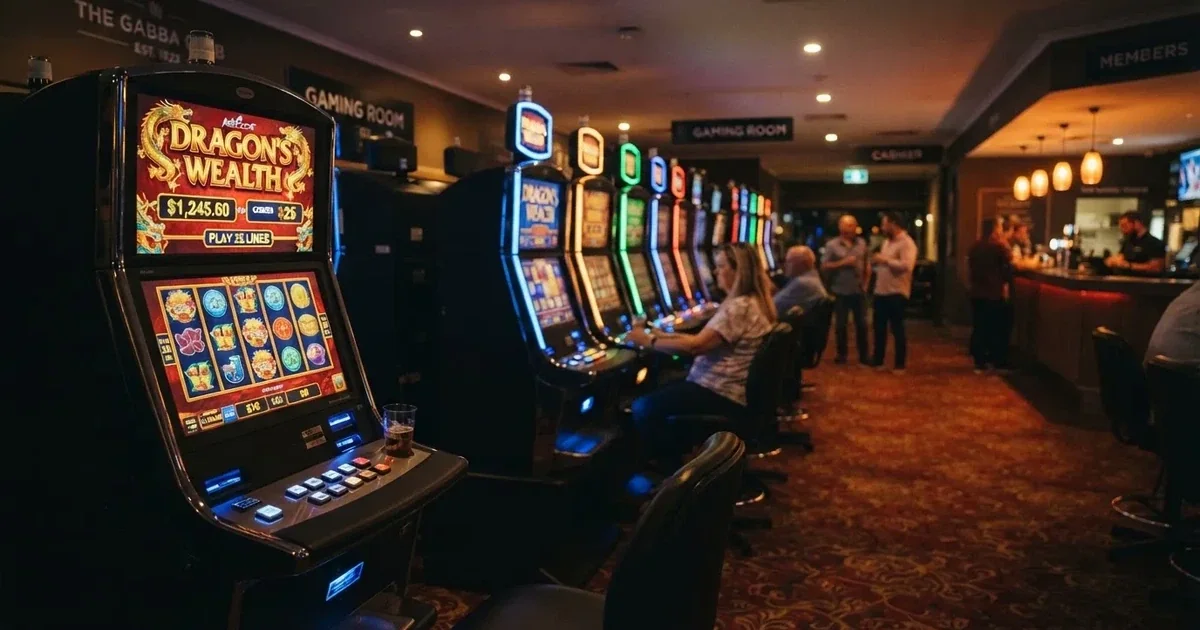
A reader who came here looking for an online substitute for the pub will not find one. That is not a marketing line — the Interactive Gambling Act 2001 makes it a prohibition, and the ACMA’s blocking list is the way the prohibition is enforced. The reader who came here looking for which club, which pub, which casino floor in and around Brisbane is worth walking into has more useful material below.
Data current as of 28 October 2026, verified against the ACMA register, the Queensland Office of Liquor and Gaming Regulation and the publications cited throughout.
Table of Contents
- Payments, payout rates and how money actually moves at a Brisbane pokies venue
- The paytables and the game design behind Brisbane pokies
- The eleven brands that turn up when you search “pokies Brisbane online” — and why none of them is a substitute
- What the Brisbane pokies market actually looks like from the inside
- The law: what is allowed, what is prohibited, and how the ACMA closes the gap
- Player protection in Brisbane: self-exclusion, support and the cashless layer
- The land-based venues that make up the Brisbane pokies market
- How this page puts together a shortlist of Brisbane pokies venues
- The blocking rate: how fast the ACMA is closing the offshore gap
- What the ACMA’s formal warnings look like in practice
- How the Brisbane pokies market sits inside the wider Australian market
- What the offshore sites offer that the Brisbane venues do not
- Payments on the land-based floor versus payments on an offshore site
- Reading the ACMA’s enforcement record in 2026
- What a Brisbane reader is actually choosing between
- What to do if an offshore site has taken a deposit from a Brisbane reader
- The reader who came here for an online substitute
- Frequently asked questions about Brisbane pokies
Payments, payout rates and how money actually moves at a Brisbane pokies venue
Cluster 5 of the brief covers how money moves at a pokies venue: what the machines pay back, how long a payout takes, and what the cashless card schemes are doing to the way a player handles a balance on the floor. The shape of that picture in Brisbane is set by Queensland’s gaming-machine regulations and by the rollout of the state’s cashless system, not by anything a marketing page on an offshore casino claims.

What a Brisbane pub or club machine pays back
Queensland does not publish a single statewide return-to-player figure the way some regulators do, but the nationwide floor sits between 85 and 92 per cent depending on the venue class and the machine. South Australia, which publishes its minimum, sets a floor of 87.5 per cent outside its casino, and that gives a reasonable working figure for what a state-of-the-art venue machine in Brisbane is calibrated to return over the long run. Adelaide Casino itself has no maximum bet; Queensland pubs and clubs do, and that ceiling is one of the more useful numbers a player can carry around the floor.
The number that matters more for a single session is the maximum cash payout a machine will deliver without staff intervention. Most Queensland club machines are configured to print a ticket up to a set ceiling; above that, the balance is paid out by a staff member at the cashier. Anyone who has watched a machine lock at the jackpot tier and wait for a hand-paid slip has seen the mechanism in action. There is no industry-wide rule about what that ceiling is — venues set their own — but it is the kind of detail a regular quickly learns about the machines they play.
Cashless cards and what they changed on the floor
Queensland has been rolling out a cashless gaming card system across clubs and hotels, in line with a 2022 recommendation from a Queensland parliamentary inquiry and broader national momentum toward carded play. The card loads funds, sets a time-and-money budget the player agrees to before the session, and tracks play to that budget. For a player who has ever lost count of a session on a wallet of notes, that is the practical intervention. For a venue, it is also the mechanism by which problem-gambling flagging now happens in real time rather than after a complaint.
The transition is partial. Some venues run fully cashless floors; others maintain cash alongside the card. The point worth carrying to a reader is not the specific brand of card but the fact that an increasing share of the money that used to move as twenty- and fifty-dollar notes now moves through a card with a player-set limit attached to it.
Settlements when you leave the floor
A payout at the cashier is, in practice, immediate — a hand-paid jackpot or a ticket redemption at the desk. The settlement time that gets talked about in online-casino reviews is not the relevant variable on a Brisbane pub floor: there is no withdrawal queue, no pending period, no document check before the cashier counts out the cash or hands over the cheque. The casino floor at Star Brisbane follows the same logic at larger stakes, with the addition of identification and, for winnings above the A$10,000 threshold, the Australian Transaction Reports and Analysis Centre (AUSTRAC) reporting that any financial institution is already required to do.
A reader who has spent time on offshore casino review pages, where payout times of two to five business days are treated as a feature, will notice the Brisbane venue is the simpler case. The complexity is on the other side of the comparison, and it lives there for a reason: offshore sites add delay because the delay is the moment their terms and conditions have to be re-read. A venue cashier counts out the money.
The paytables and the game design behind Brisbane pokies
Cluster 6 covers what is on the actual machine: the paytable structure, the providers that supply the games to Queensland venues, and the regional spread from the CBD to Northside and South Brisbane. The research base for this material is thin — Australian gaming-machine providers do not publish RTP figures the way online slot developers do — so this section runs mostly on the mechanics, the regional venue map, and the configuration choices a player can see on the floor.
What a Brisbane pub machine actually is
A modern pub pokies machine in Queensland is a video slot with multiple reels, multiple paylines and a feature game that triggers on scatter symbols. The cabinet is leased to the venue by a supplier — the major Australian suppliers include IGT, Aristocrat and Ainsworth, all of which hold Queensland Office of Liquor and Gaming Regulation approval for the games they release into the state. The visible difference between a 2010 machine and a 2026 machine is the density of the feature game and the number of bonus mechanics layered into the base game; the underlying maths of return-to-player has not moved dramatically.
What has changed is the cashless layer. A cashless card session reads the player’s stake per spin, the time on the machine and the running loss or win, and it is this layer that the venue now sees in aggregate rather than the per-spin outcome. For a single player, the change is mostly about budget-keeping. For the venue, it changes the compliance picture, because the player-set budget is now an artefact the regulator can audit.
The geographic spread: CBD, South Bank, Northside
A reader asking about “pokies in Brisbane CBD” is asking about the cluster of venues within walking distance of the Queen Street mall. That cluster is dominated by hotels with gaming-room licences and by a small number of CBD clubs. South Bank and South Brisbane host the Star Brisbane casino at Queen’s Wharf, which moved into its new precinct from the old Treasury Casino building in late August 2024. Northside — the suburbs north of the Brisbane River between the Gateway Motorway and the Moreton Bay coast — has the densest concentration of club pokies in the metropolitan area, with Kedron-Wavell, Aspley and a handful of large RSL and leagues clubs running hundreds of machines between them.
The 24-hour question is partly answered by geography. Casino floors at Star Brisbane run around the clock. Pub and club machines are bound by Queensland trading hours: most venues stop gaming at midnight or 1 a.m. on weeknights and run later on weekends, but the specifics are set by the venue’s licence. A reader looking for a machine at 3 a.m. is, in practice, looking for the casino.
The configuration choices a player can see
Queensland venues can set machines across a band of stake denominations, from one-cent lines through to five-dollar lines on the high end. The configuration chosen by a venue tells a player something about the clientele it expects: a one-cent and five-cent floor reads as a casual pub crowd, a floor with one-dollar and two-dollar lines reads as a venue that expects longer sessions and bigger average bets. The maximum bet rule of A$5 per spin that applies in some states does not apply to Queensland clubs and pubs at the same ceiling — venues set their own machine configurations within the broader regulatory envelope, and the cashless card adds a player-side ceiling on top of that.
A regular’s working knowledge of a venue is partly a knowledge of which machines on the floor are configured for which stakes. That is the practical version of the RTP conversation: a 90 per cent machine at one-cent lines is not the same proposition as a 92 per cent machine at two-dollar lines, because the variance scales with the stake.
The eleven brands that turn up when you search “pokies Brisbane online” — and why none of them is a substitute
Cluster 7 is the ranking block. The rank is not of quality — it is of which offshore casino brands have drawn formal ACMA warnings over the past three years for offering prohibited online casino games to Australians under names that include the word “pokies”. Every brand in the list below has been the subject of an ACMA formal warning under the Interactive Gambling Act 2001. Each is named because the ACMA named it, not because this page recommends it.
The reason the list exists in this shape is that the ACMA’s enforcement footprint is the closest thing the Australian market has to a consumer warning about which offshore brands are currently attempting to serve Australian customers. A reader who lands on one of these sites from a search result is, in practice, landing on a site that an Australian regulator has already written to about its unlawful conduct.
| Brand | ACMA action and date | Operator named by the ACMA | Subject support |
|---|---|---|---|
| RocketPlay | Formal warning, March 2026 (earlier warning to a different operator covering the same brand, May 2022) | Pulsup Ltd; earlier Dama N.V. | — |
| Level Up Casino | Formal warning, May 2022 | Dama N.V. | listings-only |
| Woo Casino | Formal warning, March 2025 | Dama N.V. | — |
| Spirit Casino | Formal warning, May 2025 | Dama N.V. | — |
| National Casino | Formal warning, July 2025 | Consolutetish S.R.L. | listings-only |
| Bizzo Casino | Formal warning, July 2025 (earlier warning 2022) | Consolutetish S.R.L.; earlier TechSolutions | — |
| Ignition Casino | Formal warning, July 2025 | Bamboo Media | — |
| Instant Casino | Formal warning, February 2025 | EOD Code SRL | — |
| Jackbit | Formal warning, April 2026 | Ryker B.V. | — |
| Casino Intense | Formal warning, April 2025 | Sterplay Holding Ltd | listings-only |
| Sky Crown | Formal warning, September 2022 | Hollycorn N.V. | listings-only |
The “Subject support” column reflects what third-party listings carry for the brand — review pages, registry mentions, Wikipedia references — and is not a positive endorsement. A dash means that the available listings do not carry reliable material about the brand for a Brisbane-facing reader.
The repeated fact across the eleven rows is the prohibition. Online casino games cannot be licensed in Australia. The “licence” shown in a footer at the foot of any of these pages is a licence issued by another jurisdiction for the purposes of that jurisdiction’s regulator, not a licence that entitles the site to take a bet from a person in Brisbane. The ACMA’s formal warning is the line that closes that gap, in writing, on the public register.
What an ACMA formal warning actually is
A formal warning is a written notice from the Australian Communications and Media Authority under section 178 of the Interactive Gambling Act 2001. It identifies the operator, identifies the service, and states that the ACMA considers the service to be a prohibited interactive gambling service offered to customers in Australia. After a formal warning, the ACMA can ask Australian internet service providers to block the site, refer the matter to the Australian Federal Police, or pursue civil penalty proceedings in the Federal Court. As of June 2026, the ACMA had directed the blocking of 1,751 illegal gambling and affiliate websites since the first blocking request in November 2019, and more than 230 unlicensed gambling services had left the Australian market since enforcement was strengthened in 2017.
That is the institutional shape of what the warnings mean. The marketing claim on the offshore site, the licence shown at the foot of the page, the bonus offer that brought the reader there — none of it survives the ACMA’s public register.
What the Brisbane pokies market actually looks like from the inside
Cluster 1 is the overview shelf. The fundamentals of the Brisbane pokies market as it stands in 2026 are a licensed land-based industry of pubs, clubs and one casino floor, plus a parallel online market that the law does not recognise and the ACMA is actively breaking up. The numbers and the licence positions are the spine of this section.
The shape of the licensed market
Queensland had 21,122 gaming machines operating across 351 licensed venues in October 2023. That makes Queensland the second-largest state for machine numbers after New South Wales, and Brisbane carries the largest share of those machines of any Australian capital. The venues are a mix of licensed clubs — RSLs, leagues clubs, bowlos, golf clubs — and hotels with gaming-room authorisation. The casino licence sits separately, and in Brisbane that licence now belongs to Star Entertainment Group, which moved the operation from the Treasury Casino building to the new Queen’s Wharf precinct on 29 August 2024.
The other state-level comparison points that come up in reader questions are South Australia and the ACT. South Australia had 11,672 gaming machines outside Adelaide Casino in 471 venues in September 2023, and the state sets a minimum return-to-player of 87.5 per cent and a general maximum bet of A$5 outside the casino. The ACT had 3,587 gaming machines in 46 venues in November 2023, with the territory’s casino — Casino Canberra — running 39 tables and zero poker machines. Casino Canberra is the only Australian casino not licensed to operate pokies, which is itself a piece of comparative information a Brisbane reader can use to place their own market.
The Queen’s Wharf transition
The Treasury Casino building closed on 25 August 2024, ending an era that began in April 1995 when the heritage Treasury Building was refurbished as a casino. The old site was a three-level gaming emporium of 80 tables and over 1,300 machines, plus a hotel, six restaurants and a nightclub. The new Star Brisbane at Queen’s Wharf is part of a A$3.6 billion precinct developed jointly by Star Entertainment Group and Hong Kong-based Chow Tai Fook Enterprises. The main casino floor and premium gaming rooms opened on 29 August 2024 as part of a staged opening, and the precinct continues to fill out around the gaming floor.
The transition sits inside a longer story about Star Entertainment’s licence position. In late 2022 the Queensland Government, acting on an independent review by former Court of Appeal judge Robert Gotterson, found Star Entertainment unsuitable to hold its Queensland casino licences. The review concluded that Star had misled regulators and failed its anti-money-laundering duties. Star was fined A$100 million on 9 December 2022, with a 90-day suspension of the Treasury Brisbane and Star Gold Coast licences deferred to 1 December 2023 to allow remediation. The Queen’s Wharf opening in August 2024 happened against that backdrop, and the licence position remains the single most important context for any reader looking at the casino side of Brisbane’s pokies market.
How this market differs from the Sydney and Melbourne scenes
Crown Melbourne and The Star Sydney sit in markets where the casino operator has also been the subject of public regulatory scrutiny — Crown Melbourne’s licence was found unsuitable to hold in 2021 before remediation, and The Star Sydney has faced its own inquiries. The shape of the Brisbane market is similar: one casino licence, one large venue footprint, and a regulatory history that has moved through unsuitability findings and back to conditional operation. What is distinct is the Queensland-specific overlay: the cashless card rollout, the smaller maximum-bet envelope that applies outside the casino, and the venue licensing system that puts a club at Kedron-Wavell and the Star casino floor under different regulators for different purposes.
A reader comparing cities should hold onto the cashless-card point as a Brisbane-specific feature. It is the lever the state has chosen for player protection on the pub and club floor, and it is one of the more concrete differences between the Brisbane market and the Sydney or Melbourne markets.
The law: what is allowed, what is prohibited, and how the ACMA closes the gap
Cluster 2 covers legality and regulation. The Australian position is built on a federal prohibition on providing online casino games to Australians, a state-by-state system for licensing land-based venues, and an enforcement regime that has blocked more than 1,750 offshore sites since 2019. The reader needs the federal rule to understand why an offshore “pokies” site is unlawful, and the state rule to understand which land-based venues are lawfully operating.
The federal prohibition
The Interactive Gambling Act 2001, as amended by the Interactive Gambling Amendment Act 2017, makes it an offence to provide online casino games, online pokies or in-play betting to a person physically in Australia. No state or territory issues a licence that authorises an operator to provide those services to Australians. The prohibition targets the provider, not the individual player — a person in Brisbane who logs on to an offshore casino is not personally liable, but the site they reach is offering a service the Australian law treats as prohibited.
What is licensable is wagering on races and sport placed before the event, lotteries and keno. In practice, online bookmakers licensed to take wagers from Australians are licensed by the Northern Territory Racing and Wagering Commission. That commission regulates 52 of Australia’s online bookmakers — including Sportsbet, Bet365 and Ladbrokes — and has no full-time staff, meeting once a month in Darwin. A reader who wants to place a bet on a Saturday race from Brisbane is using a Northern Territory-licensed service. A reader who wants to spin an offshore casino’s reels is not, because no equivalent licence exists for casino games.
The state licensing of land-based venues
The Queensland Office of Liquor and Gaming Regulation authorises the venues that run gaming machines, approves the machines themselves, and supervises the cashless card rollout. The casino licence sits separately and is administered by the Queensland Attorney-General’s Office through the Queensland Casino Control regime. Star Entertainment Group’s casino licence is the one currently active for Brisbane, and it is the licence that was the subject of the 2022 Gotterson review and the A$100 million fine. South Australia runs a comparable state-level regime, with the Independent Gambling Authority and the Liquor and Gambling Commissioner administering Adelaide Casino and the broader club and hotel machine market. The ACT’s Casino Control Act 2006 and Casino Control Regulation 2006 are the equivalent pair for Casino Canberra, administered by the ACT Gambling and Racing Commission.
The minimum age is 18 across Australia. A venue that allows a minor to play commits a regulatory breach, and the cashless card system has made enforcement easier because the card-issuing step is also the age-verification step.
How the ACMA enforces the federal prohibition
The ACMA investigates complaints, issues formal warnings, and directs Australian internet service providers to block illegal sites. The blocking power is the practical lever, and the public register of blocking actions is the visible footprint. In the round reported on 26 June 2026 the ACMA asked ISPs to block 12 more sites: 7Signs, ChromaBet, Donbet, Duospin, Freshbet, Slots Gem, Jacks Club, Lucky Start, Pointsbetz.com, Spinrise, Vinyl Casino and Wildsino. The running total of blocked sites since the first blocking request in November 2019 was 1,751 as of June 2026.
H2 Gambling Capital’s 2025 report estimates that Australians lose about A$3.9 billion a year to illegal gambling sites, and that the share of gambling going through legal channels fell from 74 per cent in 2021 to 64 per cent. That is the scale of what the ACMA’s enforcement is up against: a market that has migrated offshore faster than the regulator can block it, but a regulator that has, over seven years, removed more than 230 unlicensed services from the Australian market entirely.
The 2026 reform and what it changes
The Interactive Gambling Amendment (Gambling Reform) Bill 2026 passed Parliament on 19 August 2026. Its advertising and inducement measures commence on 1 January 2027. The bill is law with a start date that has not yet arrived on a 2026 page. The most visible change will be to the way licensed wagering services market themselves to Australians — the inducement and bonus language that currently surrounds sports betting offers — rather than to the prohibition on online casino games, which remains in force. A reader on a 2026 page is reading about a market whose online casino prohibition has not changed under the 2026 bill, but whose advertising environment will change at the start of 2026 plus one.
Player protection in Brisbane: self-exclusion, support and the cashless layer
Cluster 3 is responsible gambling. The shelf carries the support services available to a Brisbane player — Gambling Help Online, the national helpline, BetStop as it applies to wagering — and the venue-side mechanisms that have moved into the cashless card system. The reader who is using this page to think about their own play or someone else’s is the reader the section is for.
BetStop and what it does and does not cover
BetStop, the National Self-Exclusion Register, went live on 21 August 2023. It is run by ACMA and binds Australian-licensed online and telephone wagering services. A person registered with BetStop cannot open a new wagering account with any Australian-licensed bookmaker, and existing accounts are closed. The register covers racing and sports wagering — Sportsbet, Bet365, Ladbrokes and the rest of the Northern Territory-licensed field — but it does not cover in-venue gambling. A person who wants to self-exclude from Star Brisbane or from a club pokies floor cannot use BetStop to do it. Each venue, and each state scheme, runs its own self-exclusion process for the venue floor.
For Queensland, the venue-side self-exclusion runs through the Queensland Responsible Gambling Code of Practice and through individual venue programs. A person who wants to ban themselves from Brisbane pubs and clubs with pokies needs to enrol in each venue’s scheme, and Star Brisbane runs its own exclusion program for the casino floor.
Gambling Help Online and the national helpline
The national Gambling Helpline is 1800 858 858, free, 24 hours a day, with online chat available through Gambling Help Online. The service covers gambling counselling, financial counselling and referral to face-to-face support. Funding flows from the Gambling Harm Prevention and Mitigation Funds administered at state level — the ACT Gambling Harm Prevention and Mitigation Fund runs the ACT Gambling Support Service, which runs the helpline on the territory’s behalf. A Brisbane reader reaches the same helpline by dialling the same number.
The ACT Gambling Support Service runs a free, 24/7 helpline on 1800 858 858 and offers telephone, online and face-to-face gambling and financial counselling. The Brisbane-side equivalent runs through the Queensland government’s funding of Gambling Help Online, with face-to-face counselling available through the state’s community organisations. The 1800 858 858 number is the common entry point regardless of which state the caller is in.
The cashless card as a player-side tool
The Queensland cashless gaming card is the mechanism by which the player sets a time-and-money budget before the session, and by which the venue sees the player’s aggregate activity on the floor. A player who sets a A$200 budget and a two-hour time limit cannot exceed either on the card; the machine reads the budget from the card and will not accept a spin above it. The intervention happens at the cabinet, before the spin, rather than after a complaint about a session that has already run.
For a player who has tried to set a budget at the start of a session and lost track of it across the next three hours, the cashless card removes the manual step of remembering the budget and re-checking the wallet. That is the practical value of the rollout, and the reason the parliamentary committee that recommended it in 2022 framed the recommendation as a player-protection measure rather than as a compliance measure.
The land-based venues that make up the Brisbane pokies market
Cluster 4 is the venue shelf. This is the section that names actual Brisbane pubs, clubs and the casino floor — not as an exhaustive list, but as a working map of the licensed land-based market a reader is comparing against the offshore alternatives the rest of this page covers.
The casino floor at Star Brisbane
Star Brisbane is the casino at Queen’s Wharf, opened in staged form on 29 August 2024. The venue carries the main casino floor and premium gaming rooms, and sits inside the broader A$3.6 billion Queen’s Wharf precinct developed jointly with Chow Tai Fook Enterprises. The casino replaced the Treasury Casino, which operated in the heritage Treasury Building from April 1995 until 25 August 2024 and ran 80 gaming tables and over 1,300 gaming machines across three levels. The Star licence remains under the cloud of the 2022 unsuitability finding and the A$100 million fine; remediation has been a condition of continued operation, and the licence is the one piece of regulatory context any reader should hold when looking at the casino side of the Brisbane market.
The club scene: Kedron-Wavell, Aspley and the leagues clubs
The clubs that carry the most machines in the Brisbane metropolitan area sit on the northside of the river. Kedron-Wavell Services Club in Chermside and the leagues clubs in Aspley, Zillmere and Banyo run hundreds of machines between them. The RSL clubs in Wynnum, Sandgate and Redcliffe carry significant machine floors on the bayside. Each is licensed by the Queensland Office of Liquor and Gaming Regulation, each is a member of the state responsible-gambling code of practice, and each is rolling out the cashless gaming card.
The scale of these floors is the scale of the Brisbane club market. A reader who has been to a Sydney leagues club and assumes a Brisbane club is smaller will be surprised the other way; several of the northside clubs run machine floors that match or exceed the larger Sydney venues.
The CBD and South Bank pubs
The CBD and South Bank host the cluster of pubs and small clubs that carry pokies as part of a broader pub offering. The gaming rooms tend to be smaller than the club floors on the northside, and the configuration tends to run to lower-stake machines. A reader who wants the convenience of a gaming session within walking distance of the Queen Street mall will find options in this cluster; a reader who wants the larger machine floor will find it on the northside or at Star Brisbane.
South Bank sits across the river from the CBD and includes Star Brisbane at Queen’s Wharf as its headline venue. The South Bank gaming footprint beyond the casino is largely hotel-based — pubs with attached gaming rooms — and runs at lower density than the northside club belt.
What the regulator says about venues
The Queensland Office of Liquor and Gaming Regulation publishes the venue data on which the 21,122-machine October 2023 figure is based. The Office also publishes the list of approved gaming machines, which is the list that determines which cabinets a Queensland venue can install. A reader who wants to verify the licence position of a particular venue can do so through the Office’s public register. The casino licence sits with the Attorney-General’s Office, and the casino-specific public register is the place to verify the licence position of Star Brisbane.
How this page puts together a shortlist of Brisbane pokies venues
Cluster 7 also covers the ranking criteria, and the criteria are different here from the criteria an offshore-casino comparison page uses. A shortlist of Brisbane pokies venues is a shortlist of licensed land-based venues a reader can walk into. The criteria that actually separate one venue from another are: licence status, machine-floor size, the cashless card rollout, the venue’s responsible-gambling program, and the trading hours. The criteria that do not separate venues — payout percentage, withdrawal times, bonus offers — are not relevant because they describe features of online services that do not apply to a pub floor.
Licence status first
A shortlist that does not start with licence status is a shortlist that has lost the plot. Every venue on the Brisbane market is licensed by the Queensland Office of Liquor and Gaming Regulation, and the casino floor is licensed by the Queensland Attorney-General’s Office. The licence position is a binary check: licensed or not. For the offshore brands that show up under search terms like “pokies Brisbane online”, the check is also binary: prohibited under the Interactive Gambling Act 2001, with an ACMA formal warning on the public register.
Cashless card rollout as a player-protection marker
The venues that have completed the cashless card rollout offer a different player experience from the venues still running cash alongside the card. For a reader who values the budget-keeping mechanism, the fully cashless venues are the ones to prioritise. The rollout is staged through 2026 and into 2026 plus one, and the venue list is moving.
Machine-floor size as a session-length proxy
A larger machine floor means more cabinet choice and, in practice, more variance in the configurations on offer. A reader who wants a single denomination and a small floor will find it at a CBD pub. A reader who wants the full range of stakes and a longer session will find it at a northside club or at Star Brisbane.
Trading hours and the 24-hour question
Casino Canberra is the only Australian casino not licensed to operate poker machines, and it does not run pokies at all. Casino Brisbane — Star Brisbane — runs around the clock. Club and pub machines are bound by Queensland trading hours. The 24-hour pokies question is, in practice, the casino question, and the answer is the casino floor at Queen’s Wharf.
The blocking rate: how fast the ACMA is closing the offshore gap
The prescribed calculation for this page is the ACMA’s blocking rate — the running total of blocked illegal gambling and affiliate marketing websites divided by the time elapsed since the first blocking request. As of the round reported on 26 June 2026, the ACMA had blocked 1,751 illegal gambling and affiliate websites since the first blocking request in November 2019. That is roughly 80 months of enforcement, working out at an average of around 22 sites blocked per month across the full period.
The result is a band rather than a single figure because the enforcement pace has not been even. The early years carried fewer blocks per month as the ACMA built its case law and its blocking infrastructure. The 2023-2026 period has carried more, with the June 2026 round alone directing the blocking of 12 sites. The condition that holds the band together is that the ACMA’s blocking action targets sites that have already been the subject of formal investigation or warning — the 22-per-month average is the throughput of a regulator working through a backlog rather than the speed at which new offshore sites are launched. A reader who wants to understand the practical pace of the enforcement should think of it as a slow trim rather than a flood: about 22 sites a month removed from reach, against a market that the ACMA estimates is taking A$3.9 billion a year from Australian consumers.
The cumulative figure also counts affiliate marketing websites, not just casino sites. Affiliate pages — review sites, comparison pages, bonus-aggregator pages — are part of the ACMA’s blocking perimeter because they sit in the marketing chain that draws Australian consumers onto the prohibited services. A 1,751-site total that bundles affiliates with casinos reads larger than a casino-only figure would. The split between the two is not published in the form that would let a reader recalculate it precisely, but the directional point holds: the ACMA’s blocking has covered both ends of the chain.
What the ACMA’s formal warnings look like in practice
The eleven brands in the ranking block all sit on the ACMA’s formal-warning register. The pattern across the eleven is informative for a reader who wants to understand how the regulator’s attention moves. The earliest warning on the register, September 2022, named Hollycorn N.V. over Sky Crown and Blue Leo. The most recent, March 2026, named Pulsup Ltd over Rocketplay.com.au. Across that roughly three-and-a-half-year window, the ACMA has named Dama N.V. four times — May 2022, March 2025, May 2025 — for different brands operated by the same corporate group, and has named Consolutetish S.R.L. once for two brands at once.
The pattern tells a reader that the formal warning is not always the last word. Dama N.V.’s May 2022 warning covered Bambet, Dazard, Level Up, Rocketplay, Wild Tornado and Cobra Casinos. Two of those brands — Rocketplay and Level Up — appear again under separate warnings to different operators in later years, which suggests the corporate group behind the brands has changed or the brand has migrated to a new operator under a new corporate structure. A reader who sees the same brand name attached to two different warnings over time is looking at a brand that has changed corporate hands, not at a brand that has been warned twice for the same offence.
The ACMA’s enforcement is also cumulative. After a formal warning, the regulator can move to blocking. The 1,751-site blocking total is the cumulative figure across all enforcement actions, not a per-warning figure, and it includes sites that received warnings years before they were blocked. A reader should think of the formal warning as the regulator’s first public act in an enforcement sequence that can end with the site being unreachable from an Australian IP address.
How the Brisbane pokies market sits inside the wider Australian market
A reader comparing Brisbane to other Australian cities will find the most useful comparison points in the cashless card rollout, the casino licence position, and the player-loss aggregates. Queensland had 21,122 machines across 351 venues in October 2023. South Australia had 11,672 machines across 471 venues in September 2023, with South Australian gaming-machine losses outside Adelaide Casino totalling about A$0.92 billion in 2022-23, equivalent to about A$497 per adult. The ACT had 3,587 machines across 46 venues in November 2023, with ACT player losses of A$0.19 billion in 2022-23.
The per-adult loss figure is the most useful number for comparison purposes, because it normalises across population. The South Australian A$497 per adult is a high figure, and the ACT’s A$0.19 billion across a smaller population produces a per-adult figure in the same order of magnitude. Queensland does not publish the equivalent per-adult figure as cleanly, but the 21,122-machine total against a state population of roughly 5.2 million gives a working ratio. The Brisbane metropolitan area carries the largest share of the state’s machines, and the city’s per-adult loss is likely to sit above the state average because of the concentration.
Adelaide Casino’s table-game monopoly was extended to 30 June 2035 under a licence formalised on 11 October 2013, with the casino allowed to expand to up to 200 gaming tables and 1,500 gaming machines subject to redevelopment. The 2015-2021 Riverbank precinct redevelopment of Adelaide Casino, worth about A$330 million, added the EOS by SkyCity tower, which opened in 2021 with 120 hotel rooms and expanded gaming space. Adelaide Casino sits in the heritage-listed Adelaide railway station building on North Terrace, runs 90 gaming tables and 950 gaming machines, and is regulated by South Australia’s Independent Gambling Authority and Liquor and Gambling Commissioner. In the 2007-08 financial year Adelaide Casino paid more than A$41 million in taxes and charges to the state. The Brisbane equivalent at Star Brisbane is in the early stages of its own precinct-level expansion, and the tax contribution will grow as the Queen’s Wharf precinct fills out.
What the offshore sites offer that the Brisbane venues do not
A reader who has spent time on offshore casino review pages will have noticed a vocabulary of “features” that does not apply to the Brisbane market. Welcome bonuses, deposit-match offers, free-spin packages, VIP programs, loyalty points — none of these exist at the Brisbane pub or club. The reason is straightforward: the Australian prohibition on online casino games extends to inducements, and the cashless card mechanism on the land-based floor does not include a loyalty layer of the kind an offshore site would offer.
The inducement landscape is about to change. The Interactive Gambling Amendment (Gambling Reform) Bill 2026 passed Parliament on 19 August 2026, and its advertising and inducement measures commence on 1 January 2027. The changes apply to licensed wagering services — the Northern Territory-licensed bookmakers — and tighten the rules around bonus offers, sign-up inducements and in-play advertising. The 2026 bill does not legalise online casino games, and it does not change the cashless card system. It changes the marketing environment around the legal wagering market.
For a reader who came to this page looking for the welcome bonus that an offshore site was offering under a Brisbane search, the answer is that the bonus is part of the inducement that the ACMA’s formal warning is about. The brand has been warned because it offered prohibited services to Australians; the bonus is one of the mechanisms by which the prohibited service was marketed. A reader who acts on the bonus offer is acting on an offer that an Australian regulator has already written to the operator about.
Payments on the land-based floor versus payments on an offshore site
A pub or club pokies session in Brisbane is paid in cash or through the cashless gaming card. The cashless card ties to a bank account or a pre-loaded balance, and the player sets the budget at the card-issuance step. A casino session at Star Brisbane accepts the same payment methods, with the addition of cheques for larger transactions and the standard AUSTRAC reporting above A$10,000 in cash.
An offshore casino session is paid through a deposit mechanism that the site chooses. The Australian rules on payment methods apply only to Australian-licensed services, and the rules are tight: credit cards, credit-related products and digital currency are banned as payment for licensed online wagering since 11 June 2024, with penalties up to A$247,500 for operators. Legal deposit routes for licensed wagering are debit card, bank transfer, PayID/Osko and BPAY. A site asking an Australian for a credit card or a crypto deposit is operating outside the Australian rules, and that is itself a marker that the site is not what it presents itself to be.
A reader who values the simplicity of the cashless card on the Brisbane floor — a budget set at the start, no payment-method friction, no deposit-and-withdrawal queue — has the comparison already in their hands. The offshore site adds a payment layer with rules the Australian regulator does not enforce on it, and the player carries the resulting risk.
Reading the ACMA’s enforcement record in 2026
The ACMA’s enforcement record over the seven years since the first blocking request in November 2019 is the most concrete evidence of how the prohibition works in practice. 1,751 sites blocked, more than 230 unlicensed services having left the Australian market entirely, formal warnings issued to operators across multiple corporate groups, and a running pace of roughly 22 sites blocked per month. The 12-site round reported on 26 June 2026 is one of the larger single rounds, but it is part of a continuing series rather than a one-off.
The pattern of formal warnings also tells a reader something about which corporate structures are most active in the offshore market. Dama N.V., Consolutetish S.R.L., Hollycorn N.V. and Bamboo Media each appear at least twice in the register, suggesting these are operators running multiple brands across the Australian-facing market. A reader who has seen one of these corporate names on a brand’s footer has seen the same corporate group that the ACMA has named in a formal warning, and that is itself a piece of due-diligence information.
What a Brisbane reader is actually choosing between
The choice a Brisbane reader is making is not between eleven offshore brands and one Brisbane venue. It is between the licensed Brisbane market — pubs, clubs, Star Brisbane at Queen’s Wharf, the cashless card system, the responsible-gambling programs, the Queensland Office of Liquor and Gaming Regulation as the supervising authority — and the offshore market that the Interactive Gambling Act 2001 prohibits and the ACMA is breaking up. The marketing layer around the offshore market makes the comparison look like a like-for-like one between eleven brands. The legal layer makes it a comparison between one lawful market and one unlawful one.
For a reader who has decided to play, the lawful market has a venue in walking distance and a regulator behind it. For a reader who is researching the offshore market out of curiosity or because the marketing reached them first, this page has set out what the ACMA register says about the brands they may have encountered, and why the register matters.
What to do if an offshore site has taken a deposit from a Brisbane reader
The practical sequence is short. BetStop does not bind offshore services, so self-exclusion through BetStop will not stop an offshore site from accepting a deposit. The first step is to contact the site’s payment processor and request a chargeback through the bank that issued the debit or credit card. The second step is to file a complaint with the ACMA, which adds the site to the enforcement pipeline and contributes to the running blocking total. The third step is to contact Gambling Help Online on 1800 858 858 if the deposit is part of a pattern the reader wants to interrupt.
A balance held by an offshore site is at risk if the site is blocked. The ACMA’s blocking action does not return the balance to the player; it removes the site’s reachability from Australian IP addresses. A reader who holds a balance on a site that is about to be blocked is, in practice, holding a balance on a service that the Australian regulator has decided is unlawful. The financial recourse is through the bank and the payment processor, not through the ACMA.
The reader who came here for an online substitute
The honest answer is that there is no online substitute for a Brisbane pokies venue that an Australian reader can lawfully use. The Interactive Gambling Act 2001 prohibits the supply of online casino games to Australians, no state or territory issues a licence that would authorise such a supply, and the ACMA’s enforcement regime has blocked more than 1,750 offshore sites since 2019. The marketing language that surrounds the offshore “pokies Brisbane” search results is the marketing of a prohibited service. The brands that appear under that search are brands the ACMA has named in formal warnings, and the bonuses they offer are part of what the warnings are about.
A reader who accepts that conclusion and wants to play pokies has the licensed Brisbane market as the option. A reader who wants the online casino experience that the offshore sites market has the offshore market as the only available channel, and accepts the regulatory consequences that go with it. This page has set out the regulatory consequences — formal warnings, blocking actions, the prohibition on credit card and crypto deposits, the absence of BetStop coverage, the absence of Australian consumer protection — so that the choice is an informed one.
Frequently asked questions about Brisbane pokies
Which venues in Brisbane are licensed to operate pokies?
Pokies in Brisbane are operated by licensed pubs, clubs and the Star Brisbane casino at Queen’s Wharf. The Queensland Office of Liquor and Gaming Regulation authorises the pub and club venues — over 350 of them across the state as of October 2023 — and the Attorney-General’s Office administers the casino licence. The major club floors sit on the northside of the river, and Star Brisbane replaced Treasury Casino in late August 2024 as the city’s casino floor.
Are pokies in Brisbane available around the clock?
The Star Brisbane casino floor runs around the clock. Pub and club machines are bound by Queensland trading hours, with most venues stopping gaming at midnight or 1 a.m. on weeknights and running later on weekends. A reader looking for a machine at 3 a.m. is, in practice, looking at the casino, because the pub and club floors close before then.
What identification do Brisbane venues require before letting someone play pokies?
A player must be 18 or older. The cashless gaming card ties play to an issued card, and the card-issuance step is the age-verification step. The casino floor at Star Brisbane runs the same age-verification at the entry point. No other form of identification is typically required for a casual session, though the casino may request ID at its discretion and AUSTRAC reporting applies above A$10,000 in cash transactions.
Can visitors to Brisbane use self-exclusion schemes at local pokies venues?
BetStop covers Australian-licensed online and phone wagering services but does not cover in-venue gambling. A visitor who wants to self-exclude from Brisbane pub or club pokies must enrol in each venue’s own self-exclusion process, and the casino runs its own exclusion program for the Star Brisbane floor. The Queensland Responsible Gambling Code of Practice sets the framework, and venues implement it at their own scale.
How does the payout percentage on Brisbane pokies compare with other Australian cities?
Queensland does not publish a single statewide RTP figure, but the nationwide pub and club floor sits between 85 and 92 per cent. South Australia publishes a minimum of 87.5 per cent outside its casino, and Adelaide Casino itself has no maximum bet. Brisbane’s machine configurations vary by venue, and the cashless card system adds a player-set budget on top of the per-machine configuration. A reader who wants to compare cities should hold the cashless card as a Brisbane-specific feature rather than a payout-rate feature.
Is it legal for an online casino to advertise ‘pokies’ in Brisbane the same way a pub or club does?
No. The Interactive Gambling Act 2001 prohibits the supply of online casino games to Australians, and the ACMA has issued formal warnings to operators of brands that market “pokies” sections to Australian consumers. The pub or club advertising is lawful because the pub or club is licensed by the Queensland Office of Liquor and Gaming Regulation to run gaming machines. The offshore site’s advertising is the subject of the formal warning because the offshore site is offering a prohibited service. The two markets are not comparable on the advertising question, and the ACMA’s register is the public record of which offshore brands have been warned.