Best 5-Reel Slots in Australia: A 2026 Read on a Format That Has Nowhere Legal to Go
 Available in US
A five-reel slot is, mechanically, the simplest version of what most Australians picture when they hear the word "pokie" — five spinning columns, a handful of fixed paylines, and a paytable that runs down one side of the screen. The format has been around in physical form for decades. What changed is the delivery channel. Online, in Australia, this kind of game is not licensed anywhere, and the regulator has spent the better part of a decade shutting the door on it. This page is what an honest look at the format and the market actually looks like in 2026 — what the games are, why the Australian regulator keeps issuing warnings over them, what offshore play costs the punter, and where someone with a problem can pick up the phone.
Data current as of 23 September 2026 and verified against the Australian Communications and Media Authority’s register of formal warnings and blocking actions.
Table of Contents
- The Five-Reel Format, in Plain Terms
- Why Online Five-Reel Play Is a Different Question
- What the ACMA Has Actually Done
- The Operators the ACMA Has Named, Side by Side
- What Bonus Terms Look Like in a Market That Isn’t Supposed to Offer Them
- The Paytable, the House Edge, and Why Reel Count Is the Wrong Question
- The Player-Protection Side of the Page
- The Calculation Behind the Block Rate
- What the ACMA Warnings Actually Say
- The Brands, in the Order the Regulator Has Named Them
- What a Reader Takes Away
- Frequently Asked Questions
The Five-Reel Format, in Plain Terms
A 5-reel slot is a slot machine with five spinning columns of symbols and a fixed number of win lines — historically nine, fifteen or twenty, drawn across the grid in patterns the paytable maps out. The reels are independent columns, each holding a strip of symbols, and each spin picks one symbol per reel at random. A win is logged when the symbols landing on an active payline, read left to right, match a combination the paytable prices. Wilds substitute for other symbols to complete a line; scatters, when present, pay anywhere on the grid and often trigger a free-spin round.
What separates a 5-reel slot from a modern video slot is mostly a matter of surface area, not mathematics. A classic 5-reel game runs a smaller symbol set, fewer special features and a paytable that fits on a single page. A modern video slot can run five or more reels with fifty or more symbols per reel, producing combinations whose odds against top prizes can run as high as 300 million to one, against the roughly 1,000 combinations a mechanical three-reel machine with about ten symbols per reel ever offered. The 5-reel format sits in the middle — more combinations than the old one-armed bandits, far fewer than the contemporary video catalogue. The arithmetic that matters most to a player — the return-to-player percentage and the volatility — is set by the game designer and does not change with the reel count.
Charles Fey of San Francisco built the first automatic slot mechanism in the late nineteenth century: a three-reel machine with five symbols (horseshoes, diamonds, spades, hearts and the Liberty Bell), paying ten nickels for three bells in a row. Bally’s 1963 Money Honey was the first slot with a bottomless hopper and automatic payout of up to five hundred coins without an attendant. The first video slot was developed in 1976 by Fortune Coin Co. in Kearny Mesa, California. The 5-reel format emerged as electronics replaced mechanical reels — more symbols per strip, more paylines, more combinations, and the eventual move of the whole format onto a screen.
None of that history puts a 5-reel slot on an Australian screen for real money. New South Wales legalised slot machines in 1956, and by 2010 Australia operated an estimated 97,103 gaming machines outside casinos — about five times the per-capita rate of the United States. As of the most recent counts carried by the Wikipedia compilation of state and territory figures, New South Wales alone held 87,298 pokie-style machines outside casinos (June 2023), Victoria 26,380 (2021–22), Queensland 21,122 (October 2023), South Australia 11,672 (September 2023) and the ACT 3,587 (November 2023). Those are floor machines, in pubs and clubs, governed by state-level gaming-machine law. The online equivalent is a separate question, and a closed one.
Why Online Five-Reel Play Is a Different Question
Under the Interactive Gambling Act 2001, strengthened by the Interactive Gambling Amendment Act 2017, it is an offence to provide online casino games, online pokies or in-play betting to a person physically in Australia. No state or territory issues a licence for them. What is licensable is wagering on racing and sport placed before the event, lotteries and keno — in practice, these are licensed by the Northern Territory Racing and Wagering Commission, which regulates fifty-two of Australia’s online bookmakers (including Sportsbet, Bet365 and Ladbrokes) and runs, as ABC reporting noted in April 2026, with no full-time staff, meeting once a month in Darwin. The minimum age for any form of licensed Australian wagering is eighteen.
The regulatory target is the provider, not the player. A person who opens an account with an offshore casino is not committing an offence under the IGA, but they are also stepping outside every consumer protection the Australian system offers — no Australian complaints body, no recourse if a withdrawal is refused, no guarantee the site will still be online next week. The Australian Communications and Media Authority investigates complaints, issues formal warnings, and can direct Australian internet service providers to block illegal sites. As reported in June 2026, a cumulative 1,751 illegal gambling and affiliate marketing websites had been blocked since the first blocking request in November 2019, and more than 230 unlicensed services had left the Australian market since enforcement was strengthened in 2017. The most recent published round alone asked ISPs to block twelve more domains: 7Signs, ChromaBet, Donbet, Duospin, Freshbet, Slots Gem, Jacks Club, Lucky Start, Pointsbetz.com, Spinrise, Vinyl Casino and Wildsino.
H2 Gambling Capital’s 2025 report estimates that Australians lose about A$3.9 billion a year to illegal gambling sites, and that the share of gambling going through legal channels fell from 74% in 2021 to 64%. A market growing against the law is a market the regulator is trying to compress, not one it is leaving alone.
What the ACMA Has Actually Done
The ACMA’s formal-warning register reads as a timeline of an offshore industry that keeps reappearing under new company names. The same operators turn up, the same brands get relabelled, and the warning goes out again. A handful of the more recent entries:
The ACMA issued a formal warning over Dama N.V. in May 2022 covering six casino brands — Bambet, Dazard, Level Up, Rocketplay, Wild Tornado and Cobra Casinos — and returned to the same corporate parent in March 2025 (Woo Casino) and May 2025 (Spirit Casino). In July 2025 the ACMA issued formal warnings to Bamboo Media over Ignition Casino and to Consolutetish S.R.L. over National Casino and Bizzo Casino, the last of which had already been warned in 2022 when it sat under TechSolutions. In February 2025 a formal warning went to EOD Code SRL over Instant Casino. In April 2026 the ACMA warned Ryker B.V. over Jackbit and CasinOK. In April 2025 it warned Sterplay Holding Ltd over Casino Intense. And in September 2022, Hollycorn N.V. received a formal warning over its Sky Crown and Blue Leo services. In March 2026 the ACMA issued a fresh formal warning to Pulsup Ltd over Rocketplay, three years after the Rocketplay brand had already been on the receiving end of the May 2022 batch.
The pattern is not hard to read. A formal warning is the lightest touch the ACMA can apply — a published letter saying the named operator is offering a prohibited interactive gambling service to Australians. The next step is referral to the Australian Federal Police, and the step after that is the request to ISPs to block the domain. A blocked site with a balance still on it is the outcome the regulator is happy to publish.
The Operators the ACMA Has Named, Side by Side
The table below is not a ranking. Each brand is included because the ACMA itself has issued a formal warning over it for offering prohibited services to Australians. The point of putting them on one page is to let a reader see, in one view, what the regulator has done, who it named, and how often the same parent company reappears.
| Brand | ACMA action and date | Operator named by the ACMA | Subject support |
|---|---|---|---|
| RocketPlay | Formal warning, March 2026 (also May 2022 under prior operator) | Pulsup Ltd; earlier Dama N.V. | — |
| Level Up Casino | Formal warning, May 2022 | Dama N.V. | listings report a BGaming catalogue |
| Woo Casino | Formal warning, March 2025 | Dama N.V. | — |
| Spirit Casino | Formal warning, May 2025 | Dama N.V. | — |
| National Casino | Formal warning, July 2025 | Consolutetish S.R.L. | listed on Wikipedia’s coverage of Australian gambling |
| Bizzo Casino | Formal warning, July 2025 (earlier 2022 under prior operator) | Consolutetish S.R.L.; earlier TechSolutions | — |
| Ignition Casino | Formal warning, July 2025 | Bamboo Media | — |
| Instant Casino | Formal warning, February 2025 | EOD Code SRL | — |
| Jackbit | Formal warning, April 2026 | Ryker B.V. | — |
| Casino Intense | Formal warning, April 2025 | Sterplay Holding Ltd | listed in ABC reporting and ACMA publications |
| Sky Crown | Formal warning, September 2022 | Hollycorn N.V. | — |
What the table shows, more than anything else, is repetition. Dama N.V. alone accounts for four rows: Level Up in 2022, Woo in 2025, Spirit in 2025, and Rocketplay (under its original branding) in 2022 before a reappearance under Pulsup Ltd in March 2026. The "operator" the punter signs up with is, increasingly, a corporate name that exists for the duration of one warning cycle.
What Bonus Terms Look Like in a Market That Isn’t Supposed to Offer Them
For 5-reel online slots, the standard bonus vocabulary is the same as anywhere else — a matched deposit, free spins on a named title, a wagering multiple the player must clear before withdrawing. The mechanics are not the part that changes from market to market. What changes is the consumer behind them. A bonus offered by an offshore casino to an Australian customer is an offer made by an entity the ACMA has named as offering a prohibited service. The terms the marketing puts around it — "wagering requirement", "max cashout", "game weighting" — describe what the operator is willing to let the player keep. They do not describe what an Australian regulator will help the player recover if the operator decides otherwise.
Two ground rules follow from that. First, credit cards, credit-related products and digital currency are banned as payment for licensed online wagering in Australia since 11 June 2024, with penalties up to A$247,500 for the operator; legal deposit routes for licensed wagering are debit card, bank transfer, PayID/Osko and BPAY. A site asking an Australian for a credit card or a crypto deposit is, by definition, not running under Australian rules. Second, BetStop — the National Self-Exclusion Register, live since August 2023 — binds only Australian-licensed online and phone wagering services. An offshore casino is not connected to it. Self-exclusion through BetStop does not close an offshore account, and the offshore account’s own self-exclusion tool, if it has one, is enforced by an entity the Australian regulator has already named as illegal.
The wagering-multiple question — "how many times do I need to play the bonus through before I can withdraw" — is the right question to ask, but it is the wrong question to think settles the matter. A 35x wagering requirement on a A$100 bonus is A$3,500 of qualifying bets; the bonus’s real cost to the player depends on the return-to-player of the games the requirement can be cleared on, and most bonus terms weight slots at 100% and table games at 10% or zero. A reader who has decided to claim the bonus anyway should treat the headline figure as the beginning of a longer calculation, and the absence of an Australian complaints body as the part of that calculation that does not have a number.
The Paytable, the House Edge, and Why Reel Count Is the Wrong Question
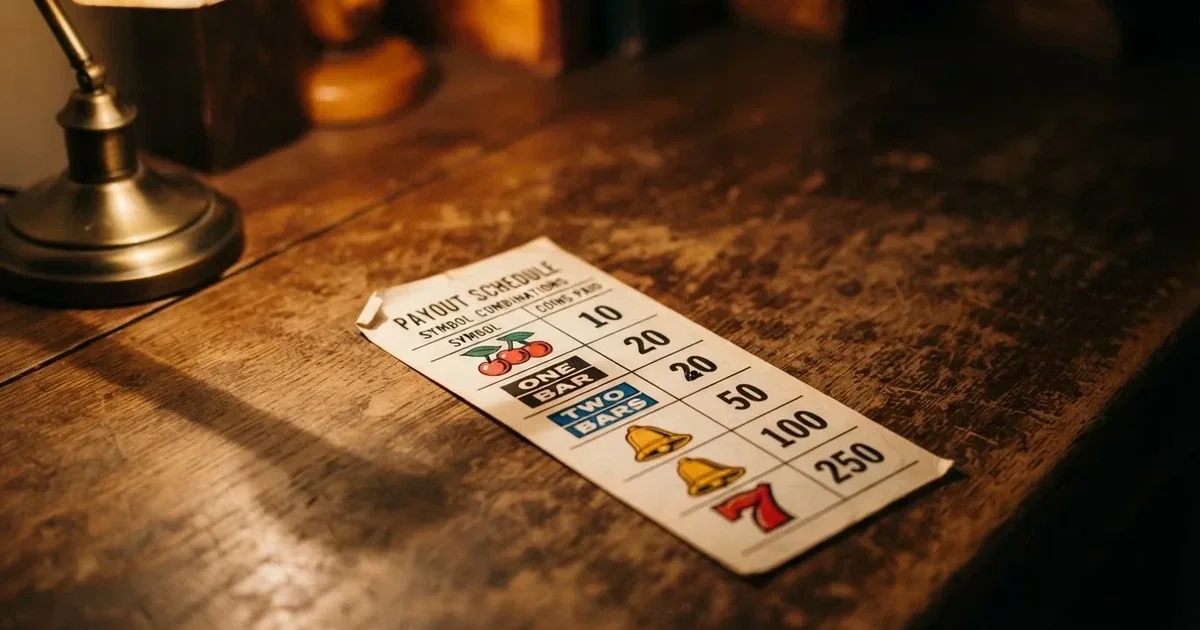
A paytable on a 5-reel slot lists every symbol, every paying combination and the multiplier each one carries. Reading it takes about a minute and is the most useful minute a player can spend before staking anything. The numbers that matter — the return-to-player, the volatility class, the maximum payout — sit on the same sheet, usually one click from the main game screen on a regulated site or in the help file on an offshore one. The reel count is below all of those in importance, because what the reels are is a presentation layer over the random-number generator that decides each spin. Five reels with nine symbols each is a different look from three reels with ten symbols each, but the percentage the house keeps over the long run is set elsewhere.
For context on what "long run" can look like across other casino formats, the house edge in baccarat runs 1.06% on the Banker bet, 1.24% on the Player bet and 14.36% on the Tie. Blackjack under liberal Las Vegas Strip rules sits at about 0.28% with optimal play, and around 0.43% under Atlantic City rules. Craps’ Pass/Come bet carries a 1.41% house edge, Don’t Pass/Don’t Come 1.36%, Any Craps 11.11%. None of these are 5-reel slots; they are the comparison points that show how thin the house edge can run when the game design is simple, and how wide it can run when it is not. A 5-reel slot lives somewhere in the middle, with a return-to-player that varies title by title and is the single number worth checking before playing. The reel count is a flavour, not a feature.
The Player-Protection Side of the Page
If the question this page is built around — is a 5-reel slot online worth playing? — has tipped from curiosity into compulsion, the next step is a phone call, not another search. Gambling Help Online runs chat support around the clock, and the National Gambling Helpline on 1800 858 858 is free and available 24/7. BetStop, the National Self-Exclusion Register, lets a person exclude themselves from every Australian-licensed online and phone wagering service in one registration; it does not reach offshore sites, which is one of the reasons the ACMA’s blocking work matters.
Gambling winnings of a recreational player are not assessable income under section 6-5 of the ITAA 1997, and losses are not deductible, unless the person is carrying on a business of gambling. That last point is one to check with the ATO, not one to take from a page like this.
The Calculation Behind the Block Rate
The blocking-rate calculation the regulator publishes is the simplest summary of what enforcement has actually done. The running total of blocked sites, as reported in June 2026, is 1,751. The first blocking request went out in November 2019. From November 2019 to June 2026 is roughly seventy-nine months, or about six years and seven months.
That puts the long-run blocking rate at roughly twenty-two sites a month over the full period. The first twelve months were slower — the machinery was new, the warning cycle was still bedding in, and the early rounds asked ISPs to block single websites at a time. The recent rounds batch twelve sites per request. A reasonable band for a reader thinking about how fast the regulator is moving today is somewhere between fifteen and twenty-five sites per month, depending on whether one counts the months from 2019 or the more active recent period — the regime has been in place for nearly seven years, the recent pace is faster than the early pace, and the count includes affiliate marketing pages as well as casino domains themselves.
The point is not the precise number. It is that the ACMA is not signalling an end to enforcement. A punter signing up with an offshore site today is signing up in a market that has, on average, had two dozen sites removed every month for the last several years, and whose latest batch removed another twelve in one round.
What the ACMA Warnings Actually Say
A formal warning under the Interactive Gambling Act is, in form, a letter. In substance, it is a public statement by the regulator that the named operator is providing a prohibited interactive gambling service to customers in Australia, and that further action — referral to the AFP, an ISP blocking request — will follow if the service does not stop. The letter is published on the ACMA’s website, dated, and named to a specific corporate entity rather than to a domain.
What the warning does not do is make the offshore site go away. The site may continue to operate in other jurisdictions; the operator may relaunch under a new brand, register a new domain, or transfer the operation to a new corporate vehicle and wait for the next round. Several of the entries above show exactly this pattern: Dama N.V. received its first warning in May 2022, and its brands have been the subject of three further warnings since. Bizzo Casino was warned in 2022 under TechSolutions and again in 2025 under Consolutetish S.R.L. Rocketplay was warned in 2022 under Dama N.V. and again in March 2026 under Pulsup Ltd. The new entity is, in form, a clean line of defence — "we are a different company" — and the ACMA’s response is to publish the warning anyway, with the corporate trail attached.
For a punter reading the register, the practical reading is that a brand’s recency on the list is not the same as a brand’s safety. The companies whose names appear more than once are the companies that have already shown they will continue to take Australian customers through the next corporate vehicle.
The Brands, in the Order the Regulator Has Named Them
What follows is the same eleven brands the table covered, written as individual write-ups, in the same order. The angle on each is the regulator’s action and what it means for an Australian player.
RocketPlay — warned twice under two operators
RocketPlay is the brand on the register with the longest Australian paper trail. The original Rocketplay was named in the ACMA’s May 2022 warning to Dama N.V., which covered six brands at once. A separate Rocketplay.com.au received a fresh formal warning in March 2026, this time addressed to Pulsup Ltd. A punter looking at RocketPlay in 2026 is looking at a brand whose corporate parent has been told, by name, to stop offering prohibited services to Australians — once under one ownership, once under another. The licence a site displays at the bottom of its homepage is not an Australian licence; under the Interactive Gambling Act, online casino games cannot be licensed anywhere in Australia, whatever foreign regulator’s mark the site chooses to print.
Level Up Casino — one of the original Dama N.V. six
Level Up was named in the May 2022 warning to Dama N.V., the same round that named Bambet, Dazard, Rocketplay, Wild Tornado and Cobra Casinos. The brand has not been the subject of a fresh formal warning since, which puts it in an odd category — older than some, but still sitting under a parent that has been warned four times in total. Third-party listings report Level Up carrying games from BGaming, the developer whose catalogue is widely white-labelled across Dama N.V.’s portfolio. That is not an endorsement; it is a description of what the brand looks like to a directory.
Woo Casino — Dama N.V.’s March 2025 return
Woo Casino received its formal warning in March 2025, three years after the original Dama N.V. round. The delay is the part worth marking: a parent company that received a warning in 2022 is, three years later, still operating brands aimed at Australian customers. The most recent warning is the only piece of evidence that is fresh, and it is the piece the ACMA publishes with a date attached.
Spirit Casino — Dama N.V.’s May 2025 entry
Spirit Casino’s warning is dated May 2025, two months after Woo’s. The pattern is the same: the operator changes, the regulator catches up, the warning is published. For a reader weighing whether to use an offshore site at all, the relevant question is whether the operator in front of them is a name the ACMA has yet to write a letter to, and how much comfort that absence ought to provide.
National Casino — Consolutetish S.R.L.’s July 2025 warning
National Casino received a formal warning in July 2025, alongside Bizzo Casino, under Consolutetish S.R.L. The brand appears in Wikipedia’s coverage of Australian gambling as a brand that has been the subject of regulatory attention. That mention is descriptive, not a recommendation — Wikipedia reports what the ACMA has done, not what a player should do about it.
Bizzo Casino — warned twice under two operators
Bizzo’s first warning was in 2022, when the brand sat under TechSolutions (CY) Group Limited and TechSolutions Group N.V. Its second was in July 2025, under Consolutetish S.R.L. The two warnings, three years apart, are the clearest illustration on the register of how a brand can survive an enforcement cycle by changing hands. The licence the site displays does not change with the corporate vehicle, but the entity the ACMA writes to does.
Ignition Casino — Bamboo Media’s July 2025 warning
Ignition Casino’s formal warning was issued in July 2025 to Bamboo Media. Ignition is best known in some markets as a poker-focused brand; under Australian law, online poker and online casino games are treated the same way, and Ignition’s offering to Australian customers is what the ACMA’s warning describes. The brand has a long offshore history and a short Australian paper trail.
Instant Casino — EOD Code SRL’s February 2025 warning
Instant Casino was named in a formal warning in February 2025, addressed to EOD Code SRL. The brand sits at the lower-stakes end of the offshore market and has appeared in marketing material aimed at Australian customers despite the prohibition. The ACMA’s action here is the same as elsewhere: publish the warning, name the operator, and let the next round of enforcement decide what happens next.
Jackbit — Ryker B.V.’s April 2026 warning
Jackbit’s formal warning was issued in April 2026, alongside CasinOK, under Ryker B.V. The brand is recent on the register — newer than most on this list — and the warning is the freshest piece of evidence about it.
Casino Intense — Sterplay Holding Ltd’s April 2025 warning
Casino Intense received a formal warning in April 2025, under Sterplay Holding Ltd. The brand has been the subject of ABC reporting and ACMA publications over the period. The warning does not stop the site from operating; it adds Casino Intense to the list of named operators whose services the ACMA considers prohibited.
Sky Crown — Hollycorn N.V.’s September 2022 warning
Sky Crown’s warning is the oldest on this list, dated September 2022 and addressed to Hollycorn N.V. The same warning also named Blue Leo. Three years on, Hollycorn N.V. has not been the subject of a fresh warning, but the 2022 letter remains on the register, dated and named.
What a Reader Takes Away
The shape of this market, in 2026, is not a market in equilibrium. The regulator is blocking sites at a rate of roughly two dozen a month and the operator count keeps replenishing itself through corporate re-shuffling. The format the question is built around — five spinning reels, a fixed paytable, a simple bonus round — is a format that lives almost entirely offshore for Australian customers, and the list of who runs it is a list of companies the ACMA has, in turn, named.
For a punter who has decided to play anyway, the practical content of the page is the part above the brand list: what the paytable says, what the wagering multiple is, what game weighting applies, what payment method the site is asking for, and whether BetStop covers them. None of that is made safer by the fact that the operator has a Curaçao or Anjouan licence at the bottom of its homepage. The Interactive Gambling Act does not recognise those licences; the ACMA’s warnings say so.
For a punter who has decided not to play, the practical content is the helpline. 1800 858 858 is free, 24/7, with chat at Gambling Help Online. The National Self-Exclusion Register, BetStop, takes one registration to exclude a person from every Australian-licensed wagering service. The offshore sites it does not reach are the same ones this page is about, and that is the connection between the format and the phone number.
Frequently Asked Questions
How is a 5-reel slot mechanically different from a standard video slot?
A 5-reel slot uses five spinning columns of symbols and a fixed number of paylines — historically nine, fifteen or twenty — with a smaller symbol set and fewer special features than a contemporary video slot. A modern video slot can run five or more reels with fifty or more symbols per reel, producing odds against top prizes as high as 300 million to one. The return-to-player and the volatility are set by the game designer and are not a function of the reel count.
Can 5-reel slot machines be found in licensed Australian pubs and clubs?
Yes, in physical form. New South Wales alone held 87,298 pokie-style machines outside casinos as of June 2023, with Victoria, Queensland, South Australia and the ACT holding tens of thousands more. These are floor machines, governed by state-level gaming-machine law, not online casinos.
Do 5-reel slots pay out differently from newer five-reel formats?
The reel count is not what determines the payout. The return-to-player percentage and the volatility class are set by the game designer and listed on the paytable or in the game’s help file. Two 5-reel titles from different studios can have very different payout profiles, and the same is true of two video slots.
Is an online 5-reel slot the same game as a 5-reel machine on a casino floor?
Not exactly. A pub or club pokie is a regulated gaming machine under state law, with a published return-to-player and a physical audit trail. An online 5-reel slot is software, served from an offshore server, with no Australian audit and no Australian licence. The mechanics look similar on screen; the consumer protections behind them do not.
Are 5-reel slots for real money available legally from an Australian-based site?
No. Under the Interactive Gambling Act 2001, as strengthened in 2017, it is an offence to provide online casino games or online pokies to a person in Australia, and no state or territory issues a licence for them. What is licensable is wagering on racing and sport placed before the event, lotteries and keno. Any site offering real-money online 5-reel slots to an Australian customer is operating outside the Australian regime.
Published by the Casino Slots Info AU team.