
Pocket Pokies Casino Australia 2026: Where the Marketing Meets the Law
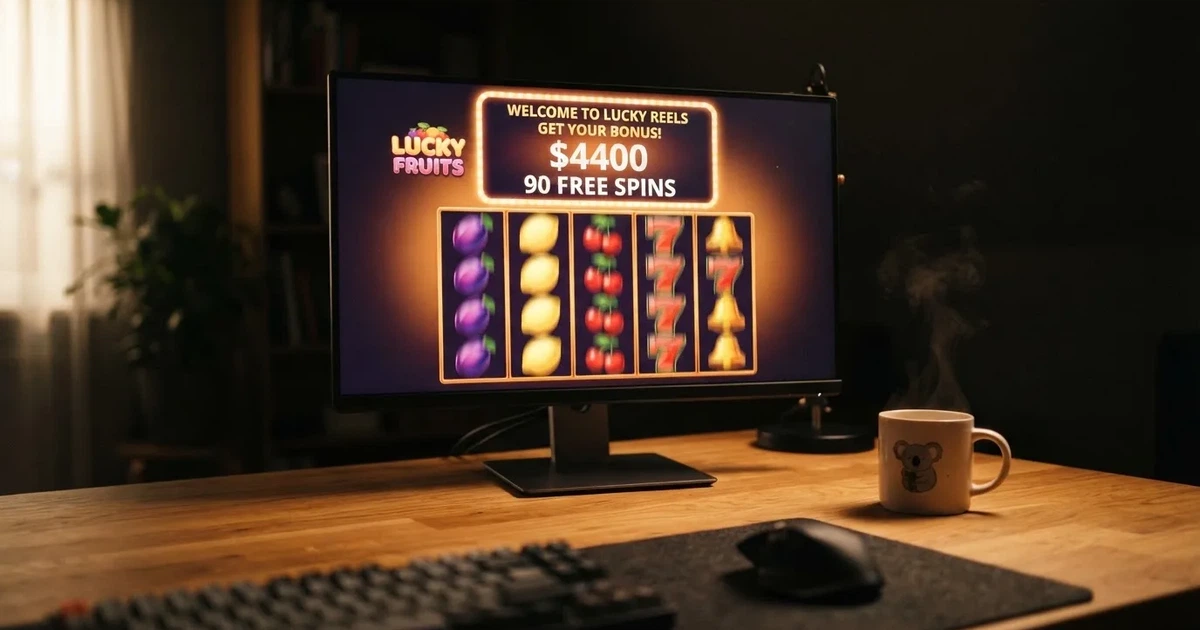
A site styled as Pocket Pokies advertises a $4400 welcome bonus and 90 free spins, and that pitch lands in inboxes and on search results across Australia every week. The arithmetic behind the offer, the licence it does not hold, and the regulator it has already heard from are all in the public record. This page walks through each, in the order a reader who acts on the offer will meet them — the bonus first, the games it ties to, the operator behind it, then the legal frame that turns the offer into a different proposition than it reads.
Data current as of 18 October 2026 and verified against the Australian Communications and Media Authority’s (ACMA) published enforcement record.
The welcome bonus that arrives with a price tag
The number most readers meet first is the welcome package, and the package most commonly attached to the Pocket Pokies name in 2026 is a $4400 match bonus plus 90 free spins, paid across the first several deposits. The shape is identical to offers run by hundreds of offshore casinos, and it works the same way: every dollar of bonus carries a wagering requirement, often between 35x and 50x, before it can be withdrawn.

A 40x wagering multiple on $4400 is $176,000 of qualifying turnover. At a typical slot stake of A$1 per spin, that is 176,000 spins. Spread across the bonus’s validity window, which is usually 30 days, the player needs to log roughly 5,800 spins a day, or close to 250 spins an hour over a 24-hour period, to clear the bonus in time. The deposit is small; the requirement is not. Most players never complete the playthrough, and the bonus expires with most of the headline value still attached to the casino’s balance sheet.
“Free spins” carries the same constraint. Wins from the 90 free spins are paid as bonus funds, and bonus funds carry their own wagering requirement before they convert to withdrawable cash. A win of, say, A$150 from the free spins at 40x is A$6,000 of further turnover before withdrawal is unlocked. The “free” in the headline names the spin, not the cash it produces.
Max-cashout caps appear on most of these offers. A common rule limits withdrawals from no-deposit free spin winnings to a fixed amount — often between A$100 and A$200 — regardless of how much the bonus balance shows. The marketing names the ceiling as a feature (“up to A$200 in real cash”); the player who clears the playthrough at A$2,400 still walks away with the cap.
The wagering rule that matters most is the one the terms bury. Slots usually contribute 100% to wagering, table games often 5% to 10%, and live dealer games frequently 0%. A player who tries to clear the bonus at the blackjack table turns A$176,000 of required turnover into A$1.76 million or more, and stops being a customer the operator wants. The fine print is where the cost of the offer lives.
What the games actually pay
The pocket pokies paytable that the marketing pictures is a real product, but it is one of thousands, and the figures attached to it sit in a narrow band. A standard five-reel video slot from a major studio runs at a return-to-player (RTP) of between 94% and 97%, with most sitting at 96%. That three-percentage-point band is the difference between a slot that holds 3 cents from every dollar wagered and one that holds 6 cents. The marketing does not name the RTP for the title it features, because the offer is the headline, not the maths.
Volatility tells the rest of the story. A high-volatility title pays rarely and in larger sums; a low-volatility title pays often and in smaller sums. The Pocket Pokies marketing usually shows the high-volatility title in its screenshots, because the picture of a near-miss followed by a large win sells better than a stream of small returns. The reader who walks in on the picture and stays for the stream is the conversion the marketing is built around.
The provider list matters because the studios behind the games carry their own reputations. Real Time Gaming, Betsoft, Pragmatic Play, BGaming and a dozen smaller studios supply most offshore pokies. Each of these studios has a house edge built into the math of its titles, and none of them is regulated by an Australian authority. A “provably fair” badge on a Pocket Pokies page is a self-attestation; the verification it claims is the casino’s own, not an Australian regulator’s.
Progressive jackpots are the third piece of the offer. The headline on a Pocket Pokies ad often includes a six- or seven-figure jackpot figure drawn from a network the slot is connected to. The figure is real in the sense that someone, somewhere, will eventually win it. It is not real in the sense that the player reading the headline has any meaningful chance of being that person. The mathematics of a wide-area progressive at the entry stake is the same mathematics as a lottery ticket: the prize exists, the player’s expected return is well below what they pay in.
The offer lands as a combination, and the combination’s effect is greater than any of its parts. A 96% RTP slot with a 40x wagering requirement and a 30-day expiry is not a 4% game; it is a 4% game played under terms that punish interruption. A player who has to step away for a day and comes back to find the bonus expired has paid the wagering cost without collecting any of the benefit. The slot’s edge was always going to take its cut; the terms make sure the cut happens even when the player stops playing.
Landsca
The marketing material attached to a site styled as Pocket Pokies runs across many brands, and the public record of what the Australian regulator has done about each of them is short and specific. The table below names the brand, the ACMA’s formal warning, the operator the regulator named in that warning, and the date of the action. None of the eleven are licensed to offer online casino games to Australians, because no Australian licence for online casino games exists.
| Brand | ACMA action and date | Operator named by the ACMA | Subject support |
|---|---|---|---|
| RocketPlay | Formal warning, March 2026 | Pulsup Ltd | Listings cite the brand |
| Level Up Casino | Formal warning, May 2022 | Dama N.V. | Listings cite the brand |
| Woo Casino | Formal warning, March 2025 | Dama N.V. | — |
| Spirit Casino | Formal warning, May 2025 | Dama N.V. | — |
| National Casino | Formal warning, July 2025 | Consolutetish S.R.L. | Listings cite the brand |
| Bizzo Casino | Formal warning, July 2025 | Consolutetish S.R.L. (previously TechSolutions, 2022) | Listings cite the brand |
| Ignition Casino | Formal warning, July 2025 | Bamboo Media | — |
| Instant Casino | Formal warning, February 2025 | EOD Code SRL | Listings cite the brand |
| Jackbit | Formal warning, April 2026 | Ryker B.V. | — |
| Casino Intense | Formal warning, April 2025 | Sterplay Holding Ltd | Listings cite the brand |
| Sky Crown | Formal warning (date as published) | Hollycorn N.V. | — |
The pattern in the operator names is the point. Dama N.V. runs at least three of the brands on this list. Consolutetish S.R.L. runs two of them. The same parent company re-entering the Australian market under a new brand after a formal warning is not a coincidence; it is a business model, and the marketing budget that produces the Pocket Pokies pitch is funded by it. The names change; the licence status does not.
The ACMA’s enforcement record extends well beyond these eleven. By June 2026, the regulator had directed Australian internet service providers to block 1,751 illegal gambling and affiliate marketing websites since the first blocking request in November 2019, and 230 unlicensed services had left the Australian market since enforcement was strengthened in 2017. The rate at which new sites are added to the blocklist is itself a measure of how quickly the offshore industry rotates around Australian blocking action.
What the blocking rate tells you
Between November 2019 and June 2026, the ACMA moved from the first blocking request to 1,751 blocked sites — a span of roughly 79 months. The average rate is about 22 blocked sites a month, but the rate is not steady. Some rounds block a dozen at a time; others pass without new additions while investigations run. A reader who wants a sense of the industry’s churn should treat the rate as a band: somewhere between 15 and 30 sites a month over the long run, with bursts above that when a single operator runs a network of brands.
That churn is the reason a single Pocket Pokies pitch can sit behind a dozen domain names in a calendar year. The page a reader lands on today may be unreachable next month, and the balance on it may travel with the brand to a new URL or may not — the terms of most offshore casinos treat the player’s balance as the operator’s property once the site ceases to serve Australian customers. BetStop, the National Self-Exclusion Register, cannot help with this case, because the offshore site is not connected to it.
What each brand’s profile does not change
RocketPlay, Level Up Casino, Woo Casino and Spirit Casino share the same parent in Dama N.V. and the same enforcement history with the ACMA; National Casino and Bizzo Casino share Consolutetish S.R.L.; Instant Casino and Jackbit are recent additions with no shared operator but the same licensing status. None of them can offer online casino games to a person in Australia without breaking the Interactive Gambling Act 2001. The bonus terms attached to each of them are the marketing of an unlawful offer, and the cost of taking it up falls on the player, not the operator.
The lone distinction worth naming is operational. Bizzo Casino has been the subject of two ACMA formal warnings across two operators — the original TechSolutions action in 2022 and the Consolutetish action in 2025 — and its continued appearance in Australian-facing marketing shows the cost of a formal warning to an offshore operator is small enough to absorb. For a player comparing offers across these brands, the answer is that none of them is licensed to serve them, and the warning record is the most reliable public evidence that the regulator agrees.
What “pocket pokies” actually means
The phrase “pocket pokies” appears in Australian-facing marketing as shorthand for a slot experience on a mobile device, and the app the marketing points to is in practice a mobile browser wrapper rather than a downloadable product from an app store. Apple and Google both enforce policies against real-money gambling apps in their stores for Australia, so a pocket pokies “app” is almost always a progressive web app — a website that adds itself to the home screen and behaves like an installed application without going through a store review.
The wrapper does not change the licence. The Interactive Gambling Act 2001 applies to the provision of online casino games to a person in Australia, regardless of whether the access point is a browser, a web app, or a sideloaded APK. The Australian-licensed products in the same space are wagering apps from the handful of operators licensed by the Northern Territory Racing and Wagering Commission, and those apps offer sports and race betting, not casino games or pokies.
The phrase “pocket pokies” also does the work of making a product sound local. Pokies is the Australian term for slot machines; “pocket” implies the game is in the reader’s hand. The combination suggests a familiar experience in a familiar setting, and that suggestion is part of the conversion. The product underneath is the same offshore casino product offered to any other market, translated into Australian English and pitched at the search terms Australians use.
A reader who searches for “pocket pokies app” meets the marketing at its strongest point — the moment the product sounds most like a local app and least like an offshore gambling site. The same reader, two clicks later, is on a deposit page asking for a credit card or a cryptocurrency wallet, both of which sit outside the payment rules the Australian licensed market operates under. The phrase and the page do not match; the reader who notices the gap before depositing has avoided the cost that the gap produces.
Payment Methods and Payout Speed
| Payment method | Status in Australia | Availability on offshore sites |
|---|---|---|
| Credit Card | Prohibited (licensed) | Common |
| PayID / Osko | Supported | Rare |
| BPAY | Supported | Unavailable |
| Crypto | Prohibited | Common |
The Interactive Gambling Act 2001, strengthened by the Interactive Gambling Amendment Act 2017, makes it an offence to provide online casino games, online pokies or in-play betting to a person physically in Australia. No state or territory issues a licence for online casino games; the licences that exist cover wagering on sports and racing before the event, lotteries, and keno. The Pocket Pokies offer, and every offer like it, sits outside the law by definition, and the ACMA’s enforcement record is the public evidence of that.
The Northern Territory Racing and Wagering Commission regulates 52 of Australia’s online bookmakers — including Sportsbet, Bet365 and Ladbrokes — but the commission is a small body with no full-time staff that meets once a month in Darwin. The bookmakers it licenses are licensed for tax reasons; they offer sports and race wagering, not pokies or online casino games. A reader who sees an “Australian licensed” badge on a Pocket Pokies page is being shown a licence that does not cover the product being offered.
The ACMA investigates complaints, issues formal warnings, and asks Australian internet service providers to block illegal sites. A round reported in June 2026 added twelve sites to the blocklist: 7Signs, ChromaBet, Donbet, Duospin, Freshbet, Slots Gem, Jacks Club, Lucky Start, Pointsbetz, Spinrise, Vinyl Casino and Wildsino. None of these names are the same as the Pocket Pokies brand, and that is the point — the industry rotates brands faster than the regulator can name them. The blocklist catches up; it does not prevent.
The individual player is not prosecuted under the IGA — the law targets the provider. What the player does face is the absence of every protection an Australian licence would normally confer. There is no Australian complaints body to escalate to, no Australian court to enforce a withdrawal, and no Australian regulator to recover funds if the operator refuses a payout. The licence the site displays is from Curaçao or another offshore jurisdiction, and the dispute resolution it offers is the dispute resolution the offshore licence requires, which is often no resolution at all.
The 2026 reform is worth naming. The Interactive Gambling Amendment (Gambling Reform) Bill 2026 passed Parliament on 19 August 2026, and its advertising and inducement measures commence on 1 January 2027. The law is in place; the start date is not yet reached on a 2026 page. Once it commences, the marketing that produces a Pocket Pokies pitch becomes a separate compliance question for the affiliate pages and SEO sites that carry it.
The tax position is the one most readers ask about, and the answer is straightforward. Recreational gambling winnings are not assessable income in Australia under section 6-5 of the Income Tax Assessment Act 1997, and losses are not deductible. A player who wins A$500 on a Pocket Pokies spin keeps the A$500 free of Australian income tax; the same player cannot offset the A$2,000 they lost on the way to the win. The only exception is a person who carries on a business of gambling, which is a high threshold to meet and not the situation for the kind of player an offshore casino markets to.
What “responsible gambling” looks like offshore
The phrase appears on every Pocket Pokies page, usually as a footer link to a self-exclusion form and a responsible gambling council logo from a Curaçao- or Malta-based body. The form excludes the player from that one site; it does not exclude them from the network of brands the same operator runs, and it does not put them on the Australian register that any Australian-licensed operator is required to honour. BetStop, the National Self-Exclusion Register, has been live since August 2023 and binds every Australian-licensed online and phone wagering service; an offshore casino is not connected to it, by design or by indifference.
The self-exclusion link on a Pocket Pokies page works the way the rest of the page works: it addresses a problem the player cannot solve through the Australian system the player is actually in. A player who needs to stop gambling and who closes a Pocket Pokies account has not stopped gambling; they have stopped gambling at one of several hundred sites that share the same operator, the same payment processor, and the same absence of Australian oversight. The next deposit is a search away.
The Australian support services that actually work are the ones BetStop sits alongside. The National Gambling Helpline at 1800 858 858 is free, available 24/7, and offers callback and chat. Gambling Help Online runs the chat service and a range of self-help tools. State-based services — Gambler’s Help in Victoria, GambleAware in New South Wales, similar bodies in each state and territory — provide counselling and financial advice. These are the services a reader who decides the Pocket Pokies offer is not for them should reach, before the next marketing email arrives.
Bank-level blocks are the most effective preventive measure most readers have not tried. Westpac’s gambling block works at the card level and refuses authorisation of transactions registered under the merchant category code “Betting/Casino Gambling” on eligible personal credit and debit cards. ANZ’s gambling block, activated in the ANZ app, also blocks gambling transactions made through a digital wallet such as Apple Pay on an eligible card; once turned on, removing it again requires a 48-hour waiting period. Commonwealth Bank lets customers apply a gambling lock to eligible cards through the CommBank app. None of these blocks guarantee that every gambling transaction will be stopped, and some non-gambling transactions might be blocked in error, but for a reader who wants to make the next deposit harder to make, the bank is the first call.
The single most important difference between an Australian-licensed product and an offshore casino is the difference between a system designed for player protection and a system designed around the player not needing one. A reader who plays with an Australian-licensed bookmaker has BetStop, has a regulator, has a dispute resolution body, and has a credit card ban that prevents the moment-of-weakness deposit. A reader who plays with a Pocket Pokies site has none of these. The “responsible gambling” footer is the only responsible-gambling layer in place, and it is the layer the player is least likely to need.
What deposits and withdrawals look like in practice
The payment page on a Pocket Pokies site is where the gap between the marketing and the law becomes a financial question. Australian-licensed online wagering services cannot accept payment by credit card or other credit-related products, and credit cards and digital wallets like Apple Pay linked to a credit account are off the table from the start. An offshore casino accepts credit cards freely, and the deposit page usually lists Visa, Mastercard, and sometimes American Express alongside crypto wallets and a handful of e-wallets.
American Express sits outside the Reserve Bank of Australia’s July 2025 review of merchant card payment costs and surcharging, which proposes removing surcharges only on eftpos, Mastercard and Visa transactions. Amex merchants can still surcharge, and Amex transactions still process through a three-party scheme rather than the four-party network Visa and Mastercard use. For a player, the practical effect is that Amex deposits on an offshore casino are more likely to attract a surcharge, more likely to be declined, and more likely to be the transaction that triggers a bank’s gambling block.
Apple Pay and Google Pay are now a large share of Australian card payments — collectively around 45% of all card payments in Australia by number at the end of 2025 — and the gambling blocks at ANZ and Westpac extend to digital wallet transactions on eligible cards. A deposit through Apple Pay on a card that has a gambling block turned on will fail at authorisation. A deposit through Apple Pay on a card without a gambling block will succeed, and the bank statement will show it under the merchant category code that the block looks for next time the player turns the block on.
PayID and Osko are the parts of Australia’s New Payments Platform that an offshore casino rarely offers, and the reason is informative. Osko transfers between participating Australian banks arrive in under a minute, 24/7, addressed to either a BSB and account number or a PayID. Paying to a PayID shows the name of the account holder before the transfer is sent, and AP+ warns that being asked to transfer money to a PayID on an illegal gambling site almost certainly means a scam site. An offshore casino asking for an Osko transfer would be identifying itself to the player’s bank as an illegal gambling operator; the absence of PayID from the deposit page is a signal, not an oversight.
The New Payments Platform became accessible to the public on 13 February 2018 and is owned by New Payments Platform Australia Ltd, a non-profit whose 13 shareholders include the Reserve Bank of Australia and the country’s major banks. More than 25 million PayID identifiers had been registered on the platform by April 2025, and participants must keep the platform’s monthly outages to no more than two minutes. The infrastructure for fast, identified Australian payments exists; the offshore casino does not use it, because using it would identify the operator to the player’s bank as the recipient of gambling funds.
Crypto deposits are the workaround the offshore industry has settled on, and they are the workaround the Australian rules have moved against. Licensed online wagering services cannot accept digital currency, and a site asking an Australian for a Bitcoin or USDT deposit is operating outside the Australian rules by definition. The crypto deposit clears the bank entirely; it also clears the bank-level gambling block, and the AUSTRAC threshold-transaction-report rule that applies to transfers of A$10,000 or more applies only to physical cash, so the crypto route has no reporting tripwire at any size. The player who deposits in crypto has left the Australian system entirely, and the protections that system offers end at the wallet address.
BPAY does not appear on offshore deposit pages for the same reason PayID does not: the bill-payment infrastructure requires a registered Australian biller, and an offshore casino is not one. BPAY has operated in Australia since 1997, is available in the online banking of over 140 banks and financial institutions, and is run by Australian Payments Plus. A reader who tries to pay a Pocket Pokies account through BPAY is trying to use an Australian bill-payment system that does not list the operator as a biller, and the payment will not go through.
Withdrawals are where the cost of an offshore relationship shows itself. The marketing promises fast payouts — “instant”, “same day”, “within 24 hours” — and the player who meets the wagering requirement and requests a withdrawal enters the operator’s internal review. The review checks identity documents, checks the source of funds, checks whether any bonus terms were breached in the playthrough, and runs on the operator’s own timeline, not the timeline the marketing named. A withdrawal that takes 72 hours in the marketing can take 14 days in the review, and the player’s recourse if the review rejects the withdrawal is the dispute resolution body of an offshore licence.
The single most common withdrawal complaint in player forums is the “source of funds” check that arrives after a player has been depositing and playing for months. The operator’s terms usually reserve the right to ask for the source of any deposit at any time, and the request is rarely satisfied by a payslip; the operator wants bank statements, evidence of the origin of the funds, and a story that adds up. The player who cannot produce that story loses the withdrawal to the operator’s “anti-money-laundering” process, and the process is the operator’s, not an Australian regulator’s.
Frequently asked questions
Is a site styled as Pocket Pokies actually licensed to operate in Australia?
No. Online casino games and online pokies cannot be licensed anywhere in Australia under the Interactive Gambling Act 2001, and no state or territory issues such a licence. The licences these sites display — usually Curaçao or another offshore jurisdiction — do not authorise them to take Australian players. Any operator offering these games to a person in Australia is breaking Australian law, regardless of the badge on its footer.
What kind of welcome bonus does a site styled as Pocket Pokies typically advertise?
The most common offer attached to the Pocket Pokies name in 2026 is a multi-deposit match bonus around A$4400 plus 90 free spins. Every dollar of the bonus carries a wagering requirement — typically 35x to 50x — before it can be withdrawn, and free spin winnings are paid as bonus funds subject to the same requirement. Max-cashout caps often limit withdrawals from free spin winnings to a fixed amount, and the bonus usually expires within 30 days if the wagering is not completed.
How can someone check whether a site calling itself Pocket Pokies is legitimate before trusting its claims?
The starting point is the ACMA’s published list of formal warnings and blocked sites, which names the operators the regulator has acted against. A site that is not on the list is not necessarily licensed; the absence of an entry is not a clean bill of health, because the regulator’s list reflects completed actions, not a complete map of every illegal site operating today. The honest test is whether the site holds an Australian licence for the product it offers, and no site offering online casino games or pokies to Australians holds one.
Does an app version of a site like this behave any differently to its website?
In practice, the “app” is a mobile browser wrapper rather than a downloadable product, because Apple and Google do not allow real-money gambling apps targeting Australia in their stores. The wrapper does not change the licence status or the legal position; the Interactive Gambling Act 2001 applies to the service regardless of the access point. The product is the same offshore casino accessed through a different icon on the home screen, and the protections — or the absence of them — are unchanged.
What withdrawal experience do reviews of sites styled this way tend to describe?
Player reports cluster around three patterns: fast payouts for small withdrawals early in the relationship, slow or paused payouts once a withdrawal reaches a few thousand dollars, and source-of-funds requests that require bank statements and proof of income. The dispute resolution body for these complaints is the offshore licence holder, not an Australian regulator, and the player’s practical recourse is limited to the operator’s own terms. A withdrawal that the operator decides not to pay is, in most cases, a withdrawal the player does not receive.
Pocket Pokies Casino Australia 2026 — More on this topic at casino slots au.