
Best pokies in NSW 2026: the venues that can run them, and the offshore sites that can’t
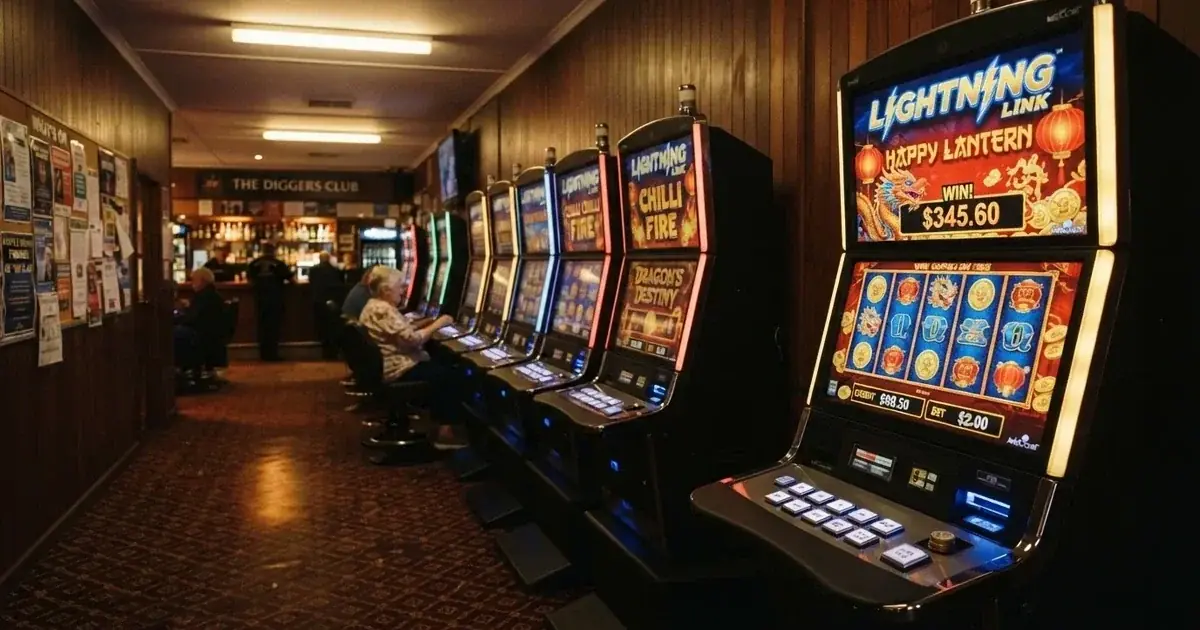
New South Wales runs more legal poker machines than any other Australian state — 87,298 of them across 2,195 pubs and clubs, with two licensed casinos on top of that. The number tells you something the word “pokies” usually hides: this is a land-based product, regulated venue by venue by state authorities, and it has been for decades. The word also gets borrowed by offshore online casinos that have no Australian licence and never will. Anyone comparing “best pokies in NSW” has to separate those two worlds before anything else, because one of them gives you a real venue, a real payout counter and a real complaints path, and the other gives you a marketing page that can be blocked by an Australian internet provider on a regulator’s instruction while your balance is still inside.
This page is built around that separation. It walks through the shape of NSW’s licensed pokies market, the way the Interactive Gambling Act 2001 (IGA) keeps online casino products out of it, the responsible-gambling supports available inside it, and how deposits and withdrawals work at licensed Australian wagering venues — most of which are bookmakers, not casinos, because that’s all the law actually allows online. The offshore casino brands at the end of the page are not a shortlist to play at. They appear because the Australian Communications and Media Authority (ACMA) has, in each case, issued a formal warning naming them. Reading them here costs nothing; depositing at them costs a balance no Australian body will help you recover.
Currency stamp: current as of 28 October 2026, verified against the ACMA register of formal warnings and the NSW Independent Casino Commission’s published media releases.
Table of Contents
- Paytables, mechanics and what a NSW pokie actually is
- How this ranking is built
- NSW licensed venues, in numbers
- The offshore brands the ACMA has warned
- What the ACMA has actually done
- What the law actually says
- Responsible gambling in NSW
- How deposits and withdrawals actually work
- Costs the reader actually pays
- What a reader comparing options should do with this
- Frequently asked questions
Paytables, mechanics and what a NSW pokie actually is
A “pokie” in NSW is a Category A, B or C gaming machine authorised under the state’s gaming-machine framework, run in a licensed club, pub or casino. The state sets a minimum return-to-player (RTP) of 87.5% on machines outside the casino; Adelaide Casino — South Australia’s only licensed casino — has no maximum-bet cap, while NSW venues outside the casino carry the general maximum-bet rule that applies to non-casino gaming machines. That figure shapes how every machine on a pub floor behaves, because the RTP is the only thing the regulator actually pegs: anything above 87.5% is the venue’s choice, and most machines sit somewhere between that floor and the low 90s.
What a player sees is a paytable — a sheet of figures printed on the machine or on a regulatory sticker. It lists the credit values for each symbol combination, the rules for free games and bonus features, and the maximum credit value a single play can be worth. NSW pub and club machines have a credit value of A$1 in most cases, with a maximum bet of A$10 per spin on a standard machine, though some venues expose higher-denomination units. A spin that costs a dollar and pays back 90 cents on average across millions of plays is not a bad bet — it is just a negative one, and the difference compounds the longer the session runs.
Inside NSW’s two casinos, the machine profile widens. The Star Sydney has run the city’s main casino floor for years, and Crown Sydney opened at Barangaroo in December 2020 to add a second venue. Casino floors allow higher maximum bets and a wider denomination range, which is one reason a high-limit player will end up there rather than at a suburban RSL. The NSW Independent Casino Commission (NICC) regulates both, which is the body that fined The Star Sydney $10 million alongside an enforceable undertaking announced 2 June 2026, and on 19 August 2026 fined Crown Sydney $1.75 million and The Star Sydney $500,000 in a coordinated action after each venue let a minor through the door. Those enforcement actions say something about the regulator’s reach: it can fine, it can name, and it can move against venues that hold the only kind of licence the IGA allows for casino play in NSW.
The mechanics themselves follow the standard Australian pokie design: three or five reels, between nine and 243 ways to win, with a mix of base-game credits, free-spin features and progressive jackpots that link machines across a venue or a chain. What the paytable does not show is volatility — the spread between small, frequent returns and rare, large ones. A 90% RTP machine can pay back almost nothing for an hour and then a four-figure sum the next, and the paytable alone won’t tell you which pattern a particular title sits on. The way to read a NSW paytable is as a regulatory floor, not as a forecast. Everything above 87.5% is the operator’s commercial call; everything below it isn’t allowed.
How this ranking is built
Ranking “best pokies in NSW” is unusual work, because the candidates don’t compete on bonuses or payout speed the way an online comparison can construct them. They compete on whether the venue can legally run a machine at all, on what hours it can run, on what kind of payout counter sits behind the cashier, and on whether a self-exclusion scheme a visitor signs up to actually binds that venue. The criteria that matter here are:
- A venue that is licensed under NSW law, with the licence type visible to a player who asks. A casino licence (The Star Sydney, Crown Sydney) is not the same as a club or hotel licence under the Liquor & Gaming NSW framework, and the difference shapes what kind of machine, what maximum bet and what hours are on offer.
- The hours during which the gaming floor is open. Most NSW pubs and clubs run machines during the venue’s licensed trading hours; a venue licensed to trade past midnight can run 24-hour gaming, but most cannot, which is why “24-hour pokies NSW open now” is a real question and a thin answer at the same time.
- Identification required before play. NSW venues are required to refuse entry to minors, and the casino floor enforces this rigorously. Outside the casinos, identification rules vary by venue — most pubs require formal ID at the door for entry to a gaming room, while a club member-guest arrangement typically requires the member to be present.
- Cashless gaming. NSW has been moving toward cashless card-based gaming under its gaming-machine reform program, with player cards that track play and enforce pre-set time and spend limits at the machine itself. Venues that have completed the rollout look different from venues still on cash.
- Self-exclusion coverage. The NSW Voluntary Self-Exclusion scheme lets a player ban themselves from venues in the state; a person who has signed up is supposed to be refused entry and refused the chance to play. The scheme applies at NSW venues, not at offshore sites.
Those criteria produce a landscape of 2,195 pubs and clubs and two casinos. The 11 venues below are not a “top eleven to play at”. They are the eleven offshore brands the ACMA has, at the time of writing, named in formal warnings for offering prohibited online casino services to people in Australia. They appear in the ranking because they are the ones the regulator has acted on, and naming them is more useful to a reader than not naming them. Where a brand has any listing record at all — an encyclopedia entry, a regulator’s incident log — that is noted under the brand. Where research found nothing, the brand is presented on the ACMA action alone.
The order of the ranking follows the order of the ACMA’s enforcement activity against each operator, with the most recent formal warnings first. None of these brands can be recommended as a place to play. Several of them can still be reached by an Australian player through workarounds, which is the ACMA’s reason for issuing the warning in the first place; the only consumer protection attached to any of them is the protection of not having deposited.
NSW licensed venues, in numbers
The shape of the NSW market is the frame inside which any “best pokies” question has to be answered, and the shape is unusually concentrated for an Australian state:
- 87,298 gaming machines outside casinos, in 2,195 venues, as at June 2023 — more machines in more venues than any other Australian state.
- Player losses on those machines outside casinos of A$8.18 billion across 2022–23, an average of about A$986 per adult.
- 2020–21 turnover on the same machines of A$85.72 billion, an average of A$13,559 per adult.
- Two licensed casinos: The Star Sydney, the long-standing Sydney venue, and Crown Sydney at Barangaroo, which opened in December 2020.
The numbers are not a recommendation to spend at any of those 2,197 venues. They are the size of the licensed market, and the licensed market is the only one a player in NSW can actually walk into. A venue with a pokies room is the only place a NSW resident can legally sit at a pokie machine.
The single biggest operational risk inside that market is regulatory action against the licensed casinos. The Star Sydney has been the subject of multiple NICC actions, the most recent being the $10 million fine and enforceable undertaking announced 2 June 2026, and the 19 August 2026 coordinated fine of $500,000 over the minor-entry incident. Crown Sydney drew a $1.75 million fine in the same 19 August 2026 action. Both venues are operating under NICC supervision, and a player who wants certainty about a venue’s licence status can check the NICC media releases page directly. A venue under enforceable undertaking is still a licensed venue — the NICC’s actions are about ensuring it stays one.
The offshore brands the ACMA has warned
Online casino games — including the “pokies” product — cannot be licensed in Australia under the Interactive Gambling Act 2001 (IGA), and that has been the law since the IGA and its 2017 amendments. The ACMA enforces the IGA by investigating offshore operators, issuing formal warnings and directing Australian internet service providers to block services that continue to take Australian customers. The list below is the set of brands the ACMA has named in formal warnings as of the date of the currency stamp above. Each is presented on what the ACMA published: the operator named, the date of the warning and the Australian legal position. None of them carries a recommendation to play.
| Brand | ACMA action and date | Operator named by the ACMA | Subject support |
|---|---|---|---|
| RocketPlay | Formal warning, March 2026 | Pulsup Ltd | — |
| Level Up Casino | Formal warning, May 2022 | Dama N.V. | listings only |
| Woo Casino | Formal warning, March 2025 | Dama N.V. | listings only |
| Spirit Casino | Formal warning, May 2025 | Dama N.V. | — |
| National Casino | Formal warning, July 2025 | Consolutetish S.R.L. | listings only |
| Bizzo Casino | Formal warning, July 2025 | Consolutetish S.R.L. | — |
| Ignition Casino | Formal warning, July 2025 | Bamboo Media | — |
| Instant Casino | Formal warning, February 2025 | EOD Code SRL | — |
| Jackbit | Formal warning, April 2026 | Ryker B.V. | — |
| Casino Intense | Formal warning, April 2025 | Sterplay Holding Ltd | listings only |
| Sky Crown | Formal warning, September 2022 | Hollycorn N.V. | listings only |
The table is a record of the ACMA’s published actions, not a feature comparison. Several operators have been warned more than once: Dama N.V. was warned in May 2022 and then again in March and May 2025 over different brands, and Bizzo Casino was the subject of an earlier 2022 warning to TechSolutions. The repetition is itself part of the story — a brand that the ACMA has warned, dropped, and then watched reappear under a new licence is a brand that treats the warning as a cost of doing business.
RocketPlay
The ACMA issued a formal warning to Pulsup Ltd over RocketPlay in March 2026. The same brand had already been the subject of a May 2022 warning to Dama N.V., which is one of the more visible cases of a casino group continuing to operate under new corporate names after a formal warning. An Australian player who lands on the site sees a “pokies” lobby, a real-money cashier and the kind of bonus headline the affiliate pages promote heavily; the ACMA’s position is that none of those things make it legal for an Australian to deposit. Rocketplay’s situation is the basic shape of the offshore market: a brand that has been warned, has cycled operators, and is still reachable from Australia because blocking a website does not delete its customer database. A player who joins today has no Australian complaints body to call if the brand refuses a withdrawal.
Level Up Casino
The ACMA issued a formal warning to Dama N.V. over Level Up Casino in May 2022 as part of a six-brand warning batch that also covered Bambet, Dazard, Rocketplay, Wild Tornado and Cobra Casinos. The encyclopedia listings the brand has picked up over the years cover its offshore bonus structure and its slot library, but those listings do not amount to a licence and they do not bind the ACMA’s position. The position is unchanged: an online casino cannot be licensed in Australia, a formal warning has been issued, and the ACMA can block the site at the Australian internet provider level if it continues to take Australian customers.
Woo Casino
The ACMA issued a formal warning to Dama N.V. over Woo Casino in March 2025. Like Level Up, Woo Casino sits inside the Dama N.V. portfolio — the second Dama N.V. warning after the May 2022 batch, and an indicator of how a single operator structure can run multiple brands under the same offshore roof. Woo Casino’s listings record is the same kind of affiliate-driven catalogue any of these brands pick up: slot counts, payment methods, software providers, none of which count as Australian regulatory standing. A player who deposits at Woo Casino today does so with the knowledge that the site has already been the subject of a formal Australian warning.
Spirit Casino
The ACMA issued a formal warning to Dama N.V. over Spirit Casino in May 2025 — the third Dama N.V. brand on this list, and the third time in three years the ACMA has named a brand inside the same operator group. The pattern tells a reader more than any single warning: a group that the ACMA has named, warned and watched continue to operate is a group that has decided the warning is cheaper than the lost Australian revenue. Spirit Casino’s own listings footprint is thin, which is part of why the ACMA warning is the central fact about it. The other facts — what slots it runs, what deposit methods it accepts, what welcome bonus it advertises — are the same shape as every other offshore casino on this list, and the same legal status.
National Casino
The ACMA issued a formal warning to Consolutetish S.R.L. over National Casino in July 2025. The brand has a small listings footprint of its own — Australian Broadcasting Corporation reporting on the broader offshore market and infrastructure-government material on payment routes, neither of which amounts to a regulatory endorsement. The same Consolutetish S.R.L. was also warned over Bizzo Casino in the same July 2025 round, which is the same kind of multi-brand single-operator pattern Dama N.V. has run. A player who picks National Casino because the affiliate site ranks it well above the others on this list is reading affiliate rankings, not regulator rankings, and the ACMA’s view of those affiliate rankings is the same as its view of the casino itself.
Bizzo Casino
The ACMA issued a formal warning to Consolutetish S.R.L. over Bizzo Casino in July 2025. Bizzo had already been the subject of a 2022 formal warning to TechSolutions (CY) Group Limited and TechSolutions Group N.V., which is the second time on this list a brand has appeared under more than one operator name. The repetition is worth naming because it is what the ACMA’s blocking power is meant to interrupt: a brand that has been warned, dropped, picked up under a new corporate wrapper and re-marketed to Australians. The listing record on Bizzo itself is thin, but the cross-references in the ACMA’s own publications tell the story of a brand that has been on the regulator’s radar for years.
Ignition Casino
The ACMA issued a formal warning to Bamboo Media over Ignition Casino in July 2025. Ignition has one of the more recognisable brand identities among the offshore casinos the ACMA has named — a poker-first heritage, a slot library pitched at the Australian market through affiliate sites, and a familiar bonus structure that affiliate copy has circulated for years. None of that puts it inside the Australian regulatory frame. The Bamboo Media warning is the ACMA’s clearest signal that the operator behind Ignition has chosen to keep taking Australian customers after the IGA’s online casino prohibition made that unlawful. The warnings are issued before blocking, so a brand on this list is one blocking round away from being unreachable from an Australian IP — with whatever balance is still inside the player’s account at that point.
Instant Casino
The ACMA issued a formal warning to EOD Code SRL over Instant Casino in February 2025. The brand had a public affiliate footprint before the warning, with marketing pitched at fast-payout claims and a “pokies” lobby that is the same shape as every other offshore casino on this list. The February 2025 warning places Instant Casino near the front of the recent enforcement window, and the ACMA’s blocking record — 1,751 illegal gambling and affiliate marketing websites blocked since November 2019, with more than 230 unlicensed services having left the Australian market since 2017 — is the larger shape of the campaign. Instant Casino is one warning inside that campaign, and the operator’s options at that point are to leave the Australian market, to keep taking Australian customers under a new corporate name, or to absorb the cost of the warning and continue.
Jackbit
The ACMA issued a formal warning to Ryker B.V. over Jackbit and CasinOK in April 2026. The April 2026 warning is one of the most recent on this list, which means Jackbit is one of the brands the ACMA has named and is most likely to block in the next enforcement round if it does not withdraw from the Australian market. Ryker B.V. is the same operator behind CasinOK, which is the multi-brand pattern this ranking has turned up at Dama N.V. and Consolutetish S.R.L. A player who deposits at Jackbit after the April 2026 warning has chosen to deposit at a brand whose Australian market access is actively shrinking.
Casino Intense
The ACMA issued a formal warning to Sterplay Holding Ltd over Casino Intense in April 2025. The brand has the broadest listings footprint of the eleven on this list — entries that reference ABC reporting on offshore gambling, trade press coverage and South Australian CBS material — which means the affiliate ecosystem has been actively marketing it to Australian players, and the ACMA’s April 2025 warning is the response. The listings footprint is not a regulatory endorsement; it is the reason the ACMA had to act. Casino Intense is the case where the affiliate-driven discovery layer is visible alongside the regulator’s enforcement layer, and the ACMA’s view of the brand is the only one that matters for a player in NSW.
Sky Crown
The ACMA issued a formal warning to Hollycorn N.V. over Sky Crown and Blue Leo in September 2022, the earliest formal warning on this list and the one that has been in the ACMA’s published register the longest. Hollycorn is the same operator behind both Sky Crown and Blue Leo, and the two-brand pattern is what the ACMA’s blocking campaign has repeatedly turned up. Sky Crown’s listings footprint is thin, but the September 2022 warning is more than three years old at the time of writing, which means the ACMA has had time to follow up with blocking, with service-provider referrals and with the same enforcement chain that has been applied to the other brands here. A brand on the ACMA’s register for that long is one that has been on the regulator’s list long enough to be the kind of brand an Australian internet provider is most likely to block on a routine basis.
What the ACMA has actually done
The 11 brands above are not the only ones the ACMA has warned, and they are not the only ones the ACMA has blocked. The total picture, as reported in June 2026, is that the ACMA has asked Australian internet service providers to block 1,751 illegal gambling and affiliate marketing websites since the first blocking request in November 2019. The pace has not slowed: in a single round reported on 26 June 2026, the ACMA asked for 12 more sites to be blocked, including 7Signs, ChromaBet, Donbet, Duospin, Freshbet, Slots Gem, Jacks Club, Lucky Start, Pointsbetz, Spinrise, Vinyl Casino and Wildsino. The blocking requests target both the casino brands themselves and the affiliate marketing pages that drive Australian traffic to them, which is why an Australian player who searches for “best pokies” can land on a page the ACMA has had blocked at the ISP level.
The arithmetic that gives this page its value is the blocking rate itself. Between November 2019 and the reporting date in June 2026 — a period of about six and a half years — the ACMA’s blocking requests removed 1,751 illegal sites from Australian reach. That’s an average of roughly 270 sites blocked per year, or just under 23 per month, with the rate sitting closer to 25 per month over the past two years as the ACMA has issued more frequent batches. The condition on that figure is that it counts blocking requests, not unique brands — a brand that has been blocked once and re-emerges under a new domain counts again, which is why the multi-brand operators on this list keep appearing in successive rounds. The headline number the ACMA itself uses is “more than 230 unlicensed gambling services have left the Australian market since 2017”, and the difference between the two figures is the gap between sites blocked and brands that exited voluntarily — a brand that has been blocked enough times tends to give up.
The wider context is the cost the industry itself estimates. H2 Gambling Capital’s 2025 report puts Australian losses to illegal gambling sites at about A$3.9 billion a year, and the share of gambling going through legal channels fell from 74% in 2021 to 64% by the time of that report. The legal channel share falling is not the same as the illegal channel growing in absolute terms — total gambling spend has grown in the same period — but the slide from 74% to 64% tells a regulator that the marketing reach of the offshore brands is outpacing the consumer-protection argument. The ACMA’s response is the blocking campaign and the formal-warning regime that produced the 11 brands above.
What the law actually says
The Interactive Gambling Act 2001 is the relevant statute, and the Interactive Gambling Amendment Act 2017 is what made it bite. Together they make it an offence to provide online casino games, online pokies or in-play betting to a person in Australia. The law targets the provider, not the player — an Australian who deposits at an offshore casino is not prosecuted, but the offshore casino is, and the ACMA’s enforcement tools run against the provider. The legal status of an offshore casino is unaffected by any offshore licence the operator displays, because no Australian state or territory licenses online casino games, and no foreign jurisdiction has standing to issue one that the IGA recognises.
What is licensable in Australia is wagering on races and sport placed before the event, lotteries and keno. In practice those services are licensed by the Northern Territory Racing and Wagering Commission (NTRWC), which regulates 52 of Australia’s online bookmakers, including Sportsbet, Bet365 and Ladbrokes, and operates with no full-time staff and a monthly meeting in Darwin. The NTRWC arrangement is the kind of regulator structure that explains why licensed Australian wagering is concentrated in a small number of large operators, and why the same offshore-brand term “casino” never attaches to a licensed Australian wagering service. A licensed Australian bookmaker offers sports and racing, not online pokies.
The minimum age for any form of legal Australian gambling is 18. The age requirement is enforced by venues under state law, and the NICC’s coordinated action against Crown Sydney and The Star Sydney on 19 August 2026 — over each venue allowing a minor to enter — is what enforcement looks like at the casino end. A licensed pub or club is required to refuse entry to anyone under 18, and a player who is asked for ID at a NSW venue is being checked against the same requirement.
The 2026 reform sits behind that frame. The Interactive Gambling Amendment (Gambling Reform) Bill 2026 passed Parliament on 19 August 2026, and its advertising and inducement measures commence on 1 January 2027. That is a law with a future start date, not a 2026 enforcement tool, and an article that treats it as already in force is publishing an error a regulator would notice.
Responsible gambling in NSW
The responsible-gambling supports available to a NSW player are tied to the licensed venues, not to the offshore brands. The supports that matter are:
- Gambling Help Online and the National Gambling Helpline on 1800 858 858, free, 24/7, with chat available at Gambling Help Online. The helpline is the first call for anyone whose play has moved from a recreational session into something they would like to stop.
- BetStop, the National Self-Exclusion Register, which has been live since August 2023. BetStop binds Australian-licensed online and phone wagering services; an offshore casino is not connected to it, which is one of the reasons the ACMA’s blocking campaign matters alongside the self-exclusion register.
- The NSW Voluntary Self-Exclusion scheme, which lets a player ban themselves from NSW pubs, clubs and casinos. A person who signs up is supposed to be refused entry at the venues covered by the scheme, and the NSW framework gives venues an enforcement role in spotting and refusing self-excluded players.
The cashless gaming rollout across NSW adds a layer that runs at the machine level rather than the venue level. A cashless card-based system ties play to a player account, which means time and spend limits can be set at the machine and respected across a session. A venue that has completed the rollout looks different from one that has not, and the practical effect is that a player who wants a hard ceiling on what they can spend in a session can set one before they sit down.
The supports are not a guarantee. The helpline is a phone call; the self-exclusion scheme is enforceable only at the venues it binds; the cashless card is opt-in. They are what the licensed market offers, and the licensed market is the only market that offers them at all.
How deposits and withdrawals actually work
A NSW pub or club handles cash. A player walks in, exchanges cash for credits at the machine, plays, and cashes out at the venue cashier if they have a credit balance. There is no online banking step, no payout-pending period, no withdrawal-limit message at a suburban RSL. The constraints on the cash model are the venue’s own — most NSW pubs and clubs will cash out any amount up to the machine’s credit maximum, and a player who hits a large prize can collect it from the cashier in person. The casino model is similar, with higher denomination units, a casino cashier for large redemptions and the casino’s own identification procedures on the way out.
The licensed Australian online market — wagering, not casino — runs on a different rails. Credit cards, credit-related products and digital currency have been banned as payment for licensed online wagering since 11 June 2024, with penalties of up to A$247,500 for operators that take them. The legal deposit routes are debit card, bank transfer, PayID/Osko and BPAY. PayID and Osko are real-time payment rails operated by Australian banks, which is why a licensed wagering deposit at a corporate bookmaker settles in seconds; BPAY runs on a slower batch schedule. A licensed Australian wagering service asking for a credit card or a crypto deposit is operating outside the rules and is, in practice, an offshore operation pretending otherwise.
The offshore casino model is different again. Deposits typically run through a mix of debit cards, e-wallets and cryptocurrency, and the withdrawal flow is the part the marketing does not foreground. A withdrawal at an offshore casino is subject to the operator’s own pending period, which can be several business days for the first withdrawal while the operator runs identity checks, and to a maximum cashout rule that limits how much of a win can be withdrawn in a given week or month. An offshore casino that refuses a withdrawal has no Australian complaints body for the player to call, because the ACMA’s role is to enforce the IGA against the provider, not to arbitrate disputes; the operator’s own terms are the only contract the player has, and the operator wrote those terms.
Payout percentage is the figure a NSW player has most reason to compare. NSW machines outside casinos carry the 87.5% minimum, with most machines sitting in the low 90s and the casino floor offering higher denominations and a wider RTP range. The figure is fixed by the regulator’s floor and by the venue’s own commercial choice above it; nothing an offshore casino advertises changes the NSW minimum, because the offshore casino is not subject to it.
Costs the reader actually pays
The cost of playing a NSW pokie is the house edge, and the house edge is whatever sits between the machine’s RTP and 100%. A 90% machine costs 10 cents on the dollar across a long session, and the long session is what the math averages out — short sessions can return almost anything, and the marketing leans on that. A machine at 87.5%, the NSW minimum, costs 12.5 cents on the dollar. A higher-denomination machine in a casino floor can run at 95% or above, which is a smaller edge but a larger dollar turnover per spin.
The cost of the offshore alternative is harder to read. The advertised payout percentages on an offshore casino’s “pokies” pages are the operator’s claim, not a regulator’s measurement; the ACMA does not test the slots an offshore casino offers, and the offshore regulator the operator cites is not the ACMA. A withdrawal that is refused, capped, or paid out over a multi-day pending period is a different kind of cost, and a cost the affiliate marketing does not name. The single biggest cost is the absence of a complaints path: an offshore casino that refuses a withdrawal leaves the player with the operator’s own customer support, which is the body that made the decision.
The NSW-specific cost is the time and money to reach a venue. NSW has 2,195 venues with machines, but they are not evenly distributed; a player in a regional centre may have one or two within reach, while a Sydney player has many. The cost of reaching a venue is what a comparison cannot eliminate, and it is what makes “best pokies near me” a question with a different answer in every NSW postcode.
What a reader comparing options should do with this
A NSW player looking for pokies has, on the evidence above, three legal routes and one closed one. The closed one is the offshore casino, which cannot be licensed in Australia regardless of what the brand’s footer says. The legal routes are the licensed pubs and clubs, the two licensed casinos, and — for wagering only, not for casino games — the licensed Australian bookmakers that the NTRWC authorises. A player who picks an offshore casino has picked the route that the ACMA has named, warned and, in many cases, blocked, with no Australian consumer protection attached.
The right read of the 11 brands on this list is to use them as a list of names to avoid, not as a comparison. A player who has already deposited at one of them and wants out can call the National Gambling Helpline on 1800 858 858 for free, 24/7 support, and can sign up to BetStop for the licensed wagering side. The cashless card rollout at NSW venues adds a tool at the machine level for players who want a hard ceiling on session spend. None of those supports reach into an offshore casino, which is why the ACMA’s blocking campaign and the formal-warning regime exist as the consumer-protection layer for the offshore market — and why the IGA’s prohibition is the foundation underneath them.
A NSW player who wants the most accurate payout percentage, the most enforceable self-exclusion and the clearest complaints path is a NSW player who walks into a licensed venue. The 2,195 pubs and clubs and the two casinos are the venue set; the paytable on any machine inside them is the regulatory document that binds them. Everything offshore is marketing on top of a product the law does not let them sell.
Frequently asked questions
Which venues in New South Wales are licensed to operate pokies?
Pubs and clubs licensed by Liquor & Gaming NSW to operate gaming machines, plus two licensed casinos: The Star Sydney and Crown Sydney at Barangaroo, both regulated by the NSW Independent Casino Commission. NSW held 87,298 gaming machines outside casinos across 2,195 venues as at June 2023.
Are pokies in New South Wales available around the clock?
Only at venues licensed to trade through the night. Most NSW pubs and clubs run machines during their licensed trading hours, which generally close at midnight; 24-hour gaming is limited to a smaller set of venues and to the casino floors.
What identification do venues in New South Wales require before letting someone play pokies?
A NSW casino requires formal identification at the door and refuses entry to anyone under 18. Pub and club gaming rooms enforce the same minimum age under the state framework, with identification practices varying by venue. The 19 August 2026 NICC fines against Crown Sydney and The Star Sydney were the result of each venue letting a minor enter.
Can visitors to New South Wales use self-exclusion schemes at local pokies venues?
The NSW Voluntary Self-Exclusion scheme applies to NSW venues, and a visitor who has signed up is supposed to be refused entry at the venues it covers. BetStop, the National Self-Exclusion Register, binds Australian-licensed online and phone wagering services and does not cover offshore casinos.
How does the payout percentage on New South Wales pokies compare with other Australian cities?
NSW sets a minimum gaming-machine return-to-player rate of 87.5% outside casinos, in line with the Australian standard. Adelaide Casino has no maximum-bet cap while South Australian non-casino venues are capped at A$5.00 per spin, and NSW machines generally sit in the low 90s above the regulatory floor.
Is it legal for an online casino to advertise ‘pokies’ in New South Wales the same way a pub or club does?
No. The Interactive Gambling Act 2001, as amended in 2017, prohibits providing online casino games — including online pokies — to a person in Australia. The ACMA enforces the prohibition with formal warnings and ISP blocking requests; 1,751 illegal gambling and affiliate marketing websites had been blocked by June 2026 since the first blocking request in November 2019.