
What a high-RTP pokies machine actually returns in Australia
A return-to-player figure is the most quoted number on any pokies paytable, and it is also the most often misread. Australian club and pub machines sit between 85 and 92 per cent by law; casino floors push higher; the offshore sites Australian players reach through a browser sit at no figure regulators can verify. This page works through what those numbers mean, who is allowed to advertise them, who has been pulled up for advertising them to Australians, and what an 87 per cent return actually costs a session at a machine. Where the ACMA has acted against an operator offering prohibited online casino games, the brand is named and the licence claim reproduced as the operator presents it — because the brand is the subject of the comparison, and a comparison without the names it compares is no comparison at all.
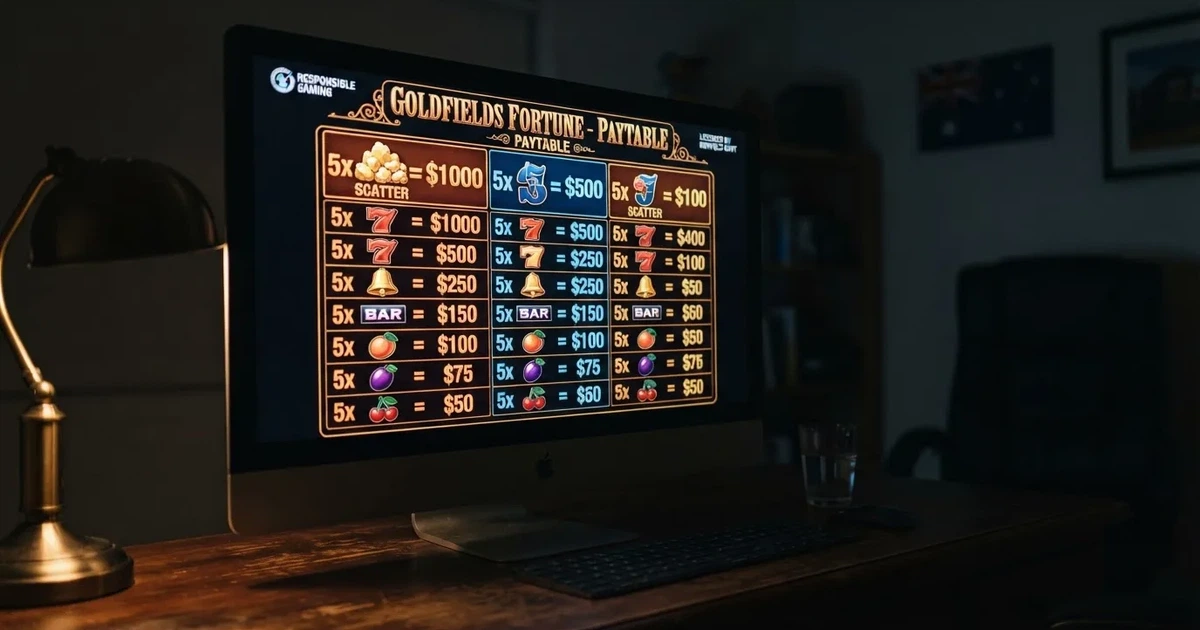
Current as of 28 October 2026 · verified against the ACMA formal-warning register and state gaming-machine data published on the regulator sites.
Table of Contents
- Why “best RTP” is a misleading frame in Australia
- How an Australian RTP comparison is actually built
- The offshore sites that advertise an RTP figure to Australians
- What the regulator says about high-RTP design choices
- The legal frame that decides who can offer what
- What a high-RTP figure does to a session in dollars
- The choices a player actually makes
- Responsible gambling supports that apply to high-RTP pokies
- Why the ACMA enforcement record matters to a “best RTP” comparison
- Frequently asked questions
Why “best RTP” is a misleading frame in Australia
The phrase is borrowed from the online casino vocabulary, where a 97 per cent slot is a marketing line and a 92 per cent slot is a complaint. In Australia, the frame does not survive the law. The Interactive Gambling Act 2001 prohibits online casino games — and online pokies with them — for anyone physically in Australia, no matter what licence badge the offshore site displays. The phrase “best RTP pokies Australia” most plausibly means one of three things: the highest-returning machines in clubs and casinos on the Australian mainland, the offshore sites that pitch a percentage to Australians from Curaçao or another jurisdiction, or both at once. The first is a comparison the law lets you make. The second is a comparison the ACMA has spent the last several years shutting down.

A figure on a paytable is not, on its own, an offer. It is a long-run average over millions of spins and tells the reader what the machine keeps, not what any session returns. The difference is the work this page is for.
What RTP means, and what it does not
RTP is the share of money a machine is set to return to players over its full design life — every spin, every bonus feature, every session that walks away early. It is set by the manufacturer, locked in by the regulator at the time of approval, and printed on the machine’s paytable or help screen under each state’s gaming-machine rules. The number is a percentage of turnover, not of any individual stake.
What it does not mean: it is not the chance of winning on the next spin, or the chance of walking away ahead after an hour, or a guarantee of any return at all. A 90 per cent machine in a session of fifty spins at A$1 will on average return about A$45 — meaning the player loses about A$5 across that session on the long-run average, with most sessions losing more and a small minority winning. The average eats the experience.
The state-by-state minimum and where each jurisdiction sits
State law sets a floor, not a single industry number. Each jurisdiction separately regulates machine design and operation, and the floor on a machine’s theoretical return varies.
| Jurisdiction | Minimum RTP | Notes |
|---|---|---|
| New South Wales | 85% | Largest machine population by venue count; 87,298 machines outside casinos across 2,195 venues as of June 2023. |
| Northern Territory | 85% | Territory is a wagering hub, not a machine floor — licences the bookmakers but sets the same floor. |
| Queensland | 85% | 21,122 machines in 351 venues at October 2023. |
| Victoria | 85% generally, 87% at Crown Melbourne | 26,380 machines outside Crown Casino in 488 venues under a 30,000 statewide cap. |
| Australian Capital Territory | 87% | |
| Tasmania | 87% | Monopoly over machines ended in November 2021; pre-commitment cards delayed until late 2025. |
| South Australia | 87.5% | |
| Western Australia | 90% | Poker machines banned in pubs and clubs when Crown Perth opened in 1985; only casino floor. |
The 85 per cent floor is older than the others and reflects a regulatory moment when machine design was simpler; the 87 and 87.5 per cent floors came in as machine design grew more complex. A higher floor does not mean higher returns — it means the regulator refused to licence anything worse. A machine at the floor in Western Australia still keeps ten cents in the dollar on average.
How an Australian RTP comparison is actually built
The phrase “best RTP pokies Australia” suggests a ranked list of machines, but a ranking by return-to-player alone is a ranking by a single number that the regulator already constrains. A more honest comparison lines up three things at once: the return figure set at the time of approval, the machine design underneath it (number of reels, volatility class, bonus feature frequency), and the venue where the player actually sits down — because a machine’s return on a casino floor at Crown Melbourne is the same number as a machine in a suburban club, but the design that delivers it can differ.
Criteria that separate one machine from another
Three criteria do most of the work. First, the published RTP itself, verified against the state regulator’s approval record rather than the operator’s own marketing. Second, volatility — the spread of returns across sessions, which is not on any paytable in Australia and which the player can only infer from session behaviour. Third, the design features that affect session length: bonus frequency, free-spin triggers, hold-and-spin mechanics. A 90 per cent low-volatility machine and a 90 per cent high-volatility machine are not the same product. One pays small wins often; the other pays larger wins rarely. The published return is the same.
The number that stops mattering once another one sits beside it
A 95 per cent machine on a casino floor is not twice as generous as a 90 per cent machine in a club. The difference is a 5 per cent wedge, applied to turnover, across millions of spins. For a session of fifty spins at A$1, that 5 per cent wedge comes to about A$2.50 of expected loss on the lower-returning machine and about A$1.25 on the higher — a real difference, but a small one at session scale and a modest one over an evening. Once a player is sitting in front of a machine, the wedge between 90 and 95 per cent is the smaller force acting on the bankroll. The larger force is how long the session runs.
The offshore sites that advertise an RTP figure to Australians
What the search phrase “best RTP pokies Australia” most often returns in practice is a list of offshore casino sites that pitch their own RTP numbers to Australian players. The figure is on the paytable of a slot the player cannot reach in person and cannot verify with any Australian regulator. The Interactive Gambling Act 2001 makes the offer itself an offence by the provider; the player is not prosecuted, but the balance they hold on the site sits outside any Australian complaints body and outside any Australian recourse if a withdrawal is refused. The ACMA’s enforcement record, accumulated since 2017, names the operators that have tried it.
What the ACMA has done, and to whom
The ACMA’s blocking regime started with the first formal request to internet service providers in November 2019. By June 2026, the cumulative count of blocked illegal gambling and affiliate marketing websites had reached 1,751, and more than 230 unlicensed gambling services had left the Australian market since the enforcement regime was strengthened in 2017. The June 2026 round alone added twelve more sites: 7Signs, ChromaBet, Donbet, Duospin, Freshbet, Slots Gem, Jacks Club, Lucky Start, Pointsbetz.com, Spinrise, Vinyl Casino and Wildsino.
H2 Gambling Capital’s 2025 estimates put Australian losses to illegal sites at about A$3.9 billion a year, and the share of gambling going through legal channels fell from 74 per cent in 2021 to 64 per cent — a drop the regulator attributes directly to offshore migration.
Where the ACMA’s formal warnings point
Formal warnings are not blocking orders; they are the regulator’s first formal step, published by name. They name the company, the date and the brand. The list below is reproduced from the ACMA’s register.
| Brand | ACMA action and date | Operator named by the ACMA | Subject support |
|---|---|---|---|
| RocketPlay | Formal warning, March 2026; earlier warning to Dama N.V., May 2022 | Pulsup Ltd (Rocketplay.com.au) | — |
| Level Up Casino | Formal warning, May 2022 | Dama N.V. | listings-only (Bgaming.com) |
| Woo Casino | Formal warning, March 2025 | Dama N.V. | — |
| Spirit Casino | Formal warning, May 2025 | Dama N.V. | — |
| National Casino | Formal warning, July 2025 | Consolutetish S.R.L. | listings-only (en.wikipedia.org) |
| Bizzo Casino | Formal warning, July 2025; earlier warning to TechSolutions, 2022 | Consolutetish S.R.L. | — |
| Ignition Casino | Formal warning, July 2025 | Bamboo Media | — |
| Instant Casino | Formal warning, February 2025 | EOD Code SRL | — |
| Jackbit | Formal warning, April 2026 | Ryker B.V. | — |
| Casino Intense | Formal warning, April 2025 | Sterplay Holding Ltd | listings-only (Abc.net.au, acma.gov.au, Crownmelbourne.com.au) |
| Sky Crown | Formal warning, September 2022 | Hollycorn N.V. | — |
The brand is named because the ACMA has acted against it. The column on operator support reflects what listing sources say is on offer, and is reproduced as those listings report it; that is not a verification of any licence claim. Where no listing source carries a confirmation, the field stays empty.
What the regulator says about high-RTP design choices
The 85 per cent floor in New South Wales, Queensland, Victoria and the Northern Territory is not a recommendation. It is a refusal to approve anything below it. Each state has its own approval process and its own set of approved titles, and the approved list differs from state to state. A machine approved at 90 per cent in Western Australia may not be approved at 90 per cent in New South Wales — the design that delivers 90 per cent on a casino floor in Perth may not satisfy the design rules for a club in Sydney. The state-by-state architecture is the reason no national “best RTP” ranking exists.
What the player can actually verify
On a licensed Australian machine, three things are verifiable on the paytable or help screen: the theoretical return-to-player percentage, the rules of any bonus feature and the maximum credit denomination. What is not on the screen is the volatility class, the hit frequency or any session-level return figure. The player can ask venue staff which machine carries which title; venue staff can usually name the title, but cannot usually quote the volatility class. To verify the regulator’s approval record, the player needs the state regulator’s own published register, which is updated as new titles are approved.
What the licensed machine population looks like, by state
The licensed machine population is the largest in New South Wales by a wide margin. New South Wales had 87,298 gaming machines outside casinos across 2,195 venues as of June 2023, with player losses of A$8.18 billion in 2022–23. Queensland had 21,122 machines in 351 venues at October 2023. Victoria had 26,380 outside Crown Casino in 488 venues under a 30,000 statewide cap. Western Australia is the structural outlier: poker machines were banned in pubs and clubs when Crown Perth opened in 1985, leaving Crown Perth itself as the state’s only licensed venue, with about 2,500 machines on its floor.
Nationally, the data published for 2020–21 put Australian gaming-machine turnover at almost A$150 billion and player losses at A$12.18 billion. Australia holds about three per cent of the world’s pub and club poker machines with about 0.3 per cent of the global population — a density no other country matches.
The legal frame that decides who can offer what
The prohibition at the centre of the market
The Interactive Gambling Act 2001, as amended by the Interactive Gambling Amendment Act 2017, makes it an offence to provide online casino games — including online pokies — to a person physically in Australia. No state or territory licenses online casino products. What is licensable is wagering on races and sport placed before the event, lotteries and keno. The Northern Territory Racing and Wagering Commission (NTRWC) regulates 52 of Australia’s online bookmakers — including Sportsbet, Bet365 and Ladbrokes — for tax reasons. The commission has no full-time staff and meets once a month in Darwin.
The minimum age for any gambling product in Australia is 18. The player is not the target of the prohibition; the provider is. The IGA creates offences for the operator offering prohibited services to Australians, not for the individual accessing the site.
What BetStop covers, and what it does not
BetStop, the National Self-Exclusion Register, has been live since August 2023. It binds every Australian-licensed online and phone wagering service. It does not bind an offshore casino operating outside the Australian framework. A self-excluded Australian can register with BetStop and the licensed operators will block their accounts; an offshore site will not. The register is the right tool for the licensed market and the wrong tool for the offshore one. The national helpline, 1800 858 858, is free, runs 24/7 and connects to Gambling Help Online.
The Interactive Gambling Amendment (Gambling Reform) Bill 2026
The Interactive Gambling Amendment (Gambling Reform) Bill 2026 passed Parliament on 19 August 2026. Its advertising and inducement measures commence on 1 January 2027. The bill is now law with a start date, not yet in force on a page written in the current year. What the bill changes for offshore sites is the subject of regulatory guidance that has not yet been published in final form.
How the regulator enforces against the offshore sites
The ACMA investigates, issues formal warnings, and directs internet service providers to block illegal sites. The blocking request of November 2019 was the first under the strengthened regime, and the cumulative count of blocked sites reached 1,751 by June 2026. The block covers the site itself and its mirror domains; it does not require the player to act. A player who already has a balance on a blocked site still holds that balance, and the operator still decides whether to pay it.
The payment rules that bind the licensed market
Credit cards, credit-related products and digital currency are banned as payment for licensed online wagering in Australia since 11 June 2024. Penalties for operators accepting them reach A$247,500. The legal deposit routes for licensed wagering are debit card, bank transfer, PayID/Osko and BPAY. A site that asks an Australian player for a credit card or a crypto deposit is operating outside the Australian rules.
The tax frame for a recreational player
Gambling winnings of a recreational player are not assessable income under section 6-5 of the ITAA 1997, and losses are not deductible. The exception is a person who carries on a business of gambling; that is a different question, settled by the ATO and not by this page.
What a high-RTP figure does to a session in dollars
The number on a paytable does its work across millions of spins. A session of fifty spins at A$1 on a 90 per cent machine has an expected loss of about A$5 — A$50 turned over, A$45 returned on average. The same session on an 87 per cent machine has an expected loss of about A$6.50. The 3 per cent wedge between them, applied across turnover, is the size of a coffee. The machine that delivers it is not a meaningfully better product; it is the same product with a slightly less aggressive return. Across an evening of five hundred spins, the wedge grows to about A$15 — meaningful at session scale, modest at bankroll scale.
The arithmetic behind the expected loss
The expected loss is turnover times one minus the return-to-player percentage. For a session of fifty A$1 spins at 87 per cent RTP: 50 × 1.00 × 0.13 = A$6.50. For the same session at 90 per cent RTP: 50 × 1.00 × 0.10 = A$5.00. The expected loss is a statistical estimate, an average over many sessions, not a guaranteed outcome for any single player. A given session can return more or less than the average — the average is the long-run convergence, not the next spin.
Why volatility matters more than the return figure at session scale
A 90 per cent low-volatility machine returns A$45 on average across fifty spins, with most sessions returning between A$40 and A$50. A 90 per cent high-volatility machine returns that same average across fifty spins, with most sessions returning between A$10 and A$80 and a long tail of rare large returns. The published number is the same. The session experience is not. A player sitting in front of one machine for an hour will see very different behaviour depending on which of the two is in front of them, and the published return figure will not tell them which.
The choices a player actually makes
Choose the venue before the machine
In New South Wales, Queensland, Victoria and the Northern Territory, the licensed machine floor varies widely: clubs in NSW suburbs, casino floors in Melbourne and Perth, large hotels in Queensland. The return figure varies with the floor, not just with the machine. Crown Melbourne’s baccarat tables are approved by the Victorian Gambling and Casino Control Commission under a separate regime from the state’s gaming machines, and the same regulator — replaced the VCGLR on 1 July 2022 — approves each table game under section 66 of the NSW Casino Control Act 1992 in NSW. The venue shapes what the player can sit down at.
Read the paytable, not the marketing line
The marketing line on the operator’s site is not the same document as the paytable on the machine. Where the machine is a licensed Australian machine, the paytable is the regulator’s record. Where the machine is on an offshore site, there is no paytable the player can hold in their hand. The difference is the entire reason the offshore sites are the subject of the ACMA’s enforcement and not the licensed venues.
Use the support tools that exist for the licensed market
BetStop is the right tool for self-exclusion from licensed wagering. The National Gambling Helpline at 1800 858 858 is free and runs around the clock. Gambling Help Online offers chat. None of these tools reach an offshore site. A player who has self-excluded through BetStop and continues to play on an offshore site is not in the protection of the self-exclusion — they have stepped out of it.
Responsible gambling supports that apply to high-RTP pokies
A high return-to-player figure does not change the responsible-gambling frame. The legal age is 18. The tools that bind licensed operators are BetStop for online wagering, the state-based pre-commitment cards (Tasmania’s mandatory cards delayed until late 2025), and the venue-level interventions on a casino floor. None of these tools reach the offshore sites offering prohibited services.
What to do if a balance is held on a blocked site
A balance on a blocked offshore site is not automatically lost. The site can still pay; the block prevents new sign-ups and new deposits from Australians. The recourse, if the operator refuses to pay, is the regulator in the operator’s home jurisdiction — Curaçao, Anjouan, or whichever the licence badge names. There is no Australian complaints body for an offshore site, and the Australian regulator cannot compel payment.
What the helpline is for, and what it is not
The National Gambling Helpline is for people who want to talk about a gambling problem, not for people who want a complaint resolved. Gambling Help Online has a chat function for the same purpose. The line is free, runs 24/7 and connects to counselling services in the player’s state or territory. The line cannot refund a balance on an offshore site.
Why the ACMA enforcement record matters to a “best RTP” comparison
A “best RTP pokies Australia” comparison that names only licensed machines without naming the offshore sites that pitch to Australians is a comparison that misses the shape of the market. The offshore sites are not at the bottom of the list because they pay badly; they are off the list because they cannot be licensed in Australia. The ACMA’s enforcement record is the regulator’s own ranking of the operators that have tried to occupy the space the comparison is searching for, and the brand names that come up there are the brand names a search for “best RTP pokies Australia” most often returns.
The list in the table above names each brand, the ACMA’s formal warning date and the operator the regulator named. It does not rank them by RTP, because no verifiable RTP figure exists for an offshore site the regulator has acted against; the regulator’s action is the comparable fact. The brand is on the page because it appeared in the ACMA’s register, not because the page recommends it as a place to play.
Frequently asked questions
What counts as a ‘high’ RTP figure on an Australian pokies machine?
A figure above 90 per cent is uncommon in Australian clubs and pubs, where the legal floor sits at 85 per cent in the largest machine populations. Casino floors in Perth and Melbourne can reach higher, and licensed titles approved at 92 per cent or above appear in some catalogues. Above 95 per cent is rare on a regulated Australian floor and is the figure most commonly quoted by offshore sites pitching to Australians.
Is RTP the same thing as the chance of winning on any single spin?
No. RTP is the share of turnover returned over the full design life of a machine, across millions of spins. The chance of any individual spin returning a prize is a separate figure — the hit frequency — which is not on any paytable in Australia and which the player can only infer from session behaviour. A high RTP machine can still produce a long run of losing spins.
Where is a pokies machine’s RTP figure legally required to be disclosed in Australia?
On the machine’s paytable or help screen, under each state’s gaming-machine rules. The figure is the design-life return as approved by the state regulator at the time of approval. A player who wants to verify the figure against the regulator’s own record needs the state regulator’s approved-titles register — the NSW Liquor & Gaming register, the Victorian Gambling and Casino Control Commission’s table of approved games, or the equivalent in the player’s jurisdiction.
Can a venue change a machine’s RTP setting after it’s installed?
No. The return-to-player setting is locked at the time of regulator approval and the venue does not have authority to alter it. Any change requires a new approval application and a fresh regulator sign-off. The published figure on the paytable is the figure the machine runs at for its installed life.
Does a high RTP figure mean smaller or larger individual wins?
It depends on the machine’s volatility, not on the RTP figure alone. A high-RTP low-volatility machine pays small wins often. A high-RTP high-volatility machine pays larger wins rarely. The published return is the same in both cases. The player cannot tell which is in front of them from the paytable alone — only from session behaviour over time.
How does the number of pokies machines vary between Australian states?
New South Wales has the largest population by a wide margin, with 87,298 machines outside casinos across 2,195 venues as of June 2023. Victoria had 26,380 machines outside Crown Casino in 488 venues under a 30,000 statewide cap. Queensland had 21,122 machines in 351 venues at October 2023. Western Australia is the structural outlier, with poker machines banned in pubs and clubs since 1985 and only the casino floor at Crown Perth licensed to operate them.