
Quickspin Online Casinos in Australia — What a Player Is Actually Buying
Quickspin is a Stockholm-born slot studio whose games surface on offshore casino sites, and none of those sites is licensed to take a bet from a person located in Australia. The page below walks through what those offshore sites advertise around Quickspin-branded titles, what the Australian Communications and Media Authority has done to the operators behind them, and where a player who wants to understand the game itself — rather than the marketing around it — should be looking. The reviewed set is not a shortlist to play on. It is a record of who has been warned, what the warning covered, and how the studios named in their lobbies line up against the providers actually licensed to serve Australians.
Data current as of 28 October 2026, verified against the Australian Communications and Media Authority’s register of formal warnings and blocking requests, the Quickspin corporate site, and the public licence pages of the studios named in the operator lobbies reviewed below.
Table of Contents
- How Quickspin Bonus and Free-Spin Offers Are Pitched to Australians
- Mobile Play and App Availability for Quickspin-Branded Titles
- Quickspin’s Catalogue and the Paytables Worth Reading
- Eleven Operators the ACMA Has Formally Warned — and How the Review Reads Them
- The Fundamentals of Quickspin’s Place in the Market
- The Legal Prohibition on Online Casino Games in Australia
- Where an Australian Player Can Find Help
- How Deposits and Withdrawals Work Through Offshore Sites
- Frequently Asked Questions About Quickspin and Online Casino in Australia
How Quickspin Bonus and Free-Spin Offers Are Pitched to Australians
The marketing around Quickspin-branded titles runs on the same vocabulary offshore casinos use for every other studio they carry: a “welcome package”, a “deposit match”, a “free-spin drop” on a named Quickspin title. Read the small print and the cost of each line becomes clear, because every offer the offshore sites pitch to Australian visitors shares the same machinery. A deposit match is a credit the player has to re-wager many times before it converts to withdrawable cash. A free-spin drop is a fixed number of spins on a named game at a fixed coin value, with the resulting winnings usually subject to its own wagering multiple. A “no deposit” line means the player signs up and gets a small credit or a handful of spins before funding an account — and the wagering conditions on that credit are typically the steepest in the entire promotional catalogue.
The shape that matters is the wagering requirement, sometimes called the playthrough. A 35-times wagering multiple on a A$100 bonus means A$3,500 of qualifying bets before any of the bonus money becomes withdrawable. A 50-times multiple on the same bonus is A$5,000. Quickspin’s own titles do not change those mechanics — they are studio-level rules set by the operator, applied to whatever game the player happens to be playing when the requirement is being cleared. A player grinding through a wagering requirement on a high-volatility Quickspin slot is doing so on a game where long dry spells are common, and a single bonus round can either finish the requirement or leave it untouched for hundreds of spins.
Cashback and “no-wagering” offers exist in the offshore market and are worth flagging on their own terms. A cashback line returns a percentage of net losses over a stated period, sometimes daily, sometimes weekly, and is usually paid as bonus funds with a much lower wagering multiple than the welcome package — often in the single digits. A “no-wagering” free-spin offer converts spin winnings to real money straight away, which is mechanically very different from the deposit-match routine. Both are advertised widely; neither changes the underlying legal position of the operator offering them. Every site on the reviewed list below has been formally warned by the ACMA, so the question for an Australian player reading any of these terms is not which bonus is cheapest to clear — it is whether the site accepting the deposit is one the ACMA has already acted against.
Mobile Play and App Availability for Quickspin-Branded Titles
Quickspin’s catalogue has been built in HTML5 since the studio’s transition away from Flash more than a decade ago, and every title in the current range loads in a mobile browser without a separate download. That covers the game side cleanly. The operator side is messier. The offshore casinos that market Quickspin games to Australians generally do so through a mobile browser wrapper rather than a downloadable app, and where an app does exist it usually sits in an APK file the player is asked to side-load rather than in the Google Play or Apple App stores. Both stores enforce policies against real-money casino apps in jurisdictions where online casino is prohibited, and a Quickspin-marketing site reaching an Australian visitor through a downloaded APK is one that has chosen a delivery method precisely because the mainstream stores will not carry it.
What that means in practice is that the player is dealing with a browser experience on a phone that is functionally similar to the desktop lobby — same games, same cashier, same bonus terms — but with a different distribution layer underneath. Load times depend on the operator’s hosting rather than on Quickspin’s servers; touch responsiveness on a Quickspin slot is built into the HTML5 build and is generally responsive on modern handsets. Where mobile genuinely adds friction is around the cashier: deposit and withdrawal flows tend to be the slowest part of the mobile experience on these sites, partly because the operator is running a small number of payment routes that work across all the markets it serves, and partly because the underlying payment infrastructure for an unlicensed site is narrower than for a licensed Australian wagering provider.
The Northern Territory-licensed wagering services that an Australian can actually use — Sportsbet, Bet365, Ladbrokes and the rest of the cohort regulated by the Northern Territory Racing and Wagering Commission — run their own apps through the standard stores, with full touch-optimised cashier flows, Face ID and fingerprint login, and responsible-gaming controls sitting on top of the betting product. A Quickspin slot is not part of that product, and the mobile path to one is, by definition, the offshore path described above.
Quickspin’s Catalogue and the Paytables Worth Reading
Quickspin was started in Stockholm by three developers who set out to make the slot games they wanted to play themselves, and the studio was acquired by Playtech in 2016, a move Quickspin describes on its own site as “a major milestone” for the studio. The company now operates from Stockholm, Sliema in Malta and Kyiv, with about 100 staff across more than 30 nationalities. Quickspin holds a Malta Gaming Authority Critical Gaming Supply Corporate licence, number MGA/CRP/137/2007, issued 6 December 2018, and is covered by parent company Playtech’s UK Gambling Commission account, number 38516, which the UK register lists as active for remote casino and gambling software. Those licences do not authorise the studio’s games to be offered to Australians — they authorise them to be supplied to operators licensed in Malta and the UK — and the distinction is the one that explains why a Quickspin logo in an offshore casino lobby is not, on its own, a sign that the casino itself is legitimate in Australia.
The studios whose games appear alongside Quickspin in the lobbies of the operators reviewed below give a useful picture of how the offshore market positions itself. Aristocrat Leisure, the Australian-listed slot and gambling-machine manufacturer founded in 1953 and now headquartered at North Ryde in Sydney, runs its regulated online real-money business as Aristocrat Interactive — formed in April 2024 by combining its Anaxi unit with the NeoGames group acquired for roughly US$1 billion the same month. Aristocrat Interactive operates through Aspire Global, BtoBet and Pariplay. Aristocrat itself reported 2025 revenue of A$6.30 billion against normalised net profit after tax and amortisation of A$1.55 billion on a 7,400-strong workforce. None of those Australian-market operations extends to a Quickspin-branded slot being offered to an Australian online; what an Australian player gets from Aristocrat is the land-based machines in clubs, hotels and casinos, plus the social-casual games under Product Madness.
1spin4win is the kind of newer, smaller studio that has grown up around the offshore channel. Founded in 2021 by a group of industry veterans, headquartered at Scharlooweg 39 in Willemstad, Curaçao, and holding a Curaçao gaming licence, the studio reports a portfolio of more than 190 online slots and more than 1,000 partnerships with online casinos and aggregators. Its total bet sum grew 46% in the first half of 2025 against the first half of 2024. 1spin4win builds in HTML5 for low-bandwidth connections, which is a design choice for the kind of mobile-heavy, multi-jurisdiction audience these offshore sites serve. Betsoft, founded in 2006, describes a catalogue of more than 200 RNG games across slots, table games, video poker and specialty titles, and points to RNG certification from Quinel and Gaming Labs International, with partnerships across regulated markets in Europe, Scandinavia, Latin America and Africa. BGaming’s team has been in iGaming since 2012, with the BGaming brand debuting in 2018 and now offering 250+ certified games across slots, video poker, lottery, card, scratch, crash and casual formats.
Reading a Quickspin paytable is the same exercise as reading any other modern video slot’s paytable, and it is worth doing before any real money goes in. Three numbers carry the most weight. The return-to-player percentage, usually in the mid-nineties for the studio’s catalogue, is the long-run theoretical payout across millions of spins — not a guarantee for any session. The volatility rating tells the player what kind of payout distribution to expect: high volatility means infrequent but larger wins, low volatility means smaller wins arriving more often. The hit rate, sometimes quoted as a percentage of spins that produce any win, gives a feel for how often the reels do anything at all. A Quickspin title rated high volatility with a 15% hit rate is going to feel very different from a medium-volatility title with a 30% hit rate, and the wagering-requirement maths discussed above changes character when the underlying game is one or the other. None of those numbers change the licence position of the casino offering the slot; they only change what kind of session the player should expect.
Eleven Operators the ACMA Has Formally Warned — and How the Review Reads Them
Every brand below carries a formal warning from the Australian Communications and Media Authority for offering prohibited interactive gambling services to Australians. The order and composition are fixed by the ACMA’s own publications, not by editorial preference. The table that opens this shelf is a record of who has been warned, when, and which operating company the warning named. The body paragraphs after the table take each brand in turn and read what the ACMA action actually means.
| Brand | ACMA action and date | Operator named by the ACMA | Subject support |
|---|---|---|---|
| RocketPlay | Formal warning, March 2026 | Pulsup Ltd | — |
| Level Up Casino | Formal warning, May 2022 | Dama N.V. | Listings (Wazdan) |
| Woo Casino | Formal warning, March 2025 | Dama N.V. | — |
| Spirit Casino | Formal warning, May 2025 | Dama N.V. | — |
| National Casino | Formal warning, July 2025 | Consolutetish S.R.L. | Listings (Betsoft, Pragmatic Play, Aristocrat) |
| Bizzo Casino | Formal warning, July 2025 (earlier 2022 to TechSolutions) | Consolutetish S.R.L. | — |
| Ignition Casino | Formal warning, July 2025 | Bamboo Media | — |
| Instant Casino | Formal warning, February 2025 | EOD Code SRL | — |
| Jackbit | Formal warning, April 2026 | Ryker B.V. | — |
| Casino Intense | Formal warning, April 2025 | Sterplay Holding Ltd | Listings (1spin4win, Aristocrat, UKGC) |
| Sky Crown | Formal warning, undated (PDF dated September 2022) | Hollycorn N.V. | — |
RocketPlay
The most recent ACMA action in the reviewed set is the formal warning issued to Pulsup Ltd over RocketPlay in March 2026. The same brand had already been the subject of an earlier formal warning to Dama N.V. in May 2022, which makes RocketPlay the only entry on the list with two ACMA warnings on record for different operating entities. That history matters because it tells the reader the ACMA’s first warning did not change what RocketPlay did — the brand resurfaced under a new corporate wrapper and the ACMA had to issue the warning a second time. An Australian considering the brand today is looking at a site whose operator has been told twice, in two different corporate forms, that offering online casino games to people in Australia is a breach of the Interactive Gambling Act 2001.
Level Up Casino
Level Up was named in the same May 2022 batch of warnings that covered six Dama N.V. brands — Bambet, Dazard, Level Up, Rocketplay, Wild Tornado and Cobra Casinos — and was one of the larger single-operator enforcement actions in the ACMA’s history at that point. Level Up’s lobby has been observed carrying Wazdan content in third-party listings, which is the position of a brand whose game catalogue is sourced from a long tail of studios rather than built around any one supplier. The five-figure reach of that Dama N.V. warning, covering six brands under one corporate owner, is the kind of pattern the ACMA uses when an operator is running a portfolio that is structurally exposed to Australian traffic regardless of which brand is being advertised.
Woo Casino
Woo Casino drew a fresh Dama N.V. warning in March 2025, three years after the original batch, and the operator has been warned for marketing the same kind of prohibited service on a continuing basis. Dama N.V.’s repeated appearance on the ACMA’s register across multiple brands — six in 2022, then Woo in March 2025 and Spirit Casino in May 2025 — is itself the most informative fact about the operator. The ACMA is not warning an outlier; it is warning a corporate owner that keeps standing up new brand fronts after the previous one has been put on notice.
Spirit Casino
Spirit Casino sits alongside Woo Casino as the second Dama N.V. brand added to the ACMA register in 2025. Spirit was warned in May 2025. The pair is a useful object lesson in how an offshore operator with an Australian-facing product handles the post-warning period: rather than wind down the brand, the operator continues to take Australian traffic under a different label and waits to be warned again. A reader looking at Spirit Casino today is looking at the second 2025 addition to the same operator’s warning count, and the only consumer-protection mechanism standing between an Australian deposit and an offshore refusal to pay is the ACMA’s enforcement pipeline itself.
National Casino
National Casino was named in the July 2025 batch alongside Bizzo Casino, with Consolutetish S.R.L. as the operator on record. National Casino’s listings show Betsoft, Pragmatic Play and Aristocrat among the studios whose games have appeared in its lobby at various points — Aristocrat being the Australian-listed manufacturer whose games have no business being offered to Australians online through an unlicensed site in the first place. The appearance of Aristocrat content in an unlicensed offshore lobby is itself a flag worth understanding: Aristocrat’s regulated online real-money offering runs through Aristocrat Interactive and does not extend to operators of this type.
Bizzo Casino
Bizzo Casino is the most heavily warned brand on the list. The July 2025 warning to Consolutetish S.R.L. came on top of an earlier 2022 formal warning to TechSolutions (CY) Group Limited and TechSolutions Group N.V. — three distinct corporate names across two enforcement rounds, four years apart. The pattern is the same as RocketPlay’s: the brand persists, the corporate wrapper changes, the warning cycle restarts. Bizzo is the clearest single example in the reviewed set of an offshore brand that has cycled through operators and remained in the ACMA’s line of sight throughout.
Ignition Casino
Ignition Casino drew a July 2025 warning to Bamboo Media, sitting in the same batch as National Casino and Bizzo. Ignition has been a familiar offshore brand to Australian-facing affiliate marketing for several years, and the warning placed it alongside two other operators whose business models are structurally similar. Bamboo Media as the named operator on the warning is the corporate entity the ACMA holds to account; the player-facing brand is Ignition Casino.
Instant Casino
Instant Casino was warned in February 2025, with EOD Code SRL named as the operator. Instant Casino’s appearance on the register earlier in 2025 made it one of the more prominent single-brand enforcement actions of that year, and it is the brand the ACMA singled out in its February 2025 communications about prohibited services to Australian customers.
Jackbit
Jackbit was the subject of an April 2026 formal warning to Ryker B.V., in the same enforcement period as the March 2026 Rocketplay warning and the June 2026 blocking request round. Jackbit is a comparatively recent entry to the ACMA’s register and is part of the enforcement pattern that has run continuously through 2026.
Casino Intense
Casino Intense drew an April 2025 warning to Sterplay Holding Ltd. Its lobby has been observed carrying 1spin4win content among other studios, and 1spin4win’s own background — Curaçao-licensed, founded in 2021, more than 1,000 partnerships with online casinos and aggregators — is the kind of studio profile that shows up in exactly this corner of the offshore market. Aristocrat content and a UK Gambling Commission reference also appear in third-party listings of Casino Intense’s supply chain.
Sky Crown
Sky Crown was named in a formal warning to Hollycorn N.V. alongside the operator’s Blue Leo casino service, with the ACMA’s PDF notice dated September 2022. Sky Crown’s place on the list is the oldest in the reviewed set and shows the ACMA has been issuing warnings over Hollycorn N.V. brands for several years.
The Fundamentals of Quickspin’s Place in the Market
Quickspin’s catalogue is sold to operators, not to players. A casino that wants to carry Quickspin-branded slots signs a supply agreement with the studio or with one of its aggregators, integrates the games through the studio’s Remote Gaming Server, and is responsible for paying out any winnings to its own customers under the rules of whatever licence that operator holds. The studio’s licences — the Malta Gaming Authority’s MGA/CRP/137/2007 and the UK Gambling Commission’s coverage through Playtech account 38516 — authorise Quickspin to supply to operators licensed in those jurisdictions. The licence does not authorise the operator to extend those games to Australian end users, and no licence carried in the footer of an offshore casino overrides the Interactive Gambling Act 2001’s prohibition on providing online casino games to a person in Australia.

The practical implication is that any Australian-facing site carrying Quickspin titles in its lobby is, on the ACMA’s published view, providing a prohibited interactive gambling service. The studio behind the game is irrelevant to that legal characterisation. A player who finds a Quickspin slot at a site with a Curaçao e-gaming logo, a Malta Gaming Authority logo, or no logo at all is looking at an operator the ACMA has either warned, blocked or never had occasion to act against yet. The game itself is the same game on every site that carries it; what changes between sites is the consumer-protection regime around it.
The Legal Prohibition on Online Casino Games in Australia
The Interactive Gambling Act 2001, strengthened by the Interactive Gambling Amendment Act 2017, makes it an offence to provide online casino games, online pokies or in-play betting to a person in Australia. No state or territory licenses online casino games. What is licensable is wagering on races and sport placed before the event, lotteries and keno — in practice licensed by the Northern Territory. The Northern Territory Racing and Wagering Commission regulates 52 of Australia’s online bookmakers, including Sportsbet, Bet365 and Ladbrokes, which are licensed in the Territory for tax reasons; the commission has no full-time staff and meets once a month in Darwin. That is the regulatory perimeter of legal online gambling in Australia, and online casino games sit outside it.
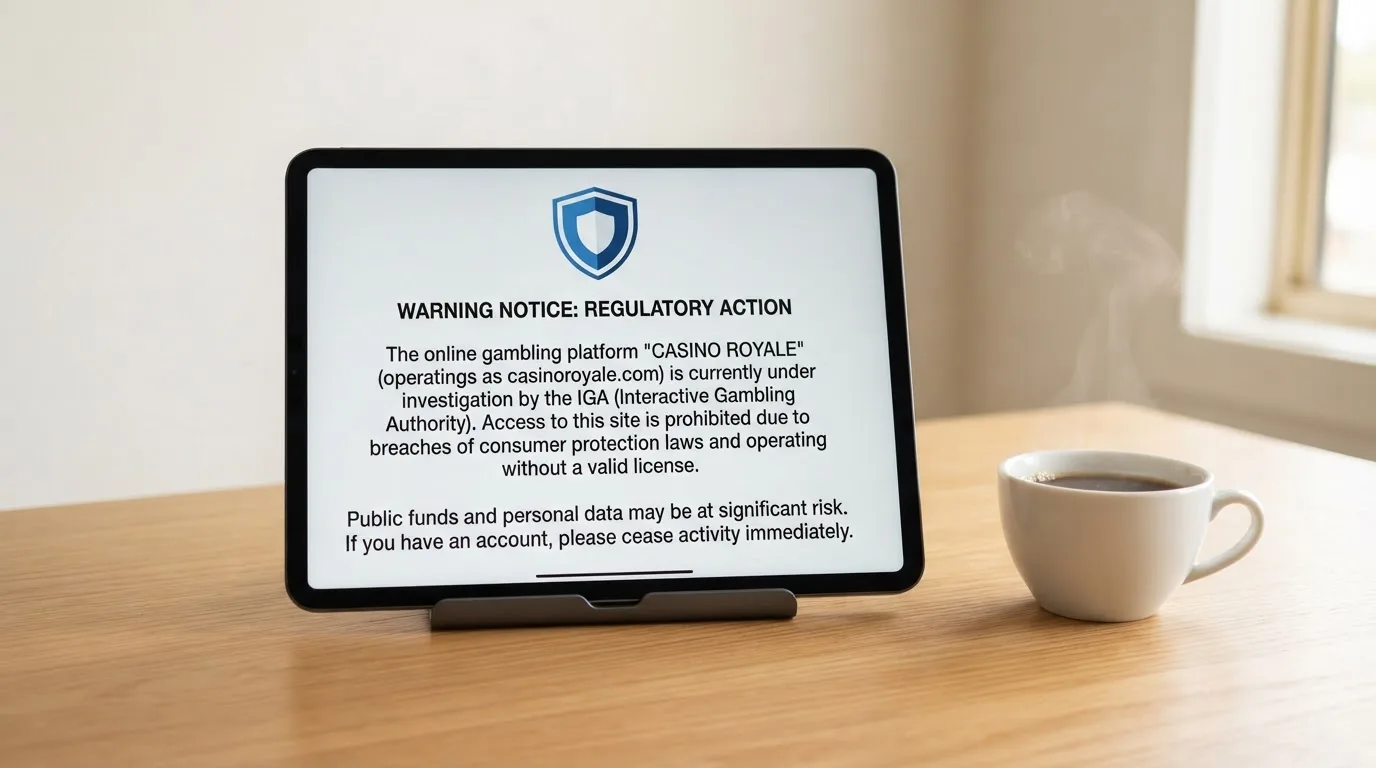
The Australian Communications and Media Authority investigates, issues formal warnings, and directs Australian internet service providers to block illegal sites. As reported in June 2026, a total of 1,751 illegal gambling and affiliate marketing websites had been blocked since the first blocking request in November 2019, and more than 230 unlicensed gambling services had left the Australian market since enforcement was strengthened in 2017. In the round reported on 26 June 2026 the ACMA asked Australian ISPs to block 12 more sites — 7Signs, ChromaBet, Donbet, Duospin, Freshbet, Slots Gem, Jacks Club, Lucky Start, Pointsbetz, Spinrise, Vinyl Casino and Wildsino. None of those 12 is on the reviewed list, but the rate at which the ACMA’s blocking requests have run is the best single proxy for the volume of prohibited marketing an Australian internet user is exposed to.
Where an Australian Player Can Find Help
Responsible-gambling supports in Australia are built around onshore services. Gambling Help Online, run by the national counselling service, offers 24/7 chat and is reachable through 1800 858 858, the National Gambling Helpline. The line is free and confidential. State and territory self-exclusion registers exist alongside the federal one, and BetStop — the National Self-Exclusion Register, live since August 2023 — is the federal mechanism an Australian player can sign up to be excluded from licensed wagering. BetStop binds Australian-licensed online and phone wagering services; an offshore casino is not connected to it, which is the structural reason an exclusion from BetStop does not by itself stop access to unlicensed offshore sites.
A useful framing for a player who is reading this page because they are weighing whether to use an offshore Quickspin-marketing site is that the responsible-gambling regime they would be using is the same regime that applies to a land-based club or pub in Australia — Gambling Help Online, the helpline, BetStop, state-level exclusions, the lot — and none of it reaches into the offshore channel. That is the practical meaning of “no Australian consumer protection” when it is printed in a warning notice.
How Deposits and Withdrawals Work Through Offshore Sites
The offshore casinos reviewed above generally process deposits through a smaller set of routes than licensed Australian wagering operators do. Cards are accepted, e-wallets are accepted, and crypto deposits have been a feature of the offshore market for years. Since 11 June 2024, credit cards, credit-related products and digital currency have been banned as payment for licensed online wagering in Australia, with penalties up to A$247,500 for operators that breach the rule. A licensed Australian wagering site asking a customer to deposit by credit card or cryptocurrency is breaking its own licence conditions. The fact that an offshore site asks for those payment methods is, by itself, a sign the site is operating outside the Australian rules.
The legal deposit routes for licensed Australian wagering are debit card, bank transfer, PayID/Osko and BPAY. Each of those routes settles through the Australian payments system and is auditable by AUSTRAC and the licensed operator’s compliance team. Offshore deposit routes settle through payment processors and crypto networks that operate outside the Australian regulatory perimeter, and a player whose deposit has gone through has no domestic recourse if the operator refuses to process the withdrawal.
Settlement times on offshore sites are typically advertised in hours for e-wallets and one to several business days for bank transfers, with crypto withdrawals sometimes faster in the optimistic case and substantially slower in the case of a withdrawal that gets flagged for additional verification. The verification process is the moment at which offshore sites most often refuse to pay — usually on the basis that the player’s documentation does not meet the operator’s anti-money-laundering standard, which is a real standard but is also a standard the operator sets unilaterally and against which the player has no appeal. The Australian licensed wagering route, by contrast, has an external dispute resolution pathway through the operator’s nominated ADR provider; offshore sites have whatever the operator’s own terms say they have, which is often nothing.
Tax is the cleanest part of the picture. Gambling winnings of a recreational player are not assessable income under section 6-5 of the Income Tax Assessment Act 1997, and losses are not deductible, unless the person is carrying on a business of gambling. That position is the same whether the player is at a licensed Australian wagering operator or at an offshore casino. The “check with the ATO” rider applies whenever a player’s gambling activity looks remotely commercial in scale.
Frequently Asked Questions About Quickspin and Online Casino in Australia
Can an Australian player legally access a Quickspin-branded online casino?
No. The IGA prohibits providing online casino games, including Quickspin-branded slots, to a person in Australia, and no state or territory licenses the activity. Every offshore site marketing Quickspin titles to Australians is offering a prohibited interactive gambling service, and the operator — not the player — is the target of the prohibition. The studio’s own licences (Malta MGA/CRP/137/2007 and UK Gambling Commission coverage through Playtech) do not extend to Australian end users.
What does Quickspin actually make?
Quickspin makes online slot games, distributed to operators through its Remote Gaming Server. The studio was founded in Stockholm in 2011, acquired in 2016, and now operates from Stockholm, Sliema and Kyiv with about 100 staff. Its catalogue is HTML5-only since the studio’s transition away from Flash, and every title runs on a mobile browser without a separate download. Quickspin does not run its own casino — it is a B2B supplier, not a consumer-facing brand.
Are Quickspin games available in land-based venues in Australia?
Quickspin is a digital-only studio and has no land-based presence in Australian clubs, hotels or casinos. The Australian land-based gaming machine market is dominated by Aristocrat Leisure, the Sydney-based manufacturer founded in 1953 and listed on the ASX in 1996. Players who encounter Quickspin-branded machines at land-based venues outside Australia will not find them in Australian venues, because Quickspin’s product is its online catalogue and that catalogue is not deployed on Australian EGMs.
How can an Australian check whether a Quickspin game is fair before considering play?
The standard tools are an independent RNG test certificate from a recognised laboratory (GLI, Quinel, eCOGRA, BMM Testlabs) and a published RTP on the operator’s game-info page. Quickspin’s supply-chain partners carry their own certifications — Betsoft points to Quinel and GLI, for instance — and a player who wants to verify a specific title can check the studio’s certification against the operator’s lobby entry. None of that changes the legal position of an offshore operator offering the game to Australians, which is the larger question.
Why do offshore sites keep advertising Quickspin games to Australians despite the IGA?
Because the offshore market is large, the marketing reaches the Australian audience regardless of where the player sits, and the ACMA’s enforcement is provider-targeted rather than player-targeted. The ACMA’s blocking requests have pulled 1,751 sites since November 2019, but the volume of new offshore brands coming online each year keeps the cumulative count climbing. The economic incentive to keep marketing to Australians is high enough that operators absorb the cost of a warning and continue.
What should an Australian do if they see a Quickspin game promoted by an unlicensed site?
Report the site to the ACMA through its online complaints page. The authority uses those reports to triage investigations, and the volume of complaints against a particular brand is one of the inputs to a blocking request. For the player personally, the relevant support channels are Gambling Help Online (24/7 chat) and the National Gambling Helpline on 1800 858 858, both free and confidential, and BetStop for self-exclusion from licensed Australian wagering. None of those channels reaches into the offshore site itself, which is the structural reason reporting matters.
How fast has the ACMA been blocking sites?
Across the 1,751 sites blocked between November 2019 and June 2026, the ACMA has been running an average of roughly 22 site-blocking requests per month — somewhere around 260 sites a year over the full window, with the rate varying substantially from round to round depending on the operators the ACMA is investigating at a given moment. The earlier rounds of enforcement pulled in much larger batches as the ACMA caught up with the backlog of obviously non-compliant sites; the more recent rounds have been shorter and more targeted. The June 2026 round of 12 sites sits at the lower end of recent batches, but it is one of two or three rounds the authority runs most months, and the cumulative total continues to climb.
The 11 operators reviewed above are not on that June 2026 blocking list. They have been formally warned, and warnings are the ACMA’s first enforcement step; a site that does not change its behaviour after a warning is the candidate for the next round of blocking requests. The reviewed set is therefore a snapshot of the warning stage rather than the block stage, and several of the brands on it are plausible candidates for inclusion in future blocking rounds if their Australian-facing activity does not change.
The individual player is not prosecuted under the IGA — the legislation targets the provider, not the user — but the practical consequences of using an unlicensed offshore site fall entirely on the player. An offshore casino gives no Australian consumer protection, no complaints body and no recourse if a withdrawal is refused, and it can be blocked by an ISP while a balance is still sitting on it. H2 Gambling Capital’s 2025 report estimates that Australians lose about A$3.9 billion a year to illegal gambling sites, and that the share of gambling going through legal channels fell from 74% in 2021 to 64%. Those are the best available estimates of the scale of the prohibited market in dollar terms.
The 2026 reform that changes the picture going forward is the Interactive Gambling Amendment (Gambling Reform) Bill 2026, which passed Parliament on 19 August 2026. Its advertising and inducement measures commence 1 January 2027 — law with a start date, not yet in force on a 2026 page. Once those measures are in force, the inducements discussed in the bonus shelf above become a regulatory target in their own right, separately from the underlying prohibition on the games themselves.