
Pokies Open Near Me in Australia in 2026: Licensed Venues, Hours and the Offshore Sites the ACMA Has Acted Against
Most Australians searching for pokies open nearby are looking for the closest pub, club or casino with the machines actually running — and the answer almost always lies on their own street, not on a screen promising “24/7” play from somewhere offshore. The legal option in every state and territory is a licensed venue with poker machines inside. Anything offered through a website to a person sitting in Australia sits outside Australian law, and the Australian Communications and Media Authority has spent the last several years listing the names of the companies behind those websites one formal warning at a time.
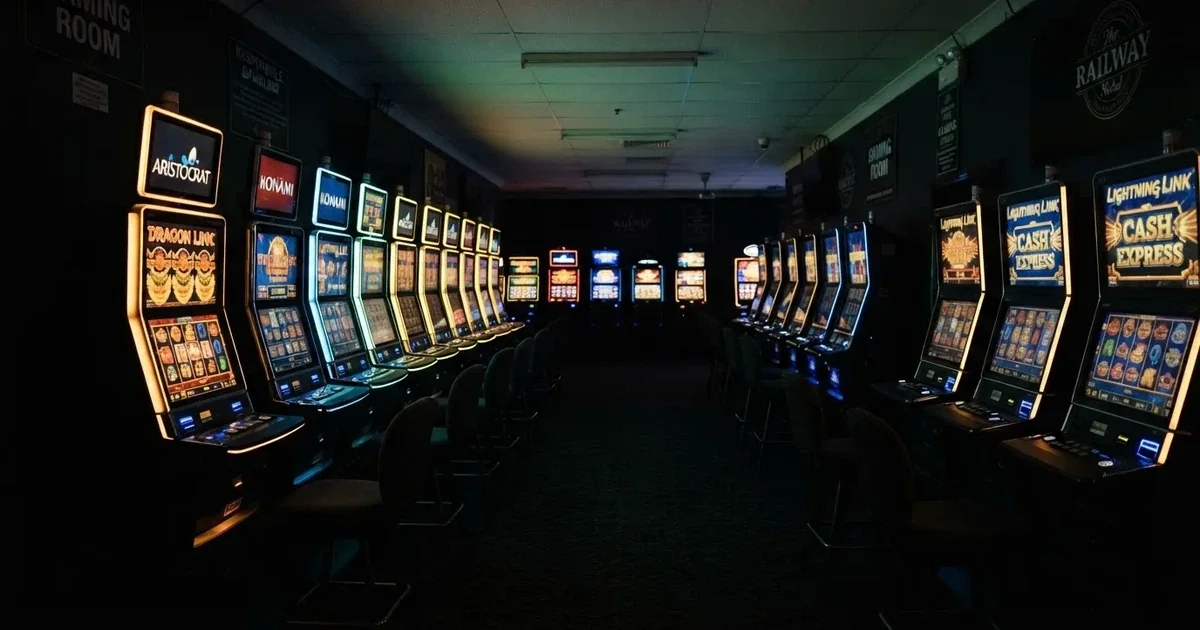
This page is a guide to the legal side of that picture: the venues themselves, the rules each state sets, and the practical things a player needs to know before walking in. It is not a directory of offshore brands and not a recommendation. The brands in the comparison block below are listed because the ACMA has acted against them by name, not because they are places to play.
Data current as of 28 October 2026, checked against ACMA formal warning publications and the ACMA blocking register.
Table of Contents
- The landscape: how 1,751 blocking requests and 230 departures reshaped what “near me” looks like
- Where pokies are legal in Australia — and where they are not
- Responsible play: where the support actually lives
- Land-based venues: hours, identification and what to expect
- The ACMA’s record against offshore brands offering prohibited services
- Why these warnings keep coming
- What a player should take from the comparison
- A short note on the games inside the machines
- How to actually find pokies open right now
- Frequently asked questions
The landscape: how 1,751 blocking requests and 230 departures reshaped what “near me” looks like
A search for “pokies open near me” returns a familiar mix: maps results pointing to local venues, and ads for offshore casinos that promise instant play, no ID and 24-hour access. The first set is what the question is really asking for. The second set is what Australian regulators have spent the last several years trying to make harder to find.
Between the first blocking request in November 2019 and the round reported on 26 June 2026, the ACMA directed Australian internet service providers to block 1,751 illegal gambling and affiliate marketing websites, and more than 230 unlicensed gambling services withdrew from the Australian market after enforcement was stepped up in 2017. The latest single round asked providers to block another twelve names — 7Signs, ChromaBet, Donbet, Duospin, Freshbet, Slots Gem, Jacks Club, Lucky Start, Pointsbetz, Spinrise, Vinyl Casino and Wildsino. The pace has not slowed. Blocking a site does not close the company behind it, and the same operators tend to surface again at a new address, which is why the ACMA now treats blocking as an ongoing maintenance task rather than a one-off clean-up.
Blocking activity
| Measure | Count |
|---|---|
| Illegal gambling and affiliate sites blocked | 1,751 |
| Unlicensed services departed market | 230 |
Where the machines actually live
Electronic gaming machines — poker machines, pokies, EGMs, slot machines, the names shift with the state — operate in every Australian state and territory, and each jurisdiction sets its own rules on how they are designed, where they are placed and what they return to players. There is no single national regulator for the machines themselves. The pattern is one of federated oversight with a handful of large concentrations.
New South Wales sits at the top of the count. The state had 87,298 gaming machines outside its casinos spread across 2,195 venues in June 2023, and players lost A$8.18 billion on those machines in 2022-23. Queensland had 21,122 machines in 351 venues as of October 2023. Victoria had 26,380 machines outside Crown Casino across 488 venues in 2021-22, operating under a statewide cap of 30,000. Western Australia is the outlier: poker machines were banned in pubs and clubs when Crown Perth opened in 1985, and the state’s only legal machines are inside that one casino, where the count has grown from about 200 in 1985 to roughly 2,500 today, all approved by the state’s Gaming and Wagering Commission.
Registered clubs operated Australia’s first legal poker machines from 1956, in New South Wales. Tasmania took a different path: the Federal Group held a monopoly licence over every poker machine in the state from 1968, until legislation passed in November 2021 ended that monopoly and moved oversight to the Tasmanian Liquor and Gaming Commission. Tasmania has since planned nation-leading mandatory pre-commitment cards for its machines, though implementation of that reform was delayed until late 2025.
What the machines pay back
The legal minimum return-to-player is set jurisdiction by jurisdiction, and the spread is wider than most players realise. The legal floor is 85% in New South Wales, the Northern Territory, Queensland and (generally) Victoria — 87% at Crown Melbourne. It rises to 87% in the Australian Capital Territory and Tasmania, 87.5% in South Australia, and 90% in Western Australia. Those are minimums. Venues and manufacturers sit above them on most machines, but the floor itself shapes the worst case a player can be dealt on a licensed floor.
A few other rules of the road are consistent enough to be worth knowing. The minimum age to play is 18, in every state and territory. Identification is checked at the door in casinos and at any venue that has signed up to a self-exclusion register; it is checked at the machine on machines that have been converted to cashless play. A venue that refuses to ask, or a website that promises not to, is one signal among several that the operation sits outside the Australian system.
Payment rules that bite before you even sit down
A second set of rules applies to how an Australian player can put money in. Credit cards, credit-related products and digital currency are banned as payment for licensed online wagering in Australia since 11 June 2024, with penalties of up to A$247,500 for operators that break the rule. The legal deposit routes for licensed wagering are debit card, bank transfer, PayID, Osko and BPAY. The list is short on purpose. A site that asks an Australian player for a credit card or a crypto deposit is operating outside the Australian rules, and the bank or card issuer that processes the payment is being asked to step outside them too.
These rules do not apply to a walk-in cash session at a pub or club. They bite the moment the player moves the action online, which is also the moment the activity stops being licensed in Australia.
Where pokies are legal in Australia — and where they are not
Australian gambling law draws a hard line between wagering (sports and race betting, lotteries, keno) and online casino games, online pokies and in-play betting. The Interactive Gambling Act 2001, strengthened by the Interactive Gambling Amendment Act 2017, makes it an offence to provide online casino games, online pokies or in-play betting to a person physically in Australia. No state or territory licenses them. The line is federal and it has been stable for years.
What is licensable online is wagering on races and sport placed before the event, lotteries and keno — in practice licensed by the Northern Territory Racing and Wagering Commission, which regulates 52 of Australia’s online bookmakers, including Sportsbet, Bet365 and Ladbrokes. The commission has no full-time staff and meets once a month in Darwin, a fact that has drawn repeated calls for reform but has not changed the structure.
What changes is the enforcement. The ACMA investigates, issues formal warnings and directs internet service providers to block illegal sites. The individual player is not prosecuted — the Interactive Gambling Act targets the provider, not the customer — but an offshore site gives no Australian consumer protection, no complaints body and no recourse if a withdrawal is refused, and the site can be blocked with a player balance still on it. The legal venues do not have that problem because they are licensed, located and answerable to a state regulator with a phone number.
The next layer of reform is already law with a future start date. The Interactive Gambling Amendment (Gambling Reform) Bill 2026 passed Parliament on 19 August 2026, and its advertising and inducement measures commence on 1 January 2027. The bill is in force as an Act from its royal assent; its operational provisions start in the new year. For most of 2026, the rule is the one above: no online casino games, no online pokies, no in-play betting, regardless of what licence the website displays.
What a “formal warning” actually does
The ACMA’s working tool for offshore operators is the formal warning letter, published on the regulator’s site and dated to the month it was issued. A warning is not a fine and not a court order. It puts the operator on notice that the ACMA considers the service prohibited, and the publication of the warning gives Australian payment providers, advertisers and affiliate networks a documented reason to cut ties. The pattern that emerges across the warnings is a small set of operator names — Dama N.V., Hollycorn N.V., Ryker B.V. and others — repeating across multiple brands. The brands change; the company behind them often does not.
The eleven brands compared below are listed because the ACMA has warned each of them by name. The table is a record of regulatory action, not a ranking and not a shortlist.
Tax: what a recreational player owes
Gambling winnings of a recreational player in Australia are not assessable income under section 6-5 of the Income Tax Assessment Act 1997, and losses are not deductible — unless the person carries on a business of gambling, which is a different matter handled by the Australian Taxation Office. For almost everyone walking into a pub or club, the answer is the same: no tax to declare, no form to file, no record to keep. Anyone whose gambling looks like it might cross the line into business should check with the ATO directly.
Responsible play: where the support actually lives
The legal side of Australian gambling has built a parallel structure of player protection that the offshore side cannot touch. The reason to know it exists is that it is the place a player is meant to land before the machines start.
BetStop — the National Self-Exclusion Register has been live since August 2023. A person can register to exclude themselves from every Australian-licensed online and phone wagering service in one step. The exclusion is binding on the operator. It does not bind an offshore casino that has no relationship with the register. A player who wants the offshore side covered too needs to use the offshore site’s own exclusion tools, with no Australian backstop if those tools are ignored.
Gambling Help Online and the National Gambling Helpline on 1800 858 858 are free, 24/7, with chat available. The helpline takes calls from players, from families and from venue staff who have concerns about a patron. The line is staffed by counsellors, not by marketing staff.
State-level support sits on top of those national services. Every state and territory runs its own problem-gambling program, with face-to-face counselling, financial counselling and self-exclusion from specific venues. The federal register and the state programs are designed to work together — a BetStop registration does not stop someone walking into a pub with machines, but a state self-exclusion order does, and is enforceable on the venue.
The rule of thumb, and one the legal venues operate by, is that the protections sit on the legal side of the line. A site that promises anonymity, no ID and 24/7 access is also a site with no BetStop registration, no state exclusion order and no complaints body. The choice to play inside the system is, in practice, the choice to be covered by it.
Land-based venues: hours, identification and what to expect
The mechanics of finding pokies open nearby are simpler than the offshore side makes them sound. Most Australian pubs and clubs keep their poker machines open during the same hours as the venue itself: typically from late morning to late evening on weekdays, with longer hours on Friday and Saturday nights. The exceptions worth knowing are the casino floors and a small number of 24-hour venues in major cities.
Hours
Pubs generally open their gaming rooms from around 10am or 11am and close them between midnight and 2am on weeknights, with later closings on Friday and Saturday. State laws vary, and a few jurisdictions impose mandatory closing hours on the machines themselves regardless of the venue’s overall opening time.
Clubs tend to run longer than pubs, often from late morning to midnight or 2am, and many RSL and community clubs keep the machines going later than the bar.
Casinos are the only venues that run near-24-hour gaming floors. Crown Melbourne’s gaming floor runs through the night; Crown Sydney runs a similar pattern; the Star Sydney operates around the clock on its main gaming floor. Adelaide’s casino is similarly extended. Crown Perth, the only legal casino in Western Australia, runs through the night on its machine floor.
24-hour venues exist in Sydney and Melbourne — a handful of hotels and late-night clubs hold the necessary liquor and gaming licences to keep machines running overnight — but they are not the majority. The reliable rule is that pubs close, clubs close later, casinos do not.
Identification
Identification is checked at the door of any casino in Australia and at the gaming room entry of any venue that has signed up to a state self-exclusion register. Venues that operate cashless machines check ID at the machine when a player loads a card. The minimum age is 18, and the rule is enforced — a venue that fails to check can lose its gaming licence.
For machines that still accept cash, the practical rule is that no venue asks for ID to play, only to enter. Players under 18 are barred at the door. A player who has self-excluded and tries to enter is stopped at the door. Everyone else walks in.
Cash, cashless and the cards
The shape of payment is changing. A growing share of machines in New South Wales and Victoria have been converted to cashless play, where a player loads a card at a kiosk and the machine deducts from the balance. The conversion is venue-led and is partly a responsible-gambling measure (the machine can be set with a loss limit) and partly an anti-money-laundering measure (the card produces a paper trail). Cash machines still dominate in most states.
Tasmania’s pre-commitment card scheme — mandatory, when it starts — will require every player to set spending and time limits before play. Implementation was delayed until late 2025, and the rollout has been slow.
Finding the nearest venue
Three tools do almost all of the work. Google Maps lists pub, club and casino gaming rooms in or near the search location, with the venue’s listed opening hours. The state regulator’s venue register lists every licensed gaming venue in the state with its address and licence number, searchable by suburb. The venue’s own website or Facebook page lists the day’s opening hours and any private functions that close the gaming room early. For most searches, the first tool is enough; for the second two, the state regulator’s site is the one to trust, because the venue list there is the legal definition of “open nearby.”
The ACMA’s record against offshore brands offering prohibited services
The eleven brands below have all received a formal warning from the ACMA for offering prohibited interactive gambling services to Australians. The table records what the regulator has done and when. The blocked sites total and the date of the first blocking request are the inputs for the calculation that follows the table.
| Brand | ACMA action and date | Operator named by the ACMA | Subject support |
|---|---|---|---|
| RocketPlay | Formal warning, March 2026 (Pulsup Ltd); earlier warning, May 2022 (Dama N.V.) | Pulsup Ltd | — |
| Level Up Casino | Formal warning, May 2022 | Dama N.V. | BGaming listings |
| Woo Casino | Formal warning, March 2025 | Dama N.V. | — |
| Spirit Casino | Formal warning, May 2025 | Dama N.V. | — |
| National Casino | Formal warning, July 2025 | Consolutetish S.R.L. | en.wikipedia.org listings |
| Bizzo Casino | Formal warning, July 2025 (Consolutetish S.R.L.); earlier warning, 2022 (TechSolutions) | Consolutetish S.R.L. | — |
| Ignition Casino | Formal warning, July 2025 | Bamboo Media | — |
| Instant Casino | Formal warning, February 2025 | EOD Code SRL | — |
| Jackbit | Formal warning, April 2026 | Ryker B.V. | — |
| Casino Intense | Formal warning, April 2025 | Sterplay Holding Ltd | Official records and media reports |
| Sky Crown | Formal warning (Hollycorn N.V.) | Hollycorn N.V. | — |
Two patterns do most of the explaining. The first is that the operator name behind a brand changes more often than the brand itself does — Dama N.V. alone accounts for four of the eleven, and Hollycorn N.V. sits behind two. The second is that a warning is not a closing: the ACMA blocked 1,751 sites between November 2019 and June 2026, but the same companies keep surfacing under new names, which is why the regulator treats blocking as a maintenance task and the warning list keeps growing.
Three of the eleven — Woo Casino, Spirit Casino and Instant Casino — were named in formal warnings in the first half of 2025. The pattern of the warnings is consistent across the list: the ACMA names the operating company, dates the letter, and publishes both on its website. There is no hearing, no right of reply recorded in the warning itself, and no appeal mechanism inside the warning process. The warning is a published statement that the regulator considers the service prohibited.
The table above covers only the brands for which the ACMA has issued a formal warning. The 1,751 blocked sites cover a wider set — most of them named in blocking requests rather than warning letters, and most of them not compared individually here because the public record on each is thinner.
Blocking rate: how fast the register grew
Between November 2019, when the first blocking request was issued, and June 2026, when the ACMA reported the 1,751 cumulative figure, the regulator asked Australian internet service providers to block 1,751 illegal gambling and affiliate marketing websites. Spread across the 79 months from the first request to the June 2026 report, that works out to roughly 22 blocks per month, or about 265 a year — a rate the ACMA has roughly held across the period, with the most recent single round asking for twelve more in one batch. The result is that the register of blocked sites has not plateaued. New names are still being added each quarter, and the older names tend to reappear at new domains within weeks of being added.
The condition on that figure matters. The 1,751 is a cumulative count of blocking requests, not a count of unique operators — many of the requests target domains run by the same handful of companies, and the regulator itself notes that blocking a site does not stop the operator. Read the rate as a measure of how much enforcement work the ACMA is doing, not as a measure of how many illegal services are still operating.
Why these warnings keep coming
The warnings follow the same shape because the operators follow the same shape. A small number of companies hold multiple brands. Dama N.V. ran RocketPlay (May 2022), Level Up Casino (May 2022), Woo Casino (March 2025) and Spirit Casino (May 2025). TechSolutions held Bizzo Casino (2022), which later surfaced under Consolutetish S.R.L. (July 2025). Hollycorn N.V. sits behind both Sky Crown and Blue Leo. The brand is the front, the operator is the back, and the front changes more often than the back.
The ACMA’s response is also steady. A formal warning is a published letter, dated to the month, naming the operator and the brand. The publication is the operational consequence: Australian payment providers see it, advertisers see it, affiliate networks see it. The site does not necessarily come down. The economic conditions that make it profitable get harder, which is the point.
What a player should take from the comparison
The eleven brands above are not options. The Interactive Gambling Act 2001 makes the services they offer prohibited, and the ACMA has put each of them on notice by name. For a player in Australia, the practical comparison is not between these brands and each other; it is between this list and the licensed pub, club or casino down the road. The list exists to make clear which sites sit outside Australian law, not to inform a choice between them.
The legal floor on offer is a pub or club gaming room with machines regulated by a state authority, accepting cash, with BetStop available, with a state complaints body behind it and with the venue physically answerable to the regulator. For most players on most nights, that is what “pokies open near me” actually means.
A short note on the games inside the machines
The poker machines in Australian pubs and clubs are not a single product. They are licensed per venue, but the game catalogue is largely set by the manufacturer and approved by the state regulator. Players familiar with the offshore side will recognise some of the underlying mathematics from online slots, but the game in a pub is a different object from the game on a website: the minimum RTP is set by state law (85% in NSW, the NT, Queensland and generally Victoria, 87% in the ACT and Tasmania, 87.5% in South Australia, 90% in Western Australia), the bet sizes and spin speeds are capped, and the games are physically present and auditable.
Two table games are worth a mention for the casino side. Baccarat is offered at Crown Melbourne in three variants — Traditional Baccarat, Crown Baccarat and 2 to 1 Baccarat — under rules approved by the Victorian Gambling and Casino Control Commission, the regulator that replaced the VCGLR on 1 July 2022. The house edge is 1.06% on the Banker bet, 1.24% on the Player bet and 14.36% on the Tie. Blackjack sits at roughly 0.28% with optimal strategy under liberal Las Vegas Strip rules (dealer stands on soft 17, double on any two cards, double after split, resplit aces, late surrender) and around 0.43% under Atlantic City rules. The math is the math; the licensed floor is the only place an Australian player can sit at those tables with a regulated game and a complaints body to take a dispute to.
How to actually find pokies open right now
The fastest answer is a maps search. Type “pokies” into Google Maps with the location turned on, and the result will be the licensed pubs, clubs and casinos within a short radius, each with its listed opening hours. The state regulator’s venue register is the next check for anything that looks unusual: it lists every licensed venue by address and licence number.
For a 24-hour option, the casinos are the answer. Crown Melbourne, Crown Sydney, the Star Sydney, Crown Perth and Adelaide casino all run machine floors through the night. Sydney and Melbourne also have a small set of late-licence hotels and clubs that hold the right combination of liquor and gaming permits to keep machines running after midnight. They are listed in the state registers and visible on maps; they are not a large set.
For an early-morning option, the rule is to wait. Most pub gaming rooms open around 10 or 11 in the morning. The clubs open a little later. The casino floors are the only ones that are reliably running at 7am.
For a check on whether a specific venue is currently open, the venue’s own page on Google or its Facebook page will usually have today’s hours. A phone call is faster and more reliable for an immediate question. The state regulator’s venue register does not show live opening status, only the licensed address and hours.
Frequently asked questions
What hours do most Australian pubs and clubs typically keep their poker machines open?
Pub gaming rooms usually open between 10am and 11am and close between midnight and 2am on weeknights, with later closings on Friday and Saturday. Clubs often run from late morning to midnight or 2am, and a small number of late-licence venues in Sydney and Melbourne keep the machines going overnight. Casino floors are the only ones that reliably run 24 hours.
Is there a way to check which nearby venue currently has poker machines open right now?
Google Maps with location turned on will list the licensed venues nearby with their listed opening hours. The state regulator’s venue register gives the licensed address and licence number, and the venue’s own page or a quick phone call confirms whether it is open at that minute. For a 24-hour option, the casino floors are the only ones guaranteed to be running.
Are poker machines in a licensed pub or club the same thing as an online pokies game?
The machines are similar in design but not in legal status. A pub or club machine is licensed in Australia, regulated by a state authority, with a legal floor on return-to-player and a venue that is physically answerable to the regulator. An online pokies game offered to a person in Australia is prohibited by the Interactive Gambling Act 2001. The mechanics can look the same; the legal frame around them does not.
Do all pubs and clubs run pokies for 24 hours, or only some venues?
Only some. Most pub gaming rooms close by 2am, and most club gaming rooms close by midnight or 2am. A handful of late-licence hotels and clubs in Sydney and Melbourne hold the necessary permits to run machines overnight, and the casino floors are open around the clock. Western Australia is the most restrictive case — poker machines were banned in pubs and clubs when Crown Perth opened in 1985, and the only legal machines in the state are inside that casino.
What identification, if any, does a venue ask for before letting someone play the machines?
Casinos check ID at the door. Clubs and pubs that have signed up to a state self-exclusion register check ID at the gaming room entry. Machines that have been converted to cashless play check ID at the machine when the player loads a card. For machines that still accept cash, the practical rule is that no venue asks for ID to play — only to enter. The minimum age is 18.
How does the number of poker machines in Australian venues compare with the rest of the world?
Australia holds roughly 3% of the world’s pub and club poker machines with about 0.3% of the global population, which works out to a per-capita density roughly ten times the world average. The 2020-21 figure of almost A$150 billion wagered through gaming machines against a population of about 26 million gives a per-capita turnover well above any other country with comparable machine counts.