
Best pokies in Geelong: where the machines actually run, and where they cannot
Updated against the ACMA register on 28 October 2026 and the Victorian Commission for Gambling and Casino Control’s published venue data. A reader walking into a Geelong pub or club tonight is met by the same thing they would have met five years ago: rows of electronic gaming machines, a maximum cash payout limit printed near the cashier, and a Victorian Commission for Gambling and Casino Control venue licence on the wall. They will not be met by a licensed online casino — there is no such thing, because the Interactive Gambling Act 2001 does not allow one to exist.
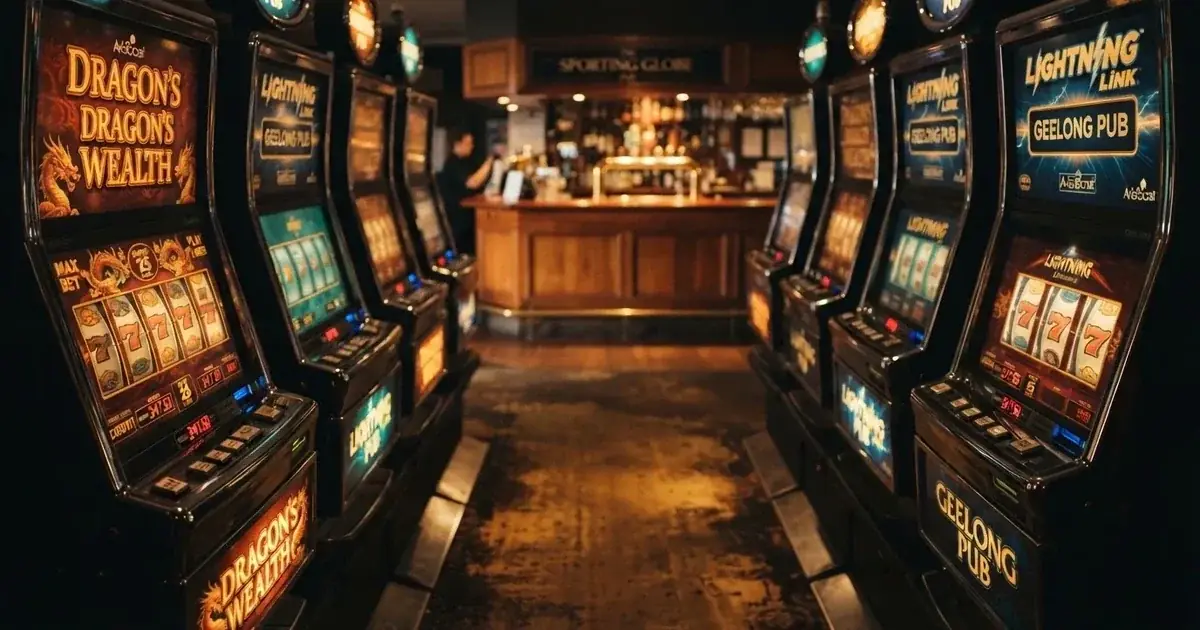
This page provides a clear guide to Geelong’s licensed pokies venues, the IGA ban on online casino games, and the offshore brands formally warned by the ACMA. The licensed reality for a Geelong player sits in pubs and clubs under state law, whereas the loud online alternative sits offshore and is unlawful to provide in Australia. This page maps the land-based reality — which venues hold machines, what the machines are required to pay back, and how the self-exclusion machinery connects to a Geelong visit. It also explains why offshore brands a reader meets through search ads cannot lawfully offer what they advertise, and lists the operators the Australian Communications and Media Authority has formally warned by name. The two halves together clarify the landscape.
Table of Contents
- Cashless cards, fast paytables and the way a Geelong machine actually settles
- What “best” actually means on a Geelong floor
- The top 11 Geelong-relevant offshore brands the ACMA has formally warned
- The shape of the Australian offshore market in 2026
- What the Interactive Gambling Act 2001 actually prohibits
- Where a Geelong reader who needs help can actually go
- The licensed venues, machine counts and what the published data shows
- How this shortlist of warnings was put together
- What this page is, and what it is not
- Frequently asked questions
Cashless cards, fast paytables and the way a Geelong machine actually settles
Payments and payout speed on a Geelong pokies floor are not a feature to be sold; they are the floor mechanics the Victorian regulator sets and a venue obeys. A player who walks in with cash buys credits at the cashier or, since cashless gaming became standard, taps a player’s card loaded from a debit account. The credits become machine credit, the machine records every spin, and the payout — when one arrives — returns to that same card. There is no online wallet, no international transfer, no cryptocurrency; the rails are Australian debit, PayID and BPAY where the venue operates any external account, and the settlement is, by design, same-day.
How Victorian venues are paid out — the rules the machines run on
The VGCCC requires every electronic gaming machine outside Crown Casino in Melbourne to meet a minimum return-to-player rate of 87 per cent. A venue cannot lawfully run a machine below that floor. The ceiling is set by the machine design and the betting limits a venue chooses, not by the player. What the reader should know is that 87 per cent is a long-run average — a number the regulator uses to police manufacturers, not a promise a machine will hand back $87 of every $100 played on a given night. The remaining 13 per cent is the house edge, and it is the same on a Geelong pub machine as on any other regulated Victorian machine.
In April 2026 the ACMA issued a formal warning to Ryker B.V. over Jackbit and CasinOK.
Maximum cash payouts and why “instant withdrawal” is a different question online
A Geelong pub or club is required by the VGCCC to print a maximum cash payout limit near the cashier — typically A$1,000 to A$2,000 for a single machine payout, with larger wins paid by cheque or electronic transfer after identity checks. That ceiling is what stops a venue from being drained in a single session and is what the reader’s night looks like in practice. The phrase “fast payout” or “instant withdrawal” that an offshore pokies site uses in its marketing describes a completely different mechanism: an international transfer from an unlicensed operator, with no Australian consumer protection standing behind it if the money does not arrive. The Victorian machine’s “speed” is the speed of the card read; the offshore site’s “speed” is the speed of a transaction the ACMA can interrupt at any time.
The cost of a Geelong session, worked through
The arithmetic on a regulated Victorian machine is unforgiving and unembellished. A player who puts A$100 through a machine returning 87 per cent on average loses A$13 over a long session. A player who puts A$500 through it loses A$65. The number is exact because the law sets the floor; the player’s evening is not exact because variance dominates it. A 30-minute session at A$1 a spin, on a typical five-second spin interval, runs about 360 spins and produces, in expectation, A$360 of turnover and A$47 of loss. That figure is what the regulator calls “harm minimisation” — the published loss number is a small fraction of what an unregulated offshore site can extract from the same player over the same elapsed time, because the offshore site has no maximum bet and no mandatory session break.
What “best” actually means on a Geelong floor
“Best paying pokies in Geelong” sounds like a ranking problem; it is closer to a reading-the-machine problem. A venue chooses its machine mix from licensed manufacturers, and each machine has a published return-to-player rate that sits at or above the 87 per cent regulatory floor. The difference between one machine and another on the same floor is usually a few percentage points. The difference between any of them and an offshore site with no enforced floor is the difference between a regulated 87 per cent and whatever the offshore site decides to publish.
What separates one Geelong venue from another
The reader’s “best” rests on four practical levers, in roughly this order. First, machine mix — venues that run newer Aristocrat and IGT titles carry slightly higher theoretical returns than the older MK6 and PC4 chassis still in service. Second, opening hours — some Geelong venues close the gaming floor well before midnight, others run later under liquor-licensed trading hours. Third, betting limits — a venue that offers a A$5 maximum credit lets a session run faster and costlier than one that caps credits at A$2. Fourth, ATM and cash access — the VGCCC requires that a venue offers cashless options, and a venue that has retired its ATM altogether makes it harder to chase a session. None of these is a marketing pitch; each is a feature of the licence the venue holds.
24-hour pokies Geelong — the legal shape of the question
The phrase “24 hour pokies Geelong open now” reads as a request for a service that does not exist under Victorian law. Hotels and clubs are bound by liquor-licensed trading hours, and the gaming floor sits inside those hours. A small number of Geelong hotels trade later under a late licence, but a 24-hour gaming floor in the Geelong region is not something the regulator allows. The reader who arrives at 3 am expecting to find an open machine room will find a closed venue. What the offshore sites promise under the same headline — a “24/7 pokies” page for Australian players — is the same illegal product as their daytime offer: an unlicensed interactive gambling service the Interactive Gambling Act 2001 prohibits.
Cashless pokies Geelong — how the card changes the experience
Cashless gaming is the change most readers have already noticed without naming it. A player’s card holds the session’s credits, the machine reads it on tap-in, and the winnings land back on the card. The Geelong venues that have completed the rollout are required to do so under the Victorian Cashless Gaming Trial and the supporting regulations; the venues still running cash on the floor are operating under the trial’s transition arrangements. The practical effect for a reader is that chasing — putting fresh money into a machine after a session’s losses — is harder when the cashpoint is in another room and the card is the only way to feed the machine. The cashless system also produces the data Victoria uses to enforce the pre-commitment limits the regulator sets per player.
The top 11 Geelong-relevant offshore brands the ACMA has formally warned
The Interactive Gambling Act 2001 prohibits offering online casino games and online pokies to a person physically in Australia. The eleven brands below each received a formal warning from the ACMA for doing exactly that. The list is not a recommendation; it is the regulator’s own enforcement record. Where a brand’s data is missing on a subject relevant to Australian players, the row carries the no-data marker rather than a guess.
| Brand | ACMA action and date | Operator named by the ACMA | Subject support |
|---|---|---|---|
| RocketPlay | Formal warning, March 2026 (and earlier Dama N.V. action, May 2022) | Pulsup Ltd | — |
| Level Up Casino | Formal warning, May 2022 | Dama N.V. | Listing only (Wikipedia, VGCCC) |
| Woo Casino | Formal warning, March 2025 | Dama N.V. | Listing only (Wikipedia) |
| Spirit Casino | Formal warning, May 2025 | Dama N.V. | — |
| National Casino | Formal warning, July 2025 | Consolutetish S.R.L. | Listing only (ABC, infrastructure.gov.au) |
| Bizzo Casino | Formal warning, July 2025 (and earlier TechSolutions action, 2022) | Consolutetish S.R.L. | — |
| Ignition Casino | Formal warning, July 2025 | Bamboo Media | — |
| Instant Casino | Formal warning, February 2025 | EOD Code SRL | — |
| Jackbit | Formal warning, April 2026 | Ryker B.V. | — |
| Casino Intense | Formal warning, April 2025 | Sterplay Holding Ltd | Listing only (ABC, ASGAM, CBS SA) |
| Sky Crown | Formal warning, September 2022 | Hollycorn N.V. | Listing only (Wikipedia) |
The table is short on purpose. The ACMA register lists many more warned brands; these eleven are the ones the regulator has named in formal action that are also relevant to a Geelong reader who might encounter them through search ads or affiliate marketing. The “Subject support” column shows where an Australian listing page references the brand by name; where it is a dash, the regulator’s action is the only authoritative Australian record.
RocketPlay — the most recent warning, the same product
RocketPlay sits at the top of the list because it carries the freshest ACMA action: a formal warning to Pulsup Ltd in March 2026, sitting on top of an earlier Dama N.V. warning from May 2022. The brand has changed hands at the operator level without changing its offer to Australians, which is itself the regulator’s complaint — the same prohibited interactive gambling service, dressed in new corporate paperwork. A reader who meets the site through an affiliate link is meeting the same unlawful product the ACMA warned about twice.
Level Up Casino and Woo Casino — Dama N.V.’s cluster of warnings
Three of the eleven brands trace to a single operator, Dama N.V.: Level Up Casino, Woo Casino and Spirit Casino, each carrying its own formal warning in successive years (May 2022, March 2025 and May 2025). The pattern matters because it shows how a single corporate vehicle can run several Australian-facing brands without any of them becoming lawful under the IGA. The ACMA’s enforcement works against the operator and the brand in parallel; the reader’s exposure is to the brand, and the regulator’s record is at the operator level.
National Casino and Bizzo Casino — the Consolutetish S.R.L. pair
Two of the eleven brands, National Casino and Bizzo Casino, were warned in the same July 2025 round against Consolutetish S.R.L. Bizzo had already been the subject of a 2022 warning against TechSolutions Group — the same pattern of corporate re-shuffling under the same product. The reader sees a casino brand; the regulator sees an operator that has changed names but not practices.
Ignition Casino, Instant Casino, Jackbit, Casino Intense and Sky Crown
The remaining five — Ignition Casino, Instant Casino, Jackbit, Casino Intense and Sky Crown — each carries its own operator name on the ACMA’s record: Bamboo Media, EOD Code SRL, Ryker B.V., Sterplay Holding Ltd and Hollycorn N.V. respectively. Sky Crown’s warning dates to September 2022, the oldest on the list; Jackbit’s dates to April 2026, the newest alongside RocketPlay. Each brand runs the same prohibited interactive gambling service under a different corporate wrapper, and the regulator’s enforcement hits each wrapper in turn.
What the table leaves out, on purpose
The table does not rank these brands. They are not a recommendation set, and they are not ordered by size or by recency of warning. They are ordered as the regulator’s enforcement record presents them, with each row carrying the same two facts the regulator published: the brand and the date. A reader who wants a recommendation is in the wrong section; the land-based section above is where a Geelong reader’s actual choice lives.
The shape of the Australian offshore market in 2026
The eleven brands above are the most visible Australian-facing names in the ACMA’s formal warnings, but they sit inside a much wider offshore market. A 2025 industry report estimated that Australians lose about A$3.9 billion a year to illegal offshore gambling sites, and that the share of gambling going through legal Australian channels fell from 74 per cent in 2021 to 64 per cent. The fall is not a consumer preference story; it is a story of offshore marketing filling a gap the Australian regulatory framework does not permit local operators to fill. The legal Australian channels are racing and sports wagering, lotteries and keno, and the licensed land-based venues covered in the section on payments and on licensed venues.
The blocking rate the ACMA has built up since 2019
The arithmetic that matters on a page about online pokies in Geelong is how quickly the ACMA’s blocking list has grown. As of June 2026, the regulator had asked Australian internet service providers to block 1,751 illegal gambling and affiliate marketing websites since the first blocking request in November 2019 — a run of six and a half years. That works out to an average of roughly 240 sites blocked a year, or about twenty a month, with the most recent June 2026 round alone adding twelve names: 7Signs, ChromaBet, Donbet, Duospin, Freshbet, Slots Gem, Jacks Club, Lucky Start, Pointsbetz, Spinrise, Vinyl Casino and Wildsino. The rate is not steady; it has accelerated since the Interactive Gambling Amendment Act 2017 strengthened the regulator’s enforcement tools, with the post-2017 period accounting for more than 230 unlicensed gambling services that have left the Australian market entirely.
What the blocking rate tells a reader
The figure sits between two truths. It is high enough to show the regulator is enforcing: an offshore operator targeting Australians today faces a credible risk of being added to a blocking round, and a credible risk of having its Australian-facing payment rails interrupted by the same process. It is not high enough to end the market: A 2025 industry report estimated that losses to illegal offshore gambling sites are about A$3.9 billion a year, and that the share of gambling going through legal Australian channels fell from 74 per cent in 2021 to 64 per cent. The reader who meets one of these brands through a search ad is meeting a product the regulator has actively tried to remove. The right comparison is not “is this site licensed somewhere”; it is “does this site have any Australian consumer protection”, and the answer to that second question is no.
The Northern Territory’s odd role in Australian wagering
The Northern Territory Racing and Wagering Commission regulates 52 of Australia’s online bookmakers — including Sportsbet, Bet365 and Ladbrokes — through a tax-efficient licensing regime that has no full-time staff and meets once a month in Darwin. The arrangement explains why a reader searching for an Australian-licensed betting site sees Northern Territory licence numbers on most of them. It does not extend to online casino games; the IGA’s prohibition applies nationally, and no state or territory licence can override it. The reader should treat a Northern Territory licence as a wagering licence only; an offshore site displaying one for online casino games is displaying the wrong document for the product it offers.
What the Interactive Gambling Act 2001 actually prohibits
The IGA, as strengthened by the Interactive Gambling Amendment Act 2017, makes it an offence to provide online casino games, online pokies or in-play betting to a person physically in Australia. The offence sits with the provider — the offshore operator and the Australian-facing brand — not with the individual player. No state or territory issues a licence for an online casino, and no international licence the site displays changes the Australian position. What the IGA does allow is wagering on races and sport placed before the event, lotteries and keno; those are the products the Australian licensing framework actually permits.
What enforcement looks like in practice
The ACMA investigates complaints, issues formal warnings, and directs Australian internet service providers to block illegal sites. The blocking mechanism is the visible half of the regime; the formal warning is the regulator’s administrative lever, and the civil penalty provisions sit behind both. The reader sees a blocked site, an affiliate link that no longer routes, or a withdrawal that does not arrive; the regulator’s record is the warning and the block. The June 2026 blocking round is the most recent published action, but the formal warnings catalogued in the ACMA’s register reach back to 2022 and continue into 2026.
What the player loses by going offshore
An offshore site gives the Australian player no consumer protection, no complaints body, and no recourse if a withdrawal is refused. The site can be blocked while a balance sits on it. The site’s payment processor can be cut off without notice. The site’s terms can be rewritten mid-session, because there is no Australian court with effective jurisdiction over an offshore operator. The reader who loses A$500 to a blocked site has no path to recover it. The reader who loses A$500 to a Geelong pub machine has, at minimum, a venue they can identify by name, a regulator they can complain to, and a self-exclusion register they can join.
The 2026 reform that has passed but is not yet in force
The Interactive Gambling Amendment (Gambling Reform) Bill 2026 passed Parliament on 19 August 2026. Its advertising and inducement measures commence on 1 January 2027, which means the law is enacted but not operative on a 2026 page. A reader reading this in late 2026 is reading under the existing IGA regime; a reader reading it in 2027 will be reading under the amended one. The page does not promise what the 2027 rules will do; it covers the regime that operates today.
What a reader should know about payments under the Australian regime
Credit cards, credit-related products and digital currency are banned as payment methods for licensed online wagering in Australia since 11 June 2024, with penalties up to A$247,500 for an operator that breaches the rule. Legal deposit routes for a licensed Australian wagering account are debit card, bank transfer, PayID/Osko and BPAY. A site asking an Australian customer for a credit card or a crypto deposit is operating outside the Australian rules, and that single signal is enough to identify an unlicensed operator. The offshore pokies sites in the ACMA’s record routinely request exactly those payment methods.
Tax, winnings and the Australian Taxation Office position
Gambling winnings of a recreational player are not assessable income in Australia (section 6-5 ITAA 1997), and losses are not deductible, unless the person carries on a business of gambling. The position is set by the ATO and applies to winnings from any source, licensed or offshore; the offshore source does not turn a recreational win into income. The reader should treat the ATO position as the default and check directly with the ATO for any non-recreational situation.
Where a Geelong reader who needs help can actually go
The Victorian self-exclusion register sits with the VGCCC and binds Geelong venues directly. A person who joins it cannot be admitted to the gaming floor of any Victorian pub, club or casino that operates electronic gaming machines, and the venues are required to enforce the exclusion at the door. The BetStop national register binds Australian-licensed online and phone wagering services; it does not bind an offshore casino, which is one of the practical reasons an offshore site is the wrong answer for a reader trying to stop.
Gambling Help Online and the National Gambling Helpline
Gambling Help Online is the free national counselling service, with chat available online. The National Gambling Helpline is 1800 858 858, free and open 24 hours a day. A Geelong reader who needs help can call from anywhere in the region at any time, and the call does not appear on the venue’s records. The support is professional, confidential and Australian.
What self-exclusion looks like for a Geelong visit
A self-excluded Victorian player who walks into a Geelong pub or club gaming floor is identified by the venue’s player card system and refused entry to the gaming area. The exclusion runs for a minimum period set at registration and can be extended. For visitors to Geelong — someone not ordinarily a Victorian resident — the same exclusion can be arranged through the VGCCC and is honoured at every venue that runs electronic gaming machines in the state. The offshore alternative offers none of this: an offshore site has no Australian identification mechanism, no Australian door staff, and no way to enforce a self-exclusion the moment a reader decides they need one.
The licensed venues, machine counts and what the published data shows
The VGCCC publishes venue-level data on gaming machine numbers, locations and losses for Greater Geelong, and the published figures for 2024-25 carry a stark local record. Gamblers in the City of Greater Geelong and the Borough of Queenscliffe lost more than A$141 million on pokies in that financial year — the highest annual total recorded locally — an average of A$388,000 a day across the local government area. The figure is not a typographical error; it is what the regulator’s venue-level data shows.
What the Greater Geelong figure means for a reader
A$141 million across a single local government area in a single year is a number the reader should sit with. It is more than the gross revenue of most mid-sized Geelong businesses. It is the answer to “how much do Geelongers lose on pokies”, and the answer is “more than ever before, by the regulator’s own count”. The harm-reduction argument the Victorian regulator runs is built around exactly this data: knowing the loss total by suburb is the precondition for the pre-commitment limits and the venue-density rules the regulator sets.
State-level machine counts Victoria runs
Victoria, the state Geelong sits in, had 26,380 electronic gaming machines across 488 venues outside Crown Casino in 2021-22, with statewide annual player losses of A$3.02 billion (A$446 per capita) in FY22-23. The per-capita figure is the cleanest summary: every Victorian adult lost A$446 on average across the year on regulated machines. The Geelong share of that statewide total is a substantial slice, given the LGA’s population and the density of its pub and club gaming floors.
How the Victorian regime compares with the rest of Australia
South Australia runs a tighter machine floor in some respects: a minimum gaming-machine return-to-player rate of 87.5 per cent and a general maximum bet of A$5.00 outside Adelaide Casino, while the casino itself has no maximum-bet limit. Queensland had 21,122 gaming machines operating in 351 venues in October 2023. The ACT had 3,587 gaming machines operating across 46 venues in November 2023, with player losses of A$0.19 billion in 2022-23. Casino Canberra in the ACT sits inside the national exception list: it is the only Australian casino not licensed to operate poker machines, with 39 gaming tables for blackjack, roulette, baccarat and other games.
Adelaide Casino and the South Australian comparison
Adelaide Casino — commercially known at various points as SkyCity Adelaide — sits in the heritage-listed Adelaide railway station building on North Terrace, runs 90 gaming tables and 950 gaming machines, and is the sole licensed casino in South Australia under the Casino Act 1997. The casino’s table-game monopoly in South Australia was extended to 30 June 2035 under a licence formalised on 11 October 2013, which also allows the casino to expand to up to 200 gaming tables and 1,500 gaming machines subject to redevelopment. The South Australian gaming-machine losses outside Adelaide Casino totalled about A$0.92 billion in 2022-23, equivalent to about A$497 per adult. A Geelong reader comparing state regimes sees Victoria at A$446 per adult, South Australia at A$497 per adult, and the ACT at a much smaller per-adult loss because of its smaller machine base.
Brisbane’s transition from Treasury Casino to the Star Brisbane
Brisbane’s Treasury Casino, operated by Star Entertainment Group, closed on 25 August 2024 to make way for the new Star casino at the Queen’s Wharf precinct. The Star Brisbane began a staged opening at the A$3.6 billion Queen’s Wharf Brisbane precinct on 29 August 2024, with the main casino floor and premium gaming rooms opening first. The transition happened under cloud: in late 2022 the Queensland Government, acting on an independent review by former Court of Appeal judge Robert Gotterson, found Star Entertainment unsuitable to hold its Queensland casino licences after concluding it had misled regulators and failed its anti-money-laundering duties; Star was fined $100 million on 9 December 2022, with a 90-day suspension of the Treasury Brisbane and Star Gold Coast licences deferred to 1 December 2023 to allow remediation. The Brisbane story is included here because it shows what an Australian casino licence looks like when the regulator actually uses it: the operator can be fined, suspended and ultimately closed if the conditions are breached.
How this shortlist of warnings was put together
The eleven brands above are not chosen for being the largest, the most heavily marketed, or the best-known. They are chosen because each one carries a formal ACMA warning that names the brand and the operator behind it, with the date of the warning published on the regulator’s register. The ACMA’s enforcement record is the authoritative source for an Australian-facing brand; an affiliate site’s claim that a brand is “licensed in Curacao” or “regulated in Malta” is not.
What the criteria actually separate
The first criterion is that the brand appears on the ACMA’s formal warning list. The second is that the warning is dated and the operator is named. The third is that the warning identifies the brand as offering a prohibited interactive gambling service to Australians. The fourth is that the brand is one a Geelong reader is plausibly exposed to through an Australian-facing search ad or affiliate page. A brand that fails any of the four is not on the list; the ACMA’s full register is longer, and a reader who wants the full set can read it directly.
Why the brands are ordered as they are
The order above places RocketPlay first because its March 2026 warning is the most recent, then groups the Dama N.V. cluster (Level Up, Woo, Spirit) by the regulator’s own operator grouping, then pairs the Consolutetish S.R.L. brands (National, Bizzo), then lists the remaining warnings in date order from oldest (Sky Crown, September 2022) to newest (Jackbit, April 2026). The order is not a quality ranking; the ACMA’s enforcement record is not a quality record, and the regulator does not claim it is.
What the table does not show, on purpose
The table does not show bonus terms, payout speed, game counts or any operator-published specification. The reason is that the only sources for those figures are affiliate marketing pages, and the ACMA’s formal warning is the regulator’s own finding that the underlying product is unlawful to offer in Australia. A reader who compares two illegal products on the affiliate metrics is comparing two things the regulator has told them not to use. The page describes what the regulator has done, not what the marketing claims.
What this page is, and what it is not
The page is a guide to Geelong’s licensed pokies venues — the pubs, clubs and casinos that hold a Victorian Commission for Gambling and Casino Control venue licence to operate electronic gaming machines — and an explanation of why the offshore alternatives a reader meets through search are not lawful in Australia. The page is not a directory of specific Geelong venues by name; the regulator’s data carries machine counts and losses at the LGA level, and the reader’s choice among licensed venues is a personal one about hours, location and machine mix. The page is not a recommendation of any of the eleven offshore brands named above; each carries the regulator’s formal warning that it has offered a prohibited product to Australians.
What the reader should take away
The licensed answer sits in Geelong’s pubs and clubs under Victorian law. The offshore answer is unlawful to provide. The ACMA’s enforcement record is the authoritative Australian list of who has been formally warned, and the eleven brands above are the relevant subset of that list. Self-exclusion and counselling are available through the VGCCC, Gambling Help Online and the National Gambling Helpline on 1800 858 858. The 2026 reform passed Parliament in August but its advertising and inducement measures commence on 1 January 2027, so this page covers the regime as it operates in 2026. The reader’s safe path is the licensed path; the offshore path is the path the regulator is actively trying to close.
Frequently asked questions
Which venues in Geelong are licensed to operate pokies?
The venues licensed to operate electronic gaming machines in Geelong are the pubs and clubs that hold a current VGCCC venue licence. The VGCCC publishes venue-level data on gaming machine numbers, locations and losses for the City of Greater Geelong and the Borough of Queenscliffe. A reader who wants the exact list should consult the VGCCC’s published register; the page does not reproduce it because the list is long and changes month to month as venues open, close or vary their gaming-floor footprint.
Are pokies in Geelong available around the clock?
No. Geelong venues are bound by liquor-licensed trading hours, and the gaming floor sits inside those hours. A small number of Geelong hotels trade later under a late licence, but a 24-hour gaming floor in the Geelong region is not something the Victorian regulator permits. A reader who arrives at 3 am will find a closed venue. An offshore site advertising “24/7 pokies” to Australians is offering a product the Interactive Gambling Act 2001 prohibits.
What identification do venues in Geelong require before letting someone play pokies?
A Victorian venue requires proof of age before admitting a player to the gaming floor, with the minimum age set at 18. Under the cashless gaming regime, a player’s card is tied to an identity record, and the venue enforces responsible-gambling limits per identity. A reader who wants to know exactly what a specific venue asks for should contact the venue directly, because the proof-of-age machinery is the venue’s own.
Can visitors to Geelong use self-exclusion schemes at local pokies venues?
Yes. A self-exclusion arranged through the VGCCC is honoured at every Victorian pub, club and casino that operates electronic gaming machines, and a non-Victorian visitor can arrange one before arriving in Geelong. The exclusion runs for the minimum period set at registration and can be extended. The BetStop national register binds Australian-licensed online and phone wagering services but does not bind an offshore casino, which is one of the practical reasons an offshore site is the wrong answer for a reader trying to stop.
How does the payout percentage on Geelong pokies compare with other Australian cities?
The Victorian regulator requires a minimum return-to-player rate of 87 per cent on every electronic gaming machine outside Crown Casino, with the rate published per machine. South Australia runs a similar minimum of 87.5 per cent with a general maximum bet of A$5.00 outside Adelaide Casino, while the casino itself has no maximum-bet limit. Per-adult losses across the year sit at A$446 in Victoria, A$497 in South Australia and a much smaller figure in the ACT, where Casino Canberra does not operate poker machines and the LGA’s machine base is correspondingly smaller.
Is it legal for an online casino to advertise ‘pokies’ in Geelong the same way a pub or club does?
No. The Interactive Gambling Act 2001 prohibits offering online casino games and online pokies to a person in Australia, and the prohibition applies to advertising that targets Australians as much as to the underlying offer. The ACMA’s blocking and formal-warning machinery is built around both the offer and the marketing. An offshore site using “pokies” the same way a Victorian pub uses it is using the word unlawfully in the Australian context, even if the word is licensed for use in another jurisdiction. The 2026 reform passed Parliament on 19 August 2026 and its advertising and inducement measures commence on 1 January 2027, which tightens the regime further.