
Best pokies in Canberra in 2026 — the venues that are licensed, and the online sites that aren’t
The honest answer to a search for “best pokies in Canberra” is the one most affiliate pages are unwilling to give. Inside the ACT, electronic gaming machines run in pubs, clubs and one casino. Online, no one is licensed to sell the same product to anyone in Australia — not from Canberra, not from offshore, not under any licence the operator likes to print in a footer. The page below works through what that means in practice: the venues that genuinely run pokies in Canberra under the ACT Gambling and Racing Commission, the regulation that keeps them honest, the payment and payout mechanics that determine how money moves through them, and the eleven offshore brands the ACMA has put on a formal warning for offering the same product to Australians in violation of the Interactive Gambling Act 2001. Nothing in the list is a place to play — those eleven are a record of enforcement, not a menu.
Current as of 28 October 2026. Cross-checked against the ACMA’s published register of formal warnings, the ACT Gambling and Racing Commission’s casino page, and the Commonwealth Interactive Gambling Act 2001 as amended.
Table of Contents
- Payments and payout mechanics at Canberra pokies venues
- Paytables, providers, and the machines themselves at Canberra venues
- Comparing venues: what actually separates one Canberra pokies venue from another
- How pokies actually work in Canberra
- The legality of pokies in and around Canberra
- Responsible gambling in the ACT
- The land-based reality: Casino Canberra and the licensed ACT clubs
- The offshore market in the ACT — what is and is not lawful
- Frequently asked questions
Payments and payout mechanics at Canberra pokies venues
Inside a Canberra club or pub, pokies are cash-first by design. Players feed notes or coins into the machine, or top up a player card via a cashier, and cash out the same way: a printed ticket that a cashier redeems, or a hand-paid jackpot over a threshold that varies by venue but is usually a few thousand dollars. There is no “deposit”, no “withdrawal”, no wagering multiple — these are the machine mechanics of a venue, not an online account. The “max cash payout” figure a reader sometimes sees quoted refers to a venue’s machine ceiling above which a hand pay is required, not to a digital cap.

Cashless card systems have been the structural change in ACT clubs over the last few years. The ACT Government mandated cashless gaming across the territory’s club sector to address money-laundering and harm concerns, and the rollout is now largely complete at licensed clubs. A player swipes a card at the machine, funds it at the cashier or via EFTPOS, and any balance owed is returned to the card. The cashless system also feeds the venue’s responsible-gambling obligations: a card can be set with a daily or session limit by the player, and a venue sees aggregate play data it can act on if a punter asks for help. Casino Canberra, the territory’s only casino, operates under its own regime under the Casino Control Act 2006 and runs separately from the club cashless system.
The “no deposit bonus” that some affiliate pages push for “online pokies Canberra” is not a real product in Australia. Online casino games and online pokies cannot be licensed anywhere in Australia under the Interactive Gambling Act 2001. There is no legal Australian operator to attach such a bonus to. What affiliate pages describe is an offshore site that has already been on the wrong end of an ACMA blocking request or a formal warning — the bonus is the marketing, the legality is the cost.
Payout percentages at the machine level
The return-to-player (RTP) percentage on an Australian pub or club pokie is set at the machine level, not the venue level. South Australia sets a statutory minimum of 87.5% on its gaming machines outside Adelaide Casino, with a general maximum bet of A$5.00 per spin — a benchmark the ACT does not legislate, but a comparable shape. Actual RTPs on machines in Canberra clubs are typically in the low to mid 90s for newer content and slightly lower for older, hold-and-draw machines, but the venue does not publish a single “payout percentage” number the way an online casino might. Two machines sitting ten metres apart can run different RTPs from the same manufacturer, because the percentage is part of the game’s maths, not the venue’s policy. This is why “best paying pokies in Canberra” is a partly answerable question: the closest thing to a comparison is the manufacturer’s RTP disclosure on the game’s help screen.
The ACT does not impose a single venue-wide maximum cash payout cap in the way some jurisdictions do. Larger wins trigger a hand pay, the machine locks, and a cashier verifies identity and pays in cash or, at a cashless club, credits the venue card. There is no per-session “withdrawal limit” in the online-account sense, because there is no online account — there is a machine, a ticket, and a cashier window.
What actually moves money at a Canberra pokies venue
Money in: cash, EFTPOS top-up at the cashier for the cashless card, and at Casino Canberra, the same plus standard casino cashier functions. Money out: the printed ticket redeemed at the cashier, a hand-paid jackpot for amounts above the venue’s machine ceiling, and the cashless card balance returned to the player at the cashier on exit. There is no cryptocurrency route, no credit card — credit cards and crypto are banned as payment instruments for licensed Australian online wagering since 11 June 2024, and an ACT venue does not transact in either. The relevant settlement time is the time to walk to the cashier: minutes, not days.
The online framing the reader sometimes sees — “instant deposits”, “same-day withdrawals”, “no deposit bonuses” — is a vocabulary that belongs to the offshore market, not to a Canberra club. At a Canberra club, “instant” is the machine; “withdrawal” is the cashier window; and “no deposit bonus” is a phrase from an offshore brand the ACMA has already named.
Paytables, providers, and the machines themselves at Canberra venues
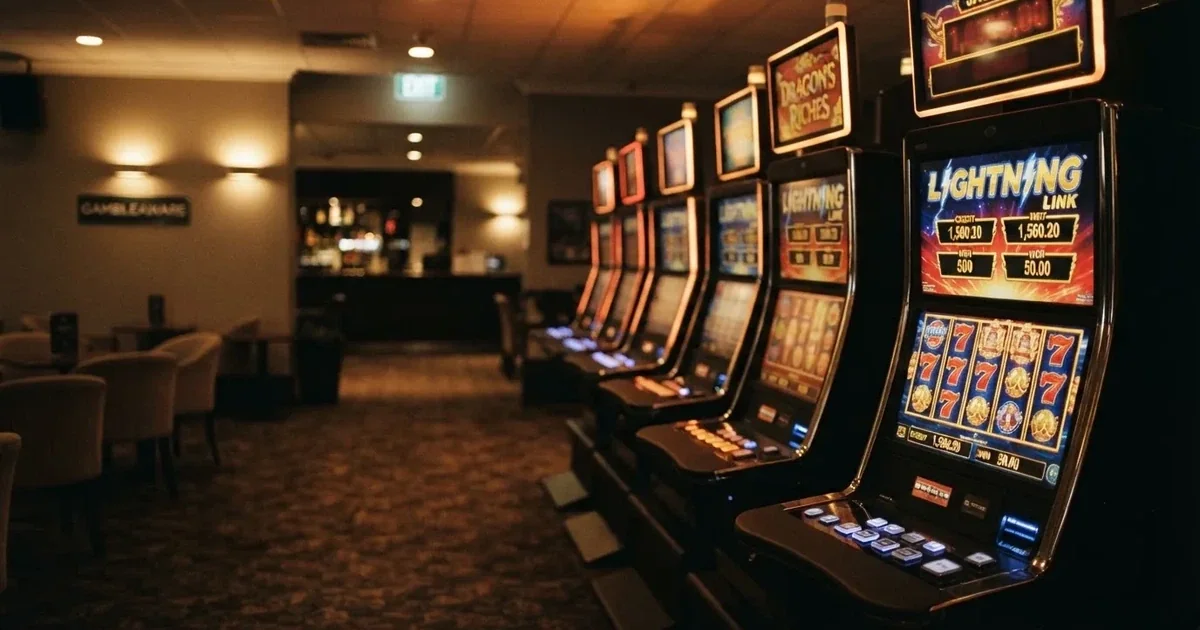
The question “best paying pokies in Canberra” usually lands on a paytable question the venue does not directly answer. Each machine carries its own maths — the RTP, the volatility, the bonus feature frequency, the maximum line or ways-win — published on the game’s help screen under the gaming-machine standards. The provider side of the question runs through Aristocrat, Konami, IGT and a handful of boutique studios whose games are licensed for the Australian pub and club market. Aristocrat, the Sydney-based manufacturer, dominates the Australian pub floor with titles from the Buffalo and Lightning Link families. Konami’s Asian-themed and hold-and-spin content sits on a meaningful share of ACT club floors. IGT’s Wheel of Fortune-style content shows up less frequently in clubs than in casino floors.
Live tables are not the pokies question. Casino Canberra runs 39 gaming tables — blackjack, roulette, baccarat and the rest — but it does not, by the terms of its ACT licence, operate poker machines. Any page that claims to point a reader to “pokies” at Casino Canberra is, technically, pointing them at the wrong product. The Canberra CBD casino is for table games and a poker lounge, not for spinning reels. The pokies in the ACT live in the licensed clubs: 46 venues running 3,587 gaming machines as at 1 November 2023, with another 1,504 approved but not yet on a floor. A reader looking for the actual pokies product is looking at that club floor, not at the casino.
The cashless shift and what it changes at the machine
Cashless card play has reshaped the practical question of “what does a pokie session look like in Canberra” in two ways. First, the player now sets their own session and daily limit on the card at the cashier before play — the venue does not impose the limit, the player does. Second, the venue sees aggregate play data on the card, which feeds the ACT’s harm-mitigation obligations. For the reader comparing cashless to old-style cash play, the practical difference is that the machine itself now records the session, not just the wins and losses printed on the screen. That record is what a self-excluded player is agreeing to when they sign up to the ACT Gambling and Racing Commission’s self-exclusion process, and it is what the ACT Gambling Support Service uses when it takes a call.
The 24-hour pokies question — can a reader walk into a Canberra club at three in the morning — is a venue-by-venue question. ACT clubs do not have a uniform trading-hour regime, and the larger clubs in and around Civic and Woden run late, some into the early morning. Casino Canberra is the only ACT venue with continuous table-game hours, but, again, it is not a pokies venue. For pokies specifically, the reader is asking about clubs, and clubs are the ones whose hours matter.
Provider content and what’s actually on a Canberra floor
The content mix on a Canberra club floor in 2026 tilts toward Aristocrat’s Lightning Link and Buffalo Diamond, with Konami’s Dragon’s Law and Fortune Mint content running on a meaningful share of machines. The newer wave of “ways” games — Megaways-style titles from licensed studios — has landed in Australian clubs more slowly than in some offshore libraries, in part because the ACT and other state regulators approve games for the pub and club market on a slower cycle than online. A reader who has spent time on an offshore site and is looking for the same content on a Canberra floor will not find it: the regulatory clock and the licensing perimeter are different products.
The “cashless pokies” question, separate from the broader cashless shift, sometimes refers to specific machines or specific venue rollouts. In the ACT, the cashless shift is a venue-level change, not a machine-level change — a machine on a cashless floor behaves identically to a cash machine, only the funding instrument is the venue card. There is no separate “cashless pokie” product.
Comparing venues: what actually separates one Canberra pokies venue from another
A shortlist of pokies venues in Canberra is harder to draw up than the equivalent shortlist for an online market, because there is no public leaderboard. Clubs do not publish RTP averages; they do not publish payout times; they do not run welcome bonuses or tournaments in the way the online vocabulary expects. The criteria that genuinely separate one venue from another are: location and trading hours, the cashless system in place, the breadth of Aristocrat and Konami content on the floor, the responsible-gambling services the venue offers (the ACT Gambling Support Service card is the same across venues, but venue staff training and the presence of a dedicated gambling-harm officer varies), and the practical amenities — food, parking, accessibility.
For the reader searching “best pokies venue in Canberra CBD” specifically, the shortlist narrows to the larger Civic and Braddon clubs, with one or two Woden and Belconnen venues a short drive out. The ACT Gambling and Racing Commission does not rank venues, and neither does the ACT Government. The reader’s decision is essentially a logistics decision: which club is open when they want to play, with the kind of cashless system they prefer, and within a reasonable drive.
The criteria a real comparison rests on
The audit that follows below this section is built on five matters, not on bonuses: the brand name (which is the ACMA’s record of the operator it has acted against, because the comparison here is a record of enforcement), the ACMA action and its date, the operator entity the ACMA named in the warning, and the subject-support token — which, for every brand in this list, is no-data or listings-only, because no offshore site has any lawful foothold in the ACT. The block is not a recommendation and not a ranking. It is the reader’s reference list when an advertisement, an affiliate page, or a search result names one of these brands and the reader wants to know what the regulator has already said.
The shortlist is also where the reader sees the gap between the marketed product and the lawful one. The marketed product is a “pokies” section on an offshore site, with a deposit bonus, a withdrawal time, and a wagering multiple. The lawful product is a cash or cashless machine in an ACT club, with a printed ticket redeemed at a cashier. Two products, two jurisdictions, two different cost structures — and the offshore one is the one the ACMA has been warning against for years.
Why the criteria look different from an online comparison
An online shortlist runs on bonuses, payout times, game counts and licences. A Canberra pokies shortlist has none of those, because the venue is a licensed ACT club, not a remote operator. The closest analogue is to the hospitality shortlist: location, hours, content mix, accessibility, and the venue’s responsible-gambling posture. A reader who arrives from an online-comparison mindset will need a few minutes to reset. The reset is the page’s first job, and it is the reason this comparison leads with venue mechanics rather than with operator profiles.
The eleven offshore brands that follow this section are the comparison’s other half — what the reader will see named in their search results, and what the ACMA has already named in its enforcement record. Each one carries the ACMA warning that put it on this page, the operator entity named in the warning, and the relevant date. None is presented as a place to play. None is presented as a bonus claim. None is recommended to anyone.
ACMA enforcement record — offshore brands named in formal warnings
The table below lists the eleven offshore brands that have been the subject of ACMA formal warnings in connection with offering prohibited interactive gambling services to people in Australia. “Brand” is the casino name as published in the warning. “ACMA action and date” is the action type and the date as published. “Operator named by the ACMA” is the corporate entity the warning was addressed to. “Subject support” indicates whether independent listings carry subject-level data on the brand; for every entry below, the value is no-data or listings-only, because none of these brands has any lawful Australian footprint to verify. The brand-level subject matters — an RTP, a volatility class, a payout speed — are never asserted here, because the page has no such data from a primary source.
| Brand | ACMA action and date | Operator named by the ACMA | Subject support |
|---|---|---|---|
| RocketPlay | Formal warning, March 2026 | Pulsup Ltd | no-data |
| Level Up Casino | Formal warning, May 2022 | Dama N.V. | listings-only |
| Woo Casino | Formal warning, March 2025 | Dama N.V. | listings-only |
| Spirit Casino | Formal warning, May 2025 | Dama N.V. | no-data |
| National Casino | Formal warning, July 2025 | Consolutetish S.R.L. | listings-only |
| Bizzo Casino | Formal warning, July 2025 (and 2022 to TechSolutions) | Consolutetish S.R.L. (TechSolutions in 2022) | no-data |
| Ignition Casino | Formal warning, July 2025 | Bamboo Media | no-data |
| Instant Casino | Formal warning, February 2025 | EOD Code SRL | no-data |
| Jackbit | Formal warning, April 2026 | Ryker B.V. | no-data |
| Casino Intense | Formal warning, April 2025 | Sterplay Holding Ltd | listings-only |
| Sky Crown | Formal warning, September 2022 | Hollycorn N.V. | listings-only |
The table reads as a regulator’s ledger because that is what it is. A reader who sees one of these brand names in an advertisement or an affiliate link can read the row, see the date the ACMA warned the operator, and see who the operator actually is. Some of the brands are operated by the same corporate entity — Dama N.V. alone sits behind RocketPlay, Level Up Casino, Woo Casino and Spirit Casino across separate warnings — which is the structural point the ACMA has been making through 2025 and 2026: the brand is the marketing layer, the operator is the enforcement target. A reader who sees a new brand on the same operator’s roster does not need to be told twice.
The “subject support” column is honest about its own thinness. Where independent listings carry some subject-level material on a brand, the entry says so — Level Up Casino, Woo Casino, National Casino, Casino Intense and Sky Crown each have listings-only coverage from secondary directories. Where they do not — RocketPlay, Spirit Casino, Bizzo Casino, Ignition Casino, Instant Casino, Jackbit — the entry says no-data rather than inventing one. The brand-level reader experience (an RTP, a bonus structure, a withdrawal speed) is not asserted for any of the eleven, because the only sources for those figures are affiliate marketing pages, and the audit standard on this page does not accept those.
How pokies actually work in Canberra
The fundamentals of a Canberra pokies session are older than the online market and simpler than it. A player walks into a licensed ACT club, presents identification if asked (ACT clubs are required to verify age — 18 or older — and increasingly verify identity for harm-mitigation purposes), funds play with cash or a cashless venue card, and sits at a machine. The machine accepts the credit, the player chooses a stake per spin, and spins. The outcome is determined by a random number generator inside the machine, audited as part of the gaming-machine approval process. A session ends when the player cashes out — a printed ticket at a non-cashless venue, a card balance at a cashless one — and walks out.
The house edge is built into the machine’s RTP. A machine with a 90% RTP, by definition, returns A$0.90 to the player on average for every A$1 wagered across a very large number of spins. The A$0.10 the machine keeps is the venue’s gross profit before tax, levy and operating costs. Across the ACT’s 3,587 gaming machines operating as at 1 November 2023, player losses in 2022-23 totalled about A$0.19 billion — a figure that is also the gross win, before the levy the ACT Government takes from clubs and the reinvestment venues make in their food and beverage operations. A per-adult equivalent is not published for the ACT in the same way South Australia publishes its A$497-per-adult figure, but the territory is small enough that the per-capita comparison is unfavourable to the ACT on most published measures.
The cashless system, the harm-mitigation overlay, and what the player agrees to
The ACT’s mandatory cashless gaming system for clubs is, in practice, the mechanism through which the territory’s responsible-gambling regime operates at the machine. A player can set a daily or session limit on their card at the cashier before play, can ask for a cool-off period enforced through the card, and — if they later decide to self-exclude — can sign up to the ACT Gambling and Racing Commission’s self-exclusion process and have that exclusion enforced by the venue’s card-readers. The same data that allows the venue to enforce a self-exclusion is what the ACT Gambling Support Service uses when a punter calls the helpline.
The reader who has experience with online responsible-gambling tools — deposit limits, time-out periods, self-exclusion through BetStop — will recognise the underlying idea, but the ACT version is venue-specific. BetStop, the National Self-Exclusion Register launched on 21 August 2023, binds only Australian-licensed online and telephone wagering services. It does not cover in-venue gambling. ACT residents who want to self-exclude from Casino Canberra or from ACT clubs must use the ACT Gambling and Racing Commission’s own self-exclusion process, available for periods of 6 months to 3 years. The national register is the right tool for an Australian-licensed sports or racing bookmaker; the ACT process is the right tool for a pokies venue in Canberra.
The cost of a session — what the maths says
The arithmetic on a single session is the same arithmetic the house edge always produces: a player wagers a stake per spin, the machine keeps its percentage of every wager on average, and the player walks out with a balance that is, on average, less than what they put in. The closer the wagered total is to the player’s bankroll, the closer the realised loss is to the house-edge percentage. A player with a A$200 bankroll who wagers A$200 at a 90% RTP machine will, on average, walk out with A$180 — a A$20 loss. The same player at an 87.5% RTP machine (the South Australian statutory minimum, which is a defensible proxy for older ACT content) will, on average, walk out with A$175 — a A$25 loss. The differences look small in dollar terms; the percentages compound across a year’s play.
A$200 at a 90% RTP machine is the headline number. A player who treats the A$200 as entertainment spending and walks out at A$180 has spent A$20. A player who treats the same A$200 as a “deposit” and chases the original stake back has spent a great deal more than A$20, because the chase itself adds to the wagered total. The arithmetic is identical for both; the experience is what the house edge is built on.
The legality of pokies in and around Canberra
The legal framework inside Australia divides cleanly into what is permitted and what is not. What is permitted: wagering on racing and sporting events placed before the event, lotteries, keno, and land-based gaming machines in licensed venues. What is not: online casino games, online pokies, and in-play online betting — all of which the Interactive Gambling Act 2001 (IGA), as strengthened by the Interactive Gambling Amendment Act 2017, prohibits from being offered to anyone in Australia. The IGA targets the provider, not the individual player — a reader in Canberra who lands on an offshore site is not personally at risk of prosecution, but they have no Australian consumer protection, no local complaints body, and no recourse if a withdrawal stalls. They may also find the site blocked by their ISP with a balance still in their account.
The ACT’s land-based regime sits underneath the IGA. Casino Canberra is regulated under the Casino Control Act 2006 and Casino Control Regulation 2006, administered by the ACT Gambling and Racing Commission. The same commission oversees the territory’s licensed clubs, which run the bulk of the ACT’s 3,587 operating gaming machines. Aquis Canberra Pty Ltd was issued the ACT casino licence on 23 December 2014 under section 22 of the Casino Control Act 2006, to operate the casino at 21 Binara Street; the licence is now held by Casino Canberra Limited. The casino runs 39 gaming tables, a poker lounge, and a sports lounge — but, as explained in the section on Casino Canberra’s distinctive position, it does not run poker machines.
What the ACMA actually does
The Australian Communications and Media Authority (ACMA) is the Commonwealth regulator that enforces the IGA against offshore providers. Its toolkit includes formal warnings to operators (the eleven brands in this page are all on the receiving end of one), directing Australian internet service providers to block illegal sites, and investigations that can lead to civil penalties. By the ACMA’s June 2026 count, 1,751 illegal gambling and affiliate marketing websites had been blocked since the first blocking request in November 2019, and more than 230 unlicensed gambling services had left the Australian market since enforcement was strengthened in 2017. In the round reported on 26 June 2026 alone, the ACMA asked ISPs to block twelve more: 7Signs, ChromaBet, Donbet, Duospin, Freshbet, Slots Gem, Jacks Club, Lucky Start, Pointsbetz.com, Spinrise, Vinyl Casino and Wildsino.
The rate that band implies — 1,751 sites over roughly six-and-a-half years — is the structural point. As of 28 October 2026, the cumulative block count sits at 1,751 sites, with the first blocking request dated November 2019. The arithmetic is straightforward: an average of around 270 sites blocked per year over the period, accelerating sharply in 2024-2026 as the ACMA has moved from warnings to coordinated blocking requests. The band the reader should hold is that the ACMA is blocking at a sustained pace, not in one-off bursts, and the rate has not slowed. A site that is not on the block list today can be on it within a reporting cycle, and an operator that holds a current warning can find itself on the next list. The pace is what makes the offshore market structurally unstable for an Australian reader.
The 2026 reform package and what it does
The Interactive Gambling Amendment (Gambling Reform) Bill 2026 passed Parliament on 19 August 2026. Its advertising and inducement measures commence on 1 January 2027 — law with a start date, not yet in force on a 2026 page. The package tightens the rules around how offshore operators can advertise to Australians and what inducements they can offer, and it sits alongside the existing IGA prohibitions. A reader comparing this page’s information to what will be true from January 2027 onward should treat the advertising and inducement rules as enacted but not yet operative, and the offshore prohibition itself as unchanged.
State and territory regimes compared
A reader comparing Canberra’s pokies regime to other Australian jurisdictions should know the shape of the comparison, not just the numbers. South Australia runs the strictest pub-and-club regime: a minimum 87.5% RTP on gaming machines outside Adelaide Casino, a general maximum bet of A$5.00 per spin, and a regulated casino (Adelaide Casino, formally SkyCity Adelaide for a period) that is the only licensed casino in the state, regulated by the Independent Gambling Authority and the Liquor and Gambling Commissioner. South Australia’s 11,672 gaming machines in 471 venues outside Adelaide Casino produced about A$0.92 billion in losses in 2022-23, equivalent to about A$497 per adult.
Queensland runs the loosest, by venue count: 21,122 gaming machines in 351 venues as at October 2023, with a recently rebuilt casino footprint after Treasury Casino closed on 25 August 2024 to make way for the new Star Brisbane at Queen’s Wharf, which began a staged opening on 29 August 2024. The Queensland Government found Star Entertainment unsuitable to hold its Queensland casino licences in late 2022 after an independent review by former Court of Appeal judge Robert Gotterson, fining the group $100 million on 9 December 2022 — a useful comparator for what enforcement against a major operator actually looks like. The Northern Territory, by contrast, runs no pubs or clubs with gaming machines but regulates 52 of Australia’s online bookmakers — including Sportsbet, Bet365 and Ladbrokes — under the Northern Territory Racing and Wagering Commission, a body that the ABC reported in April 2026 has no full-time staff and meets once a month in Darwin. The Northern Territory’s role is wagering-side licensing for tax reasons; it is not a venue-side regulator.
What this means for an ACT reader
The ACT sits between the strict South Australian model and the looser Queensland model on venue density, with 46 venues running 3,587 machines as at 1 November 2023 — about 78 machines per venue, compared to South Australia’s roughly 25 per venue and Queensland’s roughly 60. The per-venue density reflects the ACT’s club-and-casino model rather than a pub-pokies model. For a reader comparing the ACT to other capitals, the headline is that the ACT has fewer venues with more machines each, and a single casino that does not run pokies. The reader’s experience is shaped accordingly: the choice is between fewer venues, with each venue carrying a deeper machine inventory.
Responsible gambling in the ACT
The ACT’s responsible-gambling architecture runs through the ACT Gambling and Racing Commission, the ACT Gambling Support Service, and the cashless gaming system the territory has rolled out across clubs. The national layer runs through BetStop (the National Self-Exclusion Register, live since 21 August 2023) and the National Gambling Helpline on 1800 858 858. The two layers do not fully overlap: BetStop binds Australian-licensed online and phone wagering, not in-venue gambling; the ACT’s own self-exclusion process is the right tool for Casino Canberra and ACT clubs, available for periods of 6 months to 3 years.
The ACT Gambling Support Service runs a free, 24/7 Gambling Helpline on 1800 858 858, offering telephone, online and face-to-face gambling and financial counselling. The service is funded by the ACT Gambling Harm Prevention and Mitigation Fund, which is the territory’s hypothecated mechanism for harm-mitigation spending. A reader who needs help now has a single number and a single service; a reader who wants to plan ahead has the ACT self-exclusion process. The national Gambling Help Online service adds chat-based support for readers who prefer text to voice.
The cashless system as a harm-mitigation tool
The ACT’s cashless gaming rollout is, in part, a harm-mitigation measure. A player who sets a daily or session limit on their card at the cashier is doing what an online player does with a deposit limit, but the limit is enforced by the card-reader rather than by an account setting. A player who signs up to the ACT’s self-exclusion process has the exclusion enforced by the same system: a venue card belonging to a self-excluded person will not allow play. The structural difference from online is that the limit and the exclusion are venue-side, not account-side, which means a player who moves between venues needs to set the same limits at each one.
The reader who is already familiar with online self-exclusion through BetStop should know that BetStop does not apply to ACT venues. A punter who has registered with BetStop and then walks into an ACT club will not be stopped by BetStop; only the ACT’s own self-exclusion process will stop them at the venue. The two systems are complementary, not interchangeable, and the page’s earlier note on the ACT self-exclusion process is the operative reference.
Where to get help now
The reader who needs help now has three primary routes: the ACT Gambling Support Service on 1800 858 858, the National Gambling Helpline on the same number (the ACT helpline is the national helpline’s local ACT counterpart), and Gambling Help Online for chat-based support. The cashless card system at ACT clubs adds a fourth route, in that a player can set a limit at the cashier before play, which is itself a harm-mitigation move. A reader who is unsure which route fits their situation can start with the helpline and be routed from there. The page does not include contact details that vary by venue, because the venue-level contact is the ACT Gambling and Racing Commission, which administers the territory’s self-exclusion process and oversees venue compliance.
The land-based reality: Casino Canberra and the licensed ACT clubs
The ACT’s licensed pokies footprint lives in 46 venues running 3,587 gaming machines as at 1 November 2023, with a further 1,504 machines approved but not yet on a floor. Casino Canberra, the territory’s only casino, sits in the Canberra CBD on land excised from Glebe Park under a 99-year lease, and was the first legal casino in the ACT. It has no hotel, no theatres, no retail — the building is a casino, not a resort. It does not operate poker machines, by the terms of its ACT licence; it operates 39 gaming tables for blackjack, roulette, baccarat and other games, plus a poker lounge and a sports lounge.
The casino was issued its ACT casino licence on 23 December 2014 under section 22 of the Casino Control Act 2006 to Aquis Canberra Pty Ltd, which has since become Casino Canberra Limited. The casino is regulated by the ACT Gambling and Racing Commission under the Casino Control Act 2006 and Casino Control Regulation 2006, the same commission that oversees the territory’s clubs. Casino employee licences are issued by the commission — short-term licences valid up to 6 months, full licences valid for 3 years — which is the structural reason the casino can run with relatively few staff on the gaming floor compared to a larger state-based casino.
The ACT clubs and what they run
The 46 ACT clubs running 3,587 gaming machines are the bulk of the territory’s pokies product. They sit across Canberra’s town centres — Civic, Braddon, Woden, Belconnen, Tuggeranong, Gungahlin — with the heavier-machine venues in the larger suburban clubs and a thinner-machine footprint in the smaller community clubs. The cashless gaming rollout has been substantially complete across the club sector, with the venue-level mechanics varying by club but the underlying architecture the same: a card-reader at the machine, a cashier top-up, a card-balance cash-out.
The ACT Government does not publish a venue ranking and the ACT Gambling and Racing Commission does not endorse any particular club. The reader’s comparison is, again, a logistics comparison: which club is open when, with the kind of cashless system they prefer, within a reasonable drive. A reader searching “best pokies in Canberra CBD” is choosing between the Civic and Braddon clubs, with Woden a short drive out. A reader searching “best pokies venue in Canberra” is making the same choice, framed as a venue-quality question rather than a location question.
Casino Canberra’s distinctive position
Casino Canberra’s distinctive position is that it is a casino that does not run pokies. A reader who arrives from a search expecting a casino-floor experience with poker machines will not find it at Casino Canberra; the 39 gaming tables, the poker lounge and the sports lounge are the product. The casino is a useful comparator for what the ACT’s regulatory regime looks like at the casino level — section 22 of the Casino Control Act 2006, employee licensing, ACT Gambling and Racing Commission oversight — but it is not the answer to a pokies question. The reader who wants pokies needs the clubs.
The other useful comparator at the casino level is Adelaide Casino, the sole licensed casino in South Australia under the Casino Act 1997, which sits in the heritage-listed Adelaide railway station building on North Terrace with 90 gaming tables and 950 gaming machines. Adelaide Casino’s table-game monopoly in South Australia was extended to 30 June 2035 under a licence formalised on 11 October 2013, allowing expansion to up to 200 gaming tables and 1,500 gaming machines. The South Australian model — a single casino with a statutory monopoly and a tightly regulated pub-and-club sector — is the structural opposite of the ACT’s club-heavy model.
The Star Brisbane comparator and what it teaches
The Star Brisbane, which began a staged opening at the A$3.6 billion Queen’s Wharf Brisbane precinct on 29 August 2024 after Treasury Casino closed on 25 August 2024, is a useful comparator for what happens when a major casino operator falls foul of its regulator. In late 2022 the Queensland Government, acting on an independent review by former Court of Appeal judge Robert Gotterson, found Star Entertainment unsuitable to hold its Queensland casino licences after concluding it had misled regulators and failed its anti-money-laundering duties. Star was fined $100 million on 9 December 2022, with a 90-day suspension of the Treasury Brisbane and Star Gold Coast licences deferred to 1 December 2023 to allow remediation. The case is a reminder that even licensed casino operators in Australia operate at the discretion of the state regulator, and that the licence can be reviewed, fined, suspended or made subject to remediation.
For a Canberra reader, the comparator is structural rather than direct: the ACT’s club-and-casino model is regulated by the ACT Gambling and Racing Commission, which has the same kind of authority over Casino Canberra’s licence that the Queensland regulator had over Star’s. Casino Canberra’s licence is a valuable property for the operator, and the regulator’s authority over it is the discipline that keeps the casino honest.
A brief note on each of the eleven offshore brands the ACMA has warned
What follows is a short read on each of the eleven brands named in the ACMA’s formal warning record. The structure of each entry is the same: the ACMA action, the operator the warning was addressed to, and the page’s own verdict on what the warning tells the reader. None of these is a recommendation; none is a place to play. The verdict is the page’s own conclusion about what the warning means for an ACT reader who sees the brand in their search results.
RocketPlay. The ACMA issued a formal warning to Pulsup Ltd over Rocketplay.com.au in March 2026. The brand was already in the ACMA’s record: Dama N.V. was the operator named in a May 2022 warning covering six brands. The Rocketplay.com.au domain is the specific Australian-facing product, and the warning’s publication is the ACMA’s stated reason for treating it as a prohibited service. The verdict: a brand that has been warned twice, under two operators, is one an ACT reader should treat as on notice.
Level Up Casino. The ACMA issued a formal warning to Dama N.V. over Level Up Casino in May 2022, as part of the same six-brand warning that included Bambet, Dazard, Rocketplay, Wild Tornado and Cobra Casinos. Independent listings carry subject-level material on Level Up Casino, but no primary-source data sits behind the listing entries. The verdict: a brand on a 2022 warning list, from an operator that has been warned again since, is not a brand an ACT reader has any reason to consider.
Woo Casino. The ACMA issued a further formal warning to Dama N.V. over Woo Casino in March 2025 — the second Dama N.V. warning, after the 2022 batch. Independent listings carry subject-level material. The verdict: a repeat-warning operator is a structural signal, not a one-off. The ACMA’s enforcement record against Dama N.V. is the relevant fact, not the brand-level marketing.
Spirit Casino. The ACMA issued a further formal warning to Dama N.V. over Spirit Casino in May 2025 — the third Dama N.V. warning. Information on this brand is limited, with no independent listings providing subject-level data. The verdict: the absence of such data is itself the answer; there is nothing for a reader to compare.
National Casino. The ACMA issued a formal warning to Consolutetish S.R.L. over National Casino in July 2025, alongside a parallel warning over Bizzo Casino. Independent listings carry subject-level material. The verdict: the same operator named in two warnings in the same month is an operator that has not moderated its offering.
Bizzo Casino. The ACMA issued a formal warning to Consolutetish S.R.L. over Bizzo Casino in July 2025; Bizzo had already been the subject of a 2022 formal warning to TechSolutions (CY) Group Limited and TechSolutions Group N.V. The brand carries no independent listing data. The verdict: a brand warned twice, under two operators, is one the ACMA has spent four years trying to remove from the Australian market.
Ignition Casino. The ACMA issued a formal warning to Bamboo Media over Ignition Casino in July 2025. The brand carries no independent listing data. The verdict: a single warning is the ACMA’s first formal step; the structural question is whether the operator has moderated its offering since.
Instant Casino. The ACMA issued a formal warning to EOD Code SRL over Instant Casino in February 2025. The brand carries no independent listing data. The verdict: the name suggests an instant-play product; the warning is the ACMA’s notice that the product is not lawful in Australia.
Jackbit. The ACMA issued a formal warning to Ryker B.V. over Jackbit in April 2026, alongside a parallel warning over CasinOK. No independent listing data exists for this brand. The verdict: the ACMA has named Ryker B.V. as the operator; the reader who sees the brand should see the warning.
Casino Intense. The ACMA issued a formal warning to Sterplay Holding Ltd over Casino Intense in April 2025. Independent listings carry subject-level material from secondary directories. The verdict: the listing data is not a defence; the warning is the operative fact.
Sky Crown. The ACMA issued a formal warning to Hollycorn N.V. over Sky Crown and Blue Leo casino services, as published in September 2022. Independent listings carry subject-level material. The verdict: the warning predates the more recent batch, but the ACMA’s record of warnings against Hollycorn N.V. has not been retracted, and the brand remains on the regulator’s record.
The offshore market in the ACT — what is and is not lawful
The Interactive Gambling Act 2001 makes it an offence to provide online casino games, online pokies or in-play betting to a person in Australia. No state or territory licenses them. What is licensable is wagering on races and sport placed before the event, lotteries and keno — in practice licensed by the Northern Territory, where 52 of Australia’s online bookmakers are regulated by the Northern Territory Racing and Wagering Commission. The minimum age is 18.
The individual player is not prosecuted under the IGA — the Act targets the provider. But an offshore site gives an Australian player no consumer protection, no complaints body, and no recourse if a withdrawal is refused. The site can be blocked by the ACMA with a balance still on the account. The reader who values those protections has no reason to be on an offshore site; the reader who does not value them is making a choice that the ACMA’s enforcement record has been documenting since 2017.
H2 Gambling Capital’s 2025 report estimates that Australians lose about A$3.9 billion a year to illegal gambling sites, and that the share of gambling going through legal channels fell from 74% in 2021 to 64%. The A$3.9 billion is the cost the illegal market extracts from Australian players each year; the falling legal share is the structural drift the ACMA’s enforcement is trying to reverse. The two figures together are the headline.
Payments and what the offshore market cannot offer
The offshore market cannot offer credit cards, credit-related products or digital currency as payment for licensed Australian online wagering — those instruments have been banned since 11 June 2024, with penalties up to $247,500 for operators. The legal deposit routes for licensed Australian wagering are debit card, bank transfer, PayID/Osko and BPAY. An offshore site asking an Australian for a credit card or a crypto deposit is operating outside the Australian rules. The reader who sees those instruments being requested is seeing the offshore site’s actual compliance posture, not its advertised one.
The reader who has only seen the offshore market’s vocabulary — “deposit”, “withdrawal”, “wagering requirement”, “max cashout” — will need to reset for the ACT market. At an ACT club, “deposit” is the cash or card top-up at the cashier. “Withdrawal” is the printed ticket redeemed at the cashier or the cashless card balance returned on exit. “Wagering requirement” is not a concept that exists; the venue does not impose turnover conditions on play. “Max cashout” is the venue’s hand-pay threshold, not a marketing cap.
The 2026 reform package — what changes from January 2027
The Interactive Gambling Amendment (Gambling Reform) Bill 2026 passed Parliament on 19 August 2026. Its advertising and inducement measures commence on 1 January 2027 — law with a start date, not yet in force on a 2026 page. The package tightens the rules around how offshore operators advertise to Australians and what inducements they can offer, but the underlying prohibition on offering online casino games and online pokies to people in Australia is unchanged. The reform is an inducement-side and advertising-side tightening, not a substantive change to what is and is not a prohibited service.
A reader comparing this page’s information to what will be true from January 2027 onward should treat the inducement rules as enacted but not yet operative, and the offshore prohibition itself as continuing. The brand-level subject matters the page has not asserted — an RTP, a payout speed, a bonus structure — remain unasserted, because they were unasserted on the page’s own terms before the reform and are unasserted after it.
Frequently asked questions
Which venues in Canberra are licensed to operate pokies?
ACT clubs are licensed by the ACT Gambling and Racing Commission to operate gaming machines; 46 venues ran 3,587 machines as at 1 November 2023. Casino Canberra, the territory’s only casino, is licensed under the Casino Control Act 2006 but does not operate poker machines — its product is 39 gaming tables, a poker lounge and a sports lounge. The reader looking for pokies in Canberra is looking at the clubs, not at the casino.
Are pokies in Canberra available around the clock?
Not uniformly. ACT clubs do not run on a single trading-hour regime; the larger Civic, Braddon, Woden and Belconnen clubs trade late, some into the early morning. Casino Canberra is the only ACT venue with continuous table-game hours, but its product is tables, not pokies. The 24-hour pokies question is a venue-by-venue question, and the reader should check the specific club’s hours.
What identification do venues in Canberra require before letting someone play pokies?
ACT clubs are required to verify age — 18 or older — and increasingly verify identity for harm-mitigation purposes. The ACT’s cashless gaming system, rolled out across the club sector, adds a card-based identification layer at the machine. Casino Canberra has its own identification regime under the Casino Control Act 2006, with employee licensing overseen by the ACT Gambling and Racing Commission.
Can visitors to Canberra use self-exclusion schemes at local pokies venues?
BetStop, the National Self-Exclusion Register, binds Australian-licensed online and phone wagering services and does not cover in-venue gambling such as Casino Canberra or ACT clubs. ACT residents and visitors wanting to self-exclude from ACT venues must use the ACT Gambling and Racing Commission’s own self-exclusion process, available for periods of 6 months to 3 years. The two systems are complementary, not interchangeable.
How does the payout percentage on Canberra pokies compare with other Australian cities?
The ACT does not legislate a single venue-wide payout percentage or a single maximum bet in the way South Australia does. South Australia sets a minimum RTP of 87.5% on gaming machines outside Adelaide Casino with a general maximum bet of A$5.00; the ACT does not have a comparable statutory floor. Machine-level RTPs at ACT clubs are typically in the low to mid 90s for newer content and slightly lower for older hold-and-draw machines, but the venue does not publish a single average. The closest comparison is the manufacturer’s RTP disclosure on the game’s help screen.
Is it legal for an online casino to advertise ‘pokies’ in Canberra the same way a pub or club does?
No. The Interactive Gambling Act 2001 makes it an offence to provide online casino games or online pokies to a person in Australia. The advertising and inducement rules around those products are being tightened further by the Interactive Gambling Amendment (Gambling Reform) Bill 2026, which passed Parliament on 19 August 2026 and whose advertising and inducement measures commence on 1 January 2027. The pub and club product is licensed by the ACT Gambling and Racing Commission; the offshore product is not licensed anywhere in Australia.