
VPN Friendly Casinos in Australia 2026: The Choice Between Convenience and the Law
VPN friendly casinos in Australia are offshore sites that market themselves as accepting connections from masked Australian IP addresses, often explicitly inviting readers to “use your VPN” in their terms pages or affiliate blurbs. They exist because online casino games are prohibited inside the country under the Interactive Gambling Act 2001, so the only suppliers serving Australians sit abroad, and reaching them from a home connection now means routing around an ACMA block. The choice a person actually makes is not between casinos; it is between a legal wagering service they cannot use for slots and an offshore operator the regulator is actively warning Australians away from.
The data behind this page is current as of 28 October 2026 and was checked against the Australian Communications and Media Authority’s register of formal warnings and blocking requests.
Table of Contents
- The Landscape Australians Are Choosing Between
- What a VPN Friendly Casino Actually Markets
- The Prohibition Side of the Frame
- Formal Warnings — What the Regulator Has Actually Said
- What a VPN Technically Changes — and What It Doesn’t
- Responsible Play Around VPN Friendly Casinos
- The Eleven Brands the ACMA Has Warned — Side by Side
- Reading the Operator Cards
- The Blocking Rate — Why the Numbers Tell Their Own Story
- What the Choice Actually Adds Up To
- Frequently Asked Questions
The Landscape Australians Are Choosing Between
| Brand | ACMA action and date | Operator named by the ACMA | Subject support |
|---|---|---|---|
| RocketPlay | Formal warning, March 2026 | Pulsup Ltd | Listings only |
| Level Up Casino | Formal warning, May 2022 | Dama N.V. | Listings only |
| Woo Casino | Formal warning, March 2025 | Dama N.V. | No data |
| Spirit Casino | Formal warning, May 2025 | Dama N.V. | No data |
| National Casino | Formal warning, July 2025 | Consolutetish S.R.L. | Listings only |
| Bizzo Casino | Formal warning, July 2025 | Consolutetish S.R.L. | Listings only |
| Ignition Casino | Formal warning, July 2025 | Bamboo Media | No data |
| Instant Casino | Formal warning, February 2025 | EOD Code SRL | Listings only |
| Jackbit | Formal warning, April 2026 | Ryker B.V. | No data |
| Casino Intense | Formal warning, April 2025 | Sterplay Holding Ltd | Listings only |
| Sky Crown | Formal warning, September 2022 | Hollycorn N.V. | No data |
Every operator a reader can reach from inside Australia using a VPN sits in one of two camps. The first is the licensed wagering market: sportsbooks and racing bookmakers licensed by the Northern Territory Racing and Wagering Commission or a state regulator, restricted to betting before the event starts, lotteries and keno. None of these is permitted to offer online casino games, online pokies or in-play betting, so a person looking for slots or roulette has no licensed option at all. The second is the offshore market: Curaçao-licensed, Kahnawake-licensed, Anjouan-licensed and similar operators whose licence is no licence for Australians, since the Interactive Gambling Act 2001 prohibits the supply of interactive casino games to anyone physically in Australia regardless of the offshore licence the operator displays. A VPN does not change which camp a casino belongs to. It only changes whether a person can reach the offshore camp’s front door from inside Australia.

The volume of money in that offshore camp is large enough to have its own industry analyst. H2 Gambling Capital’s 2025 report estimated Australians lose roughly A$3.9 billion a year to illegal gambling sites, and the same report found the share of gambling going through legal channels fell from 74% in 2021 to 64%. The legal market is being outgrown, not replaced — a distinction that matters when a reader reads “licensed” and “unlicensed” as competing labels of the same product. They are not competing labels of the same product. One is sports betting; the other is casino gaming. The overlap is the offshore operator blurring the line by accepting Australian deposits through PayID and cryptocurrency, presenting itself as a casino-with-sportsbook, and quietly hoping the reader does not ask which regulator actually has authority over the slot reels.
What a VPN Friendly Casino Actually Markets
A casino that calls itself VPN friendly is signalling three things at once. The first is technical: the site does not run a hard geolocation block that refuses an Australian IP address. Most Australian-facing offshore sites either block on IP or leave the door open, and “VPN friendly” is the second posture, advertised as a feature. The second is procedural: the casino accepts sign-ups and play from an Australian IP routed through a foreign server. The third is legal, and this is where the marketing diverges from the regulator’s view. The casino treats a successful VPN connection as the player’s permission slip. The regulator treats it as proof the operator knowingly supplied prohibited content to an Australian.

A reader who reads the marketing and stops has a different article than the one the ACMA has been writing since 2017. The marketing version is “use any VPN, log in, play, withdraw, no questions”. The regulator’s version is “we have warned 200+ unlicensed services since 2017, we have asked ISPs to block 1,751 sites since November 2019, and we are still counting”. Both can be true at once, because they describe different actors — the casino optimising for sign-ups, the regulator optimising for compliance. Neither tells a reader what the operator will do when a withdrawal sits in pending for a week.
The Prohibition Side of the Frame
The legal frame for online casino in Australia starts with the Interactive Gambling Act 2001 and ends with the fact that no Australian licence covers online casino games. Online casino games, online pokies and in-play betting are prohibited interactive gambling services. The 2017 amendments gave the Australian Communications and Media Authority the powers it uses today: investigate complaints, issue formal warnings, refer matters for civil penalty proceedings and ask Australian internet service providers to block offending sites at the network level.
Enforcement falls on the provider, not the player. The IGA does not criminalise the person placing the bet; it criminalises the company supplying the prohibited service. Australians are not prosecuted for using offshore sites. What they do give up by using one is the entire Australian consumer-protection layer: no Australian complaints body, no requirement the operator hold player funds in segregated accounts, no Australian dispute resolution, and no recourse through the courts when a withdrawal is refused or delayed. A site that has been blocked once can be blocked again, and a balance sitting on that site at the second block is a balance with a much smaller chance of being paid out.
The credit-card ban that took effect on 11 June 2024 closes a second route. Licensed wagering services cannot accept credit cards or credit-related products, and that restriction reaches linked digital wallets because the ban applies to the underlying credit. An Australian-facing site that asks for a credit card or a crypto deposit is by definition outside the Australian rules, since neither is a permitted payment route under the Australian regime. A reader can use that as a quick filter. A casino asking for Visa credit or USDT is not running inside the Australian frame, whatever else its terms page says.
Formal Warnings — What the Regulator Has Actually Said
The ACMA’s formal warning register is the cleanest public record of which offshore operators have supplied prohibited interactive gambling services to Australians and then been told to stop. It is also the list from which the eleven operators reviewed below were drawn, which is why each one carries a warning date rather than a licence jurisdiction. There is no licence jurisdiction for an Australian player; there is only whether the regulator has acted and when.
Between 2017 and the 2026 round reported on 26 June 2026, the ACMA asked Australian ISPs to block 1,751 illegal gambling and affiliate marketing websites. The first such request went out in November 2019. The arithmetic is straightforward. Over roughly six and a half years, that works out to an average blocking rate of about 270 sites per year, and the cadence has been steady enough that another round every month or two is the norm rather than the exception. A site that is reachable today may be on a block list next quarter, and an Australian player has no advance warning when that happens. A balance on the site at the moment of the block is a balance that may be retrievable through the operator’s withdrawal queue, which the operator is under no Australian obligation to honour, or may not.
The 26 June 2026 round alone added twelve more names: 7Signs, ChromaBet, Donbet, Duospin, Freshbet, Slots Gem, Jacks Club, Lucky Start, Pointsbetz, Spinrise, Vinyl Casino and Wildsino. The cycle in which a new offshore casino appears, markets itself to Australians, draws an ACMA warning or a block request and is replaced by a fresh brand on a slightly different URL is now so established that the regulator publishes its activity in near-real-time and the affiliate industry markets around it. The reader’s practical question is whether the casino they are looking at today is on the regulator’s list or will be soon. The arithmetic suggests “soon” is the safer assumption.
What a VPN Technically Changes — and What It Doesn’t
A VPN changes the IP address that reaches the casino’s front door. It does not change the casino’s licence, the casino’s regulator, the casino’s terms of service or the fact that the person behind the connection is sitting in Adelaide. From the casino’s perspective, the connection looks foreign. From the regulator’s perspective, the connection still originates from Australia, because that is where the human is.
Several Australian banks have built their own walls on top of that. Westpac’s gambling block refuses authorisation of transactions under the merchant category code for betting and casino gambling on eligible personal cards. ANZ’s gambling block, activated in the ANZ app, blocks gambling transactions made through a digital wallet on an eligible card, not only the physical card, and once turned on it takes 48 hours to turn off again. Commonwealth Bank offers a similar gambling lock on eligible cards through its app. Each of these carries an honest caveat: not every gambling transaction will be blocked, and some non-gambling transactions may be blocked by mistake. The direction of travel, however, is clear. Australian banks are not making it easier to fund offshore gambling, and an offshore casino that lists “instant deposit” next to an Australian debit card is describing a window that is closing rather than a permanent state of the world.
PayID-based transfers add a second friction. Paying to a PayID shows the account holder’s name before the transfer is sent, and the operator of the platform warns that being asked to transfer to a PayID on an illegal gambling site is itself a strong signal of a scam. The mechanism is a feature when it is used to pay a tradie; it is a tripwire when the recipient is an offshore casino. A reader can use the same warning to triage.
Responsible Play Around VPN Friendly Casinos
Player wellbeing around VPN friendly casinos starts from a difficult premise: the offshore casino a reader might be considering is not connected to Australia’s self-exclusion infrastructure. BetStop, the National Self-Exclusion Register, has been live since August 2023 and binds every Australian-licensed online and phone wagering service. It does not bind an offshore casino. Signing up to BetStop blocks the player from every Australian-licensed operator the moment the registration lands; it does nothing to a Curaçao-licensed site the player is reaching through a VPN. Anyone treating self-exclusion as a single switch will get a partial answer.
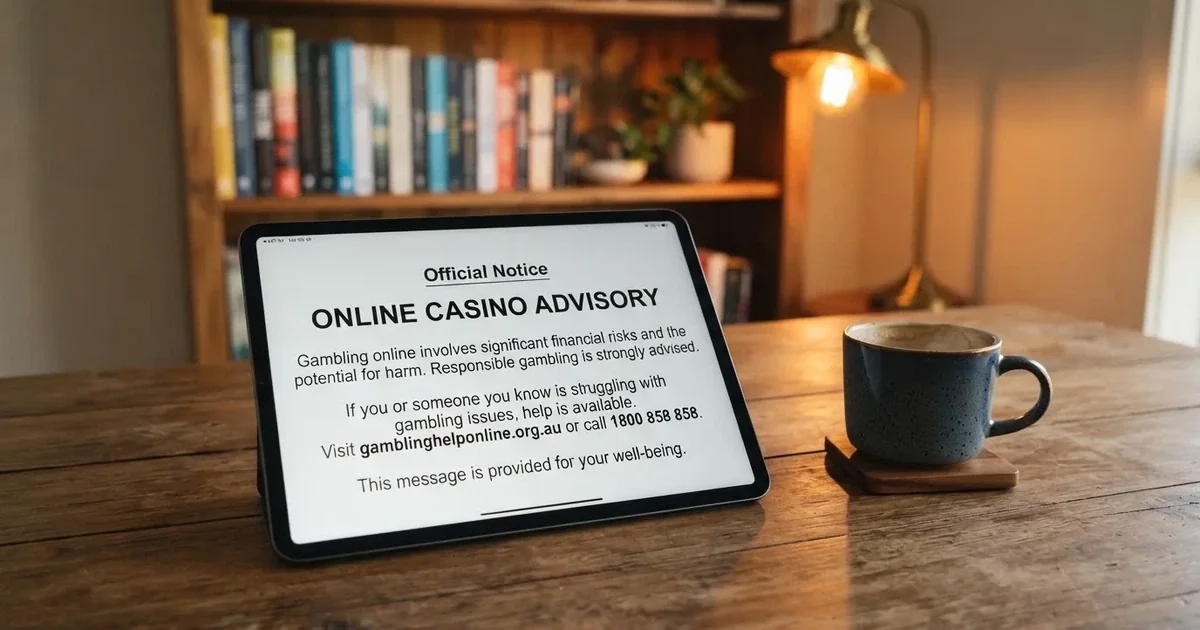
For Australians who recognise the offshore path as the problem rather than the solution, the support layer is well-developed. The National Gambling Helpline at 1800 858 858 is free, available 24/7 and reachable by chat through Gambling Help Online. Gambling Help Online also runs the same service in writing for readers who would rather not use the phone. State-based services extend the same coverage into face-to-face counselling and peer support. The Australian Banking Association’s scheme for blocking gambling transactions at the bank level is a third layer; Westpac, ANZ and Commonwealth Bank each publish how to turn the relevant block on inside their app.
A reader using a VPN to reach an offshore casino and looking for a hard stop has to stack three tools rather than one. Self-exclusion at the bank, a gambling block on the relevant card and digital wallet, and the relevant offshore site’s own self-exclusion tool — used independently because the regulator cannot enforce the offshore site’s compliance with it. None of these is a complete answer on its own. Stacked, they are the closest thing Australia has to a stop button for an offshore casino.
The Eleven Brands the ACMA Has Warned — Side by Side
The brands below are not ranked by quality, payout speed or bonus generosity. They are listed because the Australian Communications and Media Authority issued a formal warning over each one for supplying prohibited interactive gambling services to Australians. Each row carries the warning date the ACMA published and the operator it named at that date. Where a brand has been warned more than once, the most recent warning is the headline figure and earlier warnings sit underneath. The subject-support column records which mainstream payment, identity or self-exclusion infrastructure the brand appears in according to the listings that were checked. An em dash means that infrastructure does not list the brand.
| Brand | ACMA action and date | Operator named by the ACMA | Subject support |
|---|---|---|---|
| RocketPlay | Formal warning, March 2026 (earlier Dama N.V., May 2022) | Pulsup Ltd | listings only (gamblinginsider) |
| Level Up Casino | Formal warning, May 2022 | Dama N.V. | listings only (Westpac) |
| Woo Casino | Formal warning, March 2025 | Dama N.V. | — |
| Spirit Casino | Formal warning, May 2025 | Dama N.V. | — |
| National Casino | Formal warning, July 2025 | Consolutetish S.R.L. | listings only (ACMA, AUSTRAC, BetStop) |
| Bizzo Casino | Formal warning, July 2025 (earlier TechSolutions, 2022) | Consolutetish S.R.L. | listings only (gamblinginsider) |
| Ignition Casino | Formal warning, July 2025 | Bamboo Media | — |
| Instant Casino | Formal warning, February 2025 | EOD Code SRL | listings only (ecopayz, PayID) |
| Jackbit | Formal warning, April 2026 | Ryker B.V. | — |
| Casino Intense | Formal warning, April 2025 | Sterplay Holding Ltd | listings only (AUSTRAC, BetStop, gamblinginsider) |
| Sky Crown | Formal warning, September 2022 | Hollycorn N.V. | — |
The pattern in the table is the story. Of eleven brands, nine are connected to a small number of operating companies that have been warned, rebranded, re-licensed and warned again — Dama N.V. alone covers RocketPlay, Level Up Casino, Woo Casino and Spirit Casino across three separate formal warnings from 2022 to 2025. The third column is the licence that has not changed Australia’s view of any of these sites. What has changed is the operator name on the warning notice and the front-end brand at the URL. The column on the right is the one to read with a thermometer rather than a ruler: a brand that appears in mainstream Australian infrastructure, like AUSTRAC’s threshold-transaction reporting or BetStop’s registration data, has had some level of friction layered onto it that a brand with no entry has not. That friction is one-sided — the operator cannot opt in to BetStop because it is not licensed to offer its product in Australia — but it is a useful proxy for how visible the brand has been in the Australian market.
The recurring case in the column is “listings only”: the brand turns up in the source named, but the source is an affiliate or aggregator, not a regulator. That is a marketing footprint, not a regulatory one, and it tells a reader how much the brand has paid to be visible rather than how much protection the player has when dealing with it.
Reading the Operator Cards
The operator-by-operator cards below treat each brand as a single case rather than a member of a list. None is recommended; each is described so a reader can see what the regulator has done and what the listings report. Where research carries no entry for a subject support, the brand appears on its other fields and is not attached to the subject at all — neither affirmed nor denied.
RocketPlay — Most Recently Warned, Longest Paper Trail
The ACMA named Pulsup Ltd as the operator of Rocketplay in a formal warning issued in March 2026, and an earlier warning against Dama N.V. from May 2022 had already covered the brand under its previous operator. The same operating company has therefore been warned twice for the same product on the same URL over a four-year span. Listings report RocketPlay through gambling industry aggregators, but no mainstream Australian infrastructure lists the brand. The verdict here is structural: a brand that has been warned twice has had two opportunities to bring itself inside the Australian frame and has not done so, which is itself an answer to whether the operator is engaging with the Australian market as a regulated participant or as an offshore supplier routing around the regulator.
Level Up Casino — Earlier Warning, Same Operator Network
Level Up was named in the ACMA’s May 2022 warning to Dama N.V. alongside five other brands. The operator network it belongs to has since been warned three more times, in 2025 alone, which places Level Up inside the most-warned operator cluster the regulator has produced. The listings record places Level Up in the Westpac gambling block register, meaning at least one Australian bank has flagged its transaction category. This history demonstrates an operator that has consistently remained outside the regulatory framework, despite repeated formal warnings.
Woo Casino — Latest Dama N.V. Brand on the List
Woo Casino was named in the ACMA’s March 2025 warning to Dama N.V., the third time that operator has been pulled before the regulator in three years. The brand has no entry in the Australian payment, identity or self-exclusion infrastructure checked for this page. The verdict is the same as the previous Dama N.V. brands, but with a useful twist for the reader: by 2025 the regulator had a template for handling the operator, and the warning landed in the same register on the same Act. A brand that the regulator has warned three times under the same parent is not an edge case in the regulator’s workflow; it is a recurring input to it.
Spirit Casino — Second 2025 Dama N.V. Brand
Spirit Casino joined the register in May 2025, two months after Woo Casino, with the same operator name on the warning. The cluster of Dama N.V. brands now runs at four entries on the regulator’s list, with no sign of consolidation. The brand has no Australian infrastructure footprint in the sources checked. The verdict here is the same: an operator the regulator has named repeatedly does not become less named over time, and a brand in this cluster is one of several URLs the same operator is rotating.
National Casino — Closest to Australian Infrastructure
National Casino’s July 2025 warning went to Consolutetish S.R.L., and the brand carries the most substantive Australian infrastructure footprint of the eleven. It shows up in AUSTRAC’s threshold-transaction reporting, the ACMA’s own register, and BetStop’s broader data — three separate points of friction rather than one. The verdict is structural and cuts both ways: the more Australian infrastructure a brand has crossed, the harder it is to treat the offshore path as frictionless, but the more often the regulator has had occasion to record it, the longer the regulator’s record on it has become.
Bizzo Casino — Two Warnings Across Two Operators
Bizzo Casino has been warned twice, first in 2022 under TechSolutions (CY) Group Limited and TechSolutions Group N.V., then again in July 2025 under Consolutetish S.R.L. The brand has changed hands across operators and continued to be warned under the new operator. Listings report it through gambling industry aggregators only. These repeated interventions underscore that changing operators does not effectively clear a brand’s regulatory record with the ACMA.
Ignition Casino — Bamboo Media Brand
Ignition Casino was named in the ACMA’s July 2025 warning to Bamboo Media, alongside other brands the operator runs. It has no entry in the Australian infrastructure checked for this page. The verdict is the operator-network reading: an Ignition player is dealing with an operator that has been told to stop supplying prohibited services to Australians and has not provided evidence to the regulator that it has, and that absence is the regulator’s working assumption rather than a casual omission.
Instant Casino — Warning That Has Aged the Most in 2026
Instant Casino’s February 2025 warning to EOD Code SRL has had the most calendar time to age out of the news cycle. The brand’s listing profile crosses ecopayz and PayID — two pieces of Australian payment infrastructure. The presence in PayID’s reported data is the more important of the two, because it indicates the brand has intersected with the account-name verification layer that PayID enables, which is the same layer that flags an illegal-gambling recipient by name. With no Australian licence to offer these services, the operator’s continued exposure to the market illustrates how offshore services persist even after direct formal warnings from the ACMA.
Jackbit — Ryker B.V. Warning
Jackbit’s April 2026 warning to Ryker B.V. is among the most recent on the list, and the brand carries no entry in the Australian infrastructure checked. The verdict follows the same pattern as other recently warned brands: an operator named in the most recent ACMA round is one that has been on the regulator’s working list, and the warning has had the least calendar time to age.
Casino Intense — Sterplay Holding Brand
Casino Intense was named in the ACMA’s April 2025 warning to Sterplay Holding Ltd. The brand’s listing footprint crosses AUSTRAC, BetStop and gamblinginsider — three of the more substantive entries on the table. The verdict is the most operationally heavy on the list: a brand with regulator exposure, AUSTRAC exposure and self-exclusion-data exposure is one the Australian infrastructure has interacted with in three different ways, and the reader’s working assumption should be that the brand has had to negotiate each of those interfaces, with the mixed record that follows.
Sky Crown — Hollycorn N.V. Warning
Sky Crown was named in the ACMA’s formal warning to Hollycorn N.V. alongside Blue Leo. The brand carries no entry in the Australian infrastructure checked for this page. The verdict is the oldest on the list at the date the ACMA recorded it, but the regulator’s record does not expire with time: the warning remains in the register, the operator has not been removed, and a brand warned in 2022 is still a brand whose operator has been told to stop.
The Blocking Rate — Why the Numbers Tell Their Own Story
By 26 June 2026, the ACMA had asked Australian ISPs to block 1,751 illegal gambling and affiliate marketing websites since the first blocking request in November 2019. That is the headline number from the regulator’s own register, and the arithmetic it invites is simple. Over roughly six and a half years, the average blocking rate works out to about 270 sites per year, and the cadence has been steady enough that another round every month or two is the norm rather than the exception. A site reachable today is one blocking round away from being unreachable, and a balance sitting on the site at that point is at the operator’s discretion rather than the player’s.
The blocking rate also puts the eleven warned brands in context. A reader looking at a casino the ACMA has warned once should treat the warning as part of an ongoing process, not a one-off. The regulator does not warn an operator, see no change, and move on; it warns, blocks, and continues to add new URLs to the block list. The blocking rate is what that continuing attention looks like in numbers. The casino a reader is considering today is one of roughly 1,750 such sites the regulator has already classified as illegal, plus whatever the next round will add.
The conditions matter as much as the average. The 270-sites-per-year figure is an arithmetic mean over the full enforcement period, and the regulator’s recent activity has been denser than the early years. The practical reading is that the rate is steady to rising rather than steady to falling, and a brand on today’s list is one the regulator has had to remind itself about rather than one it has had to forget.
What the Choice Actually Adds Up To
A reader who is comparing what to do with this page is not choosing between eleven offshore casinos. They are choosing between an Australian-licensed market that does not offer the product they want, and an offshore market that does, with three differences the offshore market cannot make up for. The first is protection: an offshore site gives no Australian consumer protection, no complaints body and no recourse when a withdrawal stalls. The second is reachability: an offshore site that is reachable today is one blocking round away from being unreachable. The third is visibility: an offshore casino that the regulator has warned is one the regulator will warn again, and the eleven brands on the list above carry the warnings that prove it.
For readers who have decided that the offshore path is theirs, the practical ordering is short. Confirm the bank block is on for the card and the digital wallet they intend to use. Confirm the bank supports a per-transaction limit on gambling transactions. Confirm they have signed up to BetStop or to the offshore site’s own self-exclusion tool independently, since the two are not connected. Read the ACMA’s warning register for the brand they are considering, and read the date — a brand warned in 2022 carries a warning that has not been retracted, and a brand warned in 2026 is one the regulator was looking at last month.
For readers who are not committed to the offshore path, the closer reading is shorter. The Australian market does not offer online casino games; the offshore market does, at the cost of every protection an Australian licence buys. The reader’s question is not which offshore casino is best. The reader’s question is whether the cost is worth paying, and the eleven brands above are what paying that cost looks like.
Frequently Asked Questions
Why does a casino advertise itself as VPN friendly in the first place?
Because the casino is offshore and most of its potential customers are inside jurisdictions where the casino is illegal to reach. Advertising itself as VPN friendly lets the casino signal to those customers that it will not block their connection at the front door. The marketing sits on top of a prohibition; it does not change the prohibition itself.
Does using a VPN make the activity legal for someone in Australia?
No. The Interactive Gambling Act 2001 prohibits the supply of prohibited interactive gambling services to a person in Australia, and a VPN changes the IP address, not the location of the person sitting at the keyboard. What the VPN does is hide the connection from the casino and the ISP; what it does not do is move the human outside Australia.
What does a VPN actually change about what the casino sees?
The casino sees the foreign IP address and treats the connection as foreign. It does not see the Australian IP, the Australian ISP, or the Australian physical location. From the regulator’s perspective, none of that has changed — the regulator’s view of where the player is depends on where the player is, not on what the IP looks like.
What risk does a player take on by using a VPN to reach a casino that has been formally warned?
The casino is operating outside the Australian regime. The player gives up the Australian consumer protection layer, the Australian complaints body and the Australian recourse to a blocked site with a balance on it. The warning is the regulator’s record that the casino has been told to stop; it does not expire.
Is a casino that allows VPN use any different from one that simply doesn’t check?
Technically, no. From the player’s perspective the experience is the same — sign up, deposit, play, withdraw. From the regulator’s perspective, both are supplying prohibited services to Australians and both are reachable for the same reasons. The advertising posture differs; the conduct does not.
What should someone consider before treating VPN access as a safe workaround?
That the workaround only changes reachability. It does not change legality, does not change the regulator’s view, and does not change the operator’s freedom to refuse a withdrawal. The reader’s working assumption should be that they are taking on the full consumer-protection gap themselves.