The Betsoft casino search from Australia, and what it costs a punter to keep making it
 Available in US
Anyone searching for a Betsoft casino from Australia is searching for a product that does not legally exist for sale to them. Online casino games and online pokies sit on the prohibited list under the Interactive Gambling Act 2001; no state or territory hands out a licence for them; the only Australian-licensed online gambling product is pre-event wagering on racing and sport, keno and lotteries. Betsoft titles appear in catalogues of offshore operators that the Australian Communications and Media Authority has named, formally warned, and asked Australian internet service providers to block. The page below sets out what those offers usually involve, what a paytable looks like on a Betsoft slot, and what the ACMA’s blocking record means in plain numbers — so the cost of treating the search as harmless is visible before a deposit is sent.

Currency and licence status current as of 23 September 2026, checked against the ACMA’s register of formal warnings and blocking requests.
Table of Contents
- What “a Betsoft bonus” usually means on an offshore casino
- What “a Betsoft mobile app” usually means
- Reading a Betsoft paytable before putting a cent in
- What “the best Betsoft casino” looks like as a comparison
- How the Betsoft landscape actually looks in Australia
- The legal frame around any Betsoft casino offer to an Australian
- What Australian consumer protection looks like — and where it stops
- What a deposit and a payout actually involve offshore
- The arithmetic the ACMA’s blocking record actually does
- Reading the eleven brands on the ACMA’s own terms
- The cost, in plain terms
- Frequently asked questions about Betsoft casinos in Australia
What “a Betsoft bonus” usually means on an offshore casino
The first thing a comparison page sells a punter on is the welcome package, and the second is the free-spin bundle stapled to it. Both are dressed as gifts, and both are wagering gates in disguise. A bonus of A$500 with a 40x wagering requirement means the punter has to turn over A$20,000 in real bets before any of the bonus money, or the winnings from it, becomes withdrawable. The “free” spins carry the same gate: each spin’s winnings lands as bonus money, not cash, and runs through the same multiplier. A max-cashout cap, often A$100 on a no-deposit offer, sits quietly underneath so that even after the wagering clears, anything above the cap disappears.
That is the shape of the offer before geography enters. Once the punter sits in Australia, every layer of that offer is governed by a regulator the punter cannot ring: the licence displayed on the casino’s footer was issued in Curaçao, or Malta, or Anjouan, and is meaningless under Australian law. The ACMA has no power to enforce a complaint against such a licence; the punter has no Australian complaints body to walk into; if the operator refuses a withdrawal, the practical recourse is a chargeback with the card issuer, and the chargeback is itself a breach of the offshore operator’s terms. The advertised “fair play” sits behind a wall of distance.

The free-spin side deserves its own reading. A bundle of 200 “free” spins sounds generous until the maths is done. At an average spin value of A$0.20, 200 spins is A$40 of nominal play. If the wagering requirement on the winnings is 40x, that A$40 of winnings — and a slots payout is rarely that clean — has to be turned into A$1,600 of further real bets before withdrawal. The “free” spins are free at the moment of the click; everything after that click is paid play with the operator’s house edge.
A useful way to think about any Betsoft casino bonus, before its specific numbers are even read, is this: it is the cost of being allowed to play with house money, priced into the wagering multiple and the max cashout, and the punter pays it whether they win or lose. Anyone who can read those two figures can read the whole offer.
What “a Betsoft mobile app” usually means
There is no Australian app store listing for any of the offshore operators carrying Betsoft games, because the product they sell is prohibited for Australian residents. What a Betsoft “mobile casino” actually delivers, in practice, is one of three shapes, and a punter should know which one before installing anything.

The first is a browser-based mobile site, built in HTML5, that loads in Safari or Chrome. Betsoft’s own catalogue has been HTML5 since the studio’s shift away from Flash years ago, so the games themselves travel to a phone browser without a separate download. This is the safest of the three, because nothing leaves the browser sandbox: the site loads, the punter plays, the operator’s session cookie handles the balance. If the punter wants out, closing the tab is the entire exit.
The second is a progressive web app or a wrapped APK that the operator distributes by a download link, not through Google Play or the App Store. Google and Apple refuse to list online casino apps in Australia for the same reason the IGA does; the operator works around it by sending an APK to the phone directly. Installing one means accepting the source outside the phone’s normal trust chain, and the install prompts the punter to allow apps from unknown sources. Any malware risk that comes with it sits on the punter, not on the operator.
The third is a thin client that claims to be a “Betsoft casino app” in an affiliate review and is, on inspection, the same browser shell dressed in an icon. The dressing is the product; the operator charges the same rake regardless of how the punter reached it.
The mobile experience, in any of those shapes, runs on the same terms as the desktop version. The wagering requirement travels with the bonus; the max cashout travels with the free spins; the licence jurisdiction travels with the footer. Nothing about the smaller screen changes what the operator is, or what Australian law says about it.
Reading a Betsoft paytable before putting a cent in
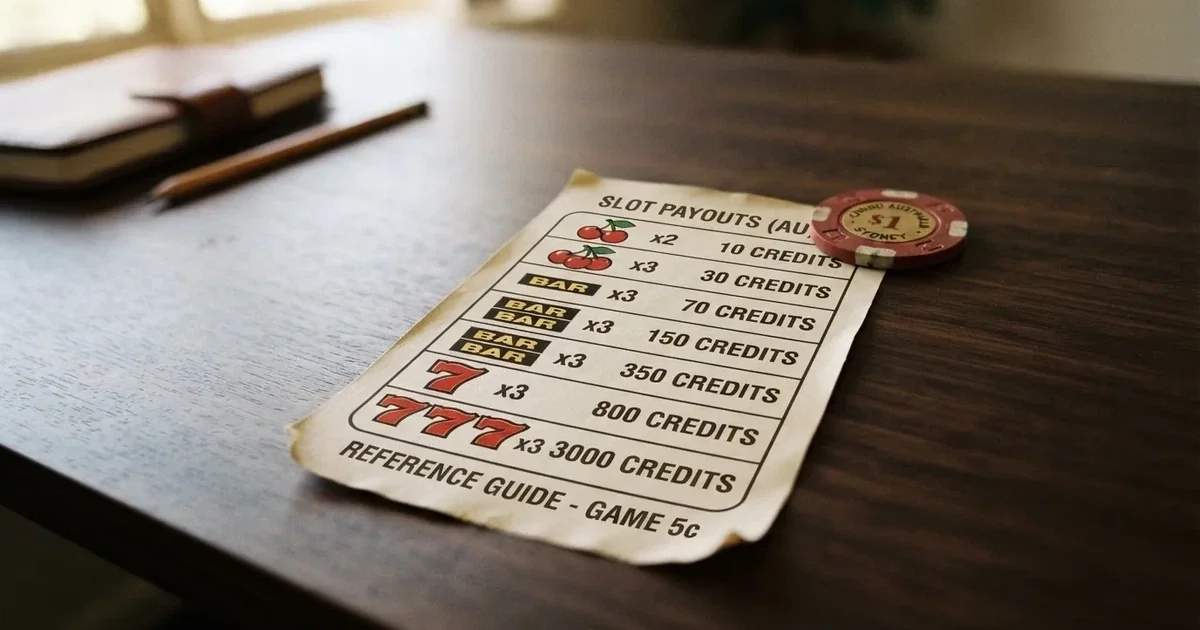
A paytable is a slot’s instruction manual, and Betsoft’s catalogues are unusually willing to publish the numbers — the studio lists return-to-player percentages, volatility tags and hit rates on individual game pages, which is more disclosure than most providers give. Two titles the studio still promotes show what a paytable looks like.
The Slotfather, live since 13 December 2012, runs on five reels and thirty paylines with a published return-to-player of 95.69%, a “Medium” volatility tag and an 8.17% hit rate. Good Girl Bad Girl 2 sits on five reels and twenty paylines with a 96.22% RTP, a “Very High” volatility tag and a 15.59% hit rate. Reading those four numbers — RTP, volatility, hit rate, payline count — tells a punter most of what they need to know about a slot without playing it.
The RTP is the long-run return per dollar wagered. A 96.22% RTP means the slot keeps 3.78 cents of every dollar over millions of spins; the punter’s session of a few hundred spins is a tiny sample inside that average, and can land anywhere inside it. The volatility tag tells the punter how the average is distributed. A “Very High” volatility slot pays rarely and in larger chunks when it does; a “Medium” volatility slot pays more often in smaller amounts. The hit rate is the share of spins that produce any return at all — even a one-credit return counts. A 15.59% hit rate on Good Girl Bad Girl 2 means about one in seven spins returns something; an 8.17% hit rate on The Slotfather means about one in twelve.
The payline count shapes the bet. A 30-payline slot at A$0.10 per line is an A$3 spin; the same bet on a 20-payline slot is A$2. A punter who reads only the headline bet and not the payline count underestimates the cost of a session by the size of that multiplier.
A paytable also shows the symbol values. Wilds, scatters and bonus symbols sit at the top; the lower-tier card symbols sit at the bottom. The ratio between the top and bottom symbol pays is one of the cleanest tells of a slot’s character — a wide ratio pushes the slot toward its bonus events, a narrow ratio keeps the base game paying modestly and often. Betsoft’s slots tend toward the wide end, which is part of how the studio’s catalogue earned its reputation for cinematic set pieces.
What “the best Betsoft casino” looks like as a comparison
A useful comparison of Betsoft casinos for an Australian punter is not the one affiliate pages run, which rank sites by deposit bonus size and free-spin count. That ranking rewards whichever operator has spent the most on affiliate commission this month, not whichever offers the cleanest terms. The honest comparison has to weigh what the operator does, what it does not do, and what the ACMA has already said about it, because in Australia the third column matters more than the first two.
Every brand in the table below is listed because the ACMA itself issued a formal warning over it under the Interactive Gambling Act 2001. The ACMA does not warn compliant operators; the warning is the regulator saying, on the public record, that the operator was found offering prohibited services to Australians. Reading the table is reading what the regulator found.
| Brand | ACMA action and date | Operator named by the ACMA | Betsoft (or other studio) support |
|---|---|---|---|
| RocketPlay | Formal warning — March 2026 | Pulsup Ltd | — |
| Level Up Casino | Formal warning — May 2022 | Dama N.V. | Listed by Wazdan as a partner venue |
| Woo Casino | Formal warning — March 2025 | Dama N.V. | — |
| Spirit Casino | Formal warning — May 2025 | Dama N.V. | — |
| National Casino | Formal warning — July 2025 | Consolutetish S.R.L. | Betsoft, Pragmatic Play and Wikipedia list the brand |
| Bizzo Casino | Formal warning — July 2025 (and 2022) | Consolutetish S.R.L. (and TechSolutions) | — |
| Ignition Casino | Formal warning — July 2025 | Bamboo Media | — |
| Instant Casino | Formal warning — February 2025 | EOD Code SRL | — |
| Jackbit | Formal warning — April 2026 | Ryker B.V. | — |
| Casino Intense | Formal warning — April 2025 | Sterplay Holding Ltd | Listed by 1spin4win, Wikipedia and the UK Gambling Commission |
| Sky Crown | Formal warning — September 2022 | Hollycorn N.V. | — |
Two columns carry mostly em dashes. That is the point. The third column is what an honest directory would record: where a Betsoft or 1spin4win listing or a regulator-published register actually names the brand as a partner venue, the page records it as that; where the studio listings do not name the brand and the regulator’s public record is the only source, the column stays empty. An em dash is not a denial — it is what the audited record shows, written in the article-language marker for “this column is not in the public record”.
The column that matters most is the third from the left, because it is the ACMA’s own record. A formal warning under the Interactive Gambling Act 2001 is a finding that the operator offered prohibited services to Australians. Eleven of them on one table is not a ranking — it is a register. The ACMA’s register, the ACMA’s dates, the ACMA’s named operators.
How the Betsoft landscape actually looks in Australia
| Studio | Headquarter | Licence |
|---|---|---|
| BGaming | Malta | MGA/B2B/785/2020 |
| Booming Games | Malta | MGA/B2B/459/2018 |
| 1spin4win | Curaçao | Curaçao |
| Aristocrat | Australia | ASX-listed |
The wider landscape a Betsoft search sits inside is dominated by studios that hold Australian-recognised licences and by studios that do not, and the line between them runs through compliance paperwork rather than through the games. Betsoft itself was founded in 2006 and publishes a catalogue of more than 200 RNG games across slots, table games, video poker and specialty titles. The studio states it operates in compliance with licensing authorities including Italy’s ADM, that its RNG carries certification from Quinel and Gaming Labs International, and that its games are integrated at more than 500 operators across regulated markets in Europe, Scandinavia, Latin America and Africa. Australia is not in that list. The studio’s own footprint tells the same story the ACMA’s warnings do, from a different direction.
The local side of the landscape is a small set of names. Aristocrat Leisure, founded in 1953 and ASX-listed since 1996, is the largest gambling-machine manufacturer in Australia and the second-largest slot-machine manufacturer in the world behind International Game Technology. Its administrative and research headquarters sit in North Ryde, Sydney, with offices in South Africa, Russia and the United States. Aristocrat develops electronic gambling machines, casino management systems, online real-money-gambling technology, iLottery products and social casino games; its online real-money arm, Aristocrat Interactive, was formed in April 2024 by combining its Anaxi unit with the NeoGames group it acquired for roughly US$1 billion. None of that arm sells online casino games to Australian residents — the IGA forbids it — and the social-casino product is not real-money play.
The international slot catalogue that does reach Australian phones is published by studios that hold Maltese, Curaçao or other offshore licences and distribute through aggregators to the offshore operators the ACMA names. BGaming, operated by Stable Games Ltd of Valletta and holding a Malta Gaming Authority Critical Gaming Supply Licence (MGA/B2B/785/2020, issued 18 March 2021), publishes 250+ certified games including slots, video poker, lottery, card, scratch, crash and casual titles, and claims 3,000+ operator integrations. Booming Games (Malta) Limited holds an MGA B2B licence (MGA/B2B/459/2018) and a UK Gambling Commission account, plus Swedish, Ontario, Romanian, Danish, Greek, Belgian, German and Brazilian regulator recognition. 1spin4win, founded in 2021 and headquartered at Scharlooweg 39 in Willemstad, Curaçao, holds a Curaçao gaming licence and publishes more than 190 online slots. The combined footprint is enormous, and none of it is licensed to sell the product to a person sitting in Sydney or Melbourne.
That asymmetry is the landscape’s defining feature. The studios are real, well-capitalised and audited. The operators carrying their games to Australians are not licensed to do so. A punter who reaches one of those operators has moved past the studio side of the catalogue, where the certification and testing are clean, and into the operator side, where the licence that matters is missing.
The legal frame around any Betsoft casino offer to an Australian
The legal frame is the part of the page where wit falls flat, because the statute is what it is. The Interactive Gambling Act 2001, strengthened by the Interactive Gambling Amendment Act 2017, makes it an offence to provide online casino games, online pokies or in-play betting to a person in Australia; no state or territory issues a licence for them. The minimum age is 18. The individual player is not prosecuted — the IGA targets the provider — and that is sometimes read, by offshore operators in their marketing copy, as a green light. It is not. It is the regulator telling the provider to stop, and the player is left in a position with no Australian consumer protection, no complaints body and no recourse if a withdrawal is refused.
Enforcement runs through the ACMA. The ACMA investigates, issues formal warnings, and directs Australian internet service providers to block illegal sites. A block can arrive while a balance still sits on the operator’s books, and the operator has no obligation — under Australian law, because the law does not reach it — to return it. The enforcement is real, the recourse for the player is not.
The Interactive Gambling Amendment (Gambling Reform) Bill 2026 passed Parliament on 19 August 2026; its advertising and inducement measures commence on 1 January 2027. It is law with a start date, and on a 2026 page it is not yet in force.
What the Australian side does license is wagering on races and sport placed before the event, keno and lotteries. In practice those licences are issued by the Northern Territory Racing and Wagering Commission, which regulates 52 of Australia’s online bookmakers — including Sportsbet, Bet365 and Ladbrokes — for tax reasons. The commission has no full-time staff and meets once a month in Darwin. The product it licenses is betting, not casino.
Tax: gambling winnings of a recreational player are not assessable income under section 6-5 of the Income Tax Assessment Act 1997, and losses are not deductible, unless the person carries on a business of gambling. That is a model rather than a ruling — anyone whose position is more than casual should check with the ATO.
What Australian consumer protection looks like — and where it stops
Australian consumer protection is built for the Australian-licensed product. BetStop, the National Self-Exclusion Register, has been live since August 2023 and binds every Australian-licensed online and phone wagering service. A person who registers with BetStop cannot open a new account with any of them, and the operators honour the exclusion at the door. That is the strongest self-exclusion tool available in the country, and it does not reach an offshore casino. The offshore operator is not connected to BetStop; the offshore operator does not see a BetStop exclusion; the offshore operator has no Australian obligation to honour one.
The National Gambling Helpline on 1800 858 858 is free, 24/7 and confidential, with chat available through Gambling Help Online. It is the right first call for anyone whose gambling has stopped being a choice. It is the right call before the offshore operator’s terms of service, before the bonus comparison, and before the ACMA’s blocking list — because the help is the part that arrives without a deposit attached.
For an offshore casino, none of that exists in the same shape. A complaint about a refused withdrawal goes to the operator’s support email, then to the operator’s licence issuer if the email fails, and the licence issuer is in another jurisdiction and speaks another legal language. A chargeback with the card issuer is the practical last step, and it breaches the operator’s terms.
What a deposit and a payout actually involve offshore
The money side of an offshore Betsoft casino is the side the comparison pages treat last and the side that costs the punter first. Legal deposit routes for Australian-licensed wagering are debit card, bank transfer, PayID/Osko and BPAY. Credit cards, credit-related products and digital currency are banned as payment for licensed online wagering since 11 June 2024, with penalties up to A$247,500 for operators who breach the ban. The ban applies to the Australian-licensed product. An offshore casino asking an Australian for a credit card or a crypto deposit is operating outside the Australian rules, and the payment that goes through has no Australian consumer protection sitting on the other end of it.
The withdrawal side runs on the operator’s own clock. Affiliate pages advertise “instant” or “same-day” payouts for crypto, “1–3 business days” for cards and “3–7 business days” for bank transfer, and the figures vary by operator and by tier. The operator’s published payout time is not enforceable in Australia; an offshore casino that sits on a withdrawal for ten days has not broken an Australian rule, because the rule does not reach it. The punter’s protection is the operator’s commercial interest in keeping its reputation with the payment processors it depends on, and that interest is real but not Australian.
A useful way to read any payout claim on a Betsoft casino review is to ignore the headline and read the conditions underneath it. A “24-hour payout” with a 48-hour internal pending period is a 72-hour payout. A “no-fee” payout that requires a deposit to have been wagered at least once is a withdrawal that costs a player a bet’s worth of expected value before it moves. A max withdrawal cap of A$2,000 per week on a balance built from a A$500 welcome bonus is a payout that the operator can stretch across months, and the operator will.
A punter who sends A$500 to an offshore casino is not paying A$500 for the entertainment of a session. They are paying A$500 for the entertainment of a session, plus the expected loss of the wagering requirement, plus the time the bonus takes to clear, plus the friction of the withdrawal, plus the risk of a refusal that ends in a chargeback. The cost is not the deposit. The cost is everything the deposit sets in motion.
The arithmetic the ACMA’s blocking record actually does
The ACMA’s blocking record is the closest thing the Australian side has to an outcome measure for the offshore market, and it is the page’s central finding. As reported in June 2026, the ACMA has asked Australian internet service providers to block 1,751 illegal gambling and affiliate marketing websites since the first blocking request in November 2019. More than 230 unlicensed gambling services have left the Australian market since enforcement was strengthened in 2017. The round reported on 26 June 2026 added another twelve sites to the block list — 7Signs, ChromaBet, Donbet, Duospin, Freshbet, Slots Gem, Jacks Club, Lucky Start, Pointsbetz, Spinrise, Vinyl Casino and Wildsino.
The arithmetic from those figures is the rate at which the ACMA has been adding illegal sites to the block list, and the band the rate sits in is the page’s cleanest summary of enforcement pressure. From November 2019 to June 2026 is roughly 79 months; 1,751 sites over 79 months is a long-run average of about 22 sites per month, but the early years ran slower as the blocking regime bedded in and the recent rounds run faster, with twelve added in a single June 2026 round alone. The honest band is somewhere between the long-run average and the pace of the most recent rounds — the long-run average flatters the early years, and the most recent rounds flatter the future. Both ends of the band are worth reading. The early years show that the ACMA’s blocking power took time to scale; the recent rounds show that it has now scaled, and the offshore operators that survive in Australia are the ones who have changed domain, payment route or front company faster than the ACMA can list them. The blocking rate is not the number of operators — it is the number of domains the regulator has had to name, and many of them are the same operator under a different web address.
The arithmetic is a band, and the band is the conclusion. No single figure captures it: the early enforcement was thinner than the recent enforcement, and the recent enforcement is faster than the long-run average. Reading the band is reading the offshore market’s shape.
Reading the eleven brands on the ACMA’s own terms
Every brand in the table above is reviewed below on what the ACMA itself published about it. The reviews do not recommend any of them. They set out what the regulator found, when it found it, and which parent company the regulator named in the warning. The order follows the page’s own ranking.
RocketPlay — the most recent ACMA warning on the list
The ACMA issued a formal warning to Pulsup Ltd over Rocketplay in March 2026, on the public register of formal warnings published by the authority. Dama N.V., a separate operator, was warned over the same brand in May 2022. The two names together suggest a brand that has been moved between parent companies since the first warning, which is itself a fact about how the offshore market operates. RocketPlay advertises a deposit-gated welcome package in its affiliate marketing, but the ACMA’s finding is the only specification on this page that carries a public source.
RocketPlay’s case is the freshest reminder that a formal warning is not a one-time event. A brand warned in 2022 can be warned again in 2026 under a different parent company. The punter who thinks they have read the operator’s compliance record has read one snapshot of it.
Level Up Casino — an early Dama N.V. warning
Level Up Casino was named in the May 2022 ACMA formal warning to Dama N.V. alongside five other brands — Bambet, Dazard, Rocketplay, Wild Tornado and Cobra Casinos. The warning was a single document naming six brands operated by the same parent company; it is the clearest public evidence that one parent company can carry a portfolio of front brands, each with its own marketing site, all governed by the same offshore licence.
Level Up Casino is listed by Wazdan as a partner venue, which is what the listings-only column in the table above records: a studio that names the brand in its public integrations list. It is not the studio’s endorsement of the brand’s terms; it is a record that the studio’s content is integrated there. The two are different things.
Woo Casino — the Dama N.V. portfolio under fresh action
Woo Casino received a fresh formal warning from the ACMA in March 2025, also under Dama N.V., three years after the 2022 batch. The 2025 warning is a separate document; the 2022 warning did not bind Woo Casino to comply in 2025. The pattern across Dama N.V. — 2022 warnings to six brands, 2025 warnings to two more — reads as a parent company that knows the ACMA is watching and is still prepared to carry Australian traffic.
There is no Betsoft listing that names Woo Casino as a partner venue, and the em dash in the table reflects that. The brand runs on its own licence footprint, whatever that footprint is; the page records the ACMA’s public record and stops there.
Spirit Casino — a 2025 Dama N.V. warning
Spirit Casino received its formal warning from the ACMA in May 2025, the second of the two fresh Dama N.V. warnings that year alongside Woo Casino. The five-month gap between the two warnings is not in itself meaningful — the ACMA’s publishing schedule is administrative rather than thematic — but the pairing is. Two formal warnings to the same parent company in one quarter tells the operator that the regulator’s interest in Dama N.V. has not faded.
Spirit Casino’s affiliate marketing carries a deposit-gated package; the page does not record the package’s terms. The record is the May 2025 warning, and the warning is the regulator’s finding that Spirit Casino was offering prohibited services to Australians at that point.
National Casino — listed by Betsoft and Pragmatic Play
National Casino received a formal warning from the ACMA in July 2025, named under Consolutetish S.R.L. — a different parent company from the Dama N.V. brands above. National Casino is listed by Betsoft itself as a partner venue, alongside Pragmatic Play and Wikipedia; the listing is a record the studios publish on their own sites, not a regulatory endorsement.
The combination of the ACMA’s warning and the studio listings is the page’s honest read of the brand. The studios that supply the games say they integrate with National Casino; the Australian regulator says National Casino was offering prohibited services. Both can be true at once, because the regulator’s frame is the Australian frame and the studios’ frame is the global one. The two frames do not meet.
Bizzo Casino — warned twice under two parent companies
Bizzo Casino carries two ACMA formal warnings on the public record. The first, in 2022, named TechSolutions (CY) Group Limited and TechSolutions Group N.V.; the second, in July 2025, named Consolutetish S.R.L. The two warnings are separated by three years and two parent companies, which is the kind of corporate history the ACMA’s register is unusually good at exposing.
The brand runs a deposit-gated welcome package in its affiliate marketing, and the package’s terms are not on this page. What is on this page is the public record of the regulator finding the brand, twice, under two different operators. The punter who reads both warnings reads the brand’s actual compliance history.
Ignition Casino — a July 2025 Bamboo Media warning
Ignition Casino received a formal warning from the ACMA in July 2025, named under Bamboo Media — a parent company not previously named on this page. The warning is a standalone document rather than a batch, which is a small administrative detail but matters to anyone reading the regulator’s record: it tells the ACMA treated Ignition Casino as worth its own warning rather than as one of six.
The brand’s affiliate marketing carries a crypto-friendly welcome structure; the page does not record the structure. The page records the July 2025 warning, the named operator, and the ACMA’s finding that the brand was offering prohibited services to Australians at that point.
Instant Casino — the EOD Code SRL warning
Instant Casino received a formal warning from the ACMA in February 2025, named under EOD Code SRL. The warning was the first ACMA action of 2025 in the offshore casino category on this page, and it arrived four months before the July 2025 batch on National Casino, Bizzo Casino and Ignition Casino.
The brand runs a same-day payout promise in its marketing; the promise is not enforceable in Australia. The page records the February 2025 warning and stops.
Jackbit — the April 2026 Ryker B.V. warning
Jackbit received a formal warning from the ACMA in April 2026 alongside CasinOK, both named under Ryker B.V. The paired warning is the kind of document the ACMA publishes when one parent company carries more than one brand; Ryker B.V. is named once and two brand sites are listed beneath it.
Jackbit markets itself as a crypto-first casino and accepts bets in cryptocurrency at the cashier. The credit-card and crypto ban under Australian law applies to the Australian-licensed product and does not bind an offshore casino, but it does describe the shape of the payment route the punter is being asked to use.
Casino Intense — listed by 1spin4win and the UK Gambling Commission
Casino Intense received a formal warning from the ACMA in April 2025, named under Sterplay Holding Ltd. Casino Intense is listed by 1spin4win as a partner venue, and the brand is named on Wikipedia and on the UK Gambling Commission’s public register. The combination of the studio listing and the regulator’s own UK register is a stronger public footprint than most of the brands on this page carry.
The UK Gambling Commission listing in particular is worth reading carefully: it means Casino Intense holds, or has held, a UK-licensed remote operating licence, and the UK licence is one of the more rigorous regimes outside Australia. The punter who reads the UK listing as a quality mark is reading a real signal. The punter who reads the ACMA warning at the same time is reading an Australian regulator’s finding that the brand was offering prohibited services here. Both are true at once.
Sky Crown — the Hollycorn N.V. warning
Sky Crown received a formal warning from the ACMA, alongside Blue Leo, under Hollycorn N.V. — the earliest warning on the page at September 2022, and one of the older documents on the regulator’s public register. The Hollycorn warning has been on the ACMA’s site long enough that it has become a citation in other warnings; the parent company is named again, indirectly, when other Hollycorn brands appear.
The brand runs a deposit-gated welcome package in its affiliate marketing, and the package’s terms are not on this page. The page records the Hollycorn N.V. warning and the ACMA’s finding.
The cost, in plain terms
The Betsoft casino search from Australia in 2026 returns a small set of well-capitalised offshore operators, several of which the ACMA has named and formally warned, all of which carry Betsoft or studio content the regulator has decided Australians cannot be sold. The cost of treating the search as harmless is the wagering requirement on the welcome package, the max-cashout cap on the free spins, the absence of Australian consumer protection on the withdrawal, the absence of BetStop reach on the self-exclusion, the absence of the ACMA on the complaint, and the risk that a block arrives before a balance leaves the operator’s books.
The studios that supply the games are real. Betsoft, BGaming, Booming Games, 1spin4win and Aristocrat Interactive all publish catalogues that are certified and audited. The operators carrying their games to Australians are not licensed to do so. The gap between the studio side and the operator side is the page’s single most useful finding, and it is the same gap the ACMA’s register, the IGA’s prohibition, and BetStop’s silence all point at.
Anyone who decides to play anyway at an offshore casino should at least know what they are paying for, and what they are paying for is a session with no Australian recourse, at terms the operator writes, against a house edge the paytable publishes, on a product the regulator has asked Australian ISPs to block. That is the cost, in plain terms, before a deposit is sent.
Frequently asked questions about Betsoft casinos in Australia
Is Betsoft itself an operator, or only a game studio that supplies content to sites?
Betsoft is a game studio. The studio publishes its own RNG catalogue — slots, table games, video poker and specialty titles — and licenses those games to operators, but the studio does not run any online casino itself. Betsoft holds third-party RNG certification from Quinel and Gaming Labs International, and states it integrates its games at more than 500 operators across regulated markets. None of those integrations is an Australian-licensed product, because online casino games cannot be licensed for the Australian market under the Interactive Gambling Act 2001.
Can Betsoft titles be played for real money at any licensed Australian casino?
No. Online casino games and online pokies are prohibited interactive gambling services under the Interactive Gambling Act 2001, and no Australian state or territory issues a licence for them. What is licensed is pre-event wagering on racing and sport, keno and lotteries, and Betsoft does not publish content in any of those categories. A real-money Betsoft slot played from Australia is being played at an offshore operator, and the ACMA’s record is the public evidence that this is what offshore operators do.
How does a Betsoft slot typically differ from other studios’ games in its paytable?
A Betsoft paytable publishes the four numbers a punter needs to read the slot: return-to-player percentage, volatility tag, hit rate and payline count. The Slotfather, live since 13 December 2012, carries a 95.69% RTP, a “Medium” volatility tag, an 8.17% hit rate and 30 paylines. Good Girl Bad Girl 2 carries a 96.22% RTP, a “Very High” volatility tag, a 15.59% hit rate and 20 paylines. The wide ratio between top and bottom symbol pays is part of what the studio’s reputation for cinematic bonus events is built on, and a punter reading the paytable will see the wide ratio directly.
Does Betsoft operate its own casino, or license its games to other operators?
Betsoft licenses its games. The studio’s revenue model is the B2B supply of RNG-certified content to operators who hold their own gambling licences, and the studio’s published footprint is the list of operator integrations. The studio’s own compliance disclosures — RNG certification, Italian ADM alignment, partner integrations across Europe, Scandinavia, Latin America and Africa — are the B2B disclosures, not the B2C promises. A punter on an offshore casino site is dealing with that site’s operator, not with Betsoft.
Why do offshore casinos highlight Betsoft as a selling point to Australian visitors?
Because the brand travels. Betsoft is a recognisable name in the slot catalogue, the studio has been publishing since 2006, and a punter who does not know the operator can still know the studio. The marketing claim is that the casino carries games from a known provider; the unspoken half is that the studio’s certification does not reach across the licence boundary, and the operator’s licence is the only one that matters for the punter’s protection. The selling point is true at the studio level and the operator’s Australian status is independent of it.
Is it legal for a site to offer Betsoft games for real money to people in Australia?
It is illegal for the site. The Interactive Gambling Act 2001 makes it an offence to provide online casino games to a person in Australia; the ACMA investigates, issues formal warnings and directs Australian ISPs to block offending sites. The individual player is not prosecuted under the IGA, but the player has no Australian consumer protection on the operator’s side if a withdrawal is refused, no Australian complaints body to walk into, and no guarantee that a balance will be retrievable after an ACMA block. The legal status of the offer is settled, and it has been settled against the operator, not against the player.
Prepared by the Casino Slots Info AU editorial staff.