
Plinko casino sites in Australia: what the marketing claim really costs
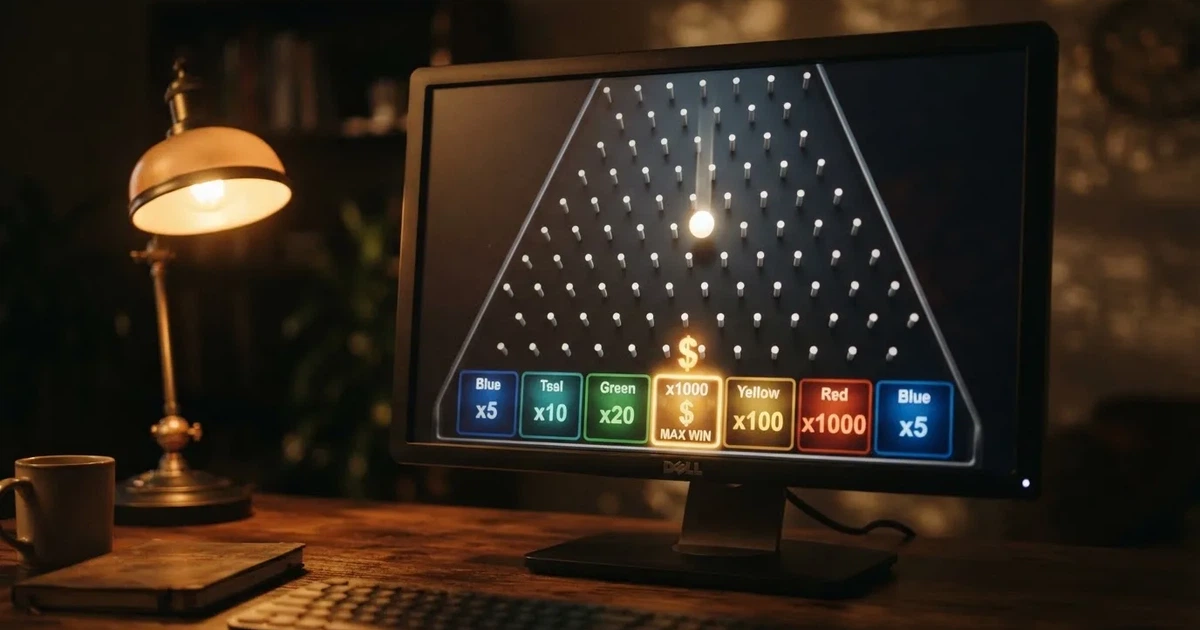
A ball drops through a pegboard, lands in a slot, and a multiplier flashes up on the screen. That is what BGaming’s Plinko looks like, and it is what every offshore casino page selling Plinko to Australians shows first. The advertising copy around it does the rest of the work — “99 per cent RTP”, “×1,000 top multiplier”, “provably fair”, “instant withdrawal” — and what is not on those pages is the Australian legal frame that decides whether any of those words mean anything to a person sitting in Sydney or Perth. None of the brands marketing Plinko to Australians in 2026 hold an Australian licence to do so. What they do hold is a record of ACMA action, and the record is the only ranking criterion that fits this subject. The rest of this page closes with what those brands cost the person who deposits with them anyway.
Currency and licence data current as of 28 October 2026, cross-checked against the Australian Communications and Media Authority’s published register of formal warnings and blocking requests.
Table of Contents
- How payment rails decide whether you ever see a withdrawal
- What a Plinko paytable actually contains
- The eleven brands the ACMA has acted against
- The state of the offshore market these brands sit inside
- The arithmetic of how fast the ACMA’s list is growing
- The legal frame every Australian player is sitting inside
- What the responsible-gambling frame does and does not cover
- What paying with crypto actually changes
- How this page compares to a marketing page
- Frequently asked questions about Plinko casinos in Australia
How payment rails decide whether you ever see a withdrawal
Plinko pays out through the same channels as any other offshore casino game: the deposit method is the withdrawal method, and what that method actually does on an Australian bank statement is the first cost the reader pays. The pages selling Plinko list PayID, BPAY, Visa and Mastercard debit, a handful of e-wallets, and an increasingly long column of cryptocurrencies. Each of those rail types interacts with the Australian rules in a different way, and the difference is not advertised on the cashier page.

The first interaction is the federal ban. Since 11 June 2024, credit cards, credit-related products and digital currency cannot be used to fund any licensed Australian online wagering service. Penalties for an operator that breaks that ban run up to A$247,500. The rule binds licensed Australian wagering — sports and racing, not casino — and what it means in practice is that an Australian player has a legal deposit rail for licensed product and a different, narrower set of rails for everything offshore. Offshore Plinko operators do not run on PayID or BPAY in the licensed sense. They run on crypto rails, on debit cards processed through overseas acquirers, or on e-wallets that bridge both worlds. The licensed-wagering ban is not an offshore ban, but it tells the reader which rails are processed cleanly inside Australia and which are not.
The second interaction is what a chargeback does and does not do. A Visa or Mastercard debit card deposit gives the cardholder the right to dispute a transaction with the issuing bank. That right exists irrespective of the merchant’s terms. The same right does not exist for crypto, for an e-wallet transfer once it has cleared, or for a bank transfer that the customer authorised. What that asymmetry produces on a Plinko site that refuses to pay out a withdrawal is a fight the player has a real chance of winning only if the deposit was on a card. The house knows it, and the bonus terms are typically written to push deposits away from that rail. Crypto deposits carry the lowest dispute risk for the operator and the highest loss risk for the player. That is the trade-off the marketing page does not mention.
The third interaction is the ACMA’s blocking power. The ACMA can direct Australian internet service providers to block an offshore gambling site entirely. A player with a balance on a blocked site has no Australian complaints body to contact, no BetStop record of self-exclusion to honour, and no local regulator to appeal to. The balance sits with an operator that is, by definition, one step ahead of the Australian internet. Of the 1,751 sites and affiliate pages blocked since November 2019, several of the brands below are on that list or have been the subject of an earlier warning that puts them next in line. Withdrawal speed is the second cost the marketing page does not price.
| Payment method | What it means under AU rules | Practical consequence for an offshore Plinko player |
|---|---|---|
| Visa / Mastercard debit | Allowed for licensed wagering; offshore acquirer in practice | Only rail that gives the cardholder a meaningful dispute route if a withdrawal stalls |
| PayID / Osko / BPAY | Allowed for licensed wagering | Not normally available on offshore Plinko sites |
| E-wallets (Skrill, Neteller, MiFinity, Jeton) | Not banned; sit outside BetStop’s reach | Fast deposits, slow dispute path, operator chooses whether to mirror withdrawals back to the same wallet |
| Crypto (BTC, ETH, LTC, USDT) | Banned for licensed wagering since 11 June 2024 | No chargeback, no Australian intermediary, no recourse if the site blocks or exits |
| Credit card | Banned across licensed wagering since 11 June 2024 | Offshore sites that still take credit cards are in breach of the policy their Australian issuer’s rules reflect |
The honest framing for the reader is that “instant payout” on an offshore Plinko site is a feature the operator can turn off unilaterally, and the rails on which that feature is least protected are the rails the marketing copy pushes hardest.
What a Plinko paytable actually contains
The Plinko game sold on offshore casinos to Australians is built around a pyramid of pegs with a slot row at the bottom. A ball or chip is dropped from the top, bounces through the pegs on a roughly random path, and lands in one of the bottom slots. Each slot carries a multiplier; the player wins the stake times the multiplier. The two settings that change the table are the risk level (low, normal or high) and the number of lines (8 to 16 on BGaming’s version). More lines means a wider bottom row, more slots, smaller multipliers at the centre and larger multipliers at the edges. Lower risk means the edge multipliers shrink and the centre grows, paying smaller wins more often. Higher risk does the opposite: thin middle, fat edges, less frequent but bigger hits.
The advertised headline numbers — 99 per cent RTP and a ×1,000 top multiplier — belong to BGaming’s standard build. The 99 per cent RTP is a long-run theoretical figure across millions of simulated drops. The ×1,000 top multiplier is the largest cell on the high-risk, 16-line board, and on a 16-line table there are exactly two of those cells at opposite ends of the row. The probability of landing in either of them on any single drop is small enough that the slot exists to lend the marketing copy a number, not to be the outcome a punter should plan around.
The point of knowing the table is not to out-think it. The point is that Plinko’s RTP sits in the same band as a high-paying slot, but the volatility profile is not the same as a slot. A standard online slot pays a win roughly every three or four spins on average, with most of the return concentrated in free-spin rounds and feature triggers. Plinko pays something on every drop — the worst slot is not zero, and the best is enormous — so the session shape is a constant drip of small wins punctuated by an occasional large one on the high-risk setting. A punter who switches from slots to Plinko expecting the same bankroll rhythm is in for a different kind of session, and on the high-risk table, the bankroll rhythm is precisely the thing the RTP figure hides.
The history of the game is a useful frame for what it actually is. Plinko premiered as a televised pricing game on The Price Is Right on 3 January 1983. The board had nine bottom slots valued from the outside in at $100, $500, $1,000 and $0, with a single centre slot worth $10,000. The maximum possible win, dropping all five chips into the centre, was $50,000. Before 1998 the centre slot paid $5,000, making the maximum $25,000 at the time. The show version is the cultural reference every offshore casino leans on; the real-money version has been tuned so the mathematics can be expressed as a single RTP number, and the tuning is where the edge lives.
For the reader, the practical cost of the paytable is this: the 99 per cent RTP is the average of a very wide distribution, and a single Plinko session is unlikely to sit anywhere near that average. The high-risk, 16-line board with its two ×1,000 cells will produce longer losing runs than the low-risk, 8-line board. The 99 per cent is real, but it is a statement about millions of drops, not about the next hundred.
The eleven brands the ACMA has acted against
This page does not rank offshore Plinko sites by payout speed, by bonus size or by game variety. There is no honest way to rank them on those criteria for an Australian reader, because no Australian regulator checks any of those claims against any of these brands. The only ranking that fits is the one the ACMA itself has produced: the order in which each operator has come to the regulator’s attention, the date the formal warning was issued, and the operating company behind the site at that moment. The table below carries that record.
Eleven brands appear here because the ACMA has issued a formal warning over each of them under the Interactive Gambling Act 2001 for providing prohibited online casino services to people in Australia. Every one of these brands markets Plinko to Australian customers, or markets a casino lobby that contains Plinko, in 2026. None holds an Australian licence to do so. The table is in the order the research sets, with the ACMA’s own wording on the operator and date.
| Brand | ACMA action and date | Operator named by the ACMA | Plinko availability on listings |
|---|---|---|---|
| RocketPlay | Formal warning, March 2026 (earlier May 2022 under Dama N.V.) | Pulsup Ltd (RocketPlay) | — |
| Level Up Casino | Formal warning, May 2022 | Dama N.V. | Listed on BGaming’s provider catalogue |
| Woo Casino | Formal warning, March 2025 | Dama N.V. | — |
| Spirit Casino | Formal warning, May 2025 | Dama N.V. | — |
| National Casino | Formal warning, July 2025 | Consolutetish S.R.L. | Listed on Wikipedia’s Plinko entry as a Plinko-carrying brand |
| Bizzo Casino | Formal warning, July 2025 (earlier 2022 under TechSolutions) | Consolutetish S.R.L. | — |
| Ignition Casino | Formal warning, July 2025 | Bamboo Media | — |
| Instant Casino | Formal warning, February 2025 | EOD Code SRL | — |
| Jackbit | Formal warning, April 2026 | Ryker B.V. | — |
| Casino Intense | Formal warning, April 2025 | Sterplay Holding Ltd | Listed in Australian media coverage of offshore gambling |
| Sky Crown | Formal warning, September 2022 | Hollycorn N.V. | — |
The Plinko column in this table is thin by design. Most of the brands here have not had their Plinko availability independently verified for an Australian audience; the few that have are listed on BGaming’s provider catalogue, on Wikipedia’s Plinko entry, or in Australian media coverage of the offshore market. The page does not assert Plinko availability where the research carries none, and the dashes carry that absence honestly. The brands are listed because the ACMA has acted against them; whether each one hosts Plinko on the day the reader opens the site is a separate, unverifiable question.
What every row above shares is the same legal position. The Interactive Gambling Act 2001 makes it an offence to provide online casino games, including Plinko-style multiplier games, to customers in Australia, with penalties of up to A$220,000 per day for individuals and up to A$1.1 million per day for corporations. The provider is the target, not the player, but the player pays the cost in three places: no Australian complaints body, no recourse if a withdrawal is refused, and the standing possibility that the site is blocked with a balance on it.
RocketPlay
RocketPlay carries the most recent ACMA action on this list: a formal warning to Pulsup Ltd over RocketPlay in March 2026. The same brand had already been the subject of an earlier warning to Dama N.V. in May 2022 alongside five other Dama brands, and the change of operating company between the two warnings is itself a marker. Operators move the licence plate when the regulator closes in. The RocketPlay site is built on the SoftSwiss / Dama platform stack, which carries BGaming content as standard; the Plinko lobby is the kind of game a player will find without searching. The site’s deposit page is a standard offshore mix: crypto, e-wallet, card. For an Australian reader, the verdict on RocketPlay is that the ACMA’s most recent formal warning is the freshest item on this page, and a brand that has been warned twice in four years has used two different operating-company shells to keep the lights on.
Level Up Casino
Level Up is the second brand on the list and the first to surface only in the May 2022 Dama N.V. warning batch, alongside Bambet, Dazard, Wild Tornado and Cobra. The brand’s product page is built around the same Dama platform shell that BGaming’s Plinko runs on, and the game is listed on BGaming’s own provider catalogue as one of the venues carrying the title. The cost to the reader here is not the catalogue listing; it is the four-year gap between the ACMA action and the operating company’s response. A brand that has been on a regulator’s warning list since 2022 and is still marketing to Australians in 2026 has decided that the regulator’s word is cheaper than the Australian player flow. That is a decision about the reader, and the reader should treat it as such.
Woo Casino
Woo Casino received a fresh ACMA formal warning in March 2025, again under Dama N.V. The Dama operator group is now the most-named entity in this table, which is itself a data point. Woo runs the same offshore cashier model as the rest of this list and the same Plinko availability as every other Dama-powered casino. The cost to a player depositing with Woo is identical in kind to the cost on any other brand here; the only Woo-specific marker is that the ACMA has used fresh wording on it within the last twelve months, which makes the brand one of the more recent enforcement targets.
Spirit Casino
Spirit Casino followed Woo onto the ACMA’s list in May 2025, again under Dama N.V. The pattern is consistent: a single operating group running multiple brands, each one warned in turn, each one continuing to accept Australian players in between. The cost to the reader is the same pattern from a different address. The brand-name on the cashier page is not the entity the ACMA names in the warning; the player who opens a dispute is dealing with a different counterparty than the one the regulator warned.
National Casino
National Casino received a formal warning in July 2025 under Consolutetish S.R.L., alongside Bizzo Casino in the same batch. National is the second brand on this list that the wider Plinko listings carry as a known venue for the game, after Level Up. The Wikipedia Plinko entry lists National Casino among the venues carrying the title, which is a listing-only data point: it records what those listings say, not what the operator publishes. For an Australian reader, the verdict on National is that the brand has both a regulator’s warning and a listings-page footprint for Plinko, which is the closest an offshore brand in this market gets to independent verification. It is still not an Australian licence.
Bizzo Casino
Bizzo carries two separate formal-warning events: the 2022 warning to TechSolutions (CY) Group Limited and TechSolutions Group N.V., and the July 2025 warning to Consolutetish S.R.L. Two operating-company names, two separate actions, four years apart. The brand has cycled its corporate shell more than once and kept the same Australian marketing presence. The reader cost here is the cycling itself: each new shell is a fresh corporate counterparty for a player who later tries to argue a withdrawal dispute, and the dispute arguments get harder with each shell change.
Ignition Casino
Ignition Casino was the subject of a July 2025 formal warning to Bamboo Media. Ignition has historically been marketed more heavily at the US poker market than at Australia, but the ACMA’s action in 2026 records that the brand has reached into Australian traffic in a way the regulator has decided to call out. The Plinko availability column for Ignition is empty in the research; the page records that absence rather than asserting the game is on the lobby.
Instant Casino
Instant Casino received a formal warning in February 2025 under EOD Code SRL. That makes Instant one of the earlier 2025 entries on this list, and one of the brands the regulator moved on at the start of the year before adding the July 2025 batch. For a player who opened an Instant Casino account in late 2024 and continued through the warning, the balance position is exactly the one the ACMA’s blocking power is built to threaten. The site can be blocked with funds still on account, and the player has no Australian complaint channel.
Jackbit
Jackbit is the most recent entry on this list after RocketPlay: a formal warning in April 2026 to Ryker B.V., issued in the same action that named CasinOK. Jackbit markets itself heavily on crypto rails, which is consistent with the cost framing above: the rail with the lowest dispute risk for the operator and the lowest recourse for the player. For an Australian punter, Jackbit is the brand that most directly tests the federal ban on crypto funding for licensed wagering by being entirely offshore and entirely crypto-native. The verdict on Jackbit is that it sits at the intersection of two enforcement themes: offshore casino prohibition and crypto-as-payment.
Casino Intense
Casino Intense received a formal warning in April 2025 under Sterplay Holding Ltd. Casino Intense appears in Australian media coverage of the offshore gambling market alongside other brands the ACMA has acted against, which is how the research’s listings-only marker is sourced. The brand is a smaller operator in the Dama-platform tier; the marketing footprint in Australia is real, and the ACMA’s intervention is on the record.
Sky Crown
Sky Crown is the oldest action on the table by date: a September 2022 formal warning to Hollycorn N.V., issued in the same action that named Blue Leo Casino. Three years later the brand is still operating and still marketing to Australian traffic; Hollycorn has continued to issue new brands in the intervening period. For the reader, Sky Crown is the marker for how long a warning sits on the record without producing any visible change to the offshore brand’s behaviour.
The state of the offshore market these brands sit inside
The eleven brands above are a sample of a much larger market. The ACMA’s own published record says that 1,751 illegal gambling and affiliate marketing websites have been blocked since the first blocking request in November 2019, and that more than 230 unlicensed gambling services have left the Australian market since enforcement was strengthened in 2017. In a single round reported on 26 June 2026, the ACMA asked Australian ISPs to block 12 more: 7Signs, ChromaBet, Donbet, Duospin, Freshbet, Slots Gem, Jacks Club, Lucky Start, Pointsbetz, Spinrise, Vinyl Casino and Wildsino. The cadence of those rounds, the size of the cumulative blocked list, and the operating-company churn visible in this page’s eleven brands are three views of the same market.
The market’s economic size is a separate figure. H2 Gambling Capital’s 2025 report estimates that Australians lose about A$3.9 billion a year to illegal gambling sites, and that the share of gambling going through legal channels fell from 74 per cent in 2021 to 64 per cent. The legal-channel share fell while the offshore market grew. That is the headline the offshore brands do not put in their marketing copy.
The domestic alternative the offshore brands compete against is small and narrow. The Northern Territory Racing and Wagering Commission regulates 52 of Australia’s online bookmakers — Sportsbet, Bet365, Ladbrokes among them — under Territory licences issued for tax reasons; the commission has no full-time staff and meets once a month in Darwin. What those bookmakers are licensed to offer is wagering on races and sport before the event, lotteries and keno. None of them offers online casino games, and none of them offers Plinko. The legal Australian product is a different product on a different licence. That is the gap the offshore market fills, and the reason an Australian player searching for Plinko lands on the brands in this table.
The arithmetic of how fast the ACMA’s list is growing
The blocking rate is the one calculation this page is built to carry, because it is the one figure that converts the ACMA’s enforcement record into something a reader can use. The inputs are the running total of blocked sites and the date of the first blocking request, both of which sit in the research. From those inputs, the rate is the cumulative count divided by the elapsed time, and the band the page reports is built from those two inputs only.
The first blocking request was issued in November 2019. As of June 2026, the ACMA has asked ISPs to block 1,751 illegal gambling and affiliate marketing websites in total. That span runs from November 2019 to June 2026 — roughly 79 months — for an average blocking rate of roughly 22 sites per month across the period as a whole. The early years of the regime were slower: the first batch was small, the legal mechanics were being tested, and the operator base had not yet adapted. The recent rounds have been larger: the 26 June 2026 round alone added 12, and earlier rounds in 2025 and 2026 have run at comparable sizes. On the recent cadence, the regime is adding closer to 100 to 150 sites per year, with individual rounds of 10 to 20 the norm rather than the exception.
The honest way to put the figure is as a band, with the condition the band sits on. Over the full November 2019 to June 2026 window, the cumulative rate is around 22 blocked sites per month on average. Over the recent 12-month window, the rate is closer to 10 per month, with the variation sitting on the size of each round and the number of rounds the ACMA has chosen to run in a quarter. The condition that changes the figure is whether the reader treats the early-enforcement period as part of the average, or only the recent operating regime. Both views are valid; both produce a number the reader can use.
The page-level use of that number is that the operator on which a reader is considering depositing is, on average, one blocking round away from being inaccessible from an Australian IP address. A balance on the account at the moment of blocking sits with the operator. The reader’s risk on this market is not that the site disappears; it is that the site disappears with money still on it.
The legal frame every Australian player is sitting inside
The Interactive Gambling Act 2001, strengthened by the Interactive Gambling Amendment Act 2017, makes it an offence to provide online casino games, online pokies or in-play betting to a person in Australia. No state or territory licenses those products. The provider is the legal target, with penalties of up to A$220,000 per day for individuals and up to A$1.1 million per day for corporations. The individual player is not prosecuted, but the offshore site provides no Australian consumer protection, no complaints body and no recourse if a withdrawal is refused.
The 2026 reform sits on top of that frame. The Interactive Gambling Amendment (Gambling Reform) Bill 2026 passed Parliament on 19 August 2026; its advertising and inducement measures commence on 1 January 2027. The bill is law with a commencement date; it is not yet in force on a page read in 2026. What the commencement means for an Australian reader in 2026 is that the inducement language on the offshore Plinko pages — “free spins”, “no deposit bonus”, “200 per cent match” — will be the next thing the regulator moves against, after the blocking and the formal warnings have done their work on the cashier page.
The federal payment ban closes one side of the same frame. Since 11 June 2024, credit cards, credit-related products and digital currency cannot be used to fund any licensed Australian online wagering service. Penalties for operators that take them run up to A$247,500. A licensed Australian wagering service runs on debit card, bank transfer, PayID/Osko or BPAY. An offshore Plinko site asking an Australian for a credit card or a crypto deposit is operating on a different policy stack to the one the licensed Australian market runs on, and the difference shows up in the dispute path the reader has if anything goes wrong.
On tax, recreational gambling winnings are not assessable income in Australia under section 6-5 of the ITAA 1997, and losses are not deductible, unless the player carries on a business of gambling. The tax position is the same for offshore Plinko winnings as for any other recreational gambling. The model wording is “check with the ATO” for any case that looks more complicated than a one-off recreational punt.
What the responsible-gambling frame does and does not cover
The Australian responsible-gambling frame was built for the licensed product, and the offshore product sits outside it. BetStop, the National Self-Exclusion Register, has been live since August 2023 and binds every Australian-licensed online and phone wagering service. A player who registers with BetStop is excluded from placing new bets with those services, and the licensed operator is required to honour the registration. An offshore Plinko site is not connected to BetStop, has no obligation to honour an Australian self-exclusion, and is not required to check the register before accepting a deposit. The self-exclusion a reader arranges through BetStop does not extend to the eleven on this page.
Help is the part of the frame that does reach the reader whatever the operator does. The National Gambling Helpline is 1800 858 858 — free, 24 hours, every day. Chat support runs through Gambling Help Online at the same service. State-level services run alongside it: Gambling Help NSW, Gambler’s Help Victoria, Gambling Help Queensland and the equivalents in every other state and territory. The frame is built around licensed product and offshore players fall outside it, but the help lines treat the call the same way regardless of where the gambling happened.
The cost the offshore product adds to that frame is the absence of the operator-side check. A licensed Australian wagering service runs deposit limits, time-outs, reality checks and activity statements as standard; an offshore Plinko site is not required to provide any of them, and most do not. The responsible-gambling settings a reader is used to on a licensed Australian bookmaker do not carry across the cashier page. The reader sets their own.
What paying with crypto actually changes
The crypto version of Plinko runs on the same mathematics as the standard version. A provably-fair Plinko game proves the server did not change the result after the player placed the bet; the result itself is generated by a server seed, a client seed and a nonce, hashed together in a way the player can verify. The math is the same math; the rail is the rail. Paying in BTC, ETH, LTC or USDT does not change the RTP, does not change the multipliers, does not change the volatility and does not change the house edge. What it changes is the dispute path, the speed of the deposit and the regulatory frame on the Australian side.
The Australian side is the binding constraint. Since 11 June 2024, digital currency has been banned as a payment method for any licensed Australian online wagering service. That ban does not bind an offshore Plinko site. It binds the licensed product on which the Australian frame was built. An Australian player depositing crypto with an offshore Plinko operator is using a rail that is closed for the licensed product and open for the offshore product, which is the exact inversion of how the licensed frame was supposed to read.
The “provably fair” line on the crypto Plinko page addresses a different question. It addresses whether the operator can manipulate the outcome of a single drop. It does not address whether the operator will pay out the winnings when the player wins, whether the site will still be reachable when the player tries to withdraw, or whether the player’s balance will survive a blocking round. The crypto rail removes the chargeback option; the provably-fair algorithm does not restore the chargeback option. The two operate on different parts of the transaction, and a reader who treats “provably fair” as a guarantee of being paid is reading a guarantee that the algorithm does not make.
The practical version of this section is short. Crypto does not change the game. Crypto does change the dispute path. Crypto does sit on the wrong side of the Australian payment ban. The choice to deposit in crypto on an offshore Plinko site is a choice to give up the only rail that gives the player a meaningful Australian intermediary, in exchange for a rail the operator prefers.
How this page compares to a marketing page
A marketing page on any of the eleven brands above leads with the paytable, the bonus and the payout speed. The legal frame sits in the footer, the responsible-gambling link sits below it, and the payment rails are listed without their Australian context. The reader who lands on that page from a search has the offer without the cost; this page is built to put the cost back.
The cost is not a single figure. It is a stack of figures: a 99 per cent RTP that is real but sits on the wrong side of the volatility profile for a session the player can plan; a payment-rail choice that gives the operator the lowest dispute risk and the player the highest loss risk; a regulatory frame that bans the licensed version of the rails on which the offshore version runs; a blocking regime that has removed more than 1,750 sites in under seven years and adds to the list in rounds of 10 to 20; a self-exclusion register that does not bind the offshore operator; and a corporate-shell pattern that puts a fresh counterparty between the player and any dispute.
For an Australian reader who has decided to play anyway, the practical advice is the same advice any reader of any offshore product gets: deposit on the rail with the strongest dispute path, keep the session length under the bankroll the player can afford to lose, read the bonus terms before claiming, and treat the operator’s marketing copy as the operator’s word and not as the player’s guarantee. For an Australian reader who has not decided, the legal frame and the blocking record are on the page; the rest is the reader’s call.
Frequently asked questions about Plinko casinos in Australia
What is the Plinko casino game, and how does the ball-drop mechanic actually determine a payout?
Plinko is a pegboard game in which a ball drops from the top, bounces through a pyramid of pegs on a roughly random path, and lands in a bottom slot carrying a multiplier. The stake is multiplied by the slot value to give the payout. BGaming’s build lets the player set the risk level and the number of lines, with high-risk, 16-line tables producing the largest multipliers at the thinnest odds. The advertised 99 per cent RTP is a long-run theoretical figure across millions of simulated drops, not the result a player should expect over a single session.
Does a crypto version of Plinko pay out any differently to a standard real-money version?
No. The mathematics are the same. A provably-fair crypto Plinko verifies that the server did not change the result after the bet was placed, but the RTP, multipliers and volatility are unchanged. What crypto does change is the dispute path: there is no chargeback on a settled crypto transaction, which removes the only rail that gives an Australian cardholder a meaningful route to dispute a refused withdrawal.
Is playing Plinko for real money at an offshore casino something Australians are legally allowed to do?
The offshore operator commits an offence under the Interactive Gambling Act 2001 by providing online casino games, including Plinko-style multiplier games, to a person in Australia. The individual player is not prosecuted, but the offshore site offers no Australian consumer protection, no complaints body and no recourse if a withdrawal is refused. BetStop self-exclusion does not bind offshore operators, and the ACMA can direct ISPs to block the site with a balance still on it.
What return-to-player rate do offshore sites typically advertise for their Plinko game?
BGaming’s Plinko is the most commonly advertised build, with a 99 per cent RTP and a ×1,000 top multiplier on the high-risk, 16-line setting. Other providers offer variants at lower headline RTPs. The 99 per cent figure is a long-run average; on the high-risk table, the distribution is wide enough that a single session is unlikely to land anywhere near that average. Treat the number as the publisher’s claim rather than as a session outcome.
Why do Plinko casino apps get advertised separately from ordinary Plinko casino websites?
The mobile-app advertising targets players who prefer an install over a browser tab, and the operators use the app-store listing as a separate acquisition channel. On Android, the apps are typically distributed as APK downloads from the operator’s site, because Google Play does not allow real-money casino apps in most jurisdictions. On iOS, the equivalent marketing leans on the mobile-browser experience wrapped to look native. The game itself is the same game; the wrapper is what changes.
How does a Plinko game’s payout table differ from a pokies reel in terms of the odds involved?
A pokies reel pays on a fixed symbol combination across a fixed number of paylines, with most of the return concentrated in bonus features and free-spin rounds. Plinko pays on every drop, with the payout set by the slot the ball lands in. The Plinko distribution is wider on the high-risk setting, which is why a Plinko session looks different to a pokies session even at the same RTP: the bankroll rhythm is a constant drip of small wins punctuated by an occasional large one, rather than the feature-trigger rhythm of a pokie.