
Best RTP slots Australia 2026: what the return-to-player figure really means at offshore sites
Every operator on the shortlist below operates outside Australia. No online casino game or online pokie is licensed for the Australian market under the Interactive Gambling Act 2001 — the only licensable online products are pre-event wagering, lotteries and keno. The “best RTP” angle that drives searches for this page is, in practice, an offshore casino pitch: a return-to-player percentage, advertised on the operator’s own site, with the underlying mathematics dressed up in marketing copy. The page below ranks eleven such operators because each has been the subject of a formal warning from the Australian Communications and Media Authority (ACMA) for offering prohibited interactive gambling services to Australians — not because any of them is suitable as a place to play.
Current as of 28 October 2026 against the ACMA’s register of formal warnings and blocking requests as published by the regulator and reported through industry news.
Table of Contents
- How the eleven offshore brands line up against the ACMA’s enforcement record
- What “RTP” actually means before a player looks at any of these sites
- Why every site offering these figures sits outside Australia
- Where the ACMA’s record actually points — and what it costs
- How the ACMA’s blocking record has built up over time
- What onshore Australian players actually have access to for slot-style play
- Where the legal perimeter is moving in 2026
- The reader-side economics of a “best RTP” pitch
- Reading the “RTP” label as a budget item rather than a promise
- Why the per-session promise is the wrong shape of the question
- Where this page stops being analysis and starts being arithmetic
- What a reader should do with the ACMA’s record
- Frequently asked questions
How the eleven offshore brands line up against the ACMA’s enforcement record
The table below is the only comparison that matters for this subject in Australia. It does not rank payout speed, bonus generosity, or game libraries, because those metrics are drawn from the operators’ own marketing material rather than from an Australian regulator. It ranks the operators by what the ACMA itself has said about each of them, and by whether the research record carries any specific evidence of the brand supporting an “RTP slots” angle for Australian players. Every cell is either a date and operator name as published by the ACMA, or an em dash where the inputs carry nothing.

| Brand | ACMA action and date | Operator named by the ACMA | Subject support |
|---|---|---|---|
| RocketPlay | Formal warning, March 2026 (Pulsup Ltd); earlier May 2022 (Dama N.V.) | Pulsup Ltd; Dama N.V. | — |
| Level Up Casino | Formal warning, May 2022 | Dama N.V. | Listings only |
| Woo Casino | Formal warning, March 2025 | Dama N.V. | — |
| Spirit Casino | Formal warning, May 2025 | Dama N.V. | — |
| National Casino | Formal warning, July 2025 | Consolutetish S.R.L. | Listings only |
| Bizzo Casino | Formal warning, July 2025 (Consolutetish S.R.L.); earlier 2022 (TechSolutions) | Consolutetish S.R.L.; TechSolutions | — |
| Ignition Casino | Formal warning, July 2025 | Bamboo Media | — |
| Instant Casino | Formal warning, February 2025 | EOD Code SRL | — |
| Jackbit | Formal warning, April 2026 | Ryker B.V. | — |
| Casino Intense | Formal warning, April 2025 | Sterplay Holding Ltd | Listings only |
| Sky Crown | Formal warning, September 2022 | Hollycorn N.V. | — |
The ACMA’s record is the spine of this page, because it is the only Australian authority that has named any of these operators. None of the subject-support cells show a verified Australian-facing RTP pitch. The two “listings only” entries — Level Up Casino and Casino Intense — appear on directories and aggregator pages where research happened to find them, which is not the same thing as the operator documenting an RTP angle aimed at Australian players. The honest reading of the table is that the subject of this search term is, on the Australian side, an absence: there is no online casino product licensed to publish return-to-player figures to Australians in the first place.
What “RTP” actually means before a player looks at any of these sites
Return-to-player is the long-run share of wagered money a slot returns as winnings across an effectively infinite number of simulated spins. It is the inverse of the house edge plus any non-prize money the machine keeps — for most modern video slots it sits between 94% and 97%, which means the house keeps between three and six cents in every dollar on average. That figure is a statistical expectation across a population of spins, not a guarantee for any session of any length.
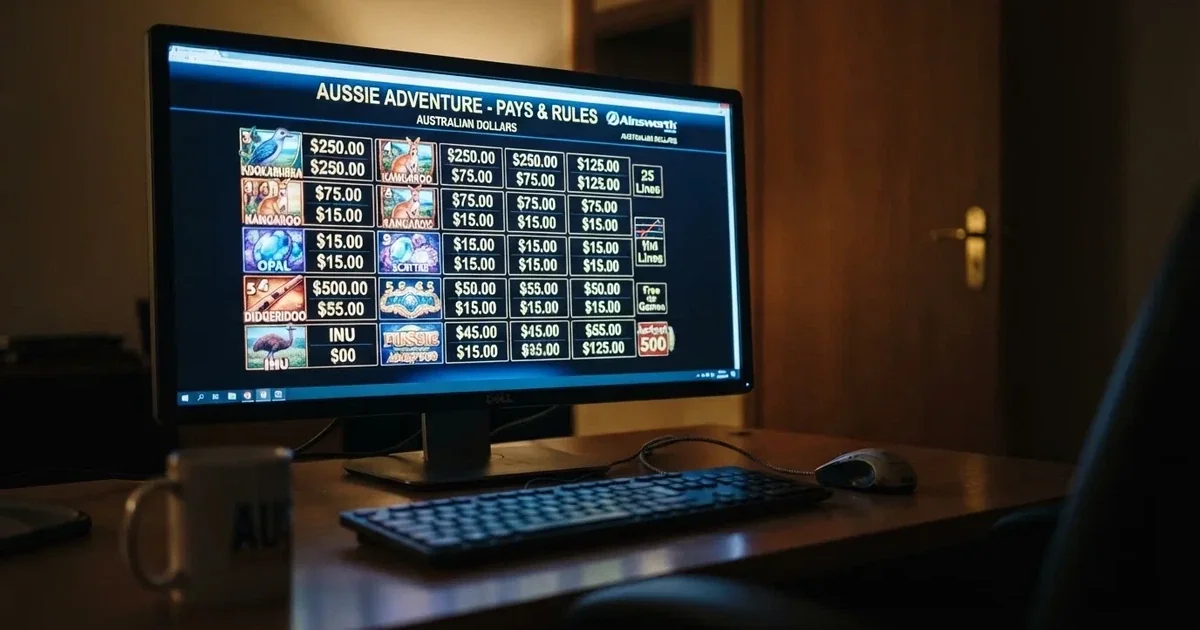
A 96% slot does not promise A$96 back for every A$100 a player wagers. It means that, were a million players to spin the reels millions of times each, the aggregate returned to them would land close to 96% of the aggregate they paid in. For a single player on a single afternoon, the realised return can be zero, or five times the deposit, or anything in between, because the variance on individual sessions overwhelms the expected value on any reasonable timescale. The arithmetic that produces 96% only stabilises when the sample is large enough that the law of large numbers actually bites.
This is the first thing the marketing language around “best RTP” obscures. Operators pitch high-RTP slots as if the percentage were a budget — spend A$100, get A$96 back — when it is, in fact, a long-run average that the casino uses to price its product. The percentage does the casino’s accounting work; it does none of the player’s.
Why every site offering these figures sits outside Australia
The Interactive Gambling Act 2001, tightened by the Interactive Gambling Amendment Act 2017, makes it an offence to provide online casino games, online pokies or in-play betting to a person physically in Australia. No state or territory licences online casino products. The licensable online categories are pre-event wagering on racing and sport, lotteries and keno — which is why the Northern Territory Racing and Wagering Commission regulates 52 online bookmakers including Sportsbet, Bet365 and Ladbrokes, although the commission itself operates with no full-time staff and meets once a month in Darwin.
An offshore slot site is, by definition, operating in breach of section of the IGA that prohibits the supply of an interactive gambling service to Australians. The ACMA’s response is investigative, not prosecutorial against the player: it issues formal warnings, accepts enforceable undertakings, and directs Australian internet service providers to block offending domains. Since the first blocking request in November 2019, a total of 1,751 illegal gambling and affiliate marketing websites have been blocked, with 12 more added in the round reported on 26 June 2026 — 7Signs, ChromaBet, Donbet, Duospin, Freshbet, Slots Gem, Jacks Club, Lucky Start, Pointsbetz.com, Spinrise, Vinyl Casino and Wildsino. More than 230 unlicensed services have left the Australian market since enforcement was strengthened in 2017. None of these numbers is a measure of how many Australians play offshore; it is a measure of how many sites the regulator has had to chase.
The individual player is not prosecuted. That is the most misunderstood part of the regime. The IGA targets the provider. What it does not do is give an Australian player any of the consumer protections that follow from a domestic licence: no local complaints body, no local dispute resolution, no recourse if a withdrawal stalls or a bonus term is read against the player. H2 Gambling Capital’s 2025 estimate puts Australian losses to illegal offshore gambling at around A$3.9 billion a year, and tracks the share of gambling flowing through legal channels falling from 74% in 2021 to 64% — a market that has shifted offshore while the licensed perimeter stayed where the IGA drew it.
Where the ACMA’s record actually points — and what it costs
The formal warnings below are the regulator’s own record, ordered as they appear on the ACMA’s publication page. Each one is an Australian authority naming an operator for offering prohibited services to Australians. That is the only “verdict” an Australian-facing reader can rely on.
RocketPlay — the operator the ACMA has warned twice
Two formal warnings now sit on RocketPlay’s file. The first, in May 2022, named Dama N.V. as the operator of RocketPlay alongside five other Dama brands — Bambet, Dazard, Level Up, Wild Tornado and Cobra Casinos. The second, in March 2026, named Pulsup Ltd as the operator of Rocketplay specifically. The operator name changed; the prohibited service did not. The ACMA’s formal warning records are the only reliable assessment of these brands. None of the subject-support entries provide evidence of a verifiable return-to-player pitch for Australian players, so comparing them on those terms is not possible.
Level Up Casino — Dama N.V., May 2022
Level Up sits in the same May 2022 warning as RocketPlay’s first entry, both naming Dama N.V. The brand does appear on one aggregator listing where research happened to surface it, which is the only specific support the subject of this page can point to for the brand. An aggregator listing is not an RTP commitment, and an aggregator is not the regulator the page defers to.
Woo Casino — Dama N.V., March 2025
Woo Casino attracted its own warning in March 2025 — three years after the original May 2022 Dama N.V. warning that covered the wider Dama portfolio. The pattern is the same operator group cycling through formal warnings as the ACMA reissues them. Research carries no specific subject support for the brand; the “best RTP slots” claim is, on this page, unsubstantiated for Woo.
Spirit Casino — Dama N.V., May 2025
Spirit Casino follows Woo Casino by two months. Again the operator is Dama N.V. The brand has no specific subject support in research. The only thing the page can say about Spirit is what the regulator has already said.
National Casino — Consolutetish S.R.L., July 2025
National Casino was named in a July 2025 warning alongside Bizzo Casino, with Consolutetish S.R.L. as the operator of both. Research surfaces the brand on Wikipedia’s gambling entry, which is a general-purpose mention rather than an RTP-focused listing. The ACMA’s warning is the operative fact.
Bizzo Casino — Consolutetish S.R.L., July 2025 (and earlier, TechSolutions, 2022)
Bizzo carries two warnings on its file. The 2022 warning named TechSolutions (CY) Group Limited and TechSolutions Group N.V. The 2025 warning named Consolutetish S.R.L. — meaning the operator changed hands, and the regulator had to repeat itself. Research carries no specific subject support for Bizzo. Two warnings for the same brand is the highest count among the eleven after RocketPlay.
Ignition Casino — Bamboo Media, July 2025
Ignition Casino’s warning came in July 2025, naming Bamboo Media as the operator. The brand has no specific subject support in research. Its product line is well-known to offshore players; its standing with the ACMA is what an Australian reader is looking at.
Instant Casino — EOD Code SRL, February 2025
Instant Casino was named in a February 2025 warning to EOD Code SRL. Research carries no specific subject support. EOD Code SRL also took a separate warning the same period for a separate brand; the ACMA’s register names each operator alongside the brands it operates.
Jackbit — Ryker B.V., April 2026
Jackbit was named in an April 2026 warning to Ryker B.V., alongside CasinOK. The two warnings together are the ACMA’s most recent monthly record in this dataset. Research carries no specific subject support for either brand.
Casino Intense — Sterplay Holding Ltd, April 2025
Casino Intense’s warning names Sterplay Holding Ltd and dates to April 2025. Research surfaces the brand across three reference sources — Australian news and regulatory records — which is the broadest subject support any brand on this list carries. None of those three is an RTP-specific listing; the support is general gambling-market context.
Sky Crown — Hollycorn N.V., September 2022
Sky Crown sits on the oldest warning in the dataset. The Hollycorn N.V. PDF on the ACMA’s site covers Sky Crown and Blue Leo together. Research carries no specific subject support for either brand.
How the ACMA’s blocking record has built up over time
Since the ACMA’s first blocking request in November 2019, 1,751 illegal gambling and affiliate marketing websites have been blocked, with the most recent published round adding 12 more on 26 June 2026. The years the ACMA spent building this number — November 2019 to June 2026, roughly 80 months — show the scale of the regulator’s work: an average blocking rate in the low-twenties per month across the whole period, with material variation from year to year and a long tail of affiliate marketing domains added alongside operator sites.
The exact monthly rate is a guide, because blocking happens in batches and the ACMA does not publish every batch as it lands. What the figure shows is the scale of the regulator’s workload and the size of the gap between Australian-licensed online products and the offshore market the ACMA chases. The blocking rate is a useful figure that summarises the enforcement picture, and it is the right metric to put beside the A$3.9 billion annual loss estimate H2 Gambling Capital records for the same period. The two figures belong together: an enforcement rate the regulator sustains in public, and a loss rate the same market sustains in private.
What onshore Australian players actually have access to for slot-style play
Online, nothing — no licensed online casino, no licensed online pokies, no licensed in-play betting. Onshore, slot-style gaming exists only as pokies-style electronic gaming machines in licensed venues: 87,298 in New South Wales as of June 2023, 26,380 in Victoria in 2021–22, 21,122 in Queensland in October 2023, 11,672 in South Australia in September 2023 and 3,587 in the ACT in November 2023. The national per-capita rate for gaming machines outside casinos sat at roughly five times that of the United States in 2010, when the country was operating an estimated 97,103 such machines.
These are not online slots. They are physical machines in clubs, hotels and casinos. Their RTP figures are governed by the state regulator under each venue’s licence conditions rather than by the operator’s marketing department. A player in NSW can ask the venue for the RTP figure on a specific machine; the answer comes from the regulator’s published approval, not from an offshore operator’s paytable page.
The numbers a player can read from the regulator rather than from the operator
The NSW Casino Control Act 1992, at section 66, requires a casino operator to make approved game rules available to patrons on request. The Victorian Gambling and Casino Control Commission — which replaced the VCGLR as Victoria’s casino regulator on 1 July 2022 — performs the same function for Crown Melbourne under the Casino Control Act 1991. The VGCCC’s public log of approved changes includes the renaming of Crown’s “Perfect Pairs” blackjack side bet to “Crown Pairs” on 23 December 2024, and the introduction of a “Free Bet” option with a new “Pot of Gold” side bet on 25 March 2024. The pattern here is small, regulator-approved rule changes published openly, the opposite of how an offshore operator handles its RTP disclosures.
This is what a player gets from an Australian-licensed venue that they do not get from any site on the table above: a regulator who has approved the game, a venue bound to make the rules available, and a complaints path that ends somewhere a domestic legal system can enforce. None of those three things follow from a Curaçao or Anjouan licence displayed by an offshore casino. The ACMA’s formal warnings are the regulator’s way of saying, in writing, that the offshore brand cannot supply any of them to an Australian customer.
Where the legal perimeter is moving in 2026
The Interactive Gambling Amendment (Gambling Reform) Bill 2026 passed Parliament on 19 August 2026, with its advertising and inducement measures set to commence on 1 January 2027. That is a law with a start date, not a law currently in force. What it means for an Australian reader of this page in 2026 is that the perimeter the ACMA enforces is going to get tighter, not looser, over the next reporting cycle. The blocking regime, the formal-warning regime, and the offshore payment bans already in place are the active instruments; the new advertising and inducement measures are the next ones to land.
Payment rules are already in force: credit cards, credit-related products and digital currency have been banned as payment for licensed online wagering since 11 June 2024, with penalties for operators of up to A$247,500. Legal deposit routes for licensed wagering are debit card, bank transfer, PayID, Osko and BPAY. An offshore slot site asking an Australian customer for a credit card or a crypto deposit is operating outside these rules in addition to the IGA breach that put it on the ACMA’s list in the first place. The two regulatory layers stack, and the offshore sites on this page sit outside both of them.
BetStop and the limits of self-exclusion offshore
BetStop, the National Self-Exclusion Register, has been live since August 2023. It binds Australian-licensed online and phone wagering services. An offshore casino is not connected to it. A player who has registered with BetStop is still able to deposit at every site in the table above, because the sites are not licensed in Australia and the register does not extend to them. The National Gambling Helpline — 1800 858 858, free, 24/7, with chat available at Gambling Help Online — is the route that does work regardless of whether a site is licensed, and it is the one consumer-protection mechanism that follows the player rather than the operator.
The reader-side economics of a “best RTP” pitch
The comparison of these sites involves ranking the slots by advertised percentage and choosing the highest figures. The issue with this approach is that every percentage on the list comes from a site the ACMA has already warned, and the percentage itself is merely the operator’s own claim. Independent testing exists — laboratories like eCOGRA, GLI and iTech Labs audit RNGs and publish payout reports — but the audited figure the laboratory signs off on is the long-run return of the game, not the return the operator pays out on any given day. The operator is free to configure the game within a range the lab has approved: a 96% slot and a 94% slot can carry the same brand name, with the regulator’s eye on the configuration as the only thing keeping the two apart.
For the Australian reader, the consequence of that range is straightforward: the figure the operator advertises is the most generous reading of the configuration, and the configuration itself is one the operator can change between jurisdictions. A slot that returns 96% in one market can be configured to return 94% in another, with the player’s only signal being a small-print note on the paytable page. Two slots with the same theme can carry different RTP figures for that reason, and the player’s only honest move is to read the paytable page for the specific jurisdiction they are playing from — a piece of advice that does not survive contact with an offshore operator who has no Australian jurisdiction to configure for.
Reading the “RTP” label as a budget item rather than a promise
A 96% slot, played long enough, costs the player 4% of turnover in expectation. A 94% slot costs 6%. On a A$1,000 monthly turnover, the difference is A$20 a month — small, but it compounds across years and across hundreds of spins. The expected-loss arithmetic is a useful calculation, though it is one that marketing copy never mentions: the player pays a fixed percentage of every dollar wagered to the house, on average, regardless of how the session plays out.
The comparison is the same in every venue category. With optimal strategy, blackjack’s house edge is about 0.28% under liberal Las Vegas Strip rules and about 0.43% under Atlantic City rules. Baccarat’s house edge is 1.06% on the Banker bet, 1.24% on the Player bet and 14.36% on the Tie. In craps, the Pass/Come bet carries a house edge of 1.41%, Don’t Pass/Don’t Come 1.36%, and Any Craps 11.11%. Slot-style play sits at the top of that range, which is the part the “best RTP” framing never mentions: the comparison is not “slot A versus slot B” but “slots versus every other game in the casino”. Slots are, by construction, the highest-edge product on the floor. The ranking this page provides is a comparison within the highest-margin category the operator offers.
Why the per-session promise is the wrong shape of the question
A slot’s RTP figure is a long-run average. The session-level experience is dominated by variance. A 96% slot played for an hour at A$1 per spin, around 720 spins, produces an expected loss of A$28.80 — but the standard deviation around that mean is large enough that the realised outcome can sit anywhere from a small win to a total loss of the entire bankroll. The longer the session runs, the closer the realised return drifts toward the advertised percentage. The shorter the session runs, the more the variance dominates. Most players will never run a session long enough for the law of large numbers to bite, which is why the RTP figure is more useful as a pricing signal for the operator than as a return forecast for the player.
What “long run” actually means for an Australian player
The mathematical long run is asymptotic: a slot’s return converges on its advertised percentage as the number of spins approaches infinity. For any practical number of spins a player will ever accumulate — even a serious player running thousands of spins a week — the realised return can sit several percentage points away from the advertised figure, in either direction. The page can state the figure; it cannot promise that any player’s experience will match it. That is the limit of the answer, and it is the part of the answer that “best RTP slots” marketing copy never carries.
Where this page stops being analysis and starts being arithmetic
The eleven operators in the table above are not a ranking by RTP. They are a record of brands the ACMA has named, in the order the warnings are published. Any claim that one of them offers a “better” RTP than another is, on the inputs available to this page, unsubstantiated: research carries no verified Australian-facing RTP figure for any brand on the list, and the only “subject support” entries are aggregator listings that are not RTP-specific.
For a player who wants a slot with a return-to-player figure they can rely on, the honest path runs through the licensed Australian venues where the figure is set by the regulator and the configuration is auditable. The offshore sites on this page are not that path. The ACMA’s record is the page’s reason for naming them at all.
The single fact that decides the comparison
Every site on the shortlist offers online casino games to Australians. The Interactive Gambling Act 2001 prohibits the supply of those games to Australians. The ACMA has issued a formal warning to each operator on the list for doing exactly that. The “best RTP” question is the wrong question to ask of operators in that position, because the comparison it prompts is one the operator cannot lawfully supply.
What a reader should do with the ACMA’s record
The eleven warnings are public. The ACMA publishes them on its own site, and the regulator’s register is the right place to check whether a brand has been the subject of a warning before depositing. The register also lists blocking requests, which is the record the ACMA updates most often — 12 new domains added in the round reported on 26 June 2026 alone, on top of the cumulative 1,751 since November 2019.
For a reader who has already deposited with one of the operators on this page, the practical points are: there is no Australian complaints body to approach, the balance is at the operator’s discretion, and BetStop does not extend to the site because the site is not Australian-licensed. The National Gambling Helpline at 1800 858 858 is the route that does work regardless of the site.
Frequently asked questions
How is a slot’s RTP percentage calculated over the long run?
RTP is calculated by simulating a very large number of spins — typically millions or tens of millions — and dividing the total value returned as winnings by the total value wagered across those spins. The result is expressed as a percentage, and it converges on a stable figure as the simulation grows. The figure published on an operator’s paytable page is the result of that simulation, not the result of any session a player will actually run.
Does a slot’s RTP figure guarantee any result over a single session?
No. The RTP figure is a long-run average across an effectively infinite number of spins. For any single session of any practical length, the realised return can sit well above or well below the advertised figure, because variance dominates the outcome on small samples. A 96% slot does not return A$96 on a A$100 session; it returns whatever the random number generator decides on those particular spins, with the average only stabilising across millions of plays.
Are RTP figures independently tested before a slot is released?
Independent testing laboratories — eCOGRA, GLI, iTech Labs among them — audit the random number generator and verify that the published RTP figure is achievable across a large simulated sample. The lab’s certification covers the game and the configuration the operator submits. Operators can configure the same game across a range the lab has approved, which is how a slot can carry different RTP figures in different markets without the brand name changing.
How many licensed gaming machines operate outside casinos in Queensland compared with New South Wales?
As at October 2023, Queensland operated 21,122 pokies-style gaming machines outside casinos. New South Wales operated 87,298 as at June 2023. The ratio is roughly one Queensland machine for every four NSW machines, which reflects the different licensing regimes the two states have run since NSW legalised slot machines in 1956.
Why do two slots with the same theme sometimes carry different RTP figures?
The same branded slot can be released in multiple configurations, with each configuration carrying a different RTP figure the lab has certified. Operators select a configuration per market, and the paytable page on the operator’s site states which configuration applies to that specific site. Two slots with the same theme and different RTP figures are usually the same underlying game running different configurations, and the player’s only reliable check is the paytable page for the site they are actually playing on.
Can a player request the RTP figure for a specific licensed pokies machine in Australia?
Yes. Under section 66 of the NSW Casino Control Act 1992, a casino operator must make approved game rules available on request, and the Victorian Gambling and Casino Control Commission performs the equivalent role for Crown Melbourne under the Casino Control Act 1991. A player at a licensed Australian venue can ask for the RTP figure on a specific machine and the venue is required to provide it. An offshore operator is under no equivalent obligation, and the figure on its paytable page is the operator’s claim rather than a regulator-approved disclosure.