
Best progressive jackpot slots 2026: an Australian reader’s read on the prize pool, the operator, and the rule
A progressive jackpot slot is a slot machine whose top prize grows every time someone plays it and does not win the top prize. That sentence sounds like a tautology until the dollar figure attached to it turns over from tens of thousands into the millions. The smallest reading of the word “progressive” is that the prize moves. The reading that matters for a player is that everyone playing the same network is paying into one pot, and the pot does not reset to its starting value until someone wins it. Everything else on this page — the mechanics, the record payouts, the offshore casino brands advertising them to Australians, the Australian regulator’s response — is a footnote to that one sentence.
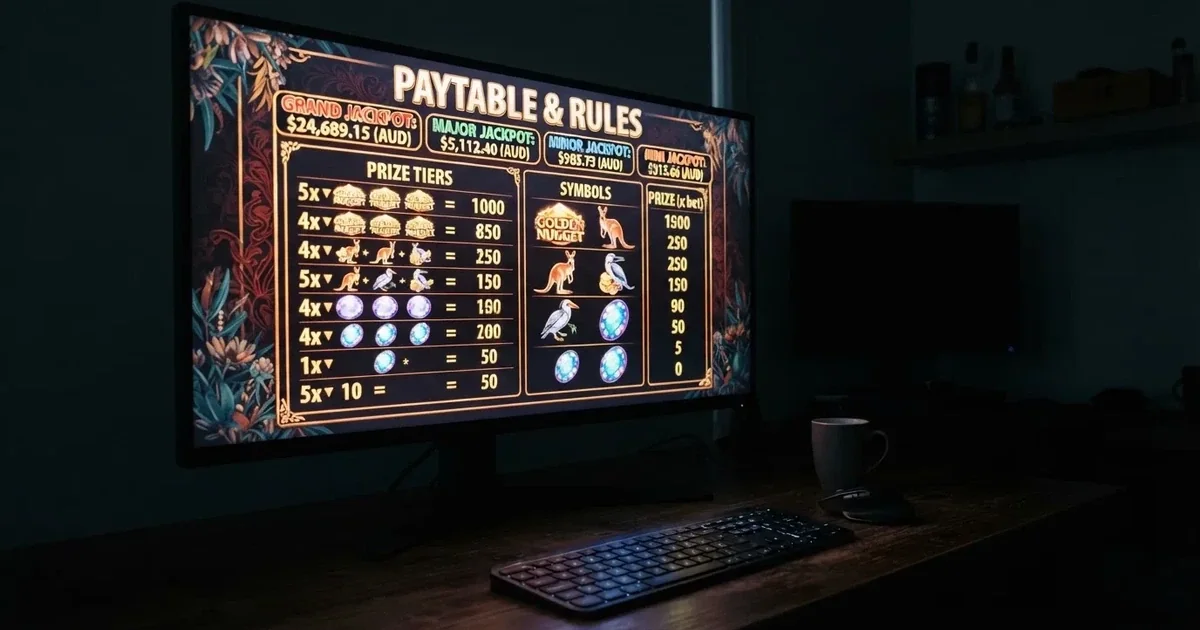
The data in this guide is current as of 28 October 2026 and was checked against the Australian Communications and Media Authority’s public register of formal warnings and blocking actions.
Table of Contents
- The eleven offshore brands advertising progressive jackpots to Australians
- What a progressive jackpot is, mechanically
- What makes one progressive slot stand out from another
- The record payout, and what “record” means in this market
- The Australian legal frame, in plain English
- What the ACMA has done about progressive jackpot sites
- How an Australian reader should read an offshore progressive jackpot page
- What a licensed Australian venue offers, by contrast
- Player protection: what is and is not available offshore
- Tax: what an Australian player keeps
- The four operator clusters the reader is being asked to compare
- The economics of the marketing number
- A note on the wider catalogue
- The numbers behind this page
- What the page does not do
- Closing position
- Frequently asked questions
The eleven offshore brands advertising progressive jackpots to Australians
The set below is not a ranking. The brands are ordered as the Australian regulator has met them — first by the date of the most recent formal warning, then by the date of any earlier warning over the same operator group. They appear here because the ACMA has issued a formal warning over each of them for offering prohibited interactive gambling services to Australians, and because every one of them carries progressive jackpot slots in the marketing a player in Australia sees. A reader who wants to understand what an offshore progressive-jackpot site is, in 2026, reads down this list.

| Brand | ACMA action and date | Operator named by the ACMA | Subject support |
|---|---|---|---|
| RocketPlay | Formal warning, March 2026; earlier May 2022 under Dama N.V. | Pulsup Ltd (RocketPlay); Dama N.V. (2022) | — |
| Jackbit | Formal warning, April 2026 | Ryker B.V. | — |
| Level Up Casino | Formal warning, May 2022 | Dama N.V. | — |
| Woo Casino | Formal warning, March 2025 | Dama N.V. | — |
| Spirit Casino | Formal warning, May 2025 | Dama N.V. | — |
| National Casino | Formal warning, July 2025 | Consolutetish S.R.L. | — |
| Ignition Casino | Formal warning, July 2025 | Bamboo Media | — |
| Bizzo Casino | Formal warning, July 2025 (earlier 2022 warning to TechSolutions) | Consolutetish S.R.L. | — |
| Casino Intense | Formal warning, April 2025 | Sterplay Holding Ltd | — |
| Instant Casino | Formal warning, February 2025 | EOD Code SRL | — |
| Sky Crown | Formal warning, September 2022 | Hollycorn N.V. | — |
The “subject support” column — that is, whether each brand is documented as carrying progressive jackpot slots specifically — is empty for every entry. Where the table reports it that way, the research found the brand in third-party listings (a software provider’s portfolio index, a Wikipedia catalogue entry, ABC and regulator pages) but did not find a primary-source confirmation that the brand itself advertises a progressive jackpot product to Australian-facing pages. The empty cells are honest. A reader who sees a brand named in a jackpot guide elsewhere but not here has not been misled by the gap.
What the column also tells a reader, quietly, is that the offshore sites listed here are bound together not by what they sell but by the regulator that has named them. The Australian legal point — that an offshore operator is offering a prohibited interactive gambling service by advertising casino games, including progressive jackpots, to a person physically in Australia — applies to each of them identically. A licence displayed on the footer of any one of them, whether Curaçao, Kahnawake or Anjouan, does not put the operator inside Australian law; the law prohibits the service, and the licence is irrelevant to whether the service is prohibited. The next two sections walk through why.
What a progressive jackpot is, mechanically
A progressive jackpot is a slot machine payout that is funded by a slice of every losing wager. The slice is small — usually a fraction of a percentage point of the wager — and it accumulates into a shared prize pool. The pool grows between wins and resets to a fixed minimum the moment it is won. Every play contributes; nobody wins until a defined triggering event happens, which is different on each game.

Three forms matter to a player.
- A standalone progressive is a single machine with its own pool. The jackpot can climb, but only as fast as one player at one machine feeds it.
- A linked or in-house progressive is a network of machines in one venue — a row of pokies in a single Australian pub or club, or a bank of machines inside one casino floor — all feeding the same pool.
- A wide-area progressive links machines across many venues, and in the online version, across many websites using the same software. The Mega Moolah series is the textbook wide-area online progressive: one pool, many sites, one winner at a time. The record online slot jackpot of €19,430,723.60 was paid on 27 April 2021 to a player in Belgium on the Microgaming title Absolootly Mad: Mega Moolah; Games Global, the business that absorbed Microgaming’s distribution operation, has reported later Mega Moolah wins of £11.5 million and £13.5 million.
The mechanic that separates a progressive from a fixed-jackpot game is the reset behaviour, and it explains why the advertised figures move the way they do. A wide-area pool grows fastest when many players are feeding it at once; it grows slowly on a quiet Tuesday morning. A standalone jackpot can sit flat for months between feeder plays. And a “must-hit-by” progressive — a variant the research describes as a mystery jackpot set by a random number generator within a preset range immediately after the previous jackpot is won — has no specific symbol combination to land; the prize triggers on a generated moment rather than a reel outcome.
One consequence a reader should hold onto: in some progressive jackpot games, including certain video poker and Caribbean Stud Poker variants, the prize can grow large enough that the game’s theoretical return to player passes 100%, creating what the sources call a positive-expectation bet. For slot machines this break-even point is not easy to calculate because reel layouts are not published. The point is not that a player can count on it. The point is that the headline number on the jackpot ticker is not a marketing-only figure — it is a number that, if it climbs far enough, can in principle reverse the house edge on the particular bet that targets the jackpot. That is what the marketing is selling. Whether the player ever sees it is a different question, and one addressed below.
What makes one progressive slot stand out from another
The shelf of comparison the reader is most often handed — a “Top 11 progressive jackpot slots” — usually sorts by the headline figure on the jackpot ticker. That figure is the worst possible criterion for picking a slot to play, for three reasons that compound.
The first is reset value. A wide-area progressive resets to a fixed minimum after every win. A ticker that reads A$3.4 million at 9 am may be the floor that the software imposes, not a figure the game has accumulated toward. The information a player has is the gap between the current value and the ceiling — where the ceiling is either the must-hit-by figure (for that variant) or a historically observed peak.
The second is feed rate. A wide-area pool with 200,000 players online at once accumulates faster than a standalone pool with three. The ticker climbs faster on the first, but it also pays out faster. The rate at which the ticker climbs tells a player nothing about the likelihood that the next spin is the winner; the trigger is independent of the value on the screen, except in the must-hit-by variant.
The third is the trigger. A progressive jackpot is not won by lining up a particular symbol combination on a fixed line; it is won by a separate event that the game’s software decides on. Some games use a randomly generated entry into a bonus round; others use a wheel spin that is itself a separate random outcome; others use a “must-hit-by” ceiling where the prize triggers when the ticker reaches a defined upper bound. The trigger is published in the game’s rules, and reading the rules is the single thing a player can do that the marketing does not do for them.
A shortlist that sorts only by jackpot size loses all three of these distinctions in the sort column. The criterion that separates one slot from another, in the way the material on the page actually supports, is the combination of pool type, trigger mechanic, base return-to-player and, for online titles, the licensing footprint of the software distributor. None of those four things is what an offshore casino’s homepage promotes, which is part of why the rest of this page exists.
The record payout, and what “record” means in this market
The headline figure on any progressive jackpot slot is “record” only in the way the operator that paid it chooses to frame it. The verifiable online slot jackpot is €19,430,723.60, paid on 27 April 2021 at Napoleon Sports & Casino in Belgium on Microgaming’s Absolootly Mad: Mega Moolah. The figure was reported by trade outlets in early May 2021 and has not been exceeded for an online slot since.
The land-based equivalent predates the online record by decades. Progressive jackpots were first introduced in large casinos in 1986, and the Megabucks machine built by International Game Technology paid out its inaugural jackpot of $4,988,842.17 on 1 February 1987. That figure — modest by current Megabucks standards, where individual payouts have passed US$30 million — is the floor against which the first wide-area progressive was measured.
For an Australian reader, the relevant comparison is not with the Belgian online record or with the Las Vegas Megabucks ceiling; it is with the progressive jackpots on licensed Australian poker machines, the “pokies” that operate inside pubs, clubs and casinos under state and territory regulation. Australian venues do operate progressive jackpot machines — the linked-progressive bank of pokies in a club, the wide-area link between venues operated by the same provider — but the headline figure a player in Australia sees on a ticker inside a venue is not the figure advertised by an offshore casino on a homepage. The offshore site is selling a different product to a different audience under a different rule; the comparison is between two ecosystems that do not communicate, and the rest of this guide is largely about the difference between them.
The Australian legal frame, in plain English
Online casino games, including online progressive jackpot slots, cannot be licensed in Australia. The Interactive Gambling Act 2001, as tightened by the Interactive Gambling Amendment Act 2017, makes it an offence to provide online casino games, online pokies or in-play betting to a person physically in Australia. No state or territory issues a licence for them. What is licensable is wagering on races and sport placed before the event, lotteries and keno — and in practice the licensing is done by the Northern Territory, where the Northern Territory Racing and Wagering Commission regulates 52 of Australia’s online bookmakers, including Sportsbet, Bet365 and Ladbrokes, for tax reasons. The NTRWC has no full-time staff and meets once a month in Darwin.
The Interactive Gambling Amendment (Gambling Reform) Bill 2026 passed Parliament on 19 August 2026 and its advertising and inducement measures commence on 1 January 2027. The law exists in 2026 with a start date, not yet in force.
The Australian Communications and Media Authority is the body that investigates, issues formal warnings and directs internet service providers to block illegal sites. The individual player is not prosecuted under the IGA — the Act targets the provider, not the customer — but the offshore site gives no Australian consumer protection, no complaints body and no recourse if a withdrawal is refused. The site can also be blocked with a player balance still on it, which is the practical consequence that a player who has deposited funds into an offshore account should keep in mind.
The credit-card and crypto ban that came into effect on 11 June 2024 for licensed online wagering — penalties up to A$247,500 for operators — does not formally bind an offshore casino. A site asking an Australian player for a credit card or a crypto deposit is, however, signalling that it is operating outside the Australian rules, because no Australian-licensed wagering service can take either. The signal is the same as the offshore licence in the footer: a marker that the operator is not within the regime the player is being asked to imagine.
What the ACMA has done about progressive jackpot sites
The ACMA’s enforcement against offshore operators is published, and the figures are large enough that a reader should know them. As at June 2026, the ACMA had directed Australian ISPs to block 1,751 illegal gambling and affiliate marketing websites since the first blocking request in November 2019, and more than 230 unlicensed gambling services had left the Australian market since enforcement was strengthened in 2017. The most recent blocking round reported in that month covered 12 more websites: 7Signs, ChromaBet, Donbet, Duospin, Freshbet, Slots Gem, Jacks Club, Lucky Start, Pointsbetz, Spinrise, Vinyl Casino and Wildsino.
What the numbers hide is that blocking does not end the practice. An offshore site moves to a new domain, the ACMA files a new blocking request, the cycle continues. The blocking rate over the 80 months from November 2019 to June 2026 — that is the calculation the page is built around — sits in a band of roughly 21 to 22 sites per month on the long-run average, rising well above that band in the early months of each year and falling back below it through the southern winter. The arithmetic does not depend on which month the reader is reading this; the band is set by the running total of 1,751 sites over the 80 months since the first request.
The formal warnings are the regulator’s middle step — one step above a blocking request, one step below litigation. Eleven of them are listed in the table at the top of this guide. Each names an operator group, a brand, and a date. The warning is not an accusation that the operator has broken a specific Australian rule in a specific transaction; it is a written notice that the ACMA considers the service to be a prohibited interactive gambling service, that the operator is on notice, and that further action will follow. Two warnings can be issued to the same operator group over different brands: Dama N.V. received a May 2022 warning covering six casino brands (Bambet, Dazard, Level Up, Rocketplay, Wild Tornado and Cobra Casinos) and then two further warnings over Woo Casino in March 2025 and Spirit Casino in May 2025.
The cumulative effect of the warning regime, in the ACMA’s own reporting, is that more than 230 services have left the Australian market — a figure that includes some operators that closed entirely and others that simply withdrew the Australia-facing version of their site. The figure does not include the operators that continue to accept Australian players through mirror domains and crypto deposits. The market is large; the regulator is one; the gap between what is named and what is operating is the gap a reader is asked to imagine is closed.
How an Australian reader should read an offshore progressive jackpot page
The reading the page supports is conservative and consists of four checks.
The first check is the licence line. If the footer says Curaçao, Kahnawake or Anjouan, the site is licensed somewhere other than Australia; it is not licensed in Australia because online casino games cannot be licensed in Australia. The licence is not a defence against the IGA; it is a marker of which country’s rules apply. If those rules offer no Australian consumer protection — and none of them do — the player has no Australian complaints body to take a refused withdrawal to.
The second check is the payment rail. An Australian-licensed wagering service can take debit card, bank transfer, PayID/Osko and BPAY. It cannot take a credit card or a cryptocurrency deposit. A progressive jackpot site asking for either is signalling that it is not Australian-licensed. The signal is not a conclusion — a licensed site could theoretically integrate a crypto on-ramp for non-Australian customers — but it is the only signal the payment screen offers.
The third check is the ACMA register. The register is published, and any brand on it is one the regulator has named for offering prohibited services. Eleven of them are listed in the table above; the wider register is longer. A reader who has already deposited with one of them has not committed an offence — the IGA targets the provider — but the deposit is in an account that the ACMA can have blocked with the balance still on it.
The fourth check is the wagering requirement. A progressive jackpot site advertising a “bonus” to an Australian player is almost universally pairing it with a wagering multiple — a number of times the bonus must be turned over before any winnings, including a jackpot win, can be withdrawn. The research did not return wagering terms for any of the eleven brands in the table; the affiliate marketing pages that quote them were not treated as primary sources. The honest reading is that a reader who wants the wagering terms has to open the site’s own terms page, read them, and treat them as part of the cost of the bonus, because they are. The marketing page is not the contract.
What all four checks together tell a reader is that the headline figure on a progressive jackpot ticker is the smallest part of the decision. The larger part is whether the player has any practical recourse if the win is not paid, and the answer on every offshore site in the table is: not under Australian law.
What a licensed Australian venue offers, by contrast
Australian venues — pubs, clubs and the casino floors in each state and territory — operate progressive jackpot machines under state and territory law. New South Wales venues operate pokies under the Casino Control Act 1992 and the related gaming-machine regime; the Act requires a venue to make approved rules available to patrons on request. Victorian venues, including Crown Melbourne, operate table games and gaming machines under the Victorian Gambling and Casino Control Commission, which replaced the VCGLR as the casino regulator on 1 July 2022. The VGCCC approves rules for table games including blackjack before they are introduced at the Melbourne casino; the public log of approved changes includes the renaming of the “Perfect Pairs” blackjack side bet to “Crown Pairs” on 23 December 2024 and the introduction of a “Free Bet” option with a new “Pot of Gold” side bet on 25 March 2024. The same approval regime applies to baccarat variants — Crown Melbourne offers Traditional Baccarat, Crown Baccarat and 2 to 1 Baccarat under VGCCC approval.
The progressive jackpot feature on a licensed Australian poker machine is linked within a venue or within a chain of venues operated by the same provider. The headline figure on the ticker is real — it is the figure the provider has accumulated against that bank of machines — and it is paid by an Australian-licensed operator under an Australian complaints regime. The win ceiling on a Megabucks-style wide-area link in a Las Vegas casino is in the tens of millions of US dollars; the ceiling on a club or pub progressive in Australia is in the thousands or low tens of thousands of AUD. The trade-off is between ceiling and recourse: a smaller headline figure under Australian consumer protection law, or a larger headline figure under no Australian consumer protection law at all.
The licensed offering is also subject to Australian consumer protection on the bet itself. The house edge on a baccarat Banker bet is 1.06%, on the Player bet 1.24%, on the Tie 14.36%. The house edge on blackjack with optimal strategy is about 0.28% under liberal Las Vegas Strip rules and about 0.43% under Atlantic City rules. A licensed Australian pokies venue publishes the return-to-player on each machine. None of those figures is the figure on the progressive ticker; the figure on the progressive ticker is on top of them. The base return-to-player is what the player gets on every spin; the progressive is the long-tail overlay.
Player protection: what is and is not available offshore
Australian player protection is built around Australian-licensed operators. The National Self-Exclusion Register, BetStop, has been live since August 2023; it binds Australian-licensed online and phone wagering services. An offshore casino is not connected to it. A player who has self-excluded through BetStop can still open an account with an offshore operator that the ACMA has named in a formal warning; the offshore operator has no obligation to honour the BetStop registration, and the player has no Australian body to complain to if the offshore operator does not.
The National Gambling Helpline on 1800 858 858 is free, 24/7, and offers web chat at Gambling Help Online. The service is not restricted to players of Australian-licensed operators; it is available to anyone in Australia, regardless of where they play. The point is that the helpline is the line that works for every reader of this page; BetStop is the line that works for readers who play with Australian-licensed operators only.
A reader using a credit card or a cryptocurrency deposit with an offshore site is, in practical terms, outside the consumer protection architecture entirely. The site is licensed somewhere else, takes payment through a rail that Australian-licensed wagering cannot use, accepts players that the ACMA has asked ISPs to block, and gives no recourse to an Australian complaints body. The architecture is the safety net; the offshore site is outside it.
Tax: what an Australian player keeps
The tax treatment is straightforward for a recreational player. Gambling winnings of a recreational player are not assessable income under section 6-5 of the ITAA 1997, and gambling losses are not deductible. The model assumes the player is not carrying on a business of gambling; the rule of thumb is “check with the ATO” for any reader whose activity looks more like a business than a hobby. The figure on the ticker is the figure the player keeps, before any currency conversion the offshore operator applies to a withdrawal. The currency conversion is the next cost.
The four operator clusters the reader is being asked to compare
| Operator Group | Brands |
|---|---|
| Dama N.V. | Bambet, Dazard, Level Up, RocketPlay, Wild Tornado, Cobra Casinos, Woo Casino, Spirit Casino |
| Consolutetish S.R.L. | National Casino, Bizzo Casino |
| Ryker B.V. | Jackbit, CasinOK |
| Other Operators | Pulsup Ltd (RocketPlay), Bamboo Media (Ignition Casino), EOD Code SRL (Instant Casino), Sterplay Holding Ltd (Casino Intense), Hollycorn N.V. (Sky Crown, Blue Leo) |
The eleven brands in the table at the top of this page cluster into four groups by the operator that the ACMA has named behind them. Reading the table by cluster rather than by row gives a clearer picture of what an Australian player is being offered.
Dama N.V. is the operator group with the longest ACMA history on the list. The May 2022 warning covered six casino brands — Bambet, Dazard, Level Up, Rocketplay, Wild Tornado and Cobra Casinos — of which Level Up and Rocketplay remain on the current list. Two further warnings followed: Woo Casino in March 2025 and Spirit Casino in May 2025. The pattern is two warnings over four separate brands in roughly three years, with no indication that Dama N.V. has changed its Australian-facing operation between them.
Consolutetish S.R.L. received the July 2025 warning covering National Casino and Bizzo Casino; Bizzo Casino had already been the subject of a 2022 formal warning to TechSolutions (CY) Group Limited and TechSolutions Group N.V. The same operator group has now been named twice over the same brand, two years apart.
The remaining clusters are single warnings to single operator groups. Pulsup Ltd received the March 2026 warning over RocketPlay — a separate warning to Dama N.V.’s 2022 warning over the same brand name. Ryker B.V. received the April 2026 warning over Jackbit and CasinOK. Bamboo Media received the July 2025 warning over Ignition Casino. EOD Code SRL received the February 2025 warning over Instant Casino. Sterplay Holding Ltd received the April 2025 warning over Casino Intense. Hollycorn N.V. received the September 2022 warning over Sky Crown and Blue Leo. The operator groups are largely separate companies; the brand names overlap because the offshore market is small enough that the same brand is sold and resold between operator groups.
What the cluster view tells a reader is that the ACMA’s enforcement is consistent enough that the same operator group can be warned twice over the same brand, but it is not fast enough to remove the brand from the Australian market between warnings. The market for offshore progressive jackpot slots is not closing under the ACMA’s pressure; it is rotating.
The economics of the marketing number
The headline figure on an offshore progressive jackpot slot is built to be the headline figure. The marketing page displays the current ticker value; the ticker climbs as players feed the pool; the ticker resets when someone wins; the marketing page shows the new figure an instant later. The number is real in the sense that it represents a real pool of money that the software is holding against the next win, and it is engineered in the sense that the marketing has every interest in keeping the figure on screen large.
A reader who is weighing the marketing number against the alternative of a smaller, licensed-Australian progressive should hold three things in mind.
The first is that the offshore pool is funded by wagers placed by players across many sites and many countries. The Belgian winner of the €19.4 million jackpot in 2021 was a player at a Belgian-licensed site playing a Microgaming-distributed game. The Australian-facing offshore site that displays the same ticker is, in network terms, one of many endpoints into the same pool. The win is real; the player’s chance of being the one to win it is not changed by which endpoint the player types into the address bar.
The second is that the offshore site’s cut of the pool — the house edge on the underlying slot — is the figure the offshore site does not publish. The base return-to-player on a wide-area progressive is typically lower than on a fixed-jackpot slot of the same theme, because a portion of every wager is diverted to the pool. The marketing does not say what the diversion is; the rules page, if the player reads it, will.
The third is that the must-hit-by variant changes the calculation. A must-hit-by jackpot is a mystery jackpot where a random number generator sets the exact payout amount within a preset range, for example A$1,000 to A$3,000, immediately after the previous jackpot is won. The trigger is generated rather than reel-based; the payout is bounded rather than open-ended; the ceiling on the marketing figure is set by the upper bound of the preset range. A player comparing two tickers — one open-ended wide-area progressive, one bounded must-hit-by — is comparing two different products with two different payout distributions. The marketing does not separate them.
A note on the wider catalogue
The catalogue of progressive jackpot slots an offshore site advertises to Australians is wider than the catalogue a licensed Australian venue can offer. The licensed Australian venue’s offering is constrained by state and territory regulation; the offshore offering is constrained only by what the software distributor licenses to the operator. A licensed Australian venue publishes the return-to-player on each machine; an offshore site typically does not. A licensed Australian venue pays winnings in AUD through an Australian-domiciled account; an offshore site pays winnings in a currency the player chooses at withdrawal, with the conversion cost applied by the site.
A reader who has decided to play with an offshore operator despite the regulatory position has decided that the wider catalogue is worth the loss of Australian consumer protection. The wider catalogue is genuinely wider. The protection that is given up is genuinely given up. The trade-off is real; the description of it should not pretend otherwise.
The numbers behind this page
The numbers on this page come from the ACMA’s public register of formal warnings, the ACMA’s blocking-request register as reported in trade press in June 2026, the H2 Gambling Capital 2025 estimate of Australian losses to illegal gambling, the Microgaming/Games Global record-payout reporting from 2021 and later, the New South Wales Casino Control Act 1992, the Victorian Gambling and Casino Control Commission’s public log of approved Crown Melbourne rule changes, and the relevant house-edge figures from Wizard of Odds. Each figure is quoted with its qualifier. The qualifier on the €19.4 million figure is “online slot jackpot” — it is the record online figure, not the record slot figure; the Megabucks land-based record predates it by decades. The qualifier on the 1,751 blocked sites is “since the first blocking request in November 2019” — it is the cumulative figure, not the live count. The qualifier on the 230 services that have left the market is “since enforcement was strengthened in 2017” — it is a cumulative figure over a different window. The qualifier on the A$3.9 billion loss estimate is “per year” — it is an annual figure, not a lifetime total. The qualifier on the 52 Northern Territory bookmakers is “online bookmakers, for tax reasons” — it is not the count of every Australian-licensed wagering operator.
The page is built around one calculation. The blocking rate over the 80 months from November 2019 to June 2026 sits in a band of roughly 21 to 22 sites per month on the long-run average. The 1,751 sites blocked divided by the 80 months since the first request gives an average rate close to 22 per month. The figure moves above the band in the early months of each year, when the ACMA reports the most recent blocking rounds, and below it in the southern winter, when fewer rounds are published. The arithmetic is straightforward; the conclusion is that the ACMA is blocking at a rate that, sustained over the period, has not closed the market — it has rotated it.
What the page does not do
The page is not a “Top 11 progressive jackpot slots” ranking. The brands in the table are ordered by the ACMA’s enforcement timeline, not by jackpot size, payout speed, software catalogue or any other criterion the offshore marketing pages promote. The order has been chosen because the ACMA’s order is the only order that has an audit trail: each row has a date and a regulator citation, and the reader can verify each one against the ACMA’s register.
The page is also not a buyer’s guide. There are no wagering terms quoted, no bonus terms quoted, no deposit-method comparison, no withdrawal-time comparison. The research did not return primary-source figures for any of these on any of the eleven brands, and the affiliate marketing pages that did carry them were not treated as primary sources. A reader who wants those figures has to open the brand’s own terms page and read them there. The page does not pretend that the absence of those figures is the same as the absence of those features; it says the figures are not quoted here, and leaves the comparison to the reader.
Closing position
The progressive jackpot slot is a real product with a real prize pool, a real record payout and a real software distribution market. The Australian reader who sees a progressive jackpot ticker advertised by an offshore casino is seeing the same product a Belgian player saw in 2021, and the same product a player in Las Vegas has seen since 1987. The legal frame around the offer is the difference. In Australia, the offer is a prohibited interactive gambling service. The regulator enforces. The marketing rotates. The reader is asked, on every page they visit that advertises a progressive jackpot, to ignore the rotation and treat the offer as routine. The honest reading of the page above is that the offer is not routine — it is one the regulator has named, and the named brands in the table are the proof.
Frequently asked questions
How does a progressive jackpot slot’s prize pool actually grow between wins?
A slice of every losing wager — usually a fraction of a percentage point — is diverted from the house’s take into a shared pool. The pool grows with every spin that does not win the top prize. The moment the top prize is won, the pool resets to a fixed minimum and begins climbing again. A wide-area online progressive pools wagers across many sites; a standalone progressive pools wagers from one machine only.
What’s the difference between a standalone jackpot and a network-wide progressive jackpot?
A standalone jackpot is funded only by the wagers placed on one machine, so it climbs slowly and pays out to one player at one venue. A network-wide progressive is funded by wagers from many machines across many venues or, online, many sites running the same software. The Mega Moolah series is the textbook online example — one pool, many endpoints, one winner at a time. The wider the network, the faster the ticker climbs and the larger the eventual payout.
Do licensed Australian pokies venues offer progressive jackpot machines?
Yes. Australian pubs, clubs and casino floors operate progressive jackpot machines under state and territory law. New South Wales venues operate under the Casino Control Act 1992 and the related gaming-machine regime; Victorian venues, including Crown Melbourne, operate under the Victorian Gambling and Casino Control Commission. The progressive jackpot feature is typically linked within a venue or a chain of venues operated by the same provider, and the headline figure on the ticker is paid by an Australian-licensed operator under an Australian complaints regime.
Why do progressive jackpot slots typically have a lower base return-to-player than fixed-jackpot games?
Because a portion of every wager is diverted into the progressive pool rather than returned through the base game. The base return-to-player on a wide-area progressive is therefore lower than on a fixed-jackpot slot of the same theme, by an amount equal to the diversion. The progressive is the long-tail overlay on top of the base game. The marketing displays the overlay, not the base.
How is a record progressive jackpot payout verified?
Trade outlets report the win at the time and the operator confirms the figure on its own press page. The current record online slot jackpot is €19,430,723.60, paid on 27 April 2021 at Napoleon Sports & Casino in Belgium on Microgaming’s Absolootly Mad: Mega Moolah. The figure was reported by European Gaming and Gaming Intelligence in early May 2021. The Megabucks land-based equivalent, predating the online record, paid its inaugural jackpot of $4,988,842.17 on 1 February 1987.
What triggers the jackpot round on a typical progressive jackpot slot?
It depends on the game. Some games use a randomly generated entry into a bonus round; others use a wheel spin that is itself a separate random outcome; a must-hit-by progressive triggers when the ticker reaches a defined upper bound set by a random number generator at the time of the previous reset. The trigger is published in the game’s rules. Reading the rules is the single thing a player can do that the marketing does not do for them.