
Best Australian Pokies Online in 2026 — Why There Is No Licensed List
The honest answer to this search is shorter than the page it sits on: there is no licensed category called “Australian pokies online,” because online casino games and online pokies cannot be licensed for anyone in Australia. The Interactive Gambling Act 2001, tightened by amendments in 2017, makes the supply of those games to a person physically in Australia a criminal offence. No state or territory issues a licence for them. Every site that markets itself under that phrase operates offshore, outside Australian consumer protection, and has been the subject of formal warnings from the regulator. This page sets out what that means in practice — what the Australian Communications and Media Authority (ACMA) has actually done, how offshore pokies sites present themselves, and what a player in Australia can and cannot do with money and recourse.
Current as of 28 October 2026. Licence claims, blocking actions and operator names cross-checked against the ACMA’s own enforcement notices.
Table of Contents
- Sign-Up Bonuses and Free Spins on Online Pokies — What the Marketing Actually Costs
- Mobile Pokies and Apps — The Browser Is Usually the Whole Story
- Specific Games and Providers — How a Paytable Reads
- Minimum RTP by Jurisdiction
- Landscape of ACMA-Warned Operators
- How Big the Blocked Market Is — and What It Costs Players
- What the Law Actually Says — and What the NTRWC Does
- Where a Player Gets Help
- Payments on Offshore Pokies Sites — PayID, Withdrawals and What They Actually Mean
- What a Reader Comparing Options Actually Has to Work With
- Frequently Asked Questions
Sign-Up Bonuses and Free Spins on Online Pokies — What the Marketing Actually Costs
A “welcome bonus” on an offshore pokies site usually means a matched deposit plus a batch of free spins, with a wagering requirement attached. The headline number — say, “100% up to A$500” — is the smallest part of the deal. The wagering multiple, the maximum cashout from a free-spin win, the eligible games list, and the time limit all sit behind it. Each one trims the value of the offer in a way the homepage does not show.

The wagering multiple is the figure to read first. A 35x bonus figure means a player must turn over thirty-five times the bonus amount before any of it can be withdrawn; a 50x figure is steeper; some sites run higher. The free-spin component usually carries its own ceiling — a cap on what those spins can ever produce, often far below the headline coin value. A “free” spin is rarely free of a wagering requirement on the resulting win, and the game on which it is usable is often a single title the operator chooses.
For online pokies play in Australia specifically, the bonus exists in a regulatory vacuum. The ACMA does not enforce fair bonus terms on offshore sites, because those sites are not licensed here. A player who disputes a bonus term has no Australian complaints body to take it to. The site’s own terms page is the entire contract. Reading it before depositing is not a nicety; it is the only protection the offer carries.
A qualitative rule of thumb holds across this market: if a bonus looks generous, one of three things is usually true — the wagering multiple is high, the eligible-games list is short, or the time window to clear it is tight. Offshore pokies sites do not differ on this from one another in any meaningful way.
Mobile Pokies and Apps — The Browser Is Usually the Whole Story
A mobile pokies “app” in this market is, almost without exception, a mobile browser version of an offshore site, sometimes wrapped in a thin native shell that adds nothing the browser does not already do. No Australian app store stocks a licensed real-money online pokies app, because the product itself is prohibited.

What a mobile browser version generally offers: a vertical layout sized for the phone, touch-optimised reels, deposit and withdrawal flows running through the same payment methods the desktop site accepts, and push notifications in the wrapped version only. What it does not offer is offline play, biometric login beyond what the phone itself provides, or any guarantee that a balance survives a phone change. Balance and account state live on the operator’s server, not on the device — clearing the browser cache or reinstalling the wrapper does not lose the account, but it does not recover a balance that a regulator’s blocking action has frozen on the operator’s end.
The practical advice is structural rather than brand-specific: install nothing from an offshore pokies site’s own download prompt, because those prompts are a known vector for unwanted software. A phone’s built-in browser, pointed at the site, is what most players who use these services at all actually use. The trade-off is convenience — a wrapper remembers the URL, the wrapper sends alerts — for a small but real device-integrity risk.
Specific Games and Providers — How a Paytable Reads
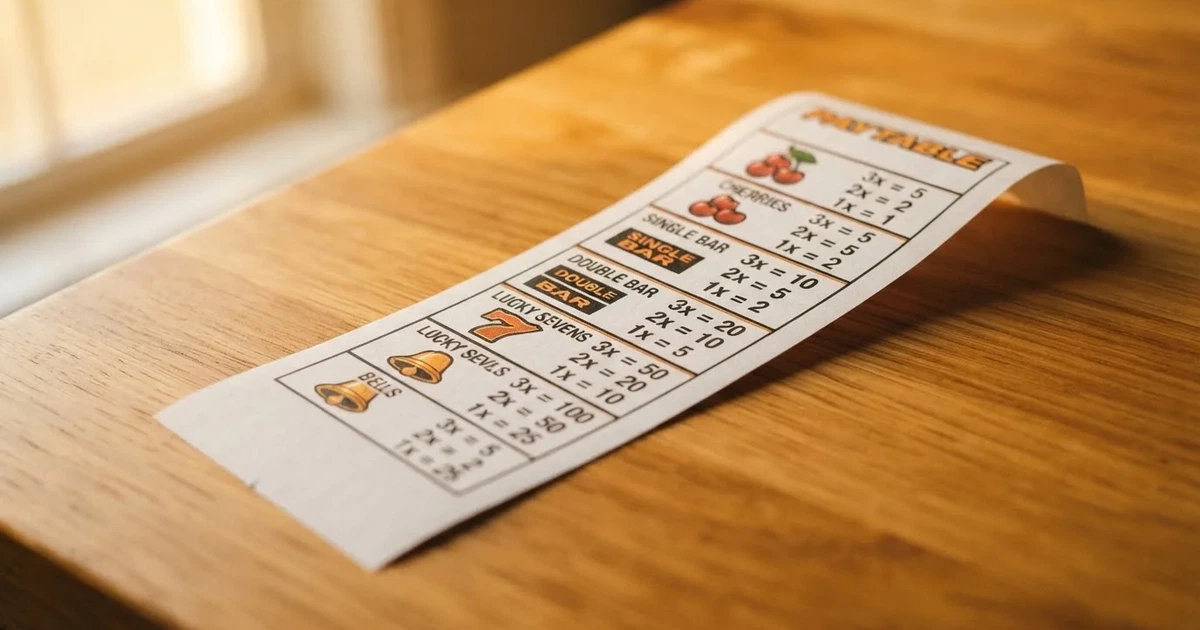
A pokies paytable, regardless of which studio builds it, breaks down into three layers a player should know how to read.
The first layer is the symbol hierarchy. High-paying symbols are usually themed — character icons, branded items, premium visuals — and pay the most for a five-of-a-kind line. Low-paying symbols are typically playing-card ranks: ace, king, queen, jack, ten, nine. A standard five-reel game pays left to right on adjacent reels from the leftmost, and a payline is a fixed pattern across the reels that the game has already chosen. Reading the paytable means knowing which patterns count.
The second layer is the special-symbol set. A wild substitutes for other symbols to complete a line; a scatter usually pays anywhere on the reels regardless of adjacency and is the trigger for the free-spins round; a bonus symbol opens a feature game. The paytable states how many scatters trigger how many free spins, and what multiplier — if any — applies during the free-spin round.
The third layer is the return-to-player (RTP) figure and the volatility class. RTP is the long-run percentage of money wagered that the game returns to players, expressed over millions of simulated spins. A 95% RTP means the house keeps 5% on average. Volatility describes the shape of the payout distribution: a low-volatility game pays small amounts often, a high-volatility game pays rarely and large. Neither figure predicts any individual session.
Minimum RTP by Jurisdiction
The legal minimum return-to-player (RTP) for poker machines varies by Australian jurisdiction. These figures are statutory floors set by the relevant regulatory bodies.
| Jurisdiction | Minimum RTP |
|---|---|
| New South Wales | 85% |
| Northern Territory | 85% |
| Queensland | 85% |
| Victoria | 85% (87% at Crown Melbourne) |
| ACT | 87% |
| Tasmania | 87% |
| South Australia | 87.5% |
| Western Australia | 90% |
Landscape of ACMA-Warned Operators
What follows is not a ranking and not a recommendation. Each brand is listed because the ACMA itself issued a formal warning to its operator for offering prohibited online gambling services to people in Australia. The brand itself is not adjudicated as good or bad — the regulatory fact is. The order is the order of the warnings as the ACMA published them.
| Brand | ACMA action and date | Operator named by the ACMA | Subject support |
|---|---|---|---|
| RocketPlay | Formal warning, March 2026 | Pulsup Ltd (Rocketplay) | — |
| Level Up Casino | Formal warning, May 2022 | Dama N.V. | Listed as operator on Bgaming |
| Woo Casino | Formal warning, March 2025 | Dama N.V. | — |
| Spirit Casino | Formal warning, May 2025 | Dama N.V. | — |
| National Casino | Formal warning, July 2025 | Consolutetish S.R.L. | Mentioned in en.wikipedia.org coverage of gambling in Australia |
| Bizzo Casino | Formal warning, July 2025; earlier 2022 | Consolutetish S.R.L. (2025); TechSolutions (2022) | — |
| Ignition Casino | Formal warning, July 2025 | Bamboo Media | — |
| Instant Casino | Formal warning, February 2025 | EOD Code SRL | — |
| Jackbit | Formal warning, April 2026 | Ryker B.V. | — |
| Casino Intense | Formal warning, April 2025 | Sterplay Holding Ltd | Referenced in coverage by the ABC, acma.gov.au and Crown Melbourne |
| Sky Crown | Formal warning, September 2022 | Hollycorn N.V. | — |
Several names cluster around the same operator: Dama N.V. sits behind RocketPlay, Level Up, Woo and Spirit, with the 2022 warning covering six brands at once and follow-up warnings in 2025 covering two more. The 2025 warnings to National Casino and Bizzo were both issued to Consolutetish S.R.L., and Bizzo had already been warned under a different corporate entity in 2022 — which is the pattern the ACMA has flagged repeatedly: a brand changes hands, sometimes within the same corporate family, and the new entity is the new target. The regulator’s enforcement follows the corporate shell, not the brand name on the homepage.
For the player, the corporate detail matters because a dispute, when one arises, follows the same trail. A complaint addressed to “Woo Casino” lands at a customer-service inbox; a complaint addressed to “Dama N.V., the entity named in the ACMA’s March 2025 formal warning” lands in a different place, and is the entity against which any future enforcement action would be brought. The brand on the page is not the legal counterparty.
The verdict on each is the same shape: a site the regulator has formally warned is operating outside Australian law, and carries none of the consumer protection that licence status would provide. That is the entire verdict the comparison allows. Ranking them against one another on game library, payment speed or bonus generosity would be a different exercise — and one for which this page carries no data.
How Big the Blocked Market Is — and What It Costs Players
The ACMA, in a round reported on 26 June 2026, asked Australian internet service providers to block a further twelve illegal gambling websites: 7Signs, ChromaBet, Donbet, Duospin, Freshbet, Slots Gem, Jacks Club, Lucky Start, Pointsbet, Spinrise, Vinyl Casino and Wildsino. Each round names a new list, but the cumulative figure is the one that puts the scale in view: since the first blocking request in November 2019, 1,751 illegal gambling and affiliate marketing websites have been blocked. More than 230 unlicensed gambling services have left the Australian market since enforcement was strengthened in 2017.
That figure translates into money the regulator’s own data does not measure, but H2 Gambling Capital’s 2025 report estimates: Australians lose about A$3.9 billion a year to illegal gambling sites. The share of gambling going through legal channels fell from 74% in 2021 to 64% — a ten-point drop over four years, and a measure of how much play has moved offshore rather than disappeared.
The blocking rate, taken over the period from November 2019 to the June 2026 round, runs at roughly 263 sites blocked per year on average — a band rather than a single figure, because the monthly cadence varies and the year-on-year rate has accelerated as the ACMA has expanded its enforcement footprint. The condition that holds the band together is the regulator’s own prioritisation: a site actively marketed to Australians and named in a complaint-driven investigation gets faster action than a dormant domain.
Two consequences follow. First, a site that was reachable last month can be unreachable this month, and a balance left in an account on a site that has just been blocked is, in practical terms, frozen — there is no Australian complaints body to compel a payout. Second, the sheer number of sites the regulator has acted against means the “best” site, on any consumer-comparison criteria, is a moving target: the next blocking round will name names that this page cannot predict, and the operator behind any one of them may simply rebrand and reopen under a new domain. The list above is the list as the ACMA has published it; it is not the list as the market stands today.
What the Law Actually Says — and What the NTRWC Does
The Interactive Gambling Act 2001 (IGA), as amended by the Interactive Gambling Amendment Act 2017, makes it an offence to provide online casino games, online pokies, or in-play betting to a person in Australia. The offence sits with the provider — the operator running the site — not with the individual player. A player in Australia is not prosecuted for placing a bet on an offshore site; the operator is the target. What the player loses, by going offshore, is not legal exposure but consumer protection: no Australian complaints body, no Australian recourse on a refused withdrawal, and no guarantee a balance survives a blocking order.
What is licensed in Australia is wagering on racing and sport, provided the bet is placed before the event starts; lotteries; and keno. Online wagering is regulated federally, but the licences themselves are issued by states and territories. The Northern Territory Racing and Wagering Commission (NTRWC) holds fifty-two of those licences, including the country’s largest online bookmakers — Sportsbet, Bet365 and Ladbrokes among them. The commission has no full-time staff and meets once a month in Darwin. The NT licences exist primarily for tax reasons: a bookmaker incorporated in the Territory pays Territory duty, not state duty in the state where the customer sits. That arrangement is the subject of an NT reform bill reported in April 2026, but the underlying structure — a small Territory regulator licensing national operators — is what the licensed side of the market currently runs on.
The minimum age to gamble on any licensed Australian product is eighteen. Credit cards and credit-related products have been banned as a deposit method for licensed online wagering since 11 June 2024, with penalties of up to A$247,500 for operators who take them; digital currency is banned under the same rule. The legal deposit routes for a licensed wagering account are debit card, bank transfer, PayID/Osko and BPAY. A site that asks an Australian player for a credit card or a crypto deposit is, by definition, not a licensed Australian wagering site. It may still be a real-money gambling site, but it is not one the Australian rules reach.
The 2026 reform package — the Interactive Gambling Amendment (Gambling Reform) Bill 2026 — passed Parliament on 19 August 2026. Its advertising and inducement measures commence on 1 January 2027: law with a start date, not yet in force on a page written for this year. The bill tightens the rules around how licensed wagering operators can advertise and offer inducements; it does not open any new category of licensed online casino product.
Where a Player Gets Help
Two services matter here, and they are not the same.
The first is the National Gambling Helpline — 1800 858 858, free, twenty-four hours a day — with web chat through Gambling Help Online. It is a counselling service, not a regulator; what it offers is confidential support for anyone whose gambling has started to feel compulsive or out of control. It does not matter whether the gambling is on a licensed product or an offshore one, and the service does not report callers to any authority. If the question is “is this becoming a problem,” that is the number to call.
The second is BetStop, the National Self-Exclusion Register, live since August 2023. Registering with BetStop binds every Australian-licensed online and phone wagering operator to refuse the registered person’s account for a minimum period. It is an effective tool against the licensed side of the market. It is not a tool against the offshore side: an offshore casino is not connected to BetStop, has no obligation to honour the exclusion, and is not under the regulator that maintains the register. Self-exclusion is a strong measure on a licensed product and a partial measure elsewhere.
The harm-minimisation framework that operates on licensed Australian pokies in pubs and clubs is far more developed than anything available offshore. Tasmania planned nation-leading mandatory pre-commitment cards for its poker machines; implementation of the reform was delayed until late 2025, but the design — a card that tracks spend in real time and enforces a player’s pre-set limit — sits at the leading edge of what any jurisdiction has attempted. Western Australia banned poker machines in pubs and clubs entirely when Crown Perth opened in 1985; Crown Perth’s own machine count has since grown from about two hundred in 1985 to roughly two and a half thousand, all approved by the state’s Gaming and Wagering Commission. New South Wales had 87,298 gaming machines outside casinos across 2,195 venues as of June 2023, with player losses of A$8.18 billion in 2022–23. None of that framework — pre-commitment, machine-level limits, venue-level harm-minimisation — reaches an offshore online pokies site. The licensed venue carries the regulation; the offshore site carries none of it.
Payments on Offshore Pokies Sites — PayID, Withdrawals and What They Actually Mean
For online pokies play in Australia, the money side of the page is informational rather than actionable: there is no licensed local product to deposit into, so no PayID deposit is, strictly, a PayID deposit into a licensed Australian wagering account.
What offshore pokies sites generally offer is a payment-method menu that includes — depending on the site — Visa and Mastercard (sometimes blocked at the Australian bank level rather than at the site), bank transfer, a handful of e-wallets, and crypto. PayID as a method is less common offshore than the marketing suggests; what appears as “PayID” on an offshore cashier is usually an Osko transfer to a personal or business account name that has no visible connection to the operator’s corporate entity. The player is paying a recipient whose only identification is a display name, not a regulated Australian financial-services provider.
Withdrawal speed is the figure the offshore market competes on, and it is the figure that varies most. E-wallet withdrawals are typically quoted at under twenty-four hours; bank transfers run from one to five business days; crypto withdrawals can be faster but introduce the conversion cost and the volatility risk. What is rarely quoted is the failure rate: the share of withdrawal requests that are reversed, paused for “verification,” or simply not paid. The Australian player has no recourse when a withdrawal is refused, which makes the quoted speed less informative than it looks — speed is measured on the requests that succeed.
The credit-card ban on licensed wagering has had a side effect on the offshore market: it has driven some Australian players to use credit cards on offshore sites, where the ban does not apply. That use is not illegal for the player, but it removes the chargeback mechanism that a credit card would otherwise offer on a domestic transaction, and the bank’s fraud department is the only line of defence left.
The reader-side rule: if a deposit method on an offshore pokies site is one the Australian rules ban on licensed wagering — credit card, crypto — that is a signal of which side of the regulatory line the operator sits on, not a convenience.
What a Reader Comparing Options Actually Has to Work With
This page closes on a comparison that is shorter than most pages on this subject, because the comparison the search asked for does not exist as a licensed product. There is no ranked list of Australian-licensed online pokies sites, because the product is prohibited. There is no consumer-comparison body that ranks offshore sites against one another on fairness, payout reliability or game integrity, because those sites are not under Australian jurisdiction.
What does exist is a record of regulatory action: the ACMA’s formal warnings, the blocking requests to ISPs, and the public list of operators the regulator has named. Those are not a consumer guide — they are an enforcement log — but for a reader in Australia, they are the closest equivalent to a vetted list of who is operating in this space. The list of eleven brands above is drawn directly from that log. The verdict on each is structural, not comparative: a brand the ACMA has warned is offering a prohibited service to Australians, and carries none of the protections that a licensed Australian wagering operator carries.
For a player who wants to gamble in a regulated environment, the licensed alternatives are wagering on racing and sport, lotteries and keno, and the poker machines inside licensed pubs, clubs and casinos — all of which sit under Australian state and territory regulators, all of which carry the consumer-protection framework the offshore market does not. The pokies inside a Crown Melbourne or Crown Perth carry statutory minimum RTPs set by the state; the machines in a NSW club carry an 85% floor; the machines in a Western Australia venue do not exist at all, by design. The trade is between a regulated product that may not be the product the reader searched for, and an unregulated product that matches the search and operates outside Australian law.
That is the honest picture, and the page ends on it.
Frequently Asked Questions
Is “Australian pokies online” a licensed category recognised by any state regulator?
No. No state or territory in Australia issues a licence for online casino games or online pokies. The Interactive Gambling Act 2001, as amended in 2017, prohibits the supply of those games to anyone in Australia. Sites marketing themselves under that phrase operate offshore, outside Australian consumer protection law.
Is there a legal Australian online pokies app, as opposed to a mobile browser site?
No licensed real-money online pokies app exists in any Australian app store, because the product is prohibited. What appears as an “app” on an offshore site is usually a mobile browser version, sometimes wrapped in a thin native shell. No statutory protection applies to it beyond what the phone’s own security provides.
What’s the difference between “Australian pokies online” and pokies in an Australian venue?
Online pokies are prohibited under federal law and cannot be licensed anywhere in Australia. Land-based pokies in pubs, clubs and casinos are licensed and regulated state by state, with statutory minimum return-to-player figures ranging from 85% in NSW, the NT and Queensland to 90% in Western Australia. The two products sit on opposite sides of the regulatory line.
Do sign-up bonuses on “Australian pokies online” sites come from a local operator?
No. The sites are operated by offshore corporate entities — Dama N.V., Consolutetish S.R.L., Hollycorn N.V. and others — none of which is licensed in Australia. The ACMA has issued formal warnings to several of those operators for offering prohibited services to Australians. No Australian regulator enforces the bonus terms attached to those offers.
Can a PayID-friendly “Australian pokies online” site still be operating from offshore?
Yes. PayID as displayed on an offshore cashier is usually an Osko transfer to a recipient whose display name has no visible connection to the operator’s corporate entity. The payment method is Australian; the operator is not. The credit-card ban that applies to licensed Australian wagering since 11 June 2024 does not extend to offshore sites, which is one of the signals of which side of the regulatory line an operator sits on.
Does the word “Australian” in a pokies site’s name indicate its actual licensing jurisdiction?
No. “Australian” in the brand name is a marketing choice, not a regulatory statement. The ACMA’s enforcement log shows multiple brands with “Australian” or Australian-sounding names whose operators are incorporated in Curaçao, Cyprus or other offshore jurisdictions. The licensing jurisdiction is the corporate entity named in the site’s terms, not the word in the homepage header.