
Best aussie pokies online Australia 2026: a market the Interactive Gambling Act does not licence
The honest answer to whether there are licensed Aussie pokies online in Australia 2026 is simpler than marketing suggests: there is no such list. Under the Interactive Gambling Act 2001 (the IGA), no company may legally offer online pokies, online casino games or in-play betting to a person physically in Australia, and no state or territory issues a licence for them. The product the topic asks about does not exist in a lawful onshore form. Everything branded “Aussie pokies” online is offshore, unlicensed for the Australian market, and either already on a block list or working its way onto one. This page maps what that means in practice — what is licensed, what the regulator has acted against, and what it costs a punter to play on sites that are not.
Data current as of 28 October 2026, checked against the ACMA’s published blocking round on 26 June 2026 and its register of formal warnings.
Table of Contents
- What “Aussie pokies” usually means in marketing — and what it means in law
- Why no fair ranking of the best Australian online pokies sites can exist
- How Australian banking treats the payments question
- The state of legal play — pub, club and casino machines, and where online does not fit
- Responsible gambling — what the Australian system actually provides
- The eleven operators the ACMA has warned — and what that warning means
- A comparison the page can fairly make
- The 2026 reform that changes the inducement picture
- What the licence at the bottom of an offshore site does — and does not — mean
- Frequently asked questions
What “Aussie pokies” usually means in marketing — and what it means in law
The word “pokies” is Australian English shorthand for poker-style gaming machines — the spinning-reel video terminals that sit in pubs, clubs and casinos from Perth to Hobart. Those machines are legal, state-licensed and very widely used. New South Wales alone had 87,298 of them outside casinos spread across 2,195 venues in June 2023, with player losses of A$8.18 billion in 2022-23, and Queensland ran 21,122 machines in 351 venues by October 2023; Victoria capped its non-Crown count at 30,000 with 26,380 in service during 2021-22.
The online version of those machines is a different legal animal. The Interactive Gambling Act 2001, tightened by the Interactive Gambling Amendment Act 2017, makes it an offence to provide online casino games, online pokies or in-play betting to a person in Australia; the law targets the provider, not the individual player. What the IGA does license is wagering on races and sport placed before the event, lotteries and keno, which in practice is run by bookmakers licensed in the Northern Territory.

Marketing sidesteps that distinction by gluing the word “Aussie” onto an offshore product. The site may have an “.com.au” domain, may accept Australian dollars, may advertise “Aussie-themed” titles — none of that changes the legal status. The licence on the footer of such a site is usually Curaçao or Anjouan, which is a licence to operate a server, not a licence to take bets from Australians.
The paytable and the catalogue — what an online pokies site actually shows
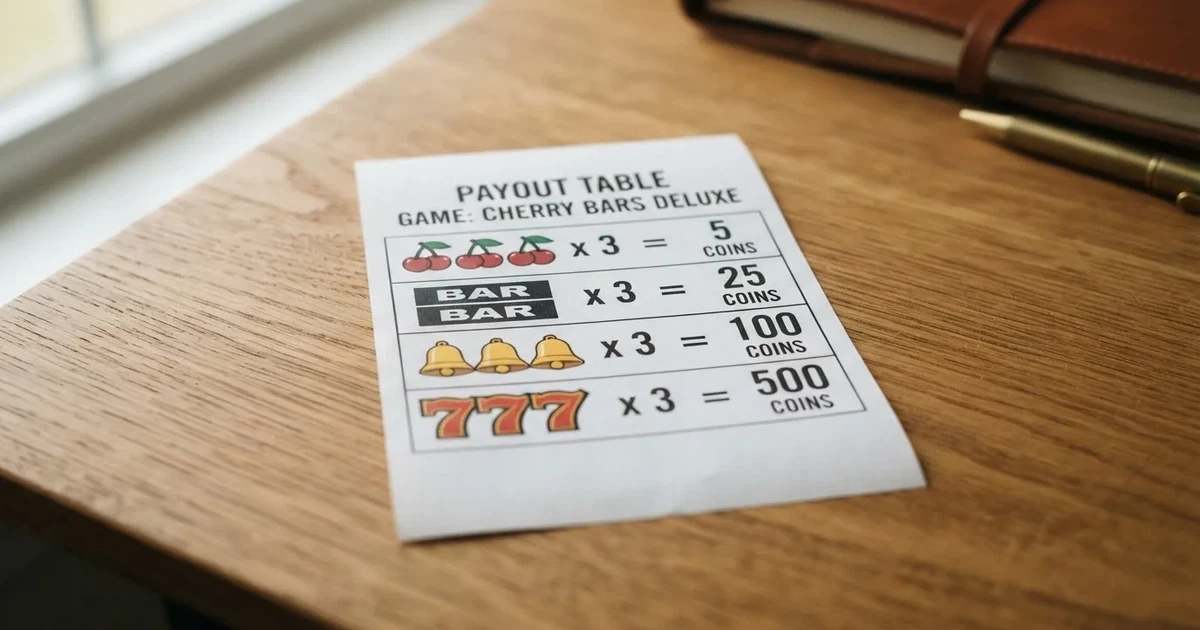
Even without a legal onshore product, the mechanics an offshore catalogue shows are easy to read once you know what to look for. A slot machine’s paytable is the reference chart on each title that lists every symbol, every winning combination, the value of each combination at each bet size and the special symbols that trigger free spins, bonus rounds or jackpots. A modern catalogue groups those titles by theme, by software provider, by volatility band and by whether the title has a fixed top payout or a pooled jackpot that grows across a network.
Two numbers on that paytable matter more than the rest. The first is the RTP — return to player — expressed as a percentage of money wagered that the game is designed to return over a very large number of spins. The second is volatility, which describes how the payouts are distributed: a low-volatility title pays often in small amounts; a high-volatility title pays rarely in larger amounts. Both are theoretical figures set by the developer, not promises about any individual session.
Reading the offer behind the bonus banner
Online pokies marketing is built on bonuses — deposit matches, free spins bundles, no-deposit credits, cashback. Every one of those offers is built from the same four parts: a bonus amount, a wagering multiple, a list of which games count and a maximum cashout cap. For online pokies play in Australia, this is background reading only: the same IGA framework that prohibits the underlying game also treats most inducements directed at Australians as unlawful, and no legitimate version of any of these offers exists onshore.
A deposit match at 100% up to a stated amount means the operator credits your account with bonus money equal to the deposit, and a 35x wagering requirement on the bonus means that total must be turned over 35 times in qualifying play before any of it can be withdrawn. Free-spin bundles attach the same multiplier to whatever the spins win. Cashback returns a percentage of net losses over a period, usually without a multiplier. Each shape can be worth very different amounts once the small print is read, which is the part the marketing does not put on the banner.
Why no fair ranking of the best Australian online pokies sites can exist
A person comparing online casinos in a regulated market can weigh licence, payout speed, RTP verification and dispute recourse. In Australia the first of those columns is empty for the product discussed. The Interactive Gambling Act 2001 makes the provision of online casino games to Australians an offence; the ACMA investigates, issues formal warnings and instructs Australian internet service providers to block offending sites. By the ACMA’s own count reported in June 2026, 1,751 illegal gambling and affiliate websites had been blocked since the first blocking request in November 2019, and more than 230 unlicensed services had left the Australian market since enforcement was strengthened in 2017.
The closest analogue to a “ranking” the regulator publishes is its list of formal warnings, and that list is the opposite of a recommendation. Each entry names an operator, a parent company, the service offered and the date of the warning. The eleven operators reviewed later on this page — RocketPlay, Level Up, Woo, Spirit, National, Bizzo, Ignition, Instant, Jackbit, Casino Intense and Sky Crown — are all on that list, for the same reason: the ACMA found them offering prohibited interactive gambling services to Australians. None is endorsed by a state regulator; none is connected to BetStop, the National Self-Exclusion Register that has bound Australian-licensed online and phone wagering services since August 2023.
That is the picture the rest of this page works from: a market the regulator has repeatedly closed, a catalogue that has moved offshore in response, and a player who has no Australian consumer protection if a withdrawal is refused and no easy way to be excluded if play stops being fun.
The blocking rate — how fast the ACMA has been closing sites
Between the first blocking request in November 2019 and the round reported on 26 June 2026, the ACMA has taken 1,751 illegal gambling and affiliate marketing websites off Australian reach. That works out to roughly an average of around 260 sites per year, or just over five sites blocked every week, for the period since blocking began. The most recent named round — the one published on 26 June 2026 — added twelve more: 7Signs, ChromaBet, Donbet, Duospin, Freshbet, Slots Gem, Jacks Club, Lucky Start, Pointsbetz, Spinrise, Vinyl Casino and Wildsino. The band is wide — some years have been quieter and some rounds much larger — but the direction of travel is steady: every quarter the regulator publishes another block list, and every quarter the offshore catalogue has to rebuild.
The cost of enforcement to the Australian market
The H2 Gambling Capital 2025 report estimates that Australians lose about A$3.9 billion a year to illegal gambling sites, and that the share of gambling going through legal channels fell from 74% in 2021 to 64%. That gap is the marketing budget the offshore industry is spending to reach Australian players, and it is the reason the same brand names reappear under different parent companies after each round of warnings — the operator changes, the offer does not.
How Australian banking treats the payments question
For the licensed product — wagering on sport and races before the event — Australian banking is tightly drawn. Since 11 June 2024, credit cards, credit-related products and digital currency are banned as payment for licensed online wagering, with penalties up to A$247,500 for operators that take them. Legal deposit routes are debit card, bank transfer, PayID/Osko and BPAY.
For the unlicensed offshore product, none of those rails apply. An offshore pokies site that asks an Australian for a credit card or a crypto deposit is operating outside the Australian rules on top of the prohibition on the product itself. The settlement time a player sees — instant deposits, withdrawals “processed within 24 hours” — is the offshore operator’s own house rule, not an Australian banking standard. That matters because if a withdrawal stalls, the only recourse is the offshore operator’s own complaints process, and if that fails, the player has no Australian regulator to escalate to.
PayID and the appearance of legitimacy
PayID is the real-time payment overlay that lets an Australian transfer funds using a mobile number, email or ABN instead of a BSB and account number, settling through Osko. It is fast, it is convenient, and it is one of the legal deposit routes for licensed wagering. An offshore pokies site advertising “PayID deposits” is borrowing that familiarity: the same word on an offshore cashier page does not move the operator into the licensed frame, because the underlying product is still prohibited. PayID works through participating Australian banks, not through a Curaçao-licensed operator’s cashier.
The state of legal play — pub, club and casino machines, and where online does not fit
The licensed product not mentioned is the electronic gaming machine in a pub, club or casino. These are state-regulated, and each state sets its own minimum return-to-player and its own machine caps. The legal minimum RTP for poker machines runs from 85% in New South Wales, the Northern Territory and Queensland — and generally in Victoria, where Crown Melbourne runs at 87% — to 87% in the Australian Capital Territory and Tasmania, 87.5% in South Australia and 90% in Western Australia. Western Australia has banned poker machines in pubs and clubs since Crown Perth opened in 1985; the casino itself holds roughly 2,500 machines, all approved by the state’s Gaming and Wagering Commission.
Two reform stories sit on top of that picture. Tasmania ended the Federal Group’s monopoly over its poker machines with legislation passed in November 2021, moving oversight of the machines to the Tasmanian Liquor and Gaming Commission; its planned nation-leading mandatory pre-commitment cards were delayed into late 2025. New South Wales separately regulates its much larger fleet, with player losses running at the A$8.18 billion figure already cited for 2022-23.
The licensed machine is also the licensed venue’s responsibility. The NSW Casino Control Act 1992, for instance, requires a casino operator not to permit a game such as baccarat to be played unless the regulator has approved the game and its rules, and the operator must make a copy of the approved rules available to patrons on request. None of that applies to a URL.
House edges that matter when an Australian player does sit at a legal table
Two table games an Australian player may legally encounter in a licensed casino are worth knowing, because they illustrate how small an edge the law has to work with. On baccarat the house edge is 1.06% on the Banker bet, 1.24% on the Player bet and 14.36% on the Tie — the Tie bet is the same shape as a long-odds novelty in any casino anywhere, and it is the one the marketing rarely talks about. With optimal strategy under liberal Las Vegas Strip rules — dealer stands on soft 17, double on any two cards, double after split, resplit aces, late surrender — blackjack’s house edge is about 0.28%, and about 0.43% under Atlantic City rules. Both figures assume the player is using a published basic strategy and the operator is running the published rules; deviation in either direction moves the edge.
The regulation of online bookmakers — the licensed face of the market
The Northern Territory Racing and Wagering Commission regulates 52 of Australia’s online bookmakers — including Sportsbet, Bet365 and Ladbrokes — which are licensed in the Territory for tax reasons. The commission has no full-time staff and meets once a month in Darwin. That thin regulator covering a large licensed wagering market is the structural detail behind the “Aussie” branding on many offshore casino sites: the licensed wagering product is well-known, well-advertised and easy to imitate visually, and the offshore industry has built an entire marketing layer on top of that imitation.
Responsible gambling — what the Australian system actually provides
If play starts to affect a person’s wellbeing, free confidential help is available any time through Gambling Help Online, the national portal run by the states and territories. The National Gambling Helpline is 1800 858 858 — free, 24/7 — with chat at the same service. These lines are independent of any operator and exist for any kind of gambling harm, licensed or not.
BetStop, the National Self-Exclusion Register, has been live since August 2023 and binds Australian-licensed online and phone wagering services — meaning licensed bookmakers, not offshore casinos. A player who has self-excluded through BetStop and then visits an offshore casino is not protected by that exclusion; the offshore operator has no connection to the register. That is one of the quiet costs of choosing an offshore site that the marketing does not put on the banner.
For an online pokies player who has decided to stop, the right order of operations is: contact Gambling Help Online or the National Gambling Helpline first for confidential advice, then engage BetStop for the licensed wagering bookmakers, and understand that the offshore casinos sit outside that second layer entirely. A genuine decision to stop play has to cover both.
The eleven operators the ACMA has warned — and what that warning means
What follows is not a recommendation. Each of the eleven brands below has had a formal warning issued against it by the ACMA under the Interactive Gambling Act 2001 for offering prohibited interactive gambling services to Australians. The table closes the comparison this inquiry asks for, with the regulator’s own record beside it rather than a marketing summary.
The ACMA record at a glance
| Brand | ACMA action and date | Operator named by the ACMA | Subject support |
|---|---|---|---|
| RocketPlay | Formal warning, March 2026 | Pulsup Ltd; earlier Dama N.V. | — |
| Level Up Casino | Formal warning, May 2022 | Dama N.V. | listings-only (Bgaming) |
| Woo Casino | Formal warning, March 2025 | Dama N.V. | — |
| Spirit Casino | Formal warning, May 2025 | Dama N.V. | — |
| National Casino | Formal warning, July 2025 | Consolutetish S.R.L. | listings-only (Wikipedia) |
| Bizzo Casino | Formal warning, July 2025; earlier warning, 2022 | Consolutetish S.R.L.; earlier TechSolutions (CY) Group Limited and TechSolutions Group N.V. | — |
| Ignition Casino | Formal warning, July 2025 | Bamboo Media | — |
| Instant Casino | Formal warning, February 2025 | EOD Code SRL | — |
| Jackbit | Formal warning, April 2026 | Ryker B.V. | — |
| Casino Intense | Formal warning, April 2025 | Sterplay Holding Ltd | listings-only (ACMA and Crown Melbourne) |
| Sky Crown | Formal warning, date as published | Hollycorn N.V. | — |
The repeated parent companies are part of the pattern. Dama N.V. has been warned under several brand names — Bambet, Dazard, Level Up, Rocketplay, Wild Tornado and Cobra Casinos in May 2022, then Woo in March 2025 and Spirit in May 2025 — and Consolutetish S.R.L. has surfaced as the parent of National Casino and Bizzo Casino in July 2025, with Bizzo already warned in 2022 under a different owner. The warning is the regulator’s tool, and the catalogue is what gets rebranded.
RocketPlay
The ACMA issued a formal warning to Pulsup Ltd in March 2026, with an earlier warning to Dama N.V. covering Rocketplay among six brands in May 2022. The site appears with a Curaçao-style licence in its footer and an “.com.au” domain in its marketing; neither moves it inside Australian law, because the Interactive Gambling Act prohibits the offering of online casino games and online pokies to a person in Australia regardless of what licence the operator displays elsewhere. There is no Australian consumer protection behind a withdrawal that stalls, no connection to BetStop, and the site can be blocked with a balance still on it.
Level Up Casino
Level Up was named in the May 2022 ACMA warning to Dama N.V. alongside five other brands. The software provider Bgaming.com lists Level Up among the operators it supplies, which is the only piece of verifiable information about the brand from a source other than the brand itself; that listing does not constitute an Australian licence, and it does not change the legal status of the games offered to Australians. The site has no onshore protection and no Australian complaints route.
Woo Casino
Dama N.V. was warned again over Woo Casino in March 2025, two and a half years after the May 2022 round. The pattern is what matters: the parent company stays the same, the brand changes, the marketing resets. From a player’s perspective, Woo in 2025 is the same operator, the same offer and the same legal status as Level Up was in 2022 — the rebranding does not put the site inside the IGA.
Spirit Casino
The May 2025 warning over Spirit Casino is the third Dama N.V. brand named in a 2025 ACMA round, after Woo in March. The shift from one brand to the next over twelve months suggests the marketing budget is moving faster than the regulator’s warning queue. A player who sees a fresh domain and a fresh banner is still being offered the same prohibited product, by the same parent, under a different skin.
National Casino
National Casino was named in the ACMA’s July 2025 warning to Consolutetish S.R.L., alongside Bizzo Casino. en.wikipedia.org’s entry on the brand is the only verifiable source outside the operator itself. As with the Dama N.V. brands, the rebranding around National Casino is a way to present a different face to Australian players while keeping the underlying offer the same.
Bizzo Casino
Bizzo was named twice: in a 2022 warning to TechSolutions (CY) Group Limited and TechSolutions Group N.V., and again in the July 2025 round to Consolutetish S.R.L. A site warned in 2022 and warned again in 2025 under a new parent company is one of the clearest signals in the ACMA’s record that enforcement has not yet caught up with the industry’s reorganisation speed. The product is the same product both times; the Australian player on it is the same Australian player both times.
Ignition Casino
The July 2025 warning to Bamboo Media over Ignition Casino is one of three in that single round — National Casino and Bizzo are the other two. Ignition’s marketing borrows the same Australian wagering visual cues as the others: a familiar banking overlay, an “Aussie” theme, fast advertised withdrawals. The legal position is unchanged.
Instant Casino
Instant Casino was warned in February 2025, with EOD Code SRL named as the operator. This is the earliest 2025 entry on the list reviewed here and one of the cleanest examples of the ACMA acting on a single brand without an earlier warning. The lesson is the same one: a single warning in a calendar year is the regulator’s tool, not a closure, and the site may continue to operate from offshore while the Australian block list is processed.
Jackbit
Ryker B.V. was warned in April 2026 over Jackbit and CasinOK. Jackbit is a newer brand on the ACMA’s record, and the operator name has not surfaced in earlier rounds. The licence the site displays is not an Australian one, and the product offered to Australians remains prohibited under the IGA.
Casino Intense
Sterplay Holding Ltd was warned over Casino Intense in April 2025. The brand surfaces in mainstream Australian reporting — Abc.net.au — and in the ACMA’s own register alongside the regulator’s own page and a venue operator’s site at Crownmelbourne.com.au. Each is a background data point rather than an endorsement: the ACMA’s record is the only relevant listing here.
Sky Crown
The ACMA’s formal warning to Hollycorn N.V. covered its Sky Crown and Blue Leo casino services. As with the other Dama N.V. and Consolutetish S.R.L. brands, the warning names the parent and the brands offered; it does not name a regulator that endorses either.
A comparison the page can fairly make
This inquiry asks for a comparison, and the only fair one on this market is the one the regulator has already published. Eleven brands, all warned by the ACMA, all offering prohibited services, none licensed onshore — that is the picture, and the operator-by-operator write-ups above are its detail. A player who wants to play online pokies legally in Australia in 2026 has only the licensed pub, club and casino machines to choose from; a player who wants to play the offshore product knows that the offer sits outside the IGA, outside BetStop and outside any Australian complaints route.
The verdict on the offshore product is the same across the eleven. None is licensed for the Australian market. None is connected to the National Self-Exclusion Register. None has an Australian regulator to escalate a complaint to. The differences between them are the differences in branding, in welcome banner and in the parent company named on the ACMA warning — and the ACMA’s record shows those differences are smaller than the marketing suggests.
The 2026 reform that changes the inducement picture
The Interactive Gambling Amendment (Gambling Reform) Bill 2026 passed Parliament on 19 August 2026. Its advertising and inducement measures commence on 1 January 2027 — law with a start date, not yet in force on a 2026 page. Once those measures commence, the inducement layer that has wrapped around the offshore product — the deposit-match banners, the free-spin bundles, the “no-deposit” credits — sits inside a tighter frame. For an Australian player on the regulated side of the market, that is a real change. For a player on the offshore product, the underlying IGA offence is unaffected.
Tax — the part the bonus banner never shows
For a recreational player in Australia, gambling winnings are not assessable income (section 6-5 ITAA 1997) and losses are not deductible. The picture changes if the person carries on a business of gambling — at which point the ATO’s tests for a gambling business apply, and the tax treatment follows. The model answer is the same one a tax adviser would give: “check with the ATO”. The offshore status of the operator does not change that, and the lack of an Australian withholding regime does not make offshore winnings tax-free in a way a domestic player should rely on.
What the licence at the bottom of an offshore site does — and does not — mean
A Curaçao or Anjouan licence on a casino footer is a permission to operate from a server in that jurisdiction; it is not a permission to take bets from Australians, and it is not a permission to advertise to Australians. The licence authority in those jurisdictions does not adjudicate complaints from Australian players about withdrawals, and it does not enforce responsible-gambling measures under Australian law. The Australian Communications and Media Authority is the only regulator with jurisdiction over the offering itself, and the ACMA’s position is the prohibition in the IGA. A footer that says otherwise is a marketing line, not a legal fact.
The repeated pattern of warning → rebrand → re-warning
The single most useful frame for the offshore pokies market in Australia is the warning-rebrand-re-warning pattern. Dama N.V. was warned in May 2022, again over Woo in March 2025 and again over Spirit in May 2025. Consolutetish S.R.L. was warned in July 2025 over National Casino and Bizzo Casino, with Bizzo already warned in 2022 under TechSolutions. Bamboo Media was warned in July 2025 over Ignition Casino. The parent company changes; the offer to Australians stays the same.
A player choosing to engage with the offshore product is choosing to engage with a market the regulator is closing one warning at a time, knowing that the next round may name the parent of the brand they have chosen. That is the structural detail the marketing never puts on the page.
Frequently asked questions
Does calling an online pokies site “Aussie” change where it is actually licensed?
No. The word “Aussie” on a casino’s homepage or in its domain is a marketing term, not a regulatory one. Under the Interactive Gambling Act 2001, no company may legally offer online pokies or online casino games to a person in Australia, regardless of how the brand positions itself. The licence on the footer of such a site is usually Curaçao or Anjouan, which is a permission to operate a server, not a permission to take bets from Australians.
Are the bonus credits and free spins on an “Aussie pokies” site legal to advertise here?
No. The IGA treats most inducements directed at Australians as unlawful, and no legitimate version of a deposit-match bonus or free-spin offer exists onshore for online pokies play. The Interactive Gambling Amendment (Gambling Reform) Bill 2026 tightens that frame further, with advertising and inducement measures commencing on 1 January 2027. Until then, the same offshore offer sits outside the Australian rules on both the underlying product and the inducement around it.
Is there a dedicated app for Aussie-branded online pokies that is legal to install locally?
No dedicated app for online pokies is licensed to be offered to Australians, because online pokies themselves cannot be licensed for the Australian market. Apps that present themselves as “Aussie pokies” apps are offshore products; installing them does not change the legal status, and the ACMA has acted against several of the operators behind them.
Do state gaming regulators recognise any “Aussie online pokies” brand as licensed?
No state or territory regulator recognises any online pokies brand as licensed for the Australian market. State regulators license land-based gaming machines — pubs, clubs, casinos — and they license online wagering on sport and races before the event, but not online pokies. The Northern Territory Racing and Wagering Commission regulates 52 online bookmakers, including Sportsbet, Bet365 and Ladbrokes; none of those offers online pokies.
How does an Aussie-branded online pokies catalogue differ from a licensed pub’s machines?
A licensed pub or club machine in Australia is state-regulated, sits under a state-set minimum return-to-player (from 85% in NSW, the NT and Queensland to 90% in Western Australia), and operates under the regulator’s responsible-gambling framework. An offshore online catalogue runs on the developer’s theoretical RTP and volatility figures, is offered under an offshore licence, and is not connected to the Australian regulator’s responsible-gambling framework. The look may be similar; the legal and consumer-protection frame is not.
Can an Aussie-branded online pokies site accept a PayID deposit and still be unlicensed?
Yes. The site accepting PayID does not move it inside the Australian licensed frame, because the underlying product — online pokies — is prohibited under the Interactive Gambling Act 2001 regardless of which deposit rail the cashier shows. PayID is a payment overlay that works through participating Australian banks; it is one of the legal deposit routes for licensed wagering, and using it on an unlicensed site does not licence the site. The same logic applies to credit cards and crypto: since 11 June 2024 those have been banned as payment for licensed online wagering, and an offshore site that still asks for them is operating outside the Australian rules on top of the prohibition on the product itself.