
What “Best Aus Pokies Online Australia” Actually Returns in 2026
This page is not a ranking. It cannot be, because the product the search asks about — online pokies licensed and available to Australians — does not exist. What follows is the honest answer to that search, written from the side of the reader who already typed it: what is legal, what is not, what the regulator has been doing about the offshore brands that take Australian money, and what a fair comparison looks like when there is nothing licensable to compare.
Verified against the Australian Communications and Media Authority’s current register on 28 October 2026.
Table of Contents
- The offer side of online pokies in Australia: what a bonus credit, free spins and a no-deposit bonus actually mean here
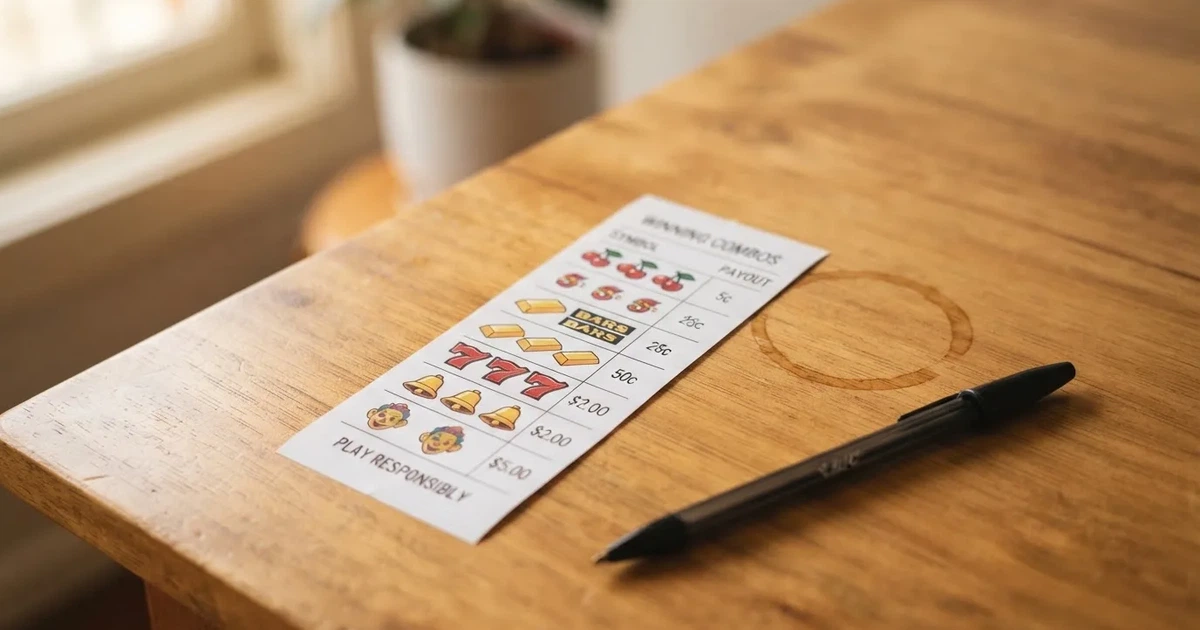
- What a pokies paytable actually shows — symbols, lines and the numbers that drive them
- A fair comparison of offshore brands: what it would weigh, and why no ranking exists
- Online pokies and the law in Australia: what the Interactive Gambling Act actually says
- If a reader is starting to feel the urge: responsible gaming in Australia
- PayID, cards and crypto: how payments to an offshore site actually work
- The blocking rate: what the ACMA’s enforcement arithmetic looks like
- The eleven brands the ACMA has named, in the order it named them
- What is licensable instead: poker machines inside Australian pubs, clubs and casinos
- Tax, age and the rest of the regulatory frame
- Closing the comparison: what to do with what is on the page
- Frequently Asked Questions
The offer side of online pokies in Australia: what a bonus credit, free spins and a no-deposit bonus actually mean here
The marketing vocabulary around online pokies is built for a market where the product is licensed. In Australia it is not. The words keep arriving through offshore sites that accept Australian sign-ups, and the bonus language — match credit, free spins, no-deposit bonus — keeps its overseas meaning while the legal footing underneath it shifts. Three reasons this matters.

A “sign-up bonus” is money the site adds on top of what the player deposits, usually with strings: a wagering multiple that has to be cleared before the bonus becomes withdrawable, a maximum cash-out cap, a list of games the bonus is allowed to be played on, and a clock that often starts before the player has read any of it. The headline figure and the playable figure are rarely the same number, and on offshore sites accepting Australians, the only body that can enforce those terms against the operator is a regulator sitting in another jurisdiction. None of that changes because the offer is called “Australian” in the page footer.
“Free spins” are credited spins on a named slot, almost always at the lowest stake the game allows, sometimes on a single title the casino has chosen because the return-to-player is set against the player. What they actually yield depends on the slot’s paytable and on the same wagering multiple that governs a cash bonus. They are not a free lunch; they are a free chance to clear a requirement.
A “no-deposit bonus” is the smallest dollar amount the casino is willing to put behind a signup, in exchange for the player’s email, phone number and the start of a file with the operator. The amount is small on purpose — it has to be small enough that the wagering multiple still leaves the house ahead on aggregate. That is the design, and reading the fine print matters more than the headline number.
None of this is illegal at the Australian player end. The Interactive Gambling Act 2001, strengthened in 2017, targets the provider of a prohibited interactive gambling service, not the punter sitting at the other end of the connection. The practical consequence falls on the player anyway: an offshore site offers no Australian consumer protection, no complaints body, no recourse if a withdrawal stalls or a bonus term is read in a way the player did not expect. The ACMA can ask Australian internet service providers to block the site, and the player’s balance can sit on the other side of that block.
What a pokies paytable actually shows — symbols, lines and the numbers that drive them
An online pokie is, mechanically, a random number generator sitting behind a set of symbols and lines. The paytable is the page that explains what each combination pays, how the bonus features trigger, and what the return-to-player figure is set at. Three things a paytable does, and three things a reader comparing slots needs to take from it.

The symbols carry values that are not the same as the bet. A scatter often pays in any position, a wild substitutes for higher-paying symbols and may carry its own multiplier, and the bonus symbol is usually the trigger for the free-spins round. The credit values are quoted in “credits” rather than dollars on purpose: the dollar value of a single line is the credit value multiplied by the line credit selected by the player.
The win lines — sometimes called paylines — are the patterns the slot reads across the reels. A classic three-reel game might offer a single horizontal line down the middle. A modern five-reel video pokie might offer 25 lines, 243 “ways”, or any of a number of cluster-and-tumble formats. The number of lines is set by the game designer; the number of lines the player pays for is set at the bet selector. A “243-ways” pokie charges one credit per spin and lights up every adjacent-symbol combination; a “25-line” pokie charges 25 credits at one credit per line.
The return-to-player is the long-run theoretical percentage of all wagered money that the game returns to players. Land-based Australian pokies run at minima set state by state — 85 per cent in New South Wales, the Northern Territory, Queensland and generally Victoria (87 per cent at Crown Melbourne), 87 per cent in the ACT and Tasmania, 87.5 per cent in South Australia, 90 per cent in Western Australia. Online pokies offered offshore are not bound by any of those floors. The figure printed on an offshore paytable is whatever the operator’s jurisdiction requires, which is often no minimum at all.
That is the whole of a paytable in plain language. It does not tell the player whether to play, and it does not change the mathematics: the house always has an edge, and an edge is the gap between 100 per cent and the return-to-player, expressed as a percentage of every dollar wagered over the long run. The long run is the word that matters; over any individual session, anything can happen.
A fair comparison of offshore brands: what it would weigh, and why no ranking exists
Eleven offshore brands have been formally warned by the ACMA over the past two years for offering prohibited online casino services to people in Australia. The list is not a ranking, because ranking them on the criteria the search usually wants — bonus generosity, payout speed, game library, customer support — would imply that one illegal offer is better than another, which is not the comparison a reader needs.
What a fair comparison would weigh, if such a comparison were licensable in Australia, falls into five blocks. None of them are weighed in this page, because the brands below are not licensable here.
The first is the licence the offshore site actually holds, and which regulator issued it. A Curaçao e-gaming licence and a Malta Gaming Authority licence are not the same document, and the consumer protection that sits behind each is different. A reader outside that jurisdiction has no formal complaint route.
The second is the bonus structure and its wagering multiple. The headline number, the multiple, the game-weighting table and the maximum cash-out cap together determine what a bonus is worth. Sites advertising in Australian dollars often attach terms designed for a different market.
The third is the payment set. Australian-licensed wagering sites accept debit card, bank transfer, PayID and BPAY, and have been banned from accepting credit cards and digital currency for online wagering since 11 June 2024. An offshore site asking for a credit card or a crypto deposit is not following the Australian rule, because the Australian rule does not bind it.
The fourth is the game library, the provider set behind it, and whether any of the named providers — Evolution for live tables, Pragmatic Play or BGaming for slots — even verify the offshore site as a place they will supply. Some providers publish lists of sites they refuse to deal with; a site absent from those lists is not the same as a site present on them.
The fifth is the responsible-gaming posture: whether the site connects to BetStop (the National Self-Exclusion Register, live since August 2023, binding only on Australian-licensed wagering services), whether deposit limits are settable in Australian dollars, and whether time-out tools work as advertised. None of the offshore brands below connect to BetStop. That fact alone settles a part of the comparison the marketing page would rather not raise.
A reader comparing options needs each of these blocks laid out, side by side, with the same columns. The table below does that for the eleven ACMA-warned brands in the order the regulator itself has acted. The cells are deliberately bare where the inputs carry no figure.
The eleven ACMA-warned brands, side by side
| Brand | ACMA action and date | Operator named by the ACMA | Subject support |
|---|---|---|---|
| RocketPlay | Formal warning, March 2026 | Pulsup Ltd (Rocketplay.com.au); earlier Dama N.V., May 2022 | — |
| Level Up Casino | Formal warning, May 2022 | Dama N.V. | BGaming lists the brand as a partner |
| Woo Casino | Formal warning, March 2025 | Dama N.V. | — |
| Spirit Casino | Formal warning, May 2025 | Dama N.V. | — |
| National Casino | Formal warning, July 2025 | Consolutetish S.R.L. | Wikipedia lists the brand |
| Bizzo Casino | Formal warning, July 2025; earlier 2022 | Consolutetish S.R.L.; earlier TechSolutions (CY) Group Limited and TechSolutions Group N.V. | — |
| Ignition Casino | Formal warning, July 2025 | Bamboo Media | — |
| Instant Casino | Formal warning, February 2025 | EOD Code SRL | — |
| Jackbit | Formal warning, April 2026 | Ryker B.V. (Jackbit, CasinOK) | — |
| Casino Intense | Formal warning, April 2025 | Sterplay Holding Ltd | ABC and ACMA publish the brand; Crown Melbourne publishes a competitor’s baccarat tables |
| Sky Crown | Formal warning, September 2022 | Hollycorn N.V. | — |
The right-hand column follows the source listings the research could verify, and stops where verification stops. Where the cell is a dash, the brand is named for the ACMA action only.
Online pokies and the law in Australia: what the Interactive Gambling Act actually says
The Interactive Gambling Act 2001 — the IGA — is the federal statute that governs interactive gambling services supplied to people in Australia. The Interactive Gambling Amendment Act 2017 strengthened it, extending the prohibition to in-play betting and clarifying that online casino games and online pokies fall within the definition of a prohibited service. Two points worth being precise about.
The first is what the prohibition covers. The IGA prohibits the supply of online casino games, online pokies and in-play betting to a person in Australia. It does not prohibit wagering on a race or sporting event placed before the event starts, lotteries, or keno. Wagering and lotteries are licensed at the state and territory level, with the Northern Territory Racing and Wagering Commission holding a particular concentration: the NTRWC regulates 52 of Australia’s online bookmakers, including Sportsbet, Bet365 and Ladbrokes, and does so with no full-time staff, meeting once a month in Darwin. That is a quirk of how the tax treatment sits, not a quirk of consumer protection.
The second is who the IGA targets. The offence sits with the provider of a prohibited interactive gambling service, not the individual player. An Australian can sit at an offshore site and place a bet without breaking the IGA personally; the offshore operator that accepts the bet is the party the regulator can act against. The practical consequence for the player is different from the legal one: there is no Australian complaints body, no Australian dispute resolution, and the ACMA can ask internet service providers to block the site, which has happened 1,751 times since the first blocking request in November 2019.
The Interactive Gambling Amendment (Gambling Reform) Bill 2026 passed Parliament on 19 August 2026, and its advertising and inducement measures commence on 1 January 2026. That is law with a start date, not law already in force on a 2026 page, and the distinction matters: a reader reading this in late 2026 is reading under the current rules; a reader reading the same page in early 2026 is reading under rules that include the new advertising restrictions.
If a reader is starting to feel the urge: responsible gaming in Australia
If the question behind the search is about play itself, it is worth saying plainly: free confidential help is available around the clock. Gambling Help Online runs a 24-hour chat service, and the National Gambling Helpline — 1800 858 858 — is free from anywhere in Australia, any hour of the day or night. The helpline is funded by the Commonwealth and staffed by trained counsellors, not by a casino.
BetStop, the National Self-Exclusion Register, has been live since August 2023. It is the register an Australian can put their own name on to block themselves from Australian-licensed online and phone wagering services for a chosen period — three months, one year, or a longer minimum. A self-excluded person cannot open a new account with a bound operator while the exclusion is active, and the operator must not let them.
The limit of BetStop is the limit of the IGA. The register binds Australian-licensed wagering services; an offshore casino has no connection to it. A player who self-excludes from Australian wagering and then signs up with an offshore operator is not protected by the exclusion. That is the most important practical sentence on this page for anyone who has decided they want to stop.
Self-exclusion is one tool. Deposit limits, time-outs, reality checks and session reminders are others, and an Australian-licensed operator is required to make them available. An offshore operator is not. The responsible-gaming posture of an offshore site is, in the end, a thing that site chooses to do.
PayID, cards and crypto: how payments to an offshore site actually work
Australian-licensed online wagering has a closed payment set. Credit cards, credit-related products and digital currency have been banned as a means of paying for licensed online wagering since 11 June 2024, with penalties of up to A$247,500 for operators that breach the ban. The legal deposit routes for licensed wagering are debit card, bank transfer, PayID/Osko and BPAY.
PayID is the Australian payments overlay that links a bank account to something easier to type — a phone number, an email, an ABN — through the New Payments Platform. PayID is the way many licensed Australian bookmakers identify a returning customer at the deposit screen. The product is real, fast and Australian.
The question of whether a PayID deposit option makes an offshore site “more Australian” is the wrong question. PayID is a payments rail; it does not convey a licence. An offshore site accepting PayID is using an Australian rail to move money into an account outside Australia, and the consumer protection that surrounds the rail stops at the Australian side. A site that calls itself an “Australian PayID pokies” site is using the words for marketing; the rail it uses is Australian, the licence is not, and the legal footing is what the IGA says it is.
A site asking an Australian for a credit card deposit or a cryptocurrency deposit on online wagering is operating outside the Australian rule. The Australian rule does not bind it. The reason the rule exists is to keep a credit line off the casino floor; an offshore site that ignores the rule is not safer for ignoring it.
The blocking rate: what the ACMA’s enforcement arithmetic looks like
The ACMA’s first blocking request went to Australian internet service providers in November 2019. The total number of illegal gambling and affiliate marketing websites blocked since then, as reported in June 2026, is 1,751. The arithmetic is straightforward: 1,751 blocks over the months between November 2019 and June 2026, which works out to a running average that depends on which month is taken as the start.
Using November 2019 as the first blocking request and June 2026 as the report month, the running total covers roughly 79 months. 1,751 divided by 79 gives an average of about 22 blocks per month over the lifetime of the regime, with the monthly pace varying as the regulator rounds up new targets. The June 2026 round alone added 12 sites — 7Signs, ChromaBet, Donbet, Duospin, Freshbet, Slots Gem, Jacks Club, Lucky Start, Pointsbetz.com, Spinrise, Vinyl Casino and Wildsino — which is on the high end of a single month and consistent with the pace of recent rounds rather than a step change.
The number to keep in mind is the cumulative one, not the monthly one. 1,751 sites have been blocked. More than 230 unlicensed gambling services have left the Australian market since enforcement was strengthened in 2017. The blocking list is the regulator’s record of where Australians have been trying to play, not a guarantee that any given site is or is not on it. A site not on the list has not been cleared by the ACMA; it has simply not been reached yet.
The H2 Gambling Capital estimate for 2026 puts Australians’ losses to illegal gambling sites at about A$3.9 billion a year, and notes that the share of gambling going through legal channels fell from 74 per cent in 2021 to 64 per cent. The blocking arithmetic and the loss estimate point at the same picture: the regulator is reaching sites faster than the market is shifting back to legal channels, which is the part of the comparison the search results do not usually carry.
The eleven brands the ACMA has named, in the order it named them
The brands below are listed because the ACMA itself issued a formal warning over each, for offering prohibited online casino services to people in Australia. The list is in the regulator’s order of action, and is not a recommendation to play on any of them. Where a brand appears to support the subject — that is, where research or a public listing carries the brand as a partner of a named game provider — that is stated as the listing reports it; where research carries no such support, the brand is presented on its other fields.
RocketPlay
The ACMA issued a formal warning over RocketPlay in March 2026, naming Pulsup Ltd as the operator behind Rocketplay.com.au. An earlier warning in May 2022 named Dama N.V. as the operator over a list that included Rocketplay. The site’s product, like every brand on this page, is a prohibited interactive gambling service under the IGA, and no licence displayed at the foot of the page changes that. Two names on one brand over four years is the regulator’s record of an operator moving between shells; the player follows whichever name sits at the top of the page on the day they sign up.
Level Up Casino
The ACMA issued a formal warning over Level Up Casino in May 2022, naming Dama N.V. as the operator. The site appears on BGaming’s public listings as a partner; BGaming does not, on those listings, certify the site’s standing with Australian regulators. The two facts are separate. A provider’s decision to supply a site is not a regulator’s decision that the site is licensable in the reader’s jurisdiction, and the IGA’s prohibition sits above both.
Woo Casino
The ACMA issued a formal warning over Woo Casino in March 2025, again naming Dama N.V. as the operator. The Dama N.V. cluster of warnings — six brands in May 2022, then Woo in March 2025 and Spirit in May 2025 — shows one operator group working through successive brand names over a period in which the ACMA has been tightening its blocking regime. A reader looking at a Dama N.V. brand today is looking at a brand the regulator has had cause to act on more than once.
Spirit Casino
The ACMA issued a formal warning over Spirit Casino in May 2025, with Dama N.V. again named as the operator. The pattern is the same as Woo Casino: the regulator caught up with a brand name that sits inside an operator group it has already acted on. The legal status of the offer to an Australian is unchanged by the brand name; the IGA prohibits the supply regardless of which trading name sits at the top of the page.
National Casino
The ACMA issued a formal warning over National Casino in July 2025, naming Consolutetish S.R.L. as the operator. The brand is listed on Wikipedia among online casino brands, which is a record of the brand’s existence rather than a certification of its licence standing in any specific jurisdiction. The IGA’s prohibition applies to the supply of a prohibited interactive gambling service to a person in Australia, and the brand name under which the service is offered does not change the analysis.
Bizzo Casino
The ACMA issued a formal warning over Bizzo Casino in July 2025, with Consolutetish S.R.L. named as the operator; the regulator had already issued a warning over Bizzo in 2022 to TechSolutions (CY) Group Limited and TechSolutions Group N.V. Two operator names on one brand, like the Dama N.V. cluster above, is the regulator’s record of the brand being moved between ownership groups while continuing to face the same underlying legal problem. The problem is not the brand name; it is the product, which the IGA prohibits regardless of the wrapper.
Ignition Casino
The ACMA issued a formal warning over Ignition Casino in July 2025, naming Bamboo Media as the operator. Ignition is one of the better-known offshore casino brands among Australian-facing search traffic, and the warning sits in the same July 2025 cluster as National Casino and Bizzo. The ACMA’s July 2025 round is the densest cluster of formal warnings over the past two years, and reflects the regulator’s enforcement pace rather than any shift in the underlying law.
Instant Casino
The ACMA issued a formal warning over Instant Casino in February 2025, naming EOD Code SRL as the operator. The brand name — built for the search term rather than for any licensed market — sits inside a category of brands the ACMA has been reaching with increasing regularity. The warning is the formal record that the regulator has acted on the brand; it is not the only record that matters to a reader, but it is the one that determines the IGA’s posture toward the brand.
Jackbit
The ACMA issued a formal warning over Jackbit in April 2026, naming Ryker B.V. as the operator over both Jackbit and CasinOK. Two brands on one warning is the regulator’s way of recording a single operator group offering more than one prohibited service to Australians. The Jackbit-CasinOK warning is the most recent ACMA formal warning named in this list, and it is one of the clearest examples of an operator running two prohibited brands under one corporate roof.
Casino Intense
The ACMA issued a formal warning over Casino Intense in April 2025, naming Sterplay Holding Ltd as the operator. The brand appears in ABC reporting and on the ACMA’s own register, alongside Crown Melbourne’s baccarat offering — which is a competitor product, not a partner. A reader searching “Casino Intense” and landing on a baccarat table at Crown is looking at a legal alternative, which is worth noting because the legal alternative is the only place online pokies-style play actually exists in Australia.
Sky Crown
The ACMA issued a formal warning over Hollycorn N.V. over its Sky Crown and Blue Leo casino services in September 2022, naming both brands on the same warning. Two brands on one corporate name is the Hollycorn N.V. pattern. Sky Crown is the oldest formal warning on this list, and the legal status of the brand has not changed since; the IGA does not have a statute of limitations on prohibited supply, and a brand the ACMA named in 2022 is not safer in 2026 for being old news.
What is licensable instead: poker machines inside Australian pubs, clubs and casinos
The land-based equivalent of the online pokie is the electronic gaming machine — the EGMs Australians call “pokies” — and the country’s roughly 195,000 of them sit in pubs, clubs and casinos licensed state by state. The figures below come from each jurisdiction’s regulator and from the ABS, and they describe a market the offshore brands above are not part of.
New South Wales had 87,298 gaming machines outside casinos across 2,195 venues as of June 2023, with player losses of A$8.18 billion in 2022–23. Queensland had 21,122 gaming machines operating in 351 venues in October 2023. Victoria had 26,380 outside Crown Casino in 488 venues in 2021–22, under a 30,000-machine statewide cap. Western Australia has no poker machines in pubs or clubs — Crown Perth is the only place they exist in the state, and the casino’s count has grown from about 200 in 1985 to roughly 2,500 today, all approved by the state’s Gaming and Wagering Commission. Tasmania ended Federal Group’s monopoly over its poker machines with legislation passed in November 2021, and the oversight of the machines moved to the Tasmanian Liquor and Gaming Commission. The ACT and the Northern Territory round out the eight Australian jurisdictions.
The minimum return-to-player varies by jurisdiction: 85 per cent in New South Wales, the Northern Territory, Queensland and (generally) Victoria (87 per cent at Crown Melbourne), 87 per cent in the ACT and Tasmania, 87.5 per cent in South Australia, and 90 per cent in Western Australia. These are floors, set by state regulation; the games on the floor run above the floor in many cases, and a poker machine in a Sydney club is a different statistical object from one in a Perth casino. None of this is online. The IGA does not apply to these machines because they are not interactive gambling services; they are physical machines in physical venues.
Tasmania had planned nation-leading mandatory pre-commitment cards for its poker machines, but implementation of the reform was delayed until late 2025. Pre-commitment cards are the technology a player uses to set their own loss limit before they sit down at a machine, and Tasmania’s delay has been the most-watched responsible-gaming reform in the country. A reader interested in what a state-led player-protection regime on pokies actually looks like can read the Tasmanian rollout as the live example.
Tax, age and the rest of the regulatory frame
The minimum age for any gambling activity in Australia is 18. The A$3.9 billion illegal-gambling loss estimate is built on data the H2 Gambling Capital 2025 report draws together; it does not appear on the ATO’s books, because gambling winnings of a recreational player are not assessable income under section 6-5 of the ITAA 1997, and losses are not deductible. A player who runs a gambling business is in a different position, and the ATO’s guidance is the place to start.
BetStop is the National Self-Exclusion Register, live since August 2023 and binding only on Australian-licensed online and phone wagering services. The advertising and inducement measures of the Interactive Gambling Amendment (Gambling Reform) Bill 2026 commence on 1 January 2026, and from that date the regime around marketing to Australians tightens in ways that the offshore brands will, in practice, ignore. The credit-card and crypto ban for licensed online wagering has been in force since 11 June 2024. None of these are recommendations about how to play; they are the legal frame around the search the page is built on.
Closing the comparison: what to do with what is on the page
The page does not rank eleven offshore brands, because ranking them on the criteria the search usually wants would imply that one illegal offer is better than another, which is the comparison a reader does not need. What the page does is lay out, side by side, what the regulator has done about each brand, in the order it did it.
A reader who wants to play pokies in Australia has two real options. The first is a licensed venue — a pub, club or casino in one of the eight Australian jurisdictions — where the machines are state-regulated, the return-to-player floor is set in law, and BetStop and the helpline both reach. The second is an offshore site, which is illegal for the operator to supply and offers no Australian consumer protection. The third option — pretending the offshore site is something other than what it is — is the one the marketing pages are built around, and is the one this page is built against.
The honest answer to the search is the answer the IGA gives: no such list exists, and the closest legal equivalent is the poker machine inside a licensed venue. That is the comparison the page closes on.
Frequently Asked Questions
Is there any licensed, ranked list of online pokies sites for Australian players?
No. Online pokies are prohibited under the Interactive Gambling Act 2001, and no state or territory issues a licence for them. The ACMA maintains a register of formal warnings and blocks, but that register is a list of brands the regulator has acted against, not a ranking of legal alternatives to play on.
Does a PayID deposit option make an online pokies site any more Australian or legal?
No. PayID is a payments rail that sits on the New Payments Platform; it does not convey a licence. An offshore site accepting PayID is using an Australian rail to move money into an account outside Australia, and the consumer protection that surrounds the rail stops at the Australian side. A PayID deposit does not make a prohibited service licensable.
What separates a licensed pub or club poker machine from an “online pokies” site?
A pub or club poker machine is a physical device inside a licensed Australian venue, regulated state by state under a minimum return-to-player floor. An online pokies site is an interactive gambling service offered over the internet, prohibited under the IGA, supplied from offshore, and outside every state-based consumer protection regime.
Can an offshore online pokies site legally advertise a sign-up bonus credit to Australians?
The IGA prohibits the supply of a prohibited interactive gambling service to a person in Australia, and a sign-up bonus is part of that supply. The Interactive Gambling Amendment (Gambling Reform) Bill 2026 adds inducement and advertising measures that commence on 1 January 2026; until then and after, the offshore brand is the party the ACMA can act against, not the player who accepts the offer.
How would payouts on an offshore online pokies site be verified as fair?
There is no Australian body that does this. The site holds the RNG, the paytable and the wallet; the player holds the receipt. A regulator in another jurisdiction — typically Curaçao or Malta — may inspect, but an Australian has no formal complaint route and no way to compel a payout. The IGA’s prohibition is independent of any fairness claim the site makes.
Is online pokies play covered by the same ban as online casino table games?
Yes. The Interactive Gambling Act 2001, as amended in 2017, prohibits the supply of online casino games, online pokies and in-play betting to a person in Australia as a single category of “prohibited interactive gambling service”. A site offering one offers the other in the regulator’s eyes, and the ACMA’s enforcement record — the warnings on this page — covers the category, not the individual game.