Best 3-reel slots Australia 2026: how the format works, why no online casino is licensed here, and what an offer really costs
 Available in US
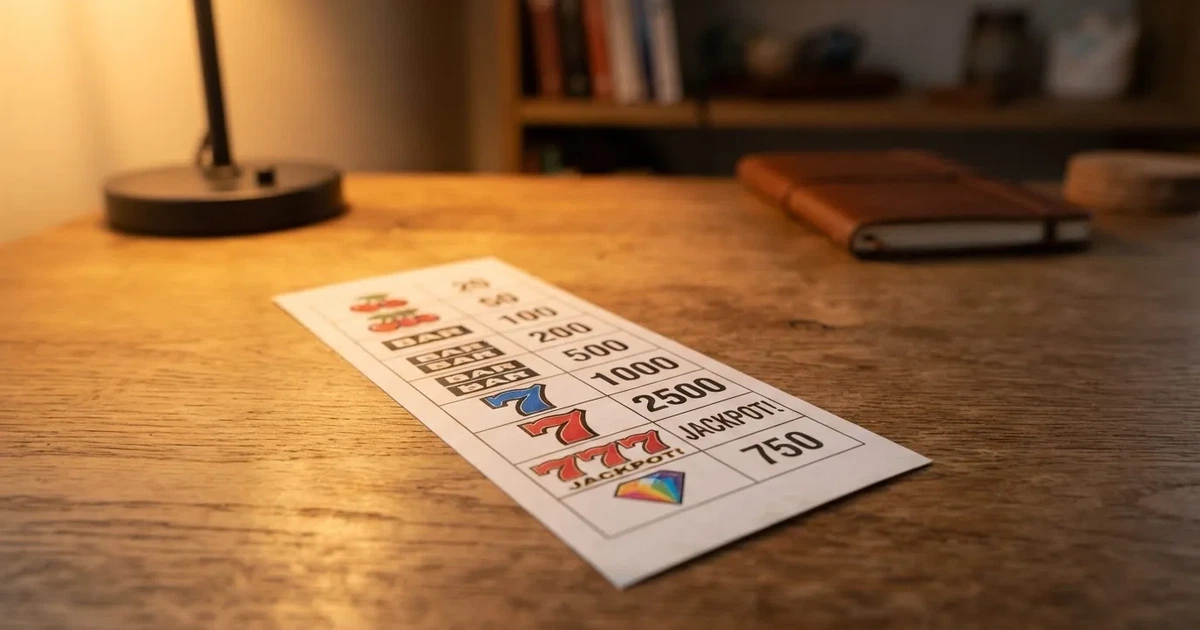
A three-reel slot is the closest thing the casino floor has to a working museum piece. Three spinning drums, a single payline down the middle, a handful of symbols — cherries, bars, sevens, bells — and a payout table that fits on a strip of paper the size of a receipt. In Australian clubs and pubs that format is still around, alongside four-reel novelty variants and the five-reel video cabinets that now dominate the floor. Online, the same three reels live on offshore casinos that the Australian Communications and Media Authority has spent the last several years warning, blocking and publicly naming. There is no online three-reel slot, in any format, that is licensed for real-money play to a person in Australia. The format itself is harmless and old. The route to play it online from here is the part that costs.
Current as of 23 September 2026, against the ACMA’s register of formal warnings and the blocking-list totals published by the Australian Communications and Media Authority.
Table of Contents
- How a three-reel slot actually works: paytables, symbols and lines
- Eleven offshore casinos the ACMA has warned over prohibited services
- The fundamentals: three reels in a wider landscape of Australian play
- Prohibition: what the Interactive Gambling Act 2001 actually prohibits
- Responsible play: what help looks like in Australia
- What a “free spins” or “3 reel bonus” offer generally involves
- The blocking rate: how fast the ACMA’s list is growing
- Frequently asked questions
How a three-reel slot actually works: paytables, symbols and lines
The classic three-reel machine was a piece of clockwork. Charles Fey’s late-nineteenth-century design — three reels, five symbols on each (horseshoes, diamonds, spades, hearts and the Liberty Bell), three bells across the centre line paying the top prize of ten nickels — set the template every later three-reel game has either inherited or reacted against. By the 1960s Bally’s Money Honey had automated the payout hopper, removing the need for an attendant to pay out wins, and the format carried that simple logic into the electronic era. The drum symbols changed. The reels stopped being physical. The relationship between the symbols, the line and the payout stayed much the same.
A three-reel slot in its modern form is still, mechanically, three vertical strips of symbols. Each reel carries a fixed set of icons — sometimes ten, sometimes a few more or fewer, depending on the title — and a single spin picks one symbol per reel. The result is a three-by-three grid in the most common contemporary three-reel video slot. The original one-arm bandit showed one symbol per reel in a row of three. The single horizontal line across the middle is the payline that almost every classic game still uses. Some three-reel video slots add a second or third payline, but the format’s defining feature is the small number of combinations. With about ten symbols per reel, a classic mechanical three-reel slot offers roughly one thousand possible outcomes per spin. A modern five-reel video slot with fifty-plus symbols per reel can produce odds as high as three hundred million to one against the top combination.
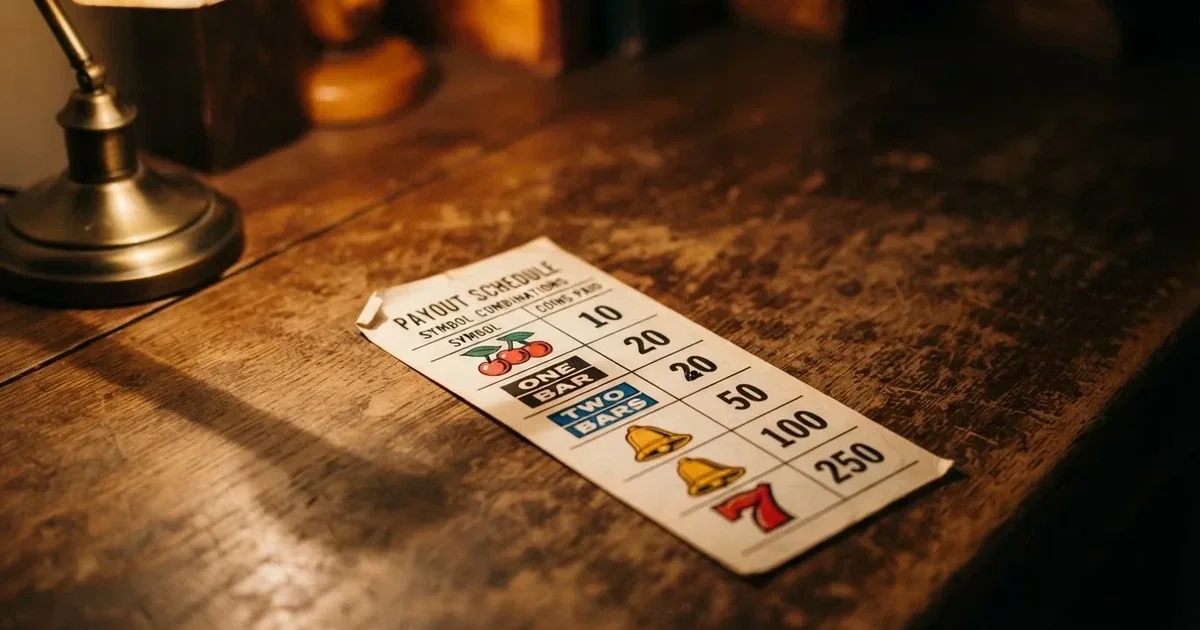
The paytable is what tells the player what each combination pays. A cherry on the first reel often pays a small return even on its own. Three cherries across the line pays more. Three sevens across the line pays the top jackpot. Two sevens and a bar pays something in between. The exact ladder of payouts, the symbols used and whether the game pays left-to-right, right-to-left, or both, lives on the paytable — usually behind a button on the game’s screen, or printed on the glass of an older cabinet. Reading it before playing is one of the few free moves available. The rest is decided by the random number generator underneath.
| Feature | Classic 3-Reel | 5-Reel Video |
|---|---|---|
| Paylines | Usually 1 | Multiple |
| Volatility | Generally lower | Higher |
| Bonus Features | Limited | Extensive |
| Top Jackpot | Smaller | Larger/Progressive |
Symbols and the ladder of payouts
The icons on a classic three-reel slot are not arbitrary. Bars, sevens, cherries, bells and, on games licensed from the original Liberty Bell design, the bell itself, are the standard set — because they were the standard set when the machine was mechanical and the symbols had to be recognisable when the reel was spinning. Most three-reel games still use some combination of those. The payouts are arranged in tiers. A single cherry on the line pays something small, often twice the line bet. Two cherries pay more. Three of a kind pays the highest amount for that symbol. Three of the top symbol pays the jackpot. The exact numbers live on the paytable, and the relationship between them — how steep the ladder is — is part of how the game’s volatility is described.
The payline and how wins are counted
The payline on a three-reel slot is the line across the centre of the grid: one symbol from reel one, one from reel two, one from reel three. The classic format pays left to right only, and the player bets one credit per spin per line. Some contemporary three-reel video slots add diagonal lines or an extra horizontal line, but the single-line game is the format’s defining version. When the player increases the bet, what changes is the size of the payout on each winning combination, not the number of lines. A three-coin bet usually multiplies the one-coin payout by three on every line of the paytable, with the top jackpot reserved for the maximum-coin bet on the games that follow that convention.
How a three-reel payout compares to a five-reel one
Three-reel payouts are easier to read at a glance because there are fewer of them. A five-reel video slot can have a paytable with twenty or thirty combinations, multiple scatter pays, a bonus round that pays differently, a free-spin feature and a gamble option. A three-reel game usually has between five and ten combinations on the paytable, sometimes fewer. The cost of that simplicity is the size of the top payout. The highest symbol on a three-reel slot will typically pay a few hundred times the line bet, against thousands or tens of thousands on a five-reel progressive. The house edge, on the other hand, is broadly comparable: most three-reel and five-reel video slots sit in the same range, somewhere between three and ten per cent of turnover depending on the title and the rule set.
That is also where the comparison between the two formats becomes a question of what the player actually values. A five-reel video slot is a longer, more varied session per credit. A three-reel slot is a tighter, more readable one. The arithmetic underneath is similar. The experience is not.
Eleven offshore casinos the ACMA has warned over prohibited services
The format is one thing. Where to play it online from Australia is another, and the honest answer is that there is no legal route to do it. What follows is not a ranking and not a recommendation. Every brand in this section is here because the Australian Communications and Media Authority itself issued a formal warning over it for offering prohibited online casino services to people in Australia. The brands are in the order the ACMA’s warnings were published, with the earliest warnings first. The table below is built from the regulator’s own register.
The shared position is the same for every brand. Under the Interactive Gambling Act 2001, online casino games — including three-reel slots and every other format of online pokies — cannot be licensed for supply to anyone in Australia. No state or territory regulator issues such a licence. An offshore operator displaying a Curaçao, Kahnawake, Anjouan or Malta licence is licensed under that regime, not under Australian law. The ACMA’s formal warnings are the regulator’s recorded position that the named operator is offering a service the IGA prohibits. That is the entry condition on every brand in this section. What changes between them is the operator name, the date of the warning, and what is publicly known about each company beyond that warning.
| Operator | Warning date | Parent entity | Earlier warning? |
|---|---|---|---|
| RocketPlay | March 2026 | Pulsup Ltd | Yes — Dama N.V., May 2022 |
| Level Up Casino | May 2022 | Dama N.V. | No |
| Woo Casino | March 2025 | Dama N.V. | No |
| Spirit Casino | May 2025 | Dama N.V. | No |
| National Casino | July 2025 | Consolutetish S.R.L. | No |
| Bizzo Casino | July 2025 | Consolutetish S.R.L. | Yes — TechSolutions, 2022 |
| Ignition Casino | July 2025 | Bamboo Media | No |
| Instant Casino | February 2025 | EOD Code SRL | No |
| Jackbit | April 2026 | Ryker B.V. | No |
| Casino Intense | April 2025 | Sterplay Holding Ltd | No |
| Sky Crown | September 2022 | Hollycorn N.V. | No |
The “Earlier warning?” column catches the two brands that have cycled through a second operator since the ACMA first named them. RocketPlay was first warned in May 2022 under Dama N.V. and again in March 2026 under Pulsup Ltd. Bizzo was first warned in 2022 under TechSolutions and again in July 2025 under Consolutetish. The other nine brands have a single formal warning in the ACMA’s register. The “Parent entity” column carries the operator name as published by the ACMA; the table does not attempt to verify or characterise the offshore company beyond that name.
1. RocketPlay
RocketPlay is the most recent of the formal warnings in the ACMA’s register, dated March 2026, when the regulator named Pulsup Ltd as the operator of RocketPlay. The same brand had already been the subject of an earlier formal warning in May 2022, when Dama N.V. — a Curaçao-registered operator that runs a portfolio of casino brands — was named in a single warning covering six of its properties. The two warnings, four years apart, trace the same domain through two different operators, which is the pattern offshore brands take when ownership changes and the brand migrates to a new corporate entity without changing the site. The March 2026 warning sits in a year in which the ACMA has continued to issue blocking requests to Australian ISPs, and is part of the same enforcement flow described in the legality section below.
Verdict. The warning is the most recent in the featured set, and the brand has cycled through two operators in the period covered. Treating the brand as a place to play means accepting what the IGA imposes on every operator in this section: no Australian consumer protection, no complaints body, no recourse if a withdrawal stalls, and a non-trivial chance the site is blocked while a balance is still on it.
2. Level Up Casino
Level Up Casino was named in the May 2022 ACMA warning to Dama N.V. as one of six brands operated by that company, alongside Bambet, Dazard, RocketPlay, Wild Tornado and Cobra Casinos. Level Up is one of the few brands in the featured set where a third-party listing of games carried could be verified: a major games studio, which supplies a number of Dama N.V. brands, lists Level Up among the operators carrying its content. That is a content-supply relationship, not an endorsement, and it does not change the brand’s position under Australian law.
Verdict. The brand has been on the ACMA’s register since the May 2022 warning — nearly four years on the regulator’s record. The studio listing tells a reader what content the brand runs; it does not change the fact that the brand has been formally warned under the IGA and that the warning remains the regulator’s published position on the brand.
3. Woo Casino
Woo Casino was the subject of an ACMA formal warning in March 2025, again naming Dama N.V. as the operator. By that point Dama N.V. was already a repeat entry in the ACMA’s register, having been warned in 2022 over its earlier six-brand portfolio and again in 2025 over Woo specifically. The 2025 warning reflects the ACMA’s enforcement approach after the 2017 amendments to the Interactive Gambling Act, which strengthened the regulator’s hand against offshore operators serving Australian customers.
Verdict. A 2025 warning to the same Dama N.V. operator that has been on the ACMA’s register for several years. The warning reflects the post-2017 enforcement approach, and the brand is exactly the kind of entry the ACMA’s blocking mechanism is built to catch.
4. Spirit Casino
Spirit Casino received an ACMA formal warning in May 2025, again under Dama N.V. The pattern is the same as Woo: an offshore operator that has been on the ACMA’s register for some years and continues to operate with an Australian-facing site despite the warnings. The 2025 date places Spirit inside the post-amendment enforcement window, and the ACMA’s blocking-request mechanism continues to be the regulator’s primary lever against offshore brands of this kind.
Verdict. The May 2025 date places Spirit inside the same enforcement window as the rest of the 2025 warnings. Dama N.V.’s repeated appearance in the ACMA’s register is itself the point: the same operator has been warned three times across four years, and that repetition is the case the regulator’s mechanism is built for.
5. National Casino
National Casino received an ACMA formal warning in July 2025, naming Consolutetish S.R.L. as the operator. The brand appears in the Wikipedia gambling index as an entry in the offshore casino market, which is the third-party listing that could be verified for this row. The Wikipedia listing is a directory entry, not an endorsement, and the same caveat applies as on every other row.
Verdict. The 2025 warning sits alongside the simultaneous warnings to Consolutetish over Bizzo, and the Wikipedia gambling index carries the brand as an entry in the offshore market. None of which changes the legal position: no Australian route to play, no Australian recourse, no Australian protection.
6. Bizzo Casino
Bizzo Casino was named in the July 2025 ACMA warning to Consolutetish S.R.L. alongside National Casino. Bizzo had already been the subject of a 2022 ACMA formal warning to TechSolutions (CY) Group Limited and TechSolutions Group N.V., which makes it one of two brands in this section with two formal warnings on the public record. The gap between warnings is the same pattern as RocketPlay: ownership of offshore brands can move, and the ACMA’s register catches each new operator as it takes over.
Verdict. Twice-warned under two operators over four years is a longer record than any other brand in this section carries. The brand has been on the regulator’s record long enough that the warnings are not a one-off mistake, and that duration is itself the point of the formal warning mechanism.
7. Ignition Casino
Ignition Casino received an ACMA formal warning in July 2025, with Bamboo Media named as the operator. The brand has been around the offshore market for some years under a number of different corporate structures, and the ACMA’s warning sits alongside the simultaneous warnings to Consolutetish over National and Bizzo. Three warnings in the same month from the same regulator is not unusual — the ACMA batches its actions against operators it has built a case on — but it does tell the reader that the regulator is treating this batch of brands as a single enforcement target.
Verdict. The July 2025 warning was issued in the same round as the Consolutetish warnings over National and Bizzo, with Bamboo Media named for Ignition. The legal frame is unchanged; the regulator’s behaviour is to batch.
8. Instant Casino
Instant Casino received an ACMA formal warning in February 2025, naming EOD Code SRL as the operator. The warning is the earliest in the 2025 enforcement round that the ACMA’s register records for this section, and the operator name is unique to this brand in the featured set.
Verdict. The February 2025 warning is the earliest entry in the 2025 enforcement round covered here, under EOD Code SRL — an operator name that appears in this section for the first time. The legal frame is unchanged; the operator is a new entry on the regulator’s record.
9. Jackbit
Jackbit received an ACMA formal warning in April 2026, naming Ryker B.V. as the operator. The same operator was named in the same action over CasinOK, which makes this the only entry in the featured set where one warning covers two separate brands. The April 2026 date places Jackbit in the same enforcement round as the RocketPlay warning a month earlier.
Verdict. The April 2026 warning bundled Jackbit with CasinOK under Ryker B.V., which makes it the only entry here where one warning covered two separate brands. The cost to a reader treating the brand as a place to play is the cost the rest of the section carries.
10. Casino Intense
Casino Intense received an ACMA formal warning in April 2025, with Sterplay Holding Ltd named as the operator. Casino Intense is the only brand in the featured set where third-party mentions could be verified across multiple sources — the ACMA’s own register and media coverage of Australian gambling regulation. The April 2025 warning is the earliest formal warning in the 2025 enforcement round covered here.
Verdict. The April 2025 warning is the earliest in the 2025 enforcement round. Sterplay Holding Ltd is the named operator, and the brand has been on the ACMA’s record for nearly the entire period the offshore market has been the focus of Australian enforcement.
11. Sky Crown
Sky Crown was named in an ACMA formal warning to Hollycorn N.V., the same operator also named for Blue Leo at the time. The warning is the oldest in the featured set by date (September 2022), which means the brand has been on the ACMA’s register longer than any other entry here. Hollycorn is a Curaçao-registered operator that runs a portfolio of casino brands, and Sky Crown has been a recurring presence in the offshore market across the years the warning covers.
Verdict. The September 2022 warning is the oldest in the featured set, predating the bulk of the ACMA’s post-2017 enforcement. Hollycorn N.V. has continued to operate Sky Crown across the years the warning covers, which is itself what the regulator’s blocking mechanism is meant to catch.
The fundamentals: three reels in a wider landscape of Australian play
Three-reel slots are one corner of a much wider Australian gambling landscape. The Australian pokies market — pubs, clubs, casinos — runs tens of thousands of machines in every state and territory. Outside casinos, New South Wales operated 87,298 pokies-style machines in June 2023; Victoria operated 26,380 across 2021 and 2022; Queensland 21,122 as of October 2023; South Australia 11,672 in September 2023; and the ACT 3,587 as of November 2023. By 2010 Australia operated an estimated 97,103 gaming machines outside casinos, a per-capita rate roughly five times that of the United States, and New South Wales had legalised slot machines in 1956. The three-reel format is a small share of that installed base today. Most pub and club machines are five-reel video cabinets. The format remains a category on most casino floors.

Online, the same arithmetic does not apply. The Interactive Gambling Act 2001, as strengthened by the Interactive Gambling Amendment Act 2017, prohibits the supply of online casino games — including online pokies in any reel configuration — to a person in Australia. No state or territory issues a licence for them. What is licensed is wagering on races and sporting events placed before the event, lotteries and keno. The Australian online wagering market is regulated by state and territory regulators, with the Northern Territory Racing and Wagering Commission licensing 52 of the country’s online bookmakers — including Sportsbet, Bet365 and Ladbrokes — for tax reasons. The commission has no full-time staff and meets once a month in Darwin, a fact reported by the ABC and worth keeping in mind when the same regulator is described as the model for Australian online gambling oversight.
For a reader typing “best 3 reel slots australia 2026” into a search engine, the landscape is therefore the inverse of the pub and club market. The format itself is well understood, well supplied and well priced on the casino floor. Online, in Australia, the format exists only on offshore sites the ACMA has spent several years warning and blocking. The fundamentals of three-reel slot play — the reels, the symbols, the paytable, the line — are the same on every site that carries the game. The fundamentals of where a player in Australia can play them legally are different, and they are the part that matters for any decision a reader is about to make.
A short history of the format
The three-reel slot machine is older than the casino floor most Australians play on. Charles Fey’s late-nineteenth-century design — three reels, five symbols, three Liberty Bells across the centre line paying the top prize of ten nickels — was the first automatic slot machine mechanism. Bally’s Money Honey, released in 1963, was the first slot with a bottomless hopper and an automatic payout of up to 500 coins without an attendant, which is the technology that made the modern pub and club floor possible. The first video slot was developed in 1976 by Fortune Coin Co. in Kearny Mesa, California, and by the time New South Wales legalised slot machines in 1956, the mechanical three-reel format was already the standard the rest of the world was following.
The shift from mechanical to video took several decades. Three-reel video slots kept the format’s defining features — three reels, a single line, a short paytable — and gave designers room to vary the symbols, the bonus structure and the bet sizes without the constraint of physical reels. By the 2010s most of the machines on Australian pub and club floors were five-reel video cabinets with bonus rounds, free spins and scatter pays, and the three-reel video slot had become a smaller category: still common in casinos, less common in clubs, and the format this article describes.
What the wider market looks like
H2 Gambling Capital’s 2025 report estimates that Australians lose about A$3.9 billion a year to illegal gambling sites, and that the share of gambling going through legal channels fell from 74 per cent in 2021 to 64 per cent. The legal share is wagering on races and sport, lotteries and keno. The illegal share is everything else, including online casino games and online pokies in any reel format. The number is an estimate and the share is rounded, but the order of magnitude is the part that matters: the offshore market is a material part of Australian gambling spend, and three-reel slots are a part of that market by virtue of being a part of the offshore casino product.
What it costs a reader to play offshore
A reader who decides to play three-reel slots online from Australia is choosing to do so outside the Australian legal frame. The cost of that choice is not a number on a paytable. It is a list of protections the reader gives up. There is no Australian consumer protection body that can intervene in a dispute with an offshore casino. There is no Australian complaints process. There is no Australian regulator that can compel a withdrawal. There is no Australian court that can order a refund. If the site stalls a payout, refuses a withdrawal or simply disappears, the reader’s only recourse is the operator’s own customer support, with the leverage that gives. If the site is added to the ACMA’s blocking list while the reader still has a balance on it, the reader’s funds are at the offshore operator’s discretion. None of this is hypothetical — it is the recorded cost of offshore play, and it is the part of the decision the marketing copy on an offshore site does not mention.
Prohibition: what the Interactive Gambling Act 2001 actually prohibits
The legal frame for three-reel slot play online in Australia is the Interactive Gambling Act 2001, as amended by the Interactive Gambling Amendment Act 2017. The IGA makes it an offence to provide certain gambling services to a person in Australia. The list of prohibited services is specific: online casino games (which includes online pokies in any reel format, including three-reel), in-play betting on sports and races, and any other interactive gambling service that is not wagering, a lottery or keno. The IGA targets the provider, not the individual player. Australians are not prosecuted for playing on an offshore site. The effect of the prohibition on the supply side is that no Australian-licensed operator offers three-reel slots or any other online casino game to Australians.
The amendments in 2017 strengthened the IGA in two ways. First, they clarified that the prohibition applies to any operator offering a prohibited service to a person in Australia, regardless of where the operator is incorporated. Second, they gave the ACMA a clearer enforcement toolkit, including the power to issue formal warnings, to refer matters to the Australian Federal Police and to direct Australian internet service providers to block illegal sites. The amendments also expanded the list of prohibited services and tightened the rules around in-play betting. The result is the regime the ACMA is enforcing today: a regulator with named targets, formal warning powers and a blocking mechanism, applying a statute that does not need a defendant to be Australian.
What the ACMA actually does
The ACMA investigates complaints, issues formal warnings to operators, refers matters to the AFP, and — most visibly — asks Australian ISPs to block illegal sites. The blocking mechanism has been the most-used lever of the post-2017 period: as of June 2026, the ACMA had asked ISPs to block 1,751 illegal gambling and affiliate marketing websites since the first blocking request in November 2019, and more than 230 unlicensed gambling services had left the Australian market since enforcement was strengthened in 2017. The blocking list is updated in rounds. The round reported on 26 June 2026 alone added twelve sites (7Signs, ChromaBet, Donbet, Duospin, Freshbet, Slots Gem, Jacks Club, Lucky Start, Pointsbetz, Spinrise, Vinyl Casino and Wildsino). The rate at which new sites are added is the rate the ACMA’s enforcement is producing.
The blocking list is not the only lever. The ACMA’s formal warnings are public, named by operator and date, and have their own pressure effect: an offshore operator that has been formally warned is on the regulator’s record, and the warning is a published action under the IGA. The warnings are also the lever the operator section above is built on. Every brand in the table is there because the ACMA named it in a formal warning.
What happens when a site is blocked
A site added to the ACMA’s blocking list is unreachable through Australian ISPs. The mechanism is a DNS or IP-level block applied at the ISP, which means a reader inside Australia cannot reach the site through a normal browser without technical workarounds. The block is targeted at Australian access. The site remains reachable from other jurisdictions. The block does not refund balances. It does not void contracts. It does not trigger any consumer protection. It just makes the site harder to reach. Funds a reader left on a blocked site are still held by the offshore operator under the site’s own terms, and the reader’s only path to those funds is the operator’s own withdrawal process, with the leverage that gives.
What offshore play costs a reader beyond the paytable
The paytable on a three-reel slot is the same on an offshore site as on any other site that runs the same game. The arithmetic underneath — the random number generator, the RTP, the house edge — is set by the game provider and is not altered by the operator. The cost a reader pays that an Australian-licensed wagering site does not charge is the cost of having no regulator behind the transaction. If the offshore operator refuses a withdrawal, the reader has no Australian body to complain to. If the operator changes the site’s terms after the reader has deposited, the reader has no Australian court to enforce the original terms. If the site is blocked with funds on it, the reader has no Australian mechanism to recover the funds. None of this is a hypothetical edge case. These are the recorded complaints the offshore market produces, and they are the cost the reader pays for the convenience of an offshore site.
Payment restrictions and what they tell a reader
Since 11 June 2024, Australian-licensed wagering operators cannot accept credit cards, credit-related products or digital currency as a deposit method. Penalties for breach run up to A$247,500 per operator. The legal deposit routes for licensed wagering are debit card, bank transfer, PayID/Osko and BPAY. A site that accepts a credit card or a crypto deposit from a reader in Australia is operating outside the Australian rules. If the site is an offshore casino, that is consistent with its status, but it is also a sign that the reader is dealing with an entity the Australian rules do not reach. The same payment rules do not bind an offshore casino directly, because the casino is not an Australian-licensed wagering provider; the rules bind Australian licensed providers. They are nonetheless a useful signal: an offshore site asking for a credit card or a crypto deposit is telling the reader, in its deposit form, that it is not subject to the rules the Australian licensed market operates under.
The 2026 reform bill
The Interactive Gambling Amendment (Gambling Reform) Bill 2026 passed Parliament on 19 August 2026. Its advertising and inducement measures commence on 1 January 2027. The bill is law, but not yet in force on a 2026 page: the measures that bite start next year. The bill’s content is on the public record; its in-force date is the part that matters for any operator currently marketing to Australians. A reader looking at an offshore site in the second half of 2026 is in the gap between royal assent and commencement, where the bill is law but the new prohibitions are not yet active.
Tax treatment for the recreational player
Gambling winnings of a recreational player in Australia are not assessable income (section 6-5 of the ITAA 1997), and losses are not deductible, unless the player carries on a business of gambling. The model is the ATO’s published position; the rule is not a clean line. For most readers of a page on three-reel slots, the practical answer is no tax owed on winnings and no value from losses. The only safe reading for any reader is to confirm with the ATO directly if the amounts are large enough that the position is worth checking.
Responsible play: what help looks like in Australia
If reading this page has put the reader in mind of playing, or if play has already started to feel like a problem, the help available in Australia is free, confidential and around the clock. The national entry point is Gambling Help Online, a free service with phone, chat and online counselling. The phone line is the National Gambling Helpline on 1800 858 858, free from anywhere in Australia, twenty-four hours a day. The chat function is on the Gambling Help Online website. Both are run by state and territory counselling services under a national framework, and both treat the caller’s information as confidential.
The other piece of the responsible play framework in Australia is BetStop, the National Self-Exclusion Register. BetStop went live in August 2023 and binds every Australian-licensed online and phone wagering service: when a reader registers with BetStop, every Australian-licensed wagering provider is required to close the reader’s accounts, refuse new account openings and stop marketing. BetStop does not bind offshore casinos. An offshore site is not a licensed Australian wagering provider, so it has no obligation under the register. Registering with BetStop does not stop an offshore site from accepting deposits or sending marketing email. For a reader whose play is moving offshore, BetStop is the Australian-licensed side of the protection; the offshore side is the offshore operator’s own self-exclusion, which is set by the site’s terms and which has no Australian enforcement behind it.
The other practical measure is the gambling block on a debit card. Australian banks offer gambling blocks that stop a debit card from being used at most gambling merchants, both licensed and offshore. A gambling block is set up through the card-issuing bank, is reversible, and is the single most effective practical step a reader can take against impulse deposits. It does not stop deposits from a different card or from a payment method that is not a debit card, but it does stop the card it is set on.
If a reader’s play has moved from casual to compulsive, or if a partner or family member is concerned about someone else’s play, Gambling Help Online and the 1800 number are the right first call. The first conversation is a clinical one. The service does not lecture, and the caller’s identity is not recorded against any register.
What a “free spins” or “3 reel bonus” offer generally involves
Search results on three-reel slots include “free spins”, “bonus” and “no deposit” offers on three-reel games. None of those offers can be made legitimately to a reader in Australia, for the reasons covered above. The mechanics of how such offers work, where they exist in the offshore market, are nonetheless useful background reading. They are also the place where the cost of an offer is hidden, which is the angle this page takes.
What a free spins offer actually contains
A “free spins” offer on an online slot is a credit of a fixed number of spins at a fixed stake, usually credited on registration or on a first deposit. The credit is the player’s to keep in the sense that the player does not have to deposit to claim it. What the player does not keep, in almost every case, is the winnings from those spins. The winnings from free spins are almost always treated as bonus funds, which means they carry a wagering requirement — a multiplier the player has to wager through before any of the winnings can be withdrawn. A 30x wagering requirement on A$10 of free-spin winnings means the player has to wager A$300 before the A$10 can be cashed out. The requirement is the standard form. The multiplier varies.
What a “3 reel bonus” offer looks like
A three-reel bonus slot is a game that adds a bonus feature to the standard three-reel format — usually a pick-em round, a second-screen game, or a fixed-jackpot feature triggered by a specific combination. The “bonus” in the name is the game’s bonus feature, not a promotional offer; the same wording is also used by some offshore sites for promotional offers tied to three-reel games. The two are different things and the marketing copy does not always make it clear which is meant.
The cost of an offer in time
The cost of an offer is not the headline free credit. It is the time it takes to clear the wagering requirement. For a player working through a 30x requirement at A$1 per spin on a three-reel slot, the requirement is A$30 in wagers per A$1 of bonus, which at five seconds per spin is roughly two and a half minutes of clicking per dollar of bonus cashed. A “free” A$10 spins offer with a 30x requirement is therefore roughly twenty-five minutes of play before the original bonus is cashable, and that is on a game where the house edge is roughly three to five per cent. The cost in expected loss is roughly A$0.30 to A$0.50 per dollar of bonus cleared, before the time. The arithmetic is mechanical. The value of the offer to the reader is the bonus cashed out less the expected loss plus the value of the time spent. The reader who treats the offer as “free” is the reader the offer is built for.
What to read before claiming any offer
The wagering requirement is one line on a longer page. The full list of terms — the maximum cashout on free spin winnings, the games that count toward the requirement, the time limit, the stake limit during wagering, the contribution rate of table games — is the page the reader should read before claiming. A maximum cashout on free spin winnings of A$100 is a different offer from the same headline with no cashout cap. A wagering requirement that excludes the three-reel games the reader wants to play is a different offer from one that includes them. None of this is unique to offshore operators. Licensed wagering operators in Australia run promotions with similar terms. The difference is the recourse: at a licensed operator the reader can complain to the regulator if the terms are not honoured. At an offshore operator the reader has the operator’s own customer support and the courts of the operator’s home jurisdiction.
The blocking rate: how fast the ACMA’s list is growing
The arithmetic on the ACMA’s blocking list is the most useful number for thinking about how the regulator is keeping up with the offshore market. As of June 2026, the ACMA had asked Australian ISPs to block 1,751 illegal gambling and affiliate marketing websites since the first blocking request in November 2019. The first blocking request was issued in November 2019. The most recent round reported here was published on 26 June 2026. The elapsed period is roughly six and a half years. Divided across that period, the running total works out to an average rate of roughly 250 to 280 sites blocked per year, or somewhere between twenty and twenty-five sites per month on average.
That is an average across a period in which the ACMA’s enforcement has intensified. The 1,751 figure is cumulative; the rate is not constant. The ACMA’s blocking rounds have varied from single-site additions to twelve-site rounds and larger. The honest reading of the number is as a band, not as a single figure: somewhere in the order of several hundred sites a year on average over the post-2017 enforcement period, with individual rounds catching anywhere from one brand to a dozen and the rate of new additions reflecting both the ACMA’s resourcing and the offshore operators’ capacity to launch new domains.
For a reader comparing the rate to the rate at which new offshore casinos appear, the band is the relevant comparison. The ACMA is blocking several hundred sites a year on average, while the offshore market is launching new sites on a comparable cadence. The blocking rate is therefore a measure of the regulator’s enforcement output, not a measure of how much of the offshore market the regulator is removing. The two figures move on the same scale and have done so for several years.
Frequently asked questions
What makes a three-reel slot different from a five-reel video slot?
A three-reel slot uses three vertical strips of symbols and usually a single payline across the middle. A five-reel video slot uses five reels, multiple paylines, scatter symbols, bonus rounds and free-spin features. The three-reel format has fewer combinations per spin — roughly a thousand against potentially hundreds of millions on a five-reel — and a smaller top payout.
Where can three-reel slot machines still be played in Australia?
Three-reel slot machines are still common in Australian casinos and appear in some pubs and clubs, although most machines in those venues are now five-reel video cabinets. The Interactive Gambling Act 2001 prohibits online casino games, including three-reel slots, for supply to a person in Australia. There is no licensed online route.
Do three-reel slots pay out differently from five-reel formats?
The house edge on a three-reel slot is broadly comparable to a five-reel video slot, usually between three and ten per cent of turnover depending on the title and rule set. Three-reel slots tend to pay smaller jackpots more often; five-reel video slots can offer larger jackpots, bonus rounds and progressive prizes.
Are three-reel slots for real money available legally online from Australia?
No. Under the Interactive Gambling Act 2001, online casino games — including three-reel slots and other online pokies in any reel configuration — cannot be licensed for supply to a person in Australia. No state or territory regulator issues such a licence. What is licensed is wagering on races and sport, lotteries and keno.
Does the format affect how volatility is described?
Volatility describes the distribution of payouts — how often the game pays and how variable the payout sizes are. A three-reel slot with a tight paytable and a low top payout is generally lower volatility than a five-reel video slot with a wide paytable, multiple bonus features and a progressive jackpot.
Prepared by the Casino Slots Info AU editorial staff.