
Instant Withdrawal Casinos Australia: The 2026 Reality Behind the Marketing
The phrase “instant withdrawal casino” is one of the cleanest promises in online gambling: deposit, play, cash out, done. In Australia, it is also one of the most carefully stage-managed. No Australian-licensed casino exists, because no Australian licence for online casino games exists. Every brand that advertises “instant payouts” to a player sitting in Sydney, Perth or Brisbane is doing so from offshore, and every brand on the reviewed list below has been the subject of a formal warning from the Australian Communications and Media Authority for offering prohibited interactive gambling services. The work of this page is not to rank those brands against each other. It is to lay out the gap, name the cost, and show what lawful Australian alternatives look like — licensed wagering with regulated payment rails, pokies venues that settle on the floor, and the self-exclusion tools that actually reach the people they cover.
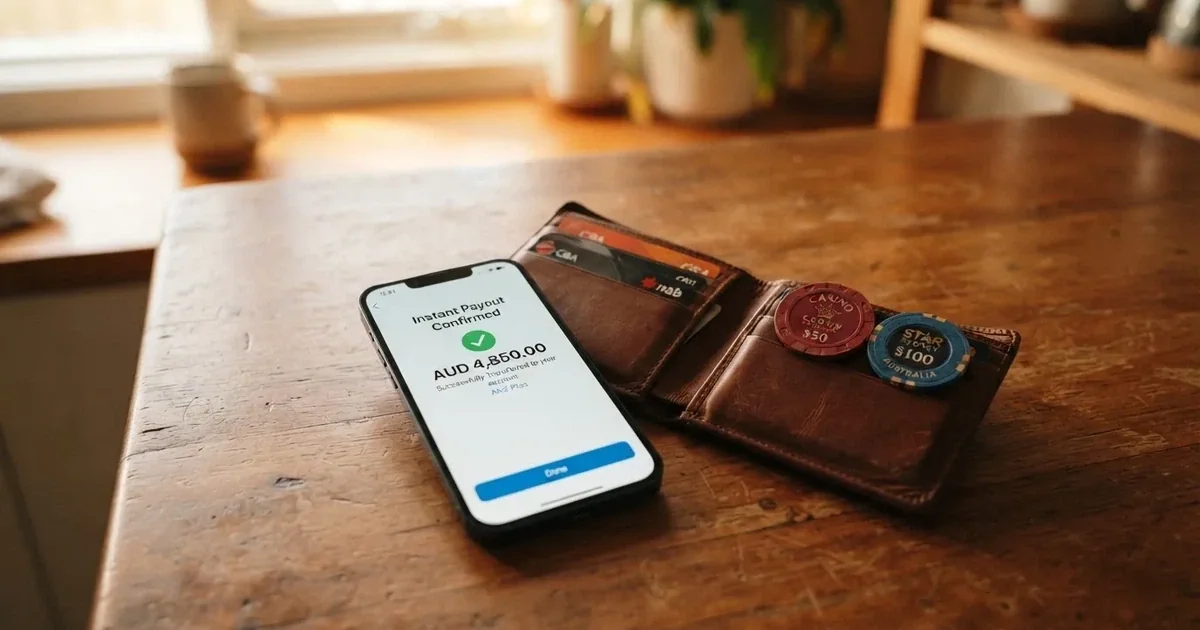
Data current as of 18 October 2026 and verified against the ACMA’s formal warning register.
Table of Contents
- What an “Instant Withdrawal” Actually Means at an Offshore Casino
- Why an Offshore Casino Cannot Be “Instant” for an Australian Player, Honestly
- Payment Rails That Actually Settle in Under a Minute in Australia
- Where the Australian Bank Can Stop the “Instant” Withdrawal
- The Enforcement Record: What the ACMA Has Actually Done
- The Prohibitions: What an Australian Reader Cannot Get from a Licensed Australian Casino
- BetStop and the Tools That Actually Reach an Australian Player
- Crypto and “No Verification” Claims: What They Are Worth at an Offshore Casino
- The Reviewed Brands: A Landscape, Not a Ranking
- What a Player Sitting in Australia Should Actually Do With This
- Frequently Asked Questions
What an “Instant Withdrawal” Actually Means at an Offshore Casino
“Instant” in this market is a marketing word, and the marketing has a habit of moving the goalposts. There are three distinct events between a player clicking “withdraw” and money turning up somewhere they can spend it, and the operator that uses the word freely is usually claiming only one of them happens instantly.

The first event is the casino’s own internal approval. A withdrawal request enters the operator’s payments queue; someone, or some algorithm, decides whether it can be released. That step can genuinely take seconds on a small payout, but the queue itself is the operator’s own — a weekend, a high-value win, a flagged bonus, or an unfinished wagering requirement will stall it, and there is no clock the player can read.
The second event is the transfer onto a payment rail. Australian-facing operators tend to advertise PayID and Osko transfers here, because both move money between participating banks in under a minute, twenty-four hours a day. The rail is genuinely fast. What the rail is not, is the casino.
The third event is the player’s own bank accepting the credit. Some banks run a gambling transaction block at card level that refuses authorisations registered under the merchant category code for betting and casino gambling. Where that block is active, the inbound transfer that the rail carried in under a minute can still be returned by the bank, or never reach the account at all.
So when an offshore brand tells an Australian reader their withdrawal will be instant, what is genuinely fast is the middle of those three steps, and what is genuinely outside the brand’s control are the first and the third. The pace a player actually sees is the slowest of the three, and a reader comparing brands should weight the slowest step, not the brand’s own claim.
Why an Offshore Casino Cannot Be “Instant” for an Australian Player, Honestly
The Interactive Gambling Act 2001, as tightened by the Interactive Gambling Amendment Act 2017, makes it an offence to provide online casino games or online pokies to a person physically in Australia. The provision side, not the player, is what the statute targets. A brand licensed in Curaçao, Anjouan or another offshore jurisdiction can still accept Australian customers, because the ACMA’s enforcement is on the provider’s side; the brand is free to process withdrawals through whatever rails it has, and the rail itself — PayID, Osko, a Visa direct credit — can be fast.
What cannot be honest is the surrounding wrapper. A site offering prohibited games to Australians has no Australian consumer protection, no access to BetStop, no complaints body an Australian player can write to, and no recourse if a balance is simply held. The fastest payout in the world is no payout at all if the operator decides, on its own queue, that the player has not cleared a condition they were never told about in plain English. ACMA’s blocking power — directing Australian ISPs to block the brand’s domains — also means the player can wake up one morning to a connection error and a balance they cannot reach.
H2 Gambling Capital’s 2025 estimates put Australian losses to illegal gambling sites at roughly A$3.9 billion a year, with the share of gambling going through legal channels falling from 74% in 2021 to 64%. Those are losses to operators no Australian regulator supervises, paid through payment rails an Australian bank can decline to honour.
Payment Rails That Actually Settle in Under a Minute in Australia
For the reader who wants to know what speed is genuinely available on lawful Australian rails, three of them clear in well under a minute between participating banks.
PayID is a name-based address that resolves to a bank account. Over 100 Australian financial institutions participate, and more than 25 million PayID identifiers were registered on Australia’s New Payments Platform by April 2025. The transfer settles through Osko, which is the instant-transfer layer of the New Payments Platform: arrival is in under a minute, including weekends and public holidays. Critically, paying to a PayID reveals the name of the account holder before the transfer is sent — Australian Payments Plus warns that being asked to send money to a PayID on an illegal gambling site almost certainly means a scam site.
Osko itself runs on the New Payments Platform, which the Reserve Bank of Australia and the country’s major banks back through New Payments Platform Australia Ltd. Participants are bound to keep monthly platform outages under two minutes. That is what “instant” looks like when it is engineered by a regulated industry rather than promised by an offshore operator with no Australian regulator.
BPAY is a different shape — it is a bill-payment service inside online banking, in use since November 1997 and offered by over 140 banks and over 95,000 businesses. It is built for paying bills, not for receiving casino payouts, and settlement runs on a different cadence than Osko. Where an Australian-licensed wagering service uses BPAY as a deposit route, the timing is the operator’s integration, not the brand’s “instant” promise.
By the end of 2025, Apple Pay, Google Pay and Samsung Pay collectively accounted for around 45% of all card payments in Australia by number. The speed of a card payment through a wallet is the speed of the underlying card network; the wallet itself does not move the money faster. The Interactive Gambling Act’s 2023 amendment restricts Australian-licensed wagering services from accepting credit cards or credit-related products, a rule that constrains gambling use of linked wallets on credit-funded accounts. Where a debit-funded wallet is used on an eligible card, the bank’s own gambling block is the deciding factor.
Where the Australian Bank Can Stop the “Instant” Withdrawal
Three of Australia’s biggest banks run card-level gambling blocks that can refuse an authorisation — or, depending on the rail, an inbound credit — before it ever settles.
Westpac’s gambling block works at card level: it refuses authorisation of transactions registered under the merchant category code for betting and casino gambling on eligible personal credit and debit cards. ANZ’s gambling transaction block, activated inside the ANZ app, blocks gambling transactions made through a digital wallet such as Apple Pay on an eligible card, not just the physical card. Once the ANZ block is on, removing it requires a 48-hour waiting period; ANZ also warns that not all gambling transactions will be blocked and that some non-gambling transactions might be blocked in error. Commonwealth Bank lets customers apply a gambling lock to eligible cards via the CommBank app, which blocks most gambling transactions, with the same caveat that the bank cannot guarantee every gambling-related purchase will be stopped.
The pattern is consistent. A bank block is a request to the card network, not a hard wall. A transfer that arrives through Osko or PayID onto an account that has no card involved can still go in, but the same transfer paid from a blocked card may be declined at the authorisation step, and the “instant” the player thought they had never actually existed.
| Bank | Block mechanism | Scope |
|---|---|---|
| Westpac | Card-level block | Refuses authorisation on registered gambling MCCs |
| ANZ | App-based toggle | Blocks digital wallet and card transactions |
| Commonwealth Bank | App-based toggle | Blocks most gambling-related purchases |
The Enforcement Record: What the ACMA Has Actually Done
By June 2026, a cumulative 1,751 illegal gambling and affiliate marketing websites had been blocked since the first blocking request in November 2019, and more than 230 unlicensed gambling services had left the Australian market since enforcement was strengthened in 2017. In a single round reported on 26 June 2026 the ACMA asked Australian ISPs to block 12 more: 7Signs, ChromaBet, Donbet, Duospin, Freshbet, Slots Gem, Jacks Club, Lucky Start, Pointsbetz, Spinrise, Vinyl Casino and Wildsino.
The blocking cadence is the ACMA’s bluntest tool. The formal-warning register is its other one, and it is the one that names operators individually. In March 2026 the ACMA issued a formal warning to Pulsup Ltd over RocketPlay. In April 2026 it warned Ryker B.V. over Jackbit and CasinOK. In July 2025 it warned Bamboo Media over Ignition Casino and Consolutetish S.R.L. over National Casino and Bizzo Casino — Bizzo Casino had already been the subject of a 2022 formal warning to TechSolutions (CY) Group Limited and TechSolutions Group N.V. In April 2025 the ACMA warned Sterplay Holding Ltd over Casino Intense. In March 2025 it warned Dama N.V. over Woo Casino and in May 2025 over Spirit Casino. In February 2025 it warned EOD Code SRL over Instant Casino. In May 2022 it warned Dama N.V. over a six-brand batch that included Bambet, Dazard, Level Up, Rocketplay, Wild Tornado and Cobra Casinos. In September 2022 it warned Hollycorn N.V. over Sky Crown and Blue Leo.
The blocking-rate calculation that follows from those figures — a running total of 1,751 blocked sites accumulated over roughly six-and-a-half years from the first blocking request in November 2019 to the June 2026 round — works out to an average of around 269 blocked sites per year, or about 22 per month. The cadence is not even. The 230-odd services that have left the market altogether, on top of the 1,751 sites blocked, is the visible shape of a prohibition that runs on warnings first and blocks second.
The Prohibitions: What an Australian Reader Cannot Get from a Licensed Australian Casino
There is no licensed Australian online casino, because no Australian jurisdiction issues the licence. What is licensable is wagering on races and sport placed before the event, lotteries and keno — in practice licensed by the Northern Territory Racing and Wagering Commission, which regulates 52 of Australia’s online bookmakers including Sportsbet, Bet365 and Ladbrokes, operates without full-time staff, and meets once a month in Darwin.

For an Australian reader who wants casino-style games, the lawful routes are land-based: pokies in licensed clubs and hotels in every state and territory, and casino floors in Crown Melbourne, Crown Perth, The Star Sydney, The Star Gold Coast, SkyCity Adelaide, Country Club Casino Launceston and Wrest Point Hobart. Settlements on those floors are in cash, on the spot. The credit-card ban under the Interactive Gambling Act 2001 as amended in 2023 applies to Australian-licensed online wagering services, with penalties up to A$247,500 for non-compliant operators; legal deposit routes for licensed wagering are debit card, bank transfer, PayID/Osko and BPAY.
A site asking an Australian reader for a credit card or a crypto deposit is operating outside the Australian rules. The Interactive Gambling Amendment (Gambling Reform) Bill 2026 passed Parliament on 19 August 2026, with its advertising and inducement measures commencing 1 January 2027 — law with a start date, not yet in force on a 2026 page.
BetStop and the Tools That Actually Reach an Australian Player
BetStop — the National Self-Exclusion Register — has been live since August 2023 and binds Australian-licensed online and phone wagering services. An offshore casino is not connected to it; registering with BetStop will not block an offshore brand. What it will do is block every Australian-licensed wagering account from being opened or used for the exclusion period the player chooses, from a minimum of three months up to a permanent exclusion.
The National Gambling Helpline is 1800 858 858, free, twenty-four hours a day, with chat available through Gambling Help Online. For a player who has been using offshore brands, the helpline and the chat service are the right entry point, because BetStop itself does not cover what they have been using.
Gambling winnings of a recreational player are not assessable income under section 6-5 of the ITAA 1997 and losses are not deductible, unless the person carries on a business of gambling. The Australian Taxation Office’s published guidance is the source a player should check; the rule above is the model, not advice.
Crypto and “No Verification” Claims: What They Are Worth at an Offshore Casino
The reader-side argument for a crypto or no-verification casino is that the blockchain settles in minutes and there is no identity paperwork between the deposit and the play. Both halves of that claim are technically true; what is also true is what they leave out.
Crypto withdrawals do skip the card network. What they do not skip is the casino’s own internal queue, which is the same queue any other withdrawal sits in, and the casino’s own withdrawal limits, which can be lower for crypto than for bank transfers because crypto payouts let the operator move funds without touching the Australian banking system at all. The Australian bank block at card level — Westpac, ANZ, Commonwealth Bank — does not touch a Bitcoin or USDT transfer on the blockchain, which is precisely the appeal; it is also the reason an Australian reader who has set up a bank block to control their gambling can route around it through a wallet they bought at an exchange, and the block they thought was a wall turns out to be a turnstile.
“No verification” claims dissolve the moment a withdrawal is large enough to matter. AUSTRAC’s threshold-transaction-report rule applies only to physical cash, so ordinary electronic bank transfers are not subject to per-transaction reporting regardless of amount — but offshore operators run their own thresholds. A withdrawal of even modest size will, on most of the brands covered below, prompt an identity check the marketing copy said would never happen. The check is what the brand uses to manage its own regulatory exposure; the player experiences it as a delay, and the “instant” word stops being true the moment the queue decides to ask.
PayID itself surfaces the holder name before a transfer is sent. Australian Payments Plus warns that being asked to transfer to a PayID on an illegal gambling site almost certainly means a scam site. The same caution applies in the other direction: a reader receiving a payout from an offshore brand to their own PayID has volunteered the linkage their bank will hold onto, and the speed of Osko is also the speed at which the transaction is recorded.
The Reviewed Brands: A Landscape, Not a Ranking
The brands below are the operators the ACMA itself has acted against for offering prohibited interactive gambling services to Australians. Each carries the same statutory backdrop: the Interactive Gambling Act 2001 prohibition, no Australian licence for online casino games, and no recourse through an Australian consumer-protection body. Where a brand surfaces on listings pages research consulted, that is reported as the listings report it; where the data is not on those pages, it stays absent.
| Brand | ACMA action and date | Operator named by the ACMA | Subject support |
|---|---|---|---|
| RocketPlay | Formal warning — March 2026; earlier warning to Dama N.V. — May 2022 | Pulsup Ltd (RocketPlay); Dama N.V. | Listings report a payments focus |
| Level Up Casino | Formal warning — May 2022 | Dama N.V. | Listings note Westpac-side coverage |
| Woo Casino | Formal warning — March 2025 | Dama N.V. | — |
| Spirit Casino | Formal warning — May 2025 | Dama N.V. | — |
| National Casino | Formal warning — July 2025 | Consolutetish S.R.L. | Listings note ACMA, AUSTRAC and BetStop references |
| Bizzo Casino | Formal warning — July 2025; earlier warning — 2022 | Consolutetish S.R.L.; TechSolutions (CY) Group Limited and TechSolutions Group N.V. | Listings report a payments focus |
| Ignition Casino | Formal warning — July 2025 | Bamboo Media | — |
| Instant Casino | Formal warning — February 2025 | EOD Code SRL | Listings note ecoPayz and PayID references |
| Jackbit | Formal warning — April 2026 | Ryker B.V. | — |
| Casino Intense | Formal warning — April 2025 | Sterplay Holding Ltd | Listings note AUSTRAC, BetStop and a payments focus |
| Sky Crown | Formal warning — September 2022 | Hollycorn N.V. | — |
What the table actually shows is the ACMA’s enforcement footprint, not a buying guide. The wider the gap between “ACMA action” and “Subject support”, the less the listings tell a reader about the brand outside of the warning itself. Several of the brands carry no subject support at all from the listings research consulted, which is the audit’s honest answer to the “instant payout” claim: there is nothing in the consulted material to verify it against.
RocketPlay
RocketPlay was the subject of a formal ACMA warning to Pulsup Ltd in March 2026, on top of an earlier warning to Dama N.V. covering the brand in May 2022. The operator behind it has been warned twice, two years apart, for the same statutory breach. Listings pages research consulted position the brand on payment-side coverage, but the ACMA record is the only public document on the table. For a reader comparing options, RocketPlay’s distinguishing feature is not the payout rail — it is the regulatory history.
Level Up Casino
Level Up was named in Dama N.V.’s May 2022 batch of six casino brands warned by the ACMA. Listings pages consulted carry Westpac-side references that are not payment-method endorsements in the research, but background on how the bank’s gambling block applies to the merchant code. The brand’s verified footprint is the warning; its payment-side coverage is what the listings happened to mention.
Woo Casino
Woo Casino is the Dama N.V. brand warned by the ACMA in March 2025. The consulted material carries no payment-side or verification-side data for the brand specifically, so the warning is the page. For a reader who knows the brand only from its affiliate marketing, the ACMA’s action is the moment the marketing meets the statute.
Spirit Casino
Spirit Casino is the other Dama N.V. brand in the 2025 batch, warned in May 2025. Two months after Woo Casino, the same operator was warned again — a sign that the 2022 batch did not produce the change the ACMA’s first warning asked for. No subject support surfaces in the consulted listings for Spirit Casino.
National Casino
Consolutetish S.R.L. was warned by the ACMA in July 2025 over National Casino. The listings consulted carry ACMA, AUSTRAC and BetStop references — which is, in this market, the warning’s natural footprint rather than a payment endorsement. National Casino sits in the cluster where the brand’s own pages and the regulator’s pages overlap.
Bizzo Casino
Bizzo Casino is the unusual case: the same brand was the subject of a 2022 formal warning to TechSolutions (CY) Group Limited and TechSolutions Group N.V., and a 2025 warning to Consolutetish S.R.L. Two operators, three years apart, both warned over the same product offering. The listings consulted carry a payments-side reference, but the relevant figure for a reader is the recurrence.
Ignition Casino
Bamboo Media was warned by the ACMA in July 2025 over Ignition Casino. The consulted listings carry no payment or verification data for the brand, so the warning is the only thing the page can attach to it.
Instant Casino
EOD Code SRL was warned by the ACMA in February 2025 over Instant Casino. The listings consulted mention ecoPayz and PayID as the rail-side surface — but a PayID payout from a brand the regulator has warned over prohibited services is the rail showing the account holder’s name before the transfer is sent, with Australian Payments Plus warning that being asked to use PayID on an illegal gambling site almost certainly means a scam site.
Jackbit
Ryker B.V. was warned by the ACMA in April 2026 over Jackbit (and CasinOK in the same notice). Jackbit is a crypto-first brand on the listings research consulted, but the consulted material carries no payment-side or verification-side data for the brand. The April 2026 warning is the only document on file.
Casino Intense
Sterplay Holding Ltd was warned by the ACMA in April 2025 over Casino Intense. The listings consulted carry AUSTRAC, BetStop and a payments-side reference — the same regulator-and-payments shape as National Casino. The distinguishing feature is the operator’s holding company, not the rail.
Sky Crown
Hollycorn N.V. was warned by the ACMA in September 2022 over Sky Crown and Blue Leo in the same notice. Sky Crown is the older entry on the table — its warning is from 2022, the earliest in the consulted list other than the Dama N.V. May 2022 batch. The consulted listings carry no subject support for the brand.
What a Player Sitting in Australia Should Actually Do With This
For a reader comparing brands, three choices line up against the table above. The first is to use a brand on the table knowingly, with eyes open about the statutory prohibition, the ACMA’s enforcement record against the operator, the absence of Australian consumer protection, and the chance that the brand’s domain can be blocked overnight. The second is to use the lawful Australian wagering market — licensed bookmakers for pre-event racing and sport, lotteries and keno, and the casino floors in Crown Melbourne, Crown Perth, The Star Sydney, The Star Gold Coast, SkyCity Adelaide, Country Club Casino Launceston and Wrest Point Hobart for casino-style play. The third is to register with BetStop, which binds every Australian-licensed wagering service for the exclusion period chosen, and to call the National Gambling Helpline on 1800 858 858 or use the chat at Gambling Help Online for the offshore brands the register does not reach.
For a reader who has already been using one of the brands above, the relevant question is what to do with the balance sitting in it. A withdrawal request before a domain block is the move that recovers funds; a withdrawal request after a block is, at best, a queue item the player has no way to verify. The ACMA’s blocking round of June 2026 added 12 sites in one notice; the cadence is not predictable.
The voice in this guide is not the marketing voice the offshore brands use, and it is not the consumer-warning voice that adds nothing to the reader’s decision. The point is the gap between the two. The marketing word “instant” describes the middle step of three; the prohibition describes what is on either side of that middle step; the lawful Australian rails describe the speed that is actually available when the regulator is in the loop. The reader’s choice sits across all three.
Frequently Asked Questions
What is the difference between a payout and a withdrawal request?
A withdrawal request is what the player sends to the operator — a click, an amount, a payment method chosen. A payout is what happens next: the operator’s internal approval, the transfer onto a rail such as PayID or Osko, and the receiving bank’s acceptance. The speed of a payout is the slowest of those three steps, not the fastest.
Why might a casino require identity verification before an instant withdrawal?
Even brands marketed as “no verification” run their own internal thresholds. A withdrawal that exceeds the threshold — by amount, by frequency, or by any flag in the operator’s queue — triggers an identity check the marketing copy did not promise. The check is what the brand uses to manage its own regulatory exposure; the player experiences it as a delay.
Is it legal for an online casino to process withdrawals for players in Australia?
The Interactive Gambling Act 2001, as tightened by the Interactive Gambling Amendment Act 2017, makes it an offence to provide online casino games or online pokies to a person physically in Australia. The statute targets the provider, not the player. An offshore brand processing a withdrawal is the provider continuing to offer a prohibited service; the player’s own position under the statute is not prosecution, but the player also has no Australian consumer protection, no complaints body and no recourse through BetStop.
Can a bank transfer withdrawal arrive within minutes in Australia?
Through Osko and PayID, yes — between participating banks, transfers settle in under a minute, twenty-four hours a day. The catch is that the receiving bank’s own gambling block can still decline an inbound transfer at card level, and the brand’s own internal queue can stall the request before it reaches the rail. The fastest rail available is not the same as the fastest withdrawal an Australian player can actually receive.
Does a crypto withdrawal skip identity checks entirely?
The blockchain hop itself does not require identity verification, and it is outside the card networks an Australian bank’s gambling block sits on. What crypto does not skip is the casino’s own internal queue, the casino’s own crypto withdrawal limits, and the identity check the operator runs when a withdrawal is large enough to matter. The “no verification” claim collapses at the operator’s threshold, which is below what most readers would consider a meaningful win.
What red flags suggest an instant withdrawal claim is not genuine?
Three are consistent across the consulted material. The first is a brand that asks for a credit card or crypto deposit, which is outside the Australian rules for licensed wagering and a strong signal the operator is offshore. The second is a payout method that requires the player to send money to a PayID — Australian Payments Plus warns that almost certainly means a scam site. The third is a brand on the ACMA’s formal warning register, where the regulator’s own document names the operator, the date and the statute breached, and the brand’s marketing has not engaged with that record.
Instant Withdrawal Casinos Australia — More on this topic at casino slots au.
See also What Makes a Pokies Machine “Best Paying” in Australia.